
Table of Contents
What if the most enduring form of humanitarian aid is not found in a temporary shelter, but in the restoration of a person’s professional identity? For the 1.2 million Rohingya refugees in Cox’s Bazar and the 126,000 in Malaysia, the journey towards stability is often blocked by the weight of aid-dependency and a lack of recognition for prior learning. Targeted skills development for refugees represents more than just job training; it is a fundamental act of restoring agency, preserving heritage, and building a future rooted in dignity.
You recognise that true empowerment requires moving beyond the immediate crisis to address the systemic barriers that keep families in a state of limbo. This article provides a clear pathway for understanding how vocational and soft skills training can foster long-term independence for those displaced from Rakhine State, also known as Arakan State, and beyond. We will examine effective training models, identify high-impact skills for the modern economy, and explore how community-led initiatives are currently bridging the gap between displacement and opportunity.
Key Takeaways
- Understand how skills development for refugees bridges the gap between crisis and stability for the 1.2 million people in Cox’s Bazar, Bangladesh, and the 126,000 in Malaysia.
- Identify high-impact training categories, such as digital literacy and English language proficiency, which serve as foundational tools for professional integration in the UK.
- Gain insight into the legal hurdles facing displaced families, including the critical transition to the Malaysian government’s DPP (Dokumen Pendaftaran Pelarian) system.
- Explore the success of community-led mentorship models that prioritise the lived experiences and unique talents of refugees over traditional top-down aid structures.
- Discover how contributing to these projects acts as a form of Sadaqah Jariyah, creating a cycle of self-sufficiency for those from Rakhine State, also known as Arakan State.
The Critical Importance of Skills Development for Refugees
Skills development for refugees acts as a vital bridge between the immediate desperation of crisis and the enduring stability of self-reliance. For the displaced communities of Rakhine State, historically known as Arakan State, the journey toward safety often leads to prolonged periods of dependency on external aid. This cycle, whilst necessary for initial survival, can erode personal agency over time. By prioritising vocational and cognitive growth, we transform the narrative of displacement from one of perpetual loss to one of potential and renewal.
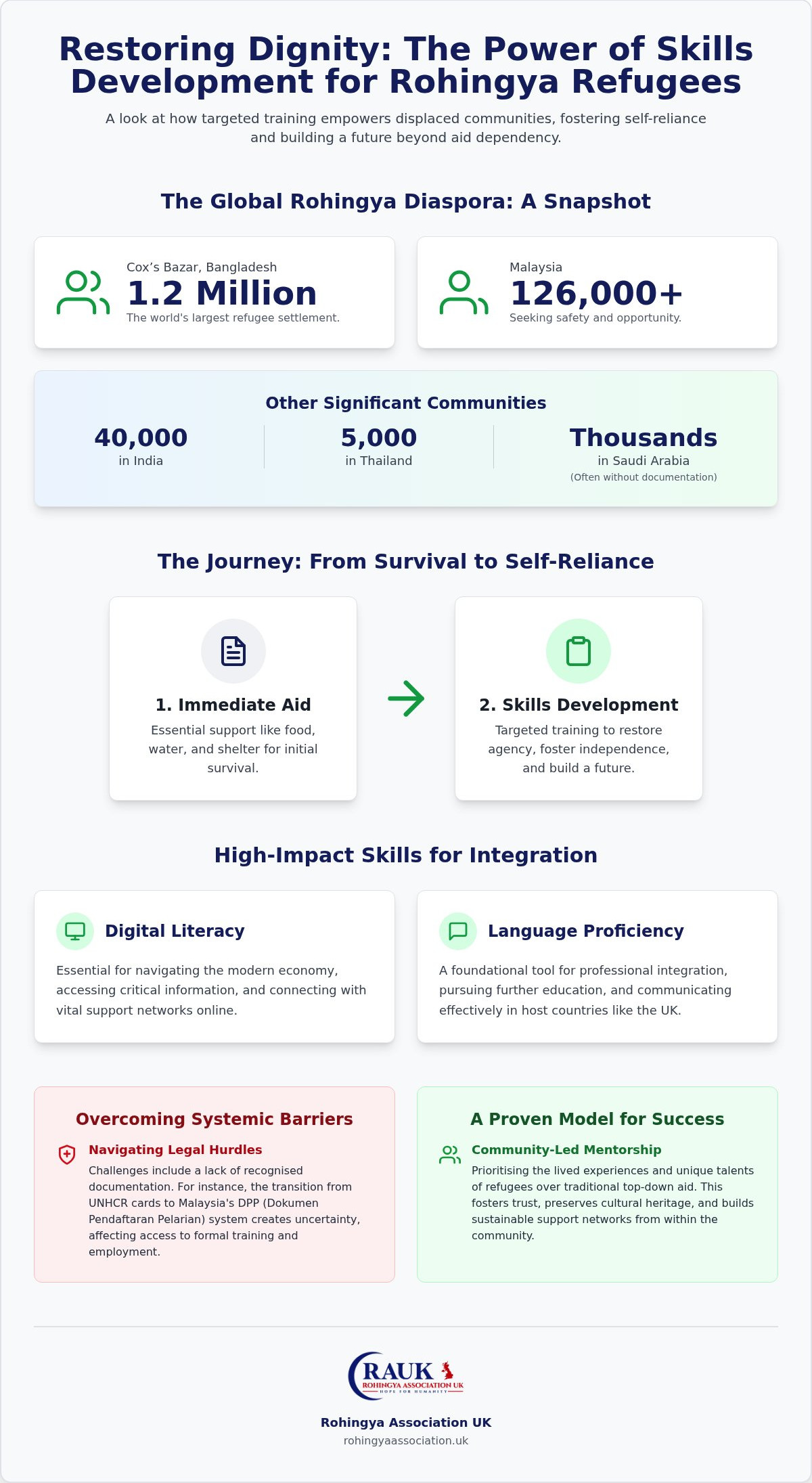
The scale of this requirement is vast and requires a coordinated global response. Currently, approximately 1.2 million Rohingya reside in the sprawling settlements of Cox’s Bazar, Bangladesh, whilst over 126,000 have sought refuge in Malaysia. These figures represent more than just statistics; they are individuals whose talents remain dormant due to a lack of opportunity. Implementing resilience-based training isn’t merely a philanthropic gesture but a human rights imperative that ensures stateless people can navigate their uncertain futures with dignity.
To better understand this concept, watch this helpful video:
From Survival to Self-Reliance
Immediate humanitarian intervention focuses on the physical: food, water, and shelter. However, long-term capacity building must follow swiftly to prevent the psychological decay that often accompanies long-term displacement. Learning a marketable trade or a new language provides a sense of purpose that counters the trauma of exile. Effective skills development for refugees ensures that individuals don’t just survive but thrive in their new environments. This process is most effective when nurtured through robust community support for displaced families, creating a safe environment where education can flourish. Newcomer education programs are essential in this transition, as they help bridge the gap between previous experiences and the demands of new, unfamiliar labour markets.
The Global Landscape of Statelessness
The Rohingya diaspora is spread across several nations, each presenting unique legal and social hurdles. Those trapped in Saudi Arabia face particularly acute challenges; they often live without any form of documentation, which effectively bars them from legal employment and formal training. Understanding the geographic distribution of these populations is the first step in coordinating effective international aid and advocacy.
| Region | Estimated Rohingya Population |
|---|---|
| Cox’s Bazar, Bangladesh | 1.2 million |
| Malaysia | Over 126,000 |
| India | 40,000 |
| Thailand | 5,000 |
Targeted training within the rohingya refugee camp is essential to equip individuals with the versatile skills needed for either a safe, voluntary return to their homeland or successful integration into host societies.
A Roundup of Essential Skills for Displaced Populations
Identifying the most impactful skills categories involves a strategic look at what provides the greatest return on agency and economic stability. Effective skills development for refugees focuses on three primary pillars: vocational trades, digital proficiency, and linguistic integration. These are known as “portable skills,” which are assets that an individual carries across borders, through checkpoints, and into new host societies. Beyond technical ability, soft skills such as leadership and community organising empower individuals to advocate for their rights and coordinate collective care within their own communities.
Vocational and Technical Training
Traditional trades remain a cornerstone of economic survival in camp settings and host nations alike. High-demand vocations such as tailoring, mobile phone repair, sustainable agriculture, and construction offer immediate pathways to micro-entrepreneurship. In the dense settlements of Cox’s Bazar, a skilled repairman or tailor can sustain a family whilst providing essential services to their neighbours. It’s vital to invest in refugee youth empowerment programs that bridge the gap between traditional craftsmanship and modern technical requirements, ensuring the next generation is equipped for the 2026 labour market.
Digital Literacy and Remote Work
Digital skills offer a unique advantage by allowing displaced people to bypass local labour market restrictions that often prohibit formal employment. Proficiency in data entry, graphic design, and coding enables refugees to participate in the global “gig economy” from within a camp or a temporary residence. However, training alone is insufficient. We must also address the significant hardware and connectivity barriers that prevent talented individuals from accessing online platforms. Successful digital initiatives in the Cox’s Bazar region have shown that with the right equipment, the diaspora can contribute to global projects whilst remaining in a state of transit.
Linguistic Integration
For those arriving in the West, linguistic ability is the ultimate gateway to safety and inclusion. Mastery of the local language is necessary to navigate complex healthcare, housing, and legal systems. Specifically, English language classes for refugees in Bradford provide more than just vocabulary; they offer the tools for social navigation and professional networking. Simultaneously, the preservation of the Rohingya language must be prioritised. It serves as a vital tool for cultural advocacy and ensures that the heritage of Rakhine State, or Arakan State, is not lost to the passage of time. You can support our Bangladesh projects to help provide these essential learning resources to those who need them most.
Navigating Barriers to Training and Employment
The transition from displacement to economic independence is rarely a straight line. For those who fled Rakhine State, historically known as Arakan State, talent is rarely the issue; rather, it’s the structural labyrinth that stifles potential. The most pervasive hurdle is the “right to work” paradox. Without formal legal status, skills development for refugees can feel like a preparation for a professional life that host countries haven’t yet permitted them to lead. This creates a state of perpetual limbo where individuals possess the capability but lack the legal key to unlock it.
Legal Restrictions and the DPP System
In Malaysia, where over 126,000 Rohingya have sought safety, the documentation landscape is undergoing a significant shift. For decades, the UNHCR card provided a thin layer of protection but no formal right to employment. The Malaysian government’s transition to a centralised system represents a new chapter in refugee management.
- Pre-2022: Refugees relied primarily on UNHCR documentation, which offered limited protection from detention but no legal pathway to work.
- 2022–2024: Introduction of the TRIS (Tracking Refugees Information System) as a mandatory registration step.
- 2025–2026: Full implementation of the DPP (Dokumen Pendaftaran Pelarian) system, moving refugee oversight from international bodies to the Malaysian government.
Whilst the DPP system aims to provide a more structured approach to registration, it hasn’t yet granted refugees a universal right to work. This lack of legal clarity discourages employers from hiring skilled Rohingya and makes long-term training programmes feel like a risky investment for the displaced. Advocacy efforts are currently prioritised towards ensuring that the DPP system eventually includes work permits, which would transform the economic landscape for thousands of families.
Beyond documentation, the Recognition of Prior Learning (RPL) remains a massive gap. Many refugees were professionals—teachers, medics, or traders—in their homeland. When they cross borders, their qualifications often vanish in the eyes of local authorities. This “brain waste” is compounded by the challenges for Rohingya youth in the UK, who often arrive with significant education gaps due to years spent in camps or in transit, making it difficult to enter the standard job market without intensive, tailored support.
Social and Cultural Obstacles
Legal barriers are often reinforced by social and cultural ones. A noticeable gender gap persists in many training initiatives, often because programmes don’t account for domestic responsibilities or cultural norms regarding women’s mobility. To be truly effective, skills development for refugees must be culturally sensitive, offering flexible learning environments that respect communal values whilst promoting individual growth.
Restoring a person’s ability to provide for their family is a core component of humanitarian restoration. True justice for Rohingya people must include the right to economic participation and the removal of the systemic barriers that keep them in a cycle of poverty. By addressing these legal and social hurdles, we move closer to a world where displacement doesn’t mean the end of a person’s professional journey.
Sustainable Models for Skills Training Success
The efficacy of skills development for refugees depends heavily on the structural model used to deliver training. Historically, top-down approaches led by international NGOs have often prioritised short-term outputs over long-term community integration. These models frequently fail because they overlook the cultural nuances and specific heritage of the people they aim to serve. In contrast, community-led models recognise displaced individuals as active stakeholders rather than passive recipients of aid. By placing the community at the heart of the educational process, we ensure that the training provided is relevant, respectful, and resilient.
Mentorship from within the diaspora is a critical component of this success. When a refugee who has successfully navigated the labour market returns to teach their peers, they provide more than just technical instruction; they offer a lived blueprint for survival and growth. This “Train the Trainer” concept creates a self-sustaining cycle of knowledge. It ensures that even if external funding fluctuates, the expertise remains a permanent asset within the community. This sustainable approach is a primary reason why the impact of donations on Rohingya education is so profound, as it directly funds the infrastructure for these internal mentorship networks.
The Role of Local Advocacy
Organisations like the Rohingya Association UK (RAUK) act as a vital bridge by organising training that meets rigorous UK professional standards whilst honouring the cultural identity of the participants. For those from Rakhine State, also known as Arakan State, education is a tool for both economic survival and cultural preservation. By integrating heritage into modern skill-building, we protect the communal bond whilst preparing individuals for the 2026 workforce. This synergy is particularly evident in our Bradford-based projects, where English proficiency is taught alongside community organising and leadership skills.
Measuring Long-Term Impact
Success in skills development for refugees must be measured by more than just graduation rates. We look to metrics that indicate true restoration: sustained employment, increased household income levels, and the emergence of new community leaders. The transformation of a single individual creates a powerful ripple effect that strengthens the entire family unit. When one person gains a marketable skill, the benefits extend far beyond their own career path:
- Economic Stability: Increased household income reduces the reliance on emergency food aid.
- Educational Advancement: Children are more likely to remain in school when the primary earner has a stable vocation.
- Health Outcomes: Improved financial resources lead to better nutritional standards and access to healthcare.
- Social Agency: Families are less vulnerable to exploitation and are better equipped to navigate local legal systems.
- Communal Growth: Trained individuals often go on to volunteer, sharing their skills with others in the settlements.
To help us expand these vocational centres and empower more displaced families, you can support our Bangladesh projects and contribute to a future of self-reliance.
How You Can Take Action Today
The journey from displacement to dignity is paved with the acquisition of new capabilities. Skills development for refugees is the most effective way to break the cycle of aid-dependency that has characterised the lives of the Rohingya for generations. By providing the tools for self-reliance, we aren’t just offering a temporary reprieve; we’re investing in a permanent solution for the 1.2 million people in Cox’s Bazar and the 126,000 currently seeking safety in Malaysia. This is a commitment to the long-term restoration of a people whose professional lives were interrupted by violence and exile.
In the framework of humanitarian advocacy, this work is a profound act of justice. For many, it also aligns with the concept of Sadaqah Jariyah, or ongoing charity. Unlike emergency food aid which is consumed immediately, a skill is a gift that keeps giving. It’s a resource that a father or mother uses to provide for their children, year after year. It’s a legacy of independence that can be passed down through generations, even within the confines of a camp or a host city. Standing with the stateless is a moral imperative that requires more than just sympathy; it requires a sustained investment in human potential.
Support Our Educational Initiatives
Our work in the United Kingdom focuses on removing the barriers to integration that often paralyse newcomers. You can donate your Sadaqah Jariyah to fund the purchase of vocational equipment, such as laptops for coding workshops or tools for technical trades. Beyond financial aid, your professional expertise is a valuable asset. We encourage specialists to volunteer with Rohingya Association UK as mentors or English language tutors. Your guidance helps bridge the education gap for youth and provides the social capital necessary to thrive in a new environment. These local efforts in places like Bradford are essential for building a community that is both self-sufficient and socially integrated.
Invest in Global Projects
The challenges in Southeast Asia remain acute, particularly for those navigating the transition to new documentation systems or living without formal status. When you support our Bangladesh projects, you fund camp-based training centres that provide high-impact vocational skills. These programmes are tailored to the specific needs of the diaspora, ensuring that the heritage and language of Rakhine State, previously known as Arakan State, remain central to the learning process. Your contribution ensures that the skills development for refugees reaches those in the most isolated settlements, providing a pathway to independence that transcends borders. Every gift helps preserve the professional identity of a community that refuses to be defined solely by its displacement. Join us in building a future rooted in dignity and resilience.
Restoring Agency Through Educational Empowerment
The path toward economic independence for the displaced is built on the foundation of knowledge and practical capability. By prioritising skills development for refugees, we provide a vital alternative to the cycle of aid-dependency that has long affected the people of Rakhine State, also known as Arakan State. We have explored how portable vocational trades, digital literacy, and linguistic integration serve as essential tools for growth, even whilst navigating the complex legal landscapes found in host countries.
As a registered charity (number 1211433), the Rohingya Association UK remains committed to community-led advocacy and direct impact. From our foundational English classes in Bradford to our vocational centres in Cox’s Bazar, we act as a bridge between displaced talent and real economic opportunity; your contribution ensures that the heritage, agency, and future of stateless families are protected through education. Support our programmes and donate your Sadaqah Jariyah. Together, we can transform the narrative of displacement into one of lasting resilience and hope.
Frequently Asked Questions
What are the most useful skills for refugees to learn in 2026?
Digital literacy, English language proficiency, and technical vocational trades are the most impactful skills for displaced populations today. Digital abilities like coding and graphic design allow individuals to bypass local labour market restrictions through remote work. Meanwhile, trades such as mobile phone repair and sustainable agriculture provide immediate micro-entrepreneurship opportunities within settlement settings like Cox’s Bazar.
Can refugees in the UK access free skills development programmes?
Yes, numerous community-led organisations and charities offer cost-free training to help newcomers integrate into the British workforce. In Bradford, specific initiatives focus on foundational abilities that help individuals navigate the housing and healthcare systems. These skills development for refugees are designed to bridge the gap between arrival and long-term economic independence.
How does the Malaysian DPP system affect skills training for refugees?
The transition to the DPP (Dokumen Pendaftaran Pelarian) system centralises refugee oversight under the Malaysian government, moving away from UNHCR-led documentation. Whilst this provides a more formal registration process, the current lack of a universal legal right to work often complicates the incentive for long-term professional training. Advocacy continues to focus on linking this documentation to formal work permits.
Why is English language training prioritised for refugees in Bradford?
English is the essential gateway skill for anyone seeking safety and stability within the United Kingdom. Proficiency in the local language is required to access primary services, understand legal rights, and secure meaningful employment. Linguistic integration ensures that displaced families can speak for themselves and participate fully in the social and economic life of the city.
What is the difference between vocational training and soft skills for refugees?
Vocational training provides the technical expertise needed for specific trades like construction, tailoring, or mechanics. Soft skills, however, focus on interpersonal abilities such as leadership, community organising, and resilience. Both are necessary for skills development for refugees; technical trades provide the income, whilst soft skills empower individuals to lead and advocate for their community’s needs.
How can I support skills development for Rohingya refugees in Bangladesh?
Contributing to the funding of vocational centres and the provision of technical equipment is the most direct way to help. Donations often go toward purchasing sewing machines, laptops, or agricultural tools for the 1.2 million people in Cox’s Bazar. Supporting these projects helps preserve the professional identity of those who fled Rakhine State, also known as Arakan State.
Are there specific programmes for Rohingya youth empowerment?
Youth-centred initiatives are prioritised to address the significant education gaps caused by years of displacement. These programmes often combine modern technical vocations with cultural preservation to ensure the next generation remains connected to their heritage. Mentorship from within the diaspora is a key component, providing young people with relatable role models who have successfully navigated similar challenges.
How does skills development contribute to the justice for Rohingya people?
Restoring economic agency is a fundamental part of the broader fight for human rights and accountability. Systemic persecution often seeks to strip a community of its ability to be self-sufficient and independent. By fostering professional skills, we help individuals reclaim their dignity and ensure they have the resources to continue advocating for justice and the protection of their heritage.