
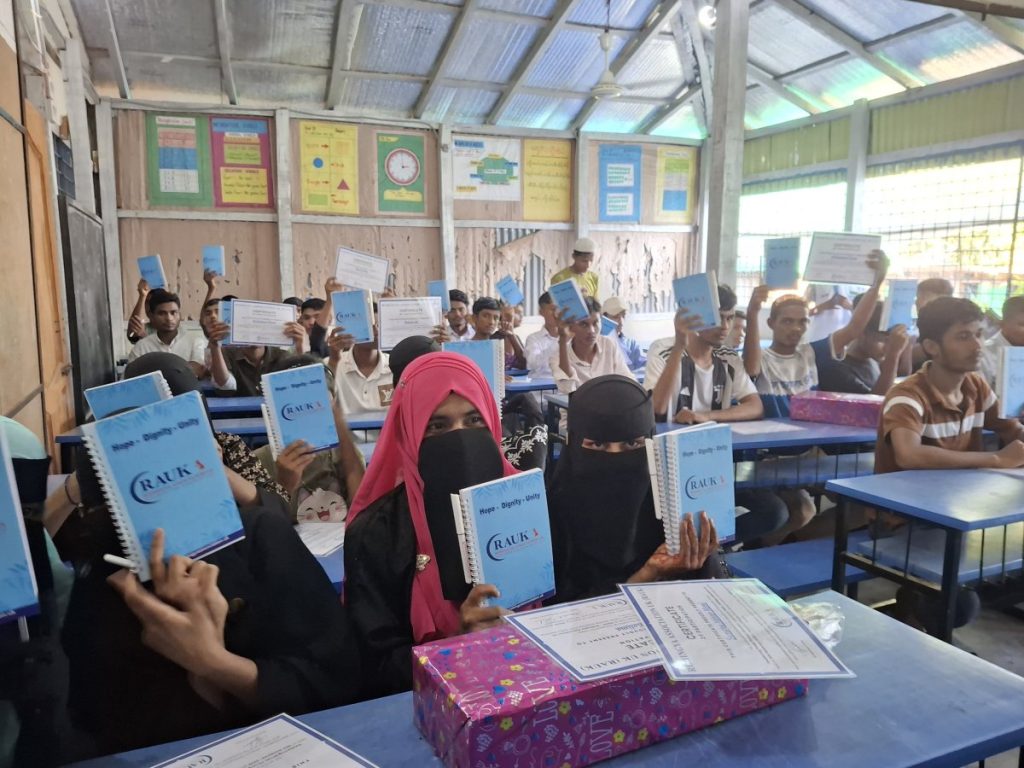
What if the true measure of humanitarian success isn’t the delivery of a temporary meal, but the restoration of a person’s dignity, heritage, and sense of belonging? It’s natural to feel overwhelmed by the sheer scale of global displacement, particularly whilst trying to distinguish between immediate emergency relief and the arduous journey toward long-term integration. You likely recognise that a roof and a ration are only the beginning, yet the path to supporting stateless individuals often feels obscured by legal complexity and social barriers. This guide demonstrates how holistic community support for displaced families transforms lives by prioritising education, dignity, and cultural belonging. We’ll examine the profound needs of those seeking sanctuary, identify meaningful ways to contribute to local integration, and explore why preserving one’s cultural identity is essential for true restoration. By shifting our focus from survival to agency, we can build communities that don’t just host displaced families but truly honour their strength, their history, and their future.
Key Takeaways
- Distinguish between immediate crisis intervention and the multi-layered framework required for long-term stability and social integration.
- Understand how holistic community support for displaced families addresses the mind, body, and spirit to restore lost dignity and individual agency.
- Recognise that integration is a collaborative, two-way process that depends on bridging the knowledge gap regarding local rights and responsibilities.
- Identify meaningful ways to contribute to your local community through purposeful financial donations or by volunteering your time and skills.
- Explore the RAUK model as a beacon of community-led empowerment that successfully balances practical assistance with the vital preservation of cultural heritage.
What is Community Support for Displaced Families?
True community support for displaced families isn’t a singular act of charity; it’s a multi-layered framework of social, emotional, and practical assistance. Whilst government agencies often manage the high-level logistics of asylum, local organisations act as the essential bridge, translating cold policy into compassionate action. They provide the protective shield and guiding hand necessary to navigate a new society. This support involves a stable commitment to crisis intervention, education, and long-term integration, ensuring that families don’t just survive their arrival but begin the vital process of flourishing within their new surroundings. It is through this collective effort that we can address the holistic needs of those who have lost everything.
The Distinction Between Relief and Restoration
Emergency aid is often the most visible form of assistance, providing the immediate essentials of food, clothing, and medicine. However, this relief is merely the first step in a much longer journey toward healing. Effective community support for displaced families must prioritise agency over dependency, moving from the model of “doing for” to “working with” those in need. This shift in perspective honours the inherent strength and skills of displaced individuals, inviting them to be active participants in their own resettlement. Community support is the mechanism that transforms a temporary shelter into a permanent home. By focusing on restoration, we aim to provide more than just safety; we strive to return the protection, dignity, and purpose that displacement so cruelly strips away.
The Unique Challenges of Stateless Families
Statelessness represents a profound form of legal exile that requires specialised advocacy and deep communal understanding. Unlike those who can clearly answer the question What is a Refugee?, stateless families often exist in a legal vacuum without recognised citizenship in any country. This lack of documentation creates a cascade of barriers, impacting everything from the right to work to the ability to enrol a child in school. It’s a condition of being “invisible” in a global legal system, which carries a heavy psychological toll of uncertainty and fear. Community-led initiatives play a vital role here, offering the specific guidance and social validation that stateless individuals often lack. Through dedicated advocacy, communities can help these families secure their rights, find their voices, and finally belong to a society that recognises their existence and value.
The Four Pillars of Holistic Support
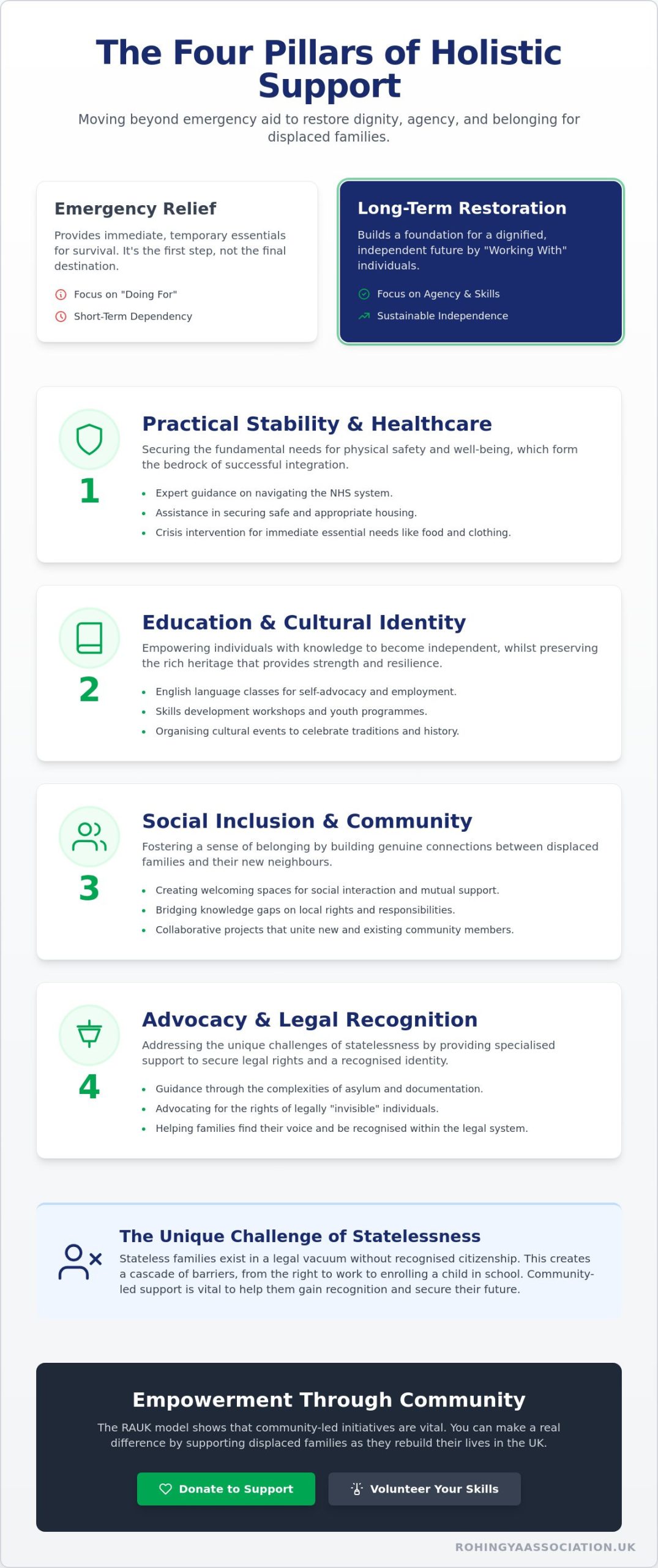
Restoration requires a foundation built on more than just material aid. A holistic model addresses the mind, body, and spirit of the individual, ensuring that the transition from displacement to belonging is sustainable and dignified. Effective community support for displaced families operates through four distinct yet interconnected pillars. These pillars provide a roadmap for moving beyond survival toward a future defined by agency and resilient optimism.
Practical Stability and Healthcare Access
Safety begins with a secure physical environment. Navigating the complexities of the NHS can be daunting for those unfamiliar with British bureaucracy; therefore, providing clear healthcare access for displaced people is a moral imperative. This ensures that physical well-being is treated as a fundamental right rather than a luxury. Similarly, securing appropriate accommodation remains a primary hurdle. Expert refugee housing guidance UK plays a critical role in preventing homelessness and ensuring families feel safe and secure in their physical environment. This stability is the bedrock upon which all other integration efforts are built.
Education and Cultural Identity
Knowledge is the most potent tool for independence. English language classes are more than just vocabulary lessons. They are the keys to employment, social connection, and self-advocacy. Youth programmes and skills development workshops further empower the next generation to contribute their unique talents to society. Simultaneously, we must resist the pressure of cultural erasure. Organising cultural events for displaced communities allows individuals to maintain their mental health by celebrating their heritage amongst friends and neighbours. Preserving traditional languages and customs acts as a tool for resilience, ensuring that displacement does not mean the loss of one’s history or the erasure of one’s soul.
The final pillar, social inclusion, recognises that integration is not a solo journey but a communal effort. It involves building genuine bonds between displaced families and their new neighbours to foster mutual respect and shared identity. Understanding the broader context of UK refugee integration policies helps local groups align their efforts with national frameworks whilst maintaining a person-centred approach. When we invest in community support for displaced families, we move beyond simple charity to create a society where everyone can thrive. You can learn more about how community-led support models are transforming lives in your local area.
Overcoming Barriers to Integration in the UK
Integration is not a passive state that occurs simply through the passage of time; rather, it is a dynamic, two-way street that requires a deliberate commitment from both the arriving family and the host community. Whilst much is expected of those seeking sanctuary, the success of their journey often hinges on the willingness of local neighbourhoods to open their doors and hearts. The primary obstacle remains a profound “Knowledge Gap” regarding legal rights, social responsibilities, and the intricate workings of British life. Without clear guidance, families can remain trapped in a state of perpetual uncertainty, unable to advocate for themselves or contribute their skills to the local economy.
Language barriers frequently compound this struggle, leading to a deep sense of social isolation that can stifle even the most resilient spirits. When a parent cannot speak with a teacher or a neighbour, the world shrinks, and the potential for meaningful connection withers. Effective community support for displaced families must therefore prioritise communication as the foundation of belonging. By providing accessible language tutoring and social spaces, we can dismantle the walls of silence that far too often surround new arrivals. Combatting the stigma and misinformation spread about displaced populations is equally vital, as it replaces fear with understanding and suspicion with solidarity.
Navigating the Resettlement Journey
The first year of arrival is a critical window that often determines the long-term trajectory of a family’s life. Dedicated refugee resettlement support UK provides the essential scaffolding during these first 12 months, offering a guiding hand through the maze of local services. In places like Bradford, community-led social programmes act as a vital lifeline, helping families move beyond the confines of their immediate household. These groups provide the practical orientation and social network required to break the cycle of isolation. They ensure that no family is left to navigate the complexities of a new country alone, acting as both a protective shield and a gateway to local life.
Mental Health and Trauma-Informed Care
We must also recognise the “invisible wounds” that displacement and statelessness leave behind. The trauma of loss, the fear of persecution, and the exhaustion of the journey don’t simply vanish upon reaching safety. Integration is impossible without addressing the psychological impact of loss. Faith-based and cultural community groups play a significant role here, providing a sense of spiritual comfort and familiar tradition that clinical services sometimes overlook. By integrating trauma-informed care into broader Refugee and Asylum Support frameworks, we can ensure that healing and integration go hand in hand. This holistic approach to community support for displaced families acknowledges that a healthy mind is just as important as a secure home.
How You Can Support Displaced Families Locally
Individual action, when coordinated through local networks, becomes a powerful catalyst for systemic change. Whilst the global refugee crisis can feel insurmountable, the most impactful community support for displaced families often begins at the neighbourhood level. You possess unique skills and resources that can directly facilitate the restoration of a family’s dignity and independence. Whether you offer your professional expertise or simply your time, your participation sends a clear message of solidarity and welcome.
- Volunteer your time: Offer language tutoring to bridge communication gaps or provide administrative support to local charities.
- Donate with purpose: Financial contributions allow community-led organisations to respond flexibly to the specific, evolving needs of the families they serve.
- Organise community events: Host gatherings that celebrate cultural diversity, fostering genuine inclusion and mutual respect amongst neighbours.
- Invest in the future: Support refugee youth empowerment programs to ensure the next generation has the tools to lead and thrive.
The Power of Faithful Giving
For many, the act of giving is rooted in deep spiritual conviction. In the UK, directing Zakat and Sadaqah toward displaced families provides a vital lifeline that respects both the donor’s faith and the recipient’s needs. By contributing to Sadaqah Jariyah projects, such as education and skills training, you create a legacy of empowerment that lasts for generations. This culture of generosity transforms the local community into a sanctuary of hope; it ensures that support is not a fleeting gesture but a stable, long-term commitment to human flourishing.
Becoming an Advocate for Change
Misinformation often acts as a barrier to empathy. You can dismantle these obstacles by sharing verified Rohingya refugee crisis facts within your schools, workplaces, and faith centres. Speaking up for the rights of the stateless creates a ripple effect that extends far beyond your immediate circle. Local action can directly bolster global Rohingya human rights advocacy, proving that even the smallest voice contributes to the fight for justice. When you choose to speak, you help ensure that the invisible are seen and the unheard are finally recognised. Take the first step today by joining our local advocacy and awareness campaigns to build a more just society.
The RAUK Model: Empowerment Through Community
The Rohingya Association UK (RAUK) stands as a testament to the power of self-determination and collective effort. As a community-led beacon of hope, it represents a vital shift from traditional aid models toward a principled leadership approach that prioritises the lived experiences of the displaced. By combining immediate practical assistance with the long-term preservation of cultural heritage, RAUK ensures that community support for displaced families is both holistic and sustainable. Based in Bradford, the organisation acts as a protective shield for the diaspora, providing a space where identity is celebrated rather than erased. Our status as a registered charity (1211433) reinforces a commitment to transparency, accountability, and moral seriousness, ensuring that every contribution serves the mission of justice and renewal.
Local Action, Global Impact
Our work transcends geographical borders, reaching families in the UK, Myanmar, and Bangladesh. Within the UK, we provide the essential scaffolding for integration through English classes, housing guidance, and tailored youth programmes. These initiatives are not mere services; they are pathways to agency. As a primary Rohingya charity Bradford, we serve as a vital hub where individuals find both practical resources and a sense of communal bond. By addressing the specific needs of our diaspora, we help bridge the gap between the trauma of the past and the potential of the future. This dual focus on local integration and global advocacy ensures that the struggle for Rohingya rights remains visible and urgent.
Join the Movement for Restoration
Restoration is a shared responsibility that requires the participation of the entire community. We invite you to donate to Rohingya refugees UK to fund these vital projects and sustain our long-term commitment to those who have lost their homes. Beyond financial support, we encourage you to participate in our cultural and Islamic community events, which foster mutual understanding and social inclusion. These gatherings are essential for maintaining the mental health and spiritual resilience of those we serve, providing a sense of belonging in an often indifferent world. Together, we can ensure no family feels stateless in our community. Let us build a future where safety, heritage, and dignity are guaranteed for all.
Building a Future of Belonging and Restoration
Restoring hope for those who have lost everything requires more than a temporary gesture; it demands a stable, long-term commitment to holistic care. We’ve explored how addressing the mind, body, and spirit through the four pillars of support creates a foundation for true independence. Effective community support for displaced families succeeds when it bridges the knowledge gap, celebrates cultural heritage, and invites every neighbour to act as an advocate for justice. By moving from simple relief to active restoration, we honour the inherent strength of those seeking sanctuary.
The Rohingya Association UK (RAUK) embodies this mission as a community-led organisation rooted in lived experience. As a Registered Charity (1211433), we manage active projects across the UK, Myanmar, and the Bangladesh refugee camps to ensure protection reaches those who need it most. Your participation is the catalyst that transforms a stateless existence into a life of belonging and purpose. It’s a choice to stand for dignity over despair.
Support our mission to empower displaced families-donate to the Rohingya Association UK today. Together, we can turn the tide of displacement into a narrative of resilience, growth, and lasting peace.
Frequently Asked Questions
How does community support differ from government aid for refugees?
Government aid primarily focuses on bureaucratic processing and basic subsistence through payments that range from £9.95 to £49.18 per week. In contrast, community support provides the social fabric necessary for true integration and emotional recovery. Local groups offer the mentorship, friendship, and cultural understanding that government systems cannot provide, transforming a cold administrative process into a journey of human connection and social belonging.
Can I support displaced families if I don’t have much money to donate?
You can provide invaluable assistance by donating your time, professional skills, or local expertise to those in need. Volunteering as a language tutor, assisting with administrative tasks, or acting as a guide to local services offers the human connection that financial aid alone cannot replicate. Advocacy is equally powerful; by educating your workplace or faith centre, you help dismantle the stigma that often hinders successful integration.
What are the most urgent needs for displaced families arriving in the UK?
The most pressing requirements include secure housing, healthcare access, and clear guidance on navigating the complex British legal framework. Families often arrive with minimal resources, facing the daunting task of rebuilding their lives from scratch whilst surviving on limited subsistence support. Effective community support for displaced families addresses these immediate gaps by providing the social networks and practical orientation required to move from survival to stability.
Why is cultural preservation considered a part of community support?
Preserving one’s heritage is a vital tool for psychological resilience, mental well-being, and individual identity during the trauma of displacement. When families maintain their language, traditions, and faith, it prevents the erasure of their history in a new country. Cultural events foster communal pride and continuity, allowing individuals to navigate their new lives whilst remaining connected to the traditions that define their soul and heritage.
How do community-led organisations help stateless individuals specifically?
Community-led organisations provide specialised advocacy that addresses the profound legal vacuum faced by those without recognised citizenship. They act as a protective shield, helping stateless individuals navigate complex documentation hurdles to secure basic rights like education and work. Because these groups are often led by people with lived experience, they offer a level of trust and empathy that formal institutions often fail to provide for the legally invisible.
Is it better to donate goods or money to refugee charities?
Financial donations are generally more effective as they allow charities to respond with precision to the specific, evolving needs of each family. Whilst donating physical goods is well-intentioned, the logistics of storage and distribution can be burdensome for local groups. Money can be used to fund professional tutoring, provide crisis intervention, or support the new community sponsorship scheme set to launch in Autumn 2026.
How can I ensure my support is reaching the people who need it most?
You can ensure your contribution has a direct impact by supporting registered charities that demonstrate transparency and are deeply embedded in their communities. Look for organisations with a clear track record of active projects in diaspora hubs and international refugee camps. By choosing a principled leader in the humanitarian sector, you guarantee that your resources are used to restore, protect, and empower the most vulnerable families.
What role do English language classes play in long-term integration?
English language proficiency is the cornerstone of independence, agency, and social inclusion for those building a new life in the UK. These classes are not merely about communication; they are the keys that unlock employment, facilitate self-advocacy, and enable genuine bonds with neighbours. Robust community support for displaced families must prioritise these sessions to ensure new arrivals can navigate the 76,714 annual asylum applications and complex local systems with dignity.