
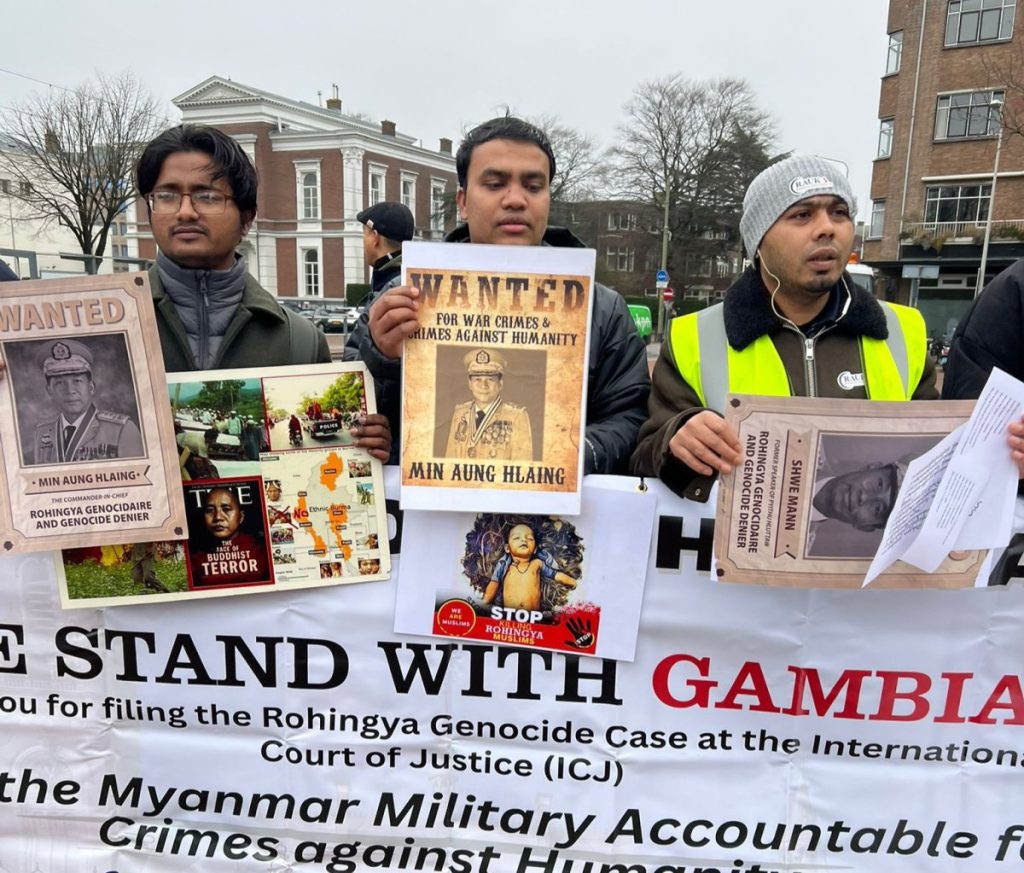
In January 2026, for the first time in over a decade, the International Court of Justice fell silent to listen to the direct testimony of survivors rather than just the arguments of diplomats. This historic milestone in The Gambia v. Myanmar case represents a profound shift in the pursuit of justice for Rohingya people, moving the focus from abstract legalities to the lived realities of those who have endured the unthinkable. It is a moment that demands our attention, our empathy, and our unwavering resolve.
It’s natural to feel a sense of cynicism regarding the slow machinery of global law, or to feel disconnected from distant courtrooms whilst humanitarian funding for the 1.2 million refugees in Bangladesh continues to face significant shortfalls. This article promises an in-depth exploration of the evolving legal, social, and community-led pathways that are finally beginning to bridge the gap between high-level institutions and actual survivor needs. We shall examine the current roles of the ICJ, the groundbreaking universal jurisdiction claims filed in Argentina this February, and how local community support in the UK provides the essential foundation for global accountability. Through restoration, protection, and collective growth, the movement for a dignified future remains resilient.
Key Takeaways
- Understand how the pursuit of justice for Rohingya people in 2026 integrates international legal accountability with essential social and restorative actions.
- Gain insight into the historic proceedings at the International Court of Justice and the vital role of global bodies in upholding human rights.
- Appreciate the transformative power of survivor testimony as a catalyst for legal change, psychological healing, and collective truth-telling.
- Learn how community-led integration and empowerment in the UK serve as a resilient form of justice by restoring dignity, heritage, and safety.
- Access a framework for meaningful advocacy that supports crisis intervention, youth empowerment, and the long-term stability of the diaspora.
The Quest for Justice for Rohingya People: Defining Accountability in 2026
To understand the quest for justice for Rohingya people in 2026, we must look beyond the sterile confines of a courtroom. True accountability isn’t a singular event or a solitary verdict; it’s a persistent, multifaceted process that seeks to repair what was systematically dismantled. For decades, the Rohingya have faced a calculated erasure of their identity, a process rooted in the discriminatory 1982 Citizenship Law that stripped them of their nationality and rendered them the largest stateless population in the world. This legal exclusion laid the groundwork for the Rohingya genocide, creating an environment where atrocities could be committed with perceived impunity.
However, 2026 has witnessed a significant shift in the global landscape. We’re seeing a transition from a world that merely watches to one that actively listens. Survivor-led advocacy has moved to the forefront, ensuring that those who lived through the violence are the ones defining the terms of their own restoration. This is where the concept of “living justice” takes root. It’s the belief that justice is found not only in a legal decree but in the ability to thrive in new communities like Bradford. It’s the right to belong, to contribute, and to live without the shadow of fear.
The Triple Pillar of Rohingya Justice
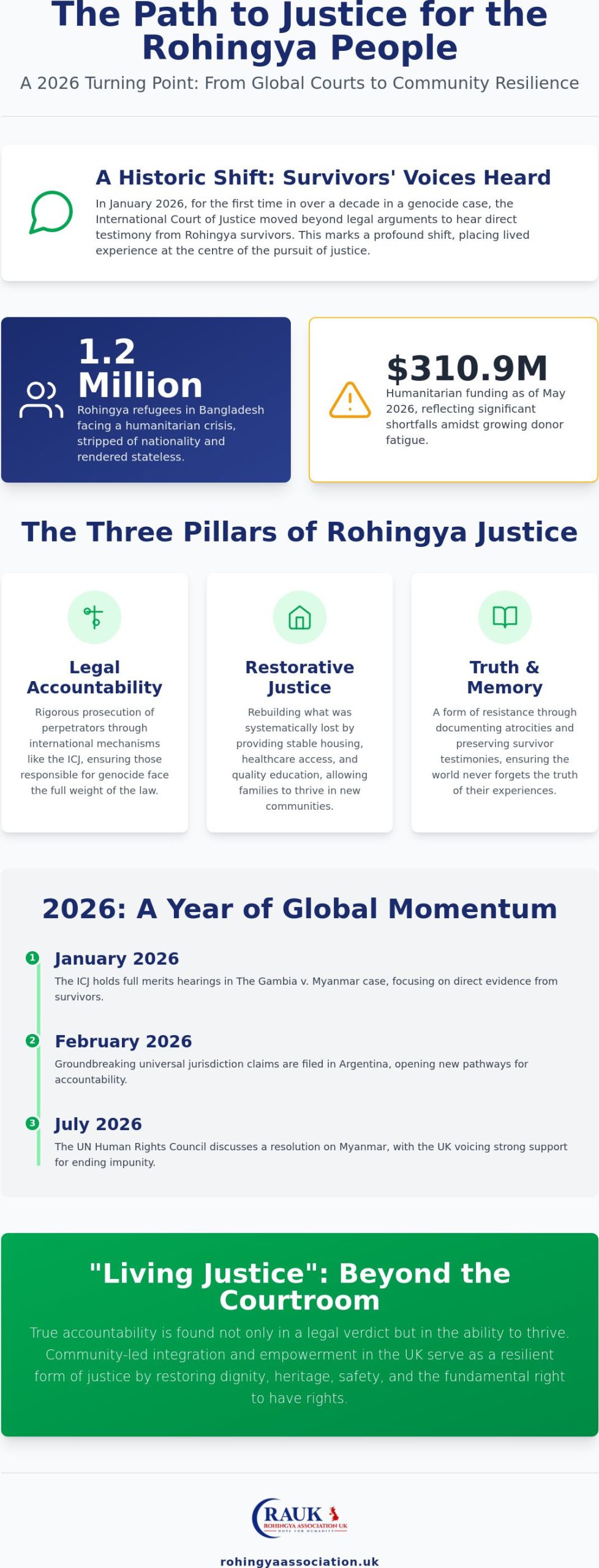
- Legal Accountability: This involves the rigorous prosecution of perpetrators through international mechanisms like the ICJ. The goal is to ensure that those responsible for genocide and crimes against humanity face the full weight of international law.
- Restorative Justice: This pillar focuses on rebuilding what was lost. It includes ensuring families have stable housing, access to healthcare, and the gift of education for the next generation.
- Truth and Memory: Documenting atrocities is a form of resistance. By preserving survivor testimonies, we ensure the world never forgets the truth of their experiences.
Why 2026 is a Turning Point for Human Rights
The momentum within international courts has reached a fever pitch this year. Whilst donor fatigue has sadly reduced humanitarian funding to $310.9 million as of May 2026, the legal landscape is more active than ever. Digital documentation and forensic evidence are now being transformed into admissible evidence with unprecedented precision, bridging the gap between historical record and legal proof. This year marks a departure from the cynicism that often plagues international law, as the voices of survivors finally take centre stage. Justice is the restoration of the fundamental right to have rights.
International Accountability: The ICJ and the Pursuit of Legal Truth
The 2026 hearings at the International Court of Justice (ICJ) represent a watershed moment for international law. In January 2026, the court dedicated three weeks to full merits hearings in the case of The Gambia v. Myanmar, marking a historic shift in how the world addresses the justice for Rohingya people. For the first time in over a decade in a genocide case, the court heard direct testimony from survivors. This transition from technical legal debate to the raw, human reality of the crisis has forced a re-evaluation of the international community’s stance, moving the needle from passive concern toward active legal accountability.
This legal momentum is sustained by the tireless work of the UN Special Rapporteur and the UN Human Rights Council. On 7 July 2026, the Council discussed a resolution specifically targeting the human rights situation in Myanmar, with the UK voicing strong support for ending impunity. These high-level deliberations aren’t merely symbolic; they serve to maintain global pressure on the military junta, ensuring that the crimes of ethnic cleansing and genocide remain at the top of the diplomatic agenda.
The Hague and the Weight of Evidence
The pursuit of truth relies on a meticulous assembly of facts. Investigators are now utilising advanced satellite imagery and forensic documentation to prove the systematic nature of the violence. These International Court of Justice proceedings provide a vital framework for human rights protection for Rohingya, yet legal action alone has limitations. Whilst a court can issue a verdict, it cannot enforce a change in regime. Therefore, legal truth must be coupled with sustained diplomatic pressure to ensure that rulings translate into tangible safety on the ground.
The Role of UN Member States in 2026
International justice requires more than just courtroom victories; it demands the political will to support survivors. In March 2026, Home Ministers from the UK and Bangladesh met to discuss the necessity of a safe, sustainable, and dignified return for refugees. However, achieving this goal is hindered by significant donor fatigue. The 2026 Joint Response Plan requires $710.5 million to sustain 1.6 million people, yet as of late May, only $310.9 million had been received. This funding gap directly impacts protection and education within the camps, making the role of member states critical in preventing a further humanitarian collapse. Supporting these global efforts begins with local awareness, and you can explore how to contribute through our advocacy and awareness campaigns.
The Power of Voice: Survivor Testimony as a Catalyst for Change
While legal frameworks provide the necessary structure for accountability, survivor voices provide the essential soul of international proceedings. In the pursuit of justice for Rohingya people, testimony isn’t merely a collection of facts; it’s a profound act of agency. By speaking their truth, survivors reclaim the identity that state-sponsored persecution sought to erase. This process is deeply restorative, allowing individuals to move from being subjects of a report to being architects of their own history. It is an instrument of truth that dismantles the carefully constructed narratives of denial that have persisted for decades.
Facing perpetrators in a court of law requires remarkable courage. For many, this involves revisiting the most traumatic moments of their lives under the scrutiny of global legal experts and the very figures who denied their existence. However, this bravery is the engine of change. When a survivor stands in The Hague, the proceedings are no longer about abstract violations of treaties; they’re about the lived reality of families, the sanctity of heritage, and the right to safety. This human-centric approach ensures that the legal process remains grounded in the needs of the community rather than the convenience of diplomats.
Centring the Narrative on Human Experience
The transition from statistics to individual stories is vital for maintaining global empathy. Whilst figures like the 3.6 million internally displaced people in Myanmar provide scale, they can often lead to a sense of detachment. Individual accounts of resilience counter this by highlighting the strength and dignity of the Rohingya spirit. Hearing the word “Rohingya” spoken with authority in the halls of global power is, in itself, a form of justice. It serves as a definitive rejection of the 1982 Citizenship Law’s attempt to render an entire people nameless and invisible.
Protecting Witnesses and Preserving Truth
Speaking out carries immense risk, and the international community must prioritise the protection of those who come forward. Local organisations play a critical role here, acting as a protective shield and a guiding hand for survivors navigating the complexities of international law. This sustained Rohingya human rights advocacy ensures that testimonies are not just heard today but are archived as an immutable record for future generations. During the three-week merits hearings in January 2026, the International Court of Justice received direct testimony from a historic cohort of survivors, marking the first time such evidence has been heard in a genocide case in over a decade. These voices are the foundation upon which a more just and accountable world is being built; they’re the light that ensures the truth can never again be hidden in the shadows.
Restorative Justice: Building Hope Through Community in the UK
Whilst international courts in The Hague deliberate on legal verdicts, a parallel and equally vital form of justice for Rohingya people is unfolding within the neighbourhoods of Bradford. Integration is not merely a social objective; it’s a profound act of resistance against the annihilation attempted in Myanmar. By facilitating successful settlement, providing housing guidance, and ensuring healthcare access, the Rohingya Association UK (RAUK) helps families rebuild the foundations of a life once systematically dismantled. This restorative approach acknowledges that true accountability must include the right to belong, to heal, and to prosper in a safe environment.
Education serves as one of the most potent tools for reclaiming agency. English language classes and youth empowerment programmes do more than bridge a communication gap; they equip survivors with the ability to advocate for themselves and their community. When a young person gains the confidence to share their story or pursue an education, they’re directly countering the decades of state-sponsored exclusion that sought to render them voiceless. This focus on long-term stability ensures that the pursuit of justice is not a fleeting reaction but a sustained, generational commitment to empowerment.
Bradford: A Centre for Resilience and Restoration
The Bradford community centre has become a vital hub for community support for displaced families, offering a space where shared experience is transformed into collective strength. Local success stories highlight a remarkable transition from the trauma of displacement to the stability of active citizenship. Islamic community events and cultural festivals play a crucial role here, strengthening the bonds of the diaspora and providing a sense of continuity. These gatherings are more than social occasions; they’re an affirmation of a shared identity that remains unshakeable despite the pressures of exile.
Heritage Preservation as Resistance
Preserving the Rohingya language, traditions, and history is a vital act of defiance against what many observers characterise as a calculated cultural genocide. RAUK remains dedicated to organising cultural events that celebrate this unique identity, ensuring that heritage remains a living force for the next generation. This commitment to preservation isn’t confined to the UK; the local community remains deeply connected to the wider diaspora, including those facing the increasingly dire conditions inside the Rohingya refugee camp in Bangladesh. By maintaining these cultural links, the community ensures that the spirit of the Rohingya people remains vibrant and whole. You can play a direct role in this ongoing restoration by supporting our refugee settlement and integration initiatives.
Sustaining the Movement: How to Support Justice for Rohingya People
The journey toward justice for Rohingya people is not a sprint; it’s a marathon of collective endurance. Whilst the legal victories in The Hague provide a necessary foundation, the momentum required to sustain this movement depends on the active participation of a global community. We must transform our empathy into a structured framework of support that addresses both the immediate humanitarian crisis and the long-term need for systemic change. In a year where international attention is frequently pulled toward competing crises, our commitment must remain steadfast, grounded, and professional.
Combatting donor fatigue is perhaps the most urgent challenge of 2026. As of late May, the Joint Response Plan had received only $310.9 million of the $710.5 million required to sustain 1.6 million people. This funding gap isn’t just a statistic; it represents a direct threat to food security, healthcare, and protection for families in Bangladesh and Myanmar. By staying informed and sharing accurate trend analyses, you help counter the apathy that often follows prolonged conflict. Advocacy is the bridge between individual concern and systemic restoration.
Practical Steps for Global Advocates
- Educate: Use your platform to highlight the current landscape of the crisis. Sharing survivor-centric narratives and legal updates, such as the 2026 ICJ merits hearings, ensures the Rohingya remain visible in the public consciousness.
- Donate: Direct your support to community-led charities that provide a dual impact. Contributions to the Rohingya Association UK fund both immediate crisis intervention and long-term community integration, ensuring that aid reaches those who need it most.
- Advocate: Maintain political pressure by writing to your local MP. Ensure the UK government continues to prioritise the Rohingya crisis in bilateral meetings, such as the March 2026 summit with Bangladesh, and remains a leader in human rights protection.
The Future of the Rohingya: A Vision of Dignity
The ultimate vision for the Rohingya is a world where citizenship, safety, and equality are not distant dreams but guaranteed realities. This requires a transition from temporary aid to permanent rights. The Rohingya Association UK remains dedicated to this mission, acting as both a protective shield for the diaspora and a guiding hand for the next generation. We don’t just provide aid; we fight for a future where every Rohingya individual can thrive with pride in their heritage. Justice is a collective effort. When we stand together, we ensure that the light of truth and the hope for restoration can never be extinguished by the weight of injustice.
A Future Rooted in Accountability and Hope
The year 2026 has established a definitive shift in the pursuit of justice for Rohingya people, moving from the abstract deliberations of distant courts to the powerful, lived truths of survivors. We have witnessed the historic merit hearings at the ICJ; we have seen the transformative impact of community restoration in Bradford; and we have recognised that true accountability requires a persistent, tripartite commitment to legal truth, cultural preservation, and social integration. Whilst the challenges of donor fatigue and political instability remain significant, the resilience of the Rohingya spirit continues to serve as a catalyst for global change.
As a community-led organisation, the Rohingya Association UK (Registered Charity number: 1211433) acts as both a protective shield and a guiding hand for families navigating the complexities of displacement. Our work delivers a direct impact amongst families in Bradford and within global refugee camps, ensuring that the quest for dignity remains a tangible reality rather than a distant hope. We invite you to stand with us in this long-term mission of restoration, protection, and growth.
Support our advocacy and community work: Donate to Rohingya Association UK today. Together, we can ensure that the light of truth and the promise of a safe, dignified future remain unshakeable.
Frequently Asked Questions
What is the current status of the ICJ case regarding the Rohingya?
In January 2026, the International Court of Justice reached a historic milestone by holding three weeks of full merits hearings in The Gambia v. Myanmar case. These proceedings were particularly significant as the court heard direct testimony from Rohingya survivors for the first time in over a decade in a genocide case. This phase of the trial focus on establishing the legal truth of the atrocities committed and determining the state of Myanmar’s responsibility under international law.
How does the International Court of Justice help the Rohingya people?
The ICJ serves as a vital instrument for justice for Rohingya people by holding the state of Myanmar accountable for violations of the Genocide Convention. Beyond issuing final verdicts, the court can mandate provisional measures to protect the group from further harm and create an immutable legal record of the crimes committed. This process validates the experiences of survivors, provides a platform for their voices, and exerts significant diplomatic pressure on the global stage.
Why is the 1982 Myanmar Citizenship Law so important for justice?
The 1982 Citizenship Law is the foundational mechanism of the systemic disenfranchisement and statelessness faced by the Rohingya. By stripping the community of their nationality and fundamental rights, this legislation created the legal vacuum in which the genocide was allowed to occur. Rescinding or reforming this law is a prerequisite for any meaningful justice, as it remains the primary barrier to the community’s right to have rights, identity, and protection.
Can the Rohingya people ever safely return to Myanmar?
Safe, voluntary, and sustainable repatriation remains the ultimate goal of international advocacy, though current conditions in Rakhine State make this impossible in 2026. Intensified conflict between the military junta and the Arakan Army has led to fresh displacement, forced recruitment, and targeted attacks. Until there is a fundamental shift in the political landscape and a restoration of citizenship rights, the international community continues to prioritise protection and aid for the 1.2 million refugees in Bangladesh.
How does supporting refugees in the UK contribute to global justice?
Supporting the diaspora in cities like Bradford is a powerful form of restorative justice that counters the intent of annihilation. By facilitating integration, providing education, and preserving heritage, we ensure that the Rohingya identity remains vibrant and unshakeable despite the pressures of exile. This local stability creates a resilient foundation for diaspora-led advocacy, allowing survivors to act as a collective voice for those who remain silenced within Myanmar or the camps.
What can I do to help the Rohingya people in 2026?
Individuals can contribute by providing financial support to community-led organisations and advocating for sustained political pressure on the military junta. With the 2026 Joint Response Plan facing a significant funding gap, donations are essential for crisis intervention and settlement services. You can also write to your local MP to ensure the UK government continues to support international sanctions and maintains its commitment to accountability in global forums.
What is the difference between the ICJ and the ICC in this crisis?
The ICJ and the ICC operate through different legal frameworks to address the crisis. The ICJ (International Court of Justice) settles disputes between states, specifically examining if Myanmar as a nation violated the Genocide Convention. In contrast, the ICC (International Criminal Court) focuses on individual criminal responsibility, investigating specific leaders for crimes against humanity, such as the forced deportation of the Rohingya across the border into Bangladesh.
How does the Rohingya Association UK spend its donations for advocacy?
Donations to the Rohingya Association UK are utilised to fund our core missions of restoration, protection, and empowerment. We direct resources toward refugee settlement and integration, youth empowerment programmes, and the preservation of our cultural heritage through community events. These funds also support our active advocacy projects in the UK and abroad, ensuring that the quest for justice for Rohingya people remains a priority for policymakers and the public alike.