
Did you know that over half of the 1.19 million people registered in the world’s largest settlements are children? For these young lives, the daily reality of a rohingya refugee camp is defined not by a temporary stay, but by a permanent struggle for identity, safety, and recognition. It’s common to feel overwhelmed by the relentless cycle of news reports detailing monsoon landslides and shifting aid budgets. You likely want to move beyond the headlines to understand the human truth of this crisis and distinguish between fleeting charity and the long-term justice these families deserve.
This article offers a comprehensive exploration of the camp infrastructure, the legal weight of statelessness, and the resilient spirit of a community that refuses to be forgotten. We’ll examine the systemic barriers facing the Rohingya in 2026, the critical funding gaps in healthcare, and how community-led action provides a genuine path toward restoration. By the end, you’ll have a clear perspective on the current landscape and know how to support trusted organisations that prioritise dignity, heritage, and communal strength.
Key Takeaways
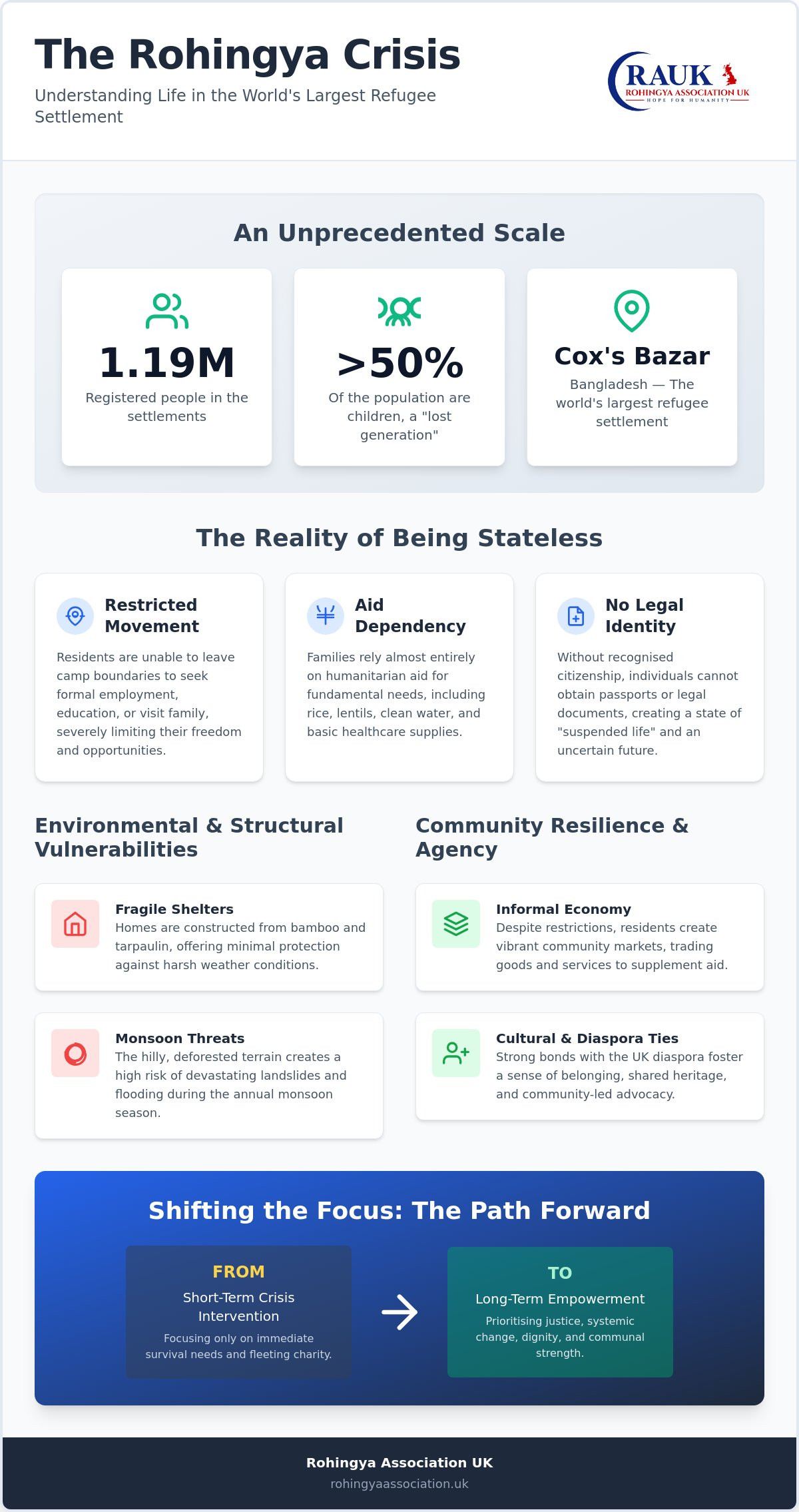
- Grasp the unprecedented scale of the Kutupalong and Nayapara settlements, where nearly 1.2 million individuals navigate life within the world’s largest sites of forced sanctuary.
- Examine the systemic challenges of statelessness, including restricted movement and the profound reliance on humanitarian aid for food, water, and essential healthcare.
- Understand the environmental vulnerabilities of the rohingya refugee camp during the 2026 monsoon season, where fragile shelters face the persistent threat of landslides and flooding.
- Discover the enduring cultural ties between camp residents and the UK diaspora, highlighting how shared heritage and community-led advocacy foster a sense of belonging.
- Learn to distinguish between short-term crisis intervention and long-term empowerment, moving toward a model of partnership that prioritises justice and systemic change.
What is a Rohingya Refugee Camp? Understanding the Scale of Displacement
A rohingya refugee camp is more than a geographical coordinate; it’s a site of forced sanctuary for a people frequently described as the world’s most persecuted minority. These sprawling settlements represent a collective effort to survive against systemic erasure. Currently, the vast majority of these families reside within the Cox’s Bazar district of Bangladesh, where the landscape has been transformed into a dense network of shelters. The camps are not merely clusters of tents but complex, informal cities that have become the only home for a generation of displaced people.
The sheer scale of the situation is staggering. As of July 2026, the registered population of Rohingya refugees in Bangladesh has reached nearly 1.2 million individuals. While the presence of the Rohingya in this region spans decades, the primary catalyst for the current density was the 2017 exodus. This mass flight, driven by targeted violence in Myanmar, forced hundreds of thousands to seek safety across the border in a matter of weeks. Today, the United Nations and the Bangladesh government work in tandem to manage these “mega-camps”, providing a fragile framework of security and aid in a landscape that remains inherently temporary yet stubbornly persistent.
The Origins of the Crisis in Rakhine State
Displacement didn’t begin in a vacuum. For decades, the Rohingya have faced institutionalised discrimination and the denial of citizenship within Myanmar’s Rakhine State. This systemic exclusion eventually culminated in the waves of violence that forced families to abandon their ancestral homes. Their journeys are often harrowing. Families travel through dense jungles or risk the volatile waters of the Bay of Bengal, carrying nothing but their children and their memories. Despite these trials, the resilience of these families remains profound; they continue to seek dignity whilst navigating the complexities of crossing international borders.
Cox’s Bazar: The World’s Largest Refugee Settlement
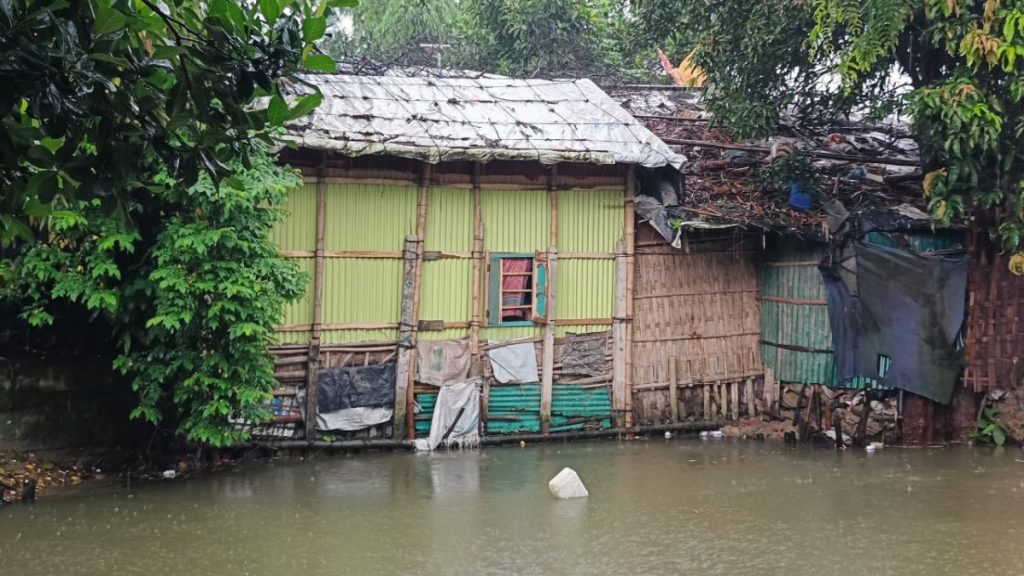
Visualising the Kutupalong and Nayapara settlements requires imagining a city built entirely of bamboo and tarpaulin. There is no permanent infrastructure here. Shelters are perched precariously on deforested, hilly terrain, creating a population density that rivals the most crowded urban centres on earth. This congestion isn’t merely a logistical challenge; it’s a human one. The defining characteristic for every resident is statelessness. Without a legal identity or a recognised home, life in a rohingya refugee camp becomes a delicate balance between the memory of the past and the uncertainty of a future without a passport.
The Reality of Daily Life: Surviving Whilst Stateless
Life within the confines of a rohingya refugee camp is a study in quiet endurance. For the nearly 1.2 million residents, daily existence is dictated by a lack of legal recognition that permeates every interaction, movement, and opportunity. This condition of statelessness means that physical freedom is strictly curtailed; most residents are unable to leave the camp boundaries to seek formal employment or visit relatives in other districts. To understand the root of this systemic exclusion, one can look at the Rohingya crisis explained by international observers, which highlights how decades of state policy have stripped this community of their most basic rights. Consequently, families are forced to rely almost entirely on humanitarian aid for their most fundamental needs, including rice, lentils, and clean water.
Despite these profound restrictions, a vibrant informal economy has emerged amongst the bamboo shelters. In the narrow, muddy alleys, community markets thrive. Residents trade small goods, repair electronics, or sell homegrown vegetables to supplement their meagre rations. This entrepreneurial spirit is a testament to their agency, yet it cannot fully mask the psychological toll of living in a state of permanent temporariness. The uncertainty of what the future holds creates a heavy mental burden. Parents often wonder if their children will ever know a life beyond the wire, leading to a sense of “suspended life” that defines the refugee experience in 2026.
Education and the “Lost Generation”
The struggle for education is a critical challenge. Over half of the camp population are children, yet they lack access to a formal, recognised curriculum that would allow them to pursue professional careers. Community-led learning centres often step into the gap, providing basic literacy and numeracy. Supporting humanitarian aid for Myanmar refugees is essential for ensuring these centres have the materials and teachers needed to prevent a “lost generation” from losing hope. Education remains the only bridge to a future of self-reliance. For displaced young people who do reach safety in the UK, refugee youth empowerment programs provide the structured support needed to transform that foundation into genuine leadership and long-term integration.
Healthcare Challenges and Sanitation
In such high-density environments, health is a precarious asset. The lack of permanent infrastructure within the rohingya refugee camp means that communal wash facilities are often overstretched, increasing the risk of communicable diseases. Access to medical supplies is a fundamental human right that remains precarious due to funding shortfalls. Addressing these inequalities requires a dedicated, long-term commitment to community support. You can help us in tackling these systemic inequalities to ensure every family has access to the dignified care they deserve.
Environmental and Safety Risks: Monsoons and Vulnerability
The physical environment of a rohingya refugee camp is defined by its extreme vulnerability to the elements. In early July 2026, heavy monsoon rains triggered devastating landslides in the Cox’s Bazar region, resulting in the deaths of at least 14 Rohingya refugees, including five children. These hills, once lush with forests, were stripped to accommodate the density of the settlements, leaving the soil unstable and prone to collapse during the torrential downpours that characterise the season. The shelters themselves, constructed primarily from bamboo and tarpaulin, offer little resistance to high winds and flooding. This isn’t a seasonal inconvenience; it’s a structural crisis that requires year-round crisis intervention rather than a reactive, short-term response. Understanding how to provide effective support for Cox’s Bazar refugees is essential for anyone who wants to move beyond reactive charity toward sustained, dignified assistance.
Beyond the weather, the high-density nature of the camps creates significant safety hazards that threaten the dignity and safety of every resident. Fire is a constant, terrifying threat, as cooking flames can quickly ignite the flammable materials of the shelters in a landscape where fire-fighting access is severely limited. According to the U.S. State Department report on refugee conditions, the lack of freedom of movement and overcrowded living spaces exacerbate these protection risks. For women and children, the absence of permanent lighting and secure housing makes them particularly vulnerable to exploitation, requiring constant vigilance and communal support.
Climate Resilience in the Camps
Despite the fragility of their surroundings, refugees demonstrate remarkable agency by organising themselves to reinforce shelters before the rains arrive. Community volunteers play a vital role in disaster risk reduction, digging drainage channels and planting grass to stabilise the muddy slopes. However, their efforts are hampered by government restrictions that prohibit the use of permanent materials like brick or concrete. This policy ensures that even the most resilient families remain in a state of precariousness, unable to build structures that can truly withstand the shifting earth.
Protection and Social Welfare
Maintaining security amongst a million displaced people is a complex, ongoing challenge that requires a deep understanding of communal bonds. Protection efforts focus on creating child-friendly spaces and women’s support groups, which serve as essential hubs for restoration, protection, and growth. These spaces provide a shield against the harsh realities of camp life, offering education and psychological support. At RAUK, we advocate for better protection standards globally, ensuring that the voices of the community are heard in the fight for systemic change and long-term justice. You can learn more about our commitment to advocacy and awareness campaigns to see how we bridge the gap between local needs and global action.
The Bridge to Belonging: From the Camp to the Diaspora
The physical borders of a rohingya refugee camp are defined by wire and mud, yet the emotional and cultural boundaries of this community extend across the globe. Families in the UK maintain deep, unbreakable ties with those still navigating the precarious conditions of Cox’s Bazar. These connections are more than just personal; they are a vital lifeline of information, financial support, and communal hope. In cities like Bradford, which has become a significant centre for Rohingya heritage, the diaspora works tirelessly to ensure their relatives are not forgotten by the international community. This global network serves as a powerful reminder that displacement cannot erase the bonds of kinship.
This connection serves as a model for restoration. We believe that community support for displaced families in the UK provides a blueprint for how integration and advocacy can work hand-in-hand. By establishing a stable, supportive foundation here, the diaspora is better equipped to fight for the rights of those still living in statelessness. It’s a relationship built on mutual strength, where the resilience of those in the camps inspires the advocacy of those in the UK.
Preserving Heritage Across Borders
Identity is a powerful tool for resilience. Amongst the displaced, the preservation of the Rohingya language, traditional culinary practices, and the Islamic faith acts as a psychological shield against the trauma of erasure. For a child growing up in a rohingya refugee camp or a youth navigating life in the UK, understanding their heritage is essential for mental well-being and long-term integration. RAUK acts as a principled leader in this space, facilitating cultural and community events that connect the next generation to their roots. This bonding reinforces a shared identity that transcends the temporary nature of the settlements.
Advocacy: Giving a Voice to the Stateless
True restoration requires more than just aid; it demands justice and accountability. RAUK uses its platform to highlight ongoing human rights violations in Myanmar and the systemic failures within the camp system that keep families in a state of limbo. We encourage our supporters to see refugees not as passive recipients of pity, but as agents of change who are capable of leading their own journey toward restoration. By amplifying their voices, we bridge the gap between the silence of the camps and the global stage of human rights advocacy.
If you are ready to stand with us in this mission, you can join our advocacy and awareness campaigns to help drive the systemic change required for long-term justice and communal growth.
How You Can Help: Supporting the Rohingya Journey
Supporting the Rohingya community requires a fundamental shift in perspective. While immediate crisis intervention in a rohingya refugee camp is vital for survival, true restoration depends on long-term community empowerment. We invite you to move beyond a feeling of pity and embrace a model of partnership. By standing with a community-led organisation, you ensure that aid is not just a distant gesture but a collaborative effort that respects the agency and dignity of those it serves. Your involvement helps bridge the gap between the precariousness of displacement and the stability of a recognised future.
Actionable support can take many forms, from local integration efforts in the UK to global advocacy for those still in Rakhine State. We act as a principled leader in this space, ensuring that every resource is used to foster self-reliance and communal growth. Whether you are contributing your time, your voice, or your financial support, you are participating in a movement that seeks systemic change rather than just temporary relief.
Donating to Community-Led Aid
Donations to the Rohingya Association UK (RAUK) are directed toward a spectrum of essential services across the UK, Myanmar, and Bangladesh. As a registered UK charity (No. 1211433), we prioritise transparency and cultural sensitivity in every project we undertake. Your support funds practical initiatives such as English language classes for families in Bradford and youth empowerment programmes that build confidence amongst the next generation. These efforts ensure that displaced families have the tools to navigate their new lives whilst maintaining a strong, proud connection to their heritage. If you want to ensure your generosity reaches those who need it most, our 2026 checklist for how to donate to Bangladesh refugee camps outlines exactly how to give with confidence and impact.
Volunteering and Awareness
Support extends beyond financial contributions. For those in Bradford and across the country, volunteering your time to assist with local integration or advocacy is an invaluable way to strengthen the communal bond. Sharing verified Rohingya refugee crisis facts within your own networks is equally critical. Misinformation often clouds the reality of life in a rohingya refugee camp; by spreading accurate information, you help to humanise the crisis and build a broader movement for justice and accountability. Every conversation you start is a step toward breaking the cycle of statelessness.
Join the Rohingya Association UK in our mission to restore hope and justice.
A Shared Commitment to Restoration and Justice
The landscape of a rohingya refugee camp remains one of the most challenging environments on earth; it is a place where nearly 1.2 million people navigate the heavy weight of statelessness amongst the constant threats of monsoon landslides and systemic neglect. Yet, as we’ve explored, the story of the Rohingya is not merely one of suffering but of profound agency, cultural pride, and communal strength. By bridging the gap between the settlements in Cox’s Bazar and the vibrant diaspora in cities like Bradford, we can move from short-term aid to long-term systemic change. True restoration is possible when we prioritise the voices of those who have lived the experience of displacement.
As a community-led charity (Registered Charity No: 1211433), RAUK has been dedicated to local and global aid projects since our founding. We believe that empowerment is most effective when it is led by the community, for the community. You can support our community-led mission to empower Rohingya families to help us protect heritage, provide education, and secure a future defined by dignity. Together, we can ensure that the path toward justice remains open and that every family has the opportunity to thrive. Your partnership is the catalyst for lasting renewal.
Frequently Asked Questions
Where is the largest Rohingya refugee camp located?
The largest rohingya refugee camp is located in the Cox’s Bazar district of south-eastern Bangladesh, primarily within the Kutupalong-Balukhali expansion site. This vast settlement houses the majority of the 1.19 million registered refugees who have sought safety across the border. The landscape is a dense network of temporary bamboo and tarpaulin shelters that have effectively become a sprawling, informal city since the mass displacement of 2017.
Why are the Rohingya people considered stateless?
Rohingya people are considered stateless because the 1982 Citizenship Law in Myanmar effectively stripped them of their nationality and legal identity. This legislation excluded them from the list of recognised ethnic groups, leaving them without a country to call their own. Consequently, they lack basic rights such as freedom of movement, access to state education, and legal protection, making them the world’s largest stateless population.
Can Rohingya refugees in the camps go to school or work?
Formal employment and state-accredited education are largely prohibited for residents living within the settlements. Whilst community-led learning centres provide basic literacy, an estimated 235,000 children aged 5-17 remain out of formal schooling as of 2026. Most families are entirely dependent on humanitarian aid, although many participate in a vibrant informal economy within the camp boundaries to trade essential goods and maintain a sense of self-reliance.
How does the monsoon season affect the refugee camps in Bangladesh?
The monsoon season brings torrential rains that trigger devastating landslides and flooding across the deforested hills of the rohingya refugee camp. In July 2026, heavy rainfall resulted in at least 14 fatalities, including five children, as fragile shelters were swept away by shifting soil. These environmental risks are compounded by the lack of permanent building materials, which leaves families in a constant state of vulnerability every year.
What is the difference between a refugee and a stateless person?
A refugee is an individual forced to flee their home country due to conflict or persecution, whilst a stateless person is someone who is not recognised as a national by any state. Most Rohingya individuals fall into both categories; they are refugees seeking sanctuary in Bangladesh and stateless people with no legal claim to citizenship in Myanmar. This dual status makes their journey toward justice and restoration particularly complex.
How can I support Rohingya refugees living in the UK?
You can support the community by partnering with organisations that focus on local integration, such as providing assistance with housing, healthcare, and education. In cities like Bradford, community-led initiatives offer English language classes and youth empowerment programmes to help families navigate their new lives. Advocacy is also essential; raising awareness about the crisis helps to ensure that the rights of displaced families remain a priority for policymakers.
What are the long-term solutions for the Rohingya refugee crisis?
The primary long-term solution is a safe, voluntary, and dignified return to Myanmar with full citizenship rights and guaranteed safety. Currently, conditions in Rakhine State remain too volatile for repatriation, meaning the international community must focus on sustained humanitarian support and legal accountability. Strengthening education and vocational opportunities within the camps is also vital to ensure that refugees can lead their own path toward restoration when return becomes possible.
Is the Rohingya Association UK a registered charity?
Yes, the Rohingya Association UK is a registered charity in England and Wales with the charity number 1211433. We’re a community-led organisation that is uniquely positioned to provide culturally sensitive support because our leadership is drawn from the Rohingya community itself. We operate local integration projects in the UK whilst also conducting global advocacy and crisis intervention to support families in Myanmar and the Bangladesh settlements.