
What if we stopped viewing displacement as a permanent state of victimhood and started seeing it as a temporary pause in a trajectory of leadership? For many, the sheer scale of the global crisis feels insurmountable, particularly as the UK received 101,000 asylum applications in 2025 alone. It’s natural to feel overwhelmed by these figures, to question the efficacy of short-term aid, or to wonder if genuine change is possible for those navigating a system that now grants only 30 months of initial protection.
This article demonstrates how holistic refugee youth empowerment programs transform the lives of displaced young people from surviving to leading. You will learn how these initiatives provide the essential tools for restoration, protection, and growth; they are not merely about providing shelter, but about reclaiming a sense of heritage, agency, and safety. We will examine the profound connection between education and community leadership, whilst providing clear, actionable pathways for you to support displaced youth within your own local area and help build a future rooted in dignity and resilience.
Key Takeaways
- Distinguish between immediate emergency relief and the transformative potential of refugee youth empowerment programs that cultivate long-term leadership and agency.
- Identify the essential pillars of holistic support, including mentorship and educational bridging, that help young people reclaim their academic and professional trajectories.
- Gain a deeper understanding of the invisible barriers of trauma and statelessness that impact the psychological well-being and identity of Rohingya youth in the UK.
- Explore the importance of local integration in cities like Bradford, where community-led initiatives create a vital safety net for displaced families.
- Learn how targeted investment in skills and cultural preservation enables young refugees to move beyond survival and become active, leading members of their communities.
Defining Refugee Youth Empowerment: More Than Just Assistance
Empowerment is a term that carries a weight of moral seriousness; it’s not a fleeting emotional reaction to a crisis, but a methodical restoration of agency and confidence. While emergency aid provides the calories and shelter necessary for physical survival, it does not address the fundamental human need for purpose and belonging. Refugee youth empowerment programmes bridge this gap by transitioning young people from a state of passive reception to one of active leadership. It’s the difference between merely existing and truly thriving in a new society. We believe that aid is the starting point, but agency is the destination.
For young people aged 15 to 24, the stakes of displacement are particularly high. This demographic stands at a developmental crossroads, where the weight of the past often threatens to crush the promise of the future. By fostering a sense of "resilient optimism," we provide a guiding hand that helps them navigate the UK’s complex social and legal landscapes. We act as both a protective shield and a guiding hand, ensuring that systemic barriers do not extinguish individual talent. This approach ensures that their identity is defined by their strength, heritage, and potential rather than their status as a displaced person.
The Shift from Survival to Agency
Basic needs like food and safety are the foundation of any humanitarian response, but empowerment is the actual structure of a new life. There’s a vital psychological transition that takes place when an individual stops being a "beneficiary" of aid and becomes an active "participant" in their community. They begin to see themselves as contributors, thinkers, and leaders. Empowerment is the restoration of the right to dream and plan.
Why Youth-Specific Focus Matters
Adolescence and young adulthood represent a unique developmental window. During this time, the challenges faced by refugee children, such as trauma and social isolation, can have long-lasting effects if not addressed with precision. By focusing on this age group, we prevent the "lost generation" phenomenon that occurs when talent is left to stagnate. These young people act as vital cultural bridges within their own families, helping them navigate a new country whilst preserving communal bonds. Investing in refugee youth empowerment programmes is a strategy for long-term community stability and justice.
The Holistic Pillars of Effective Youth Programmes
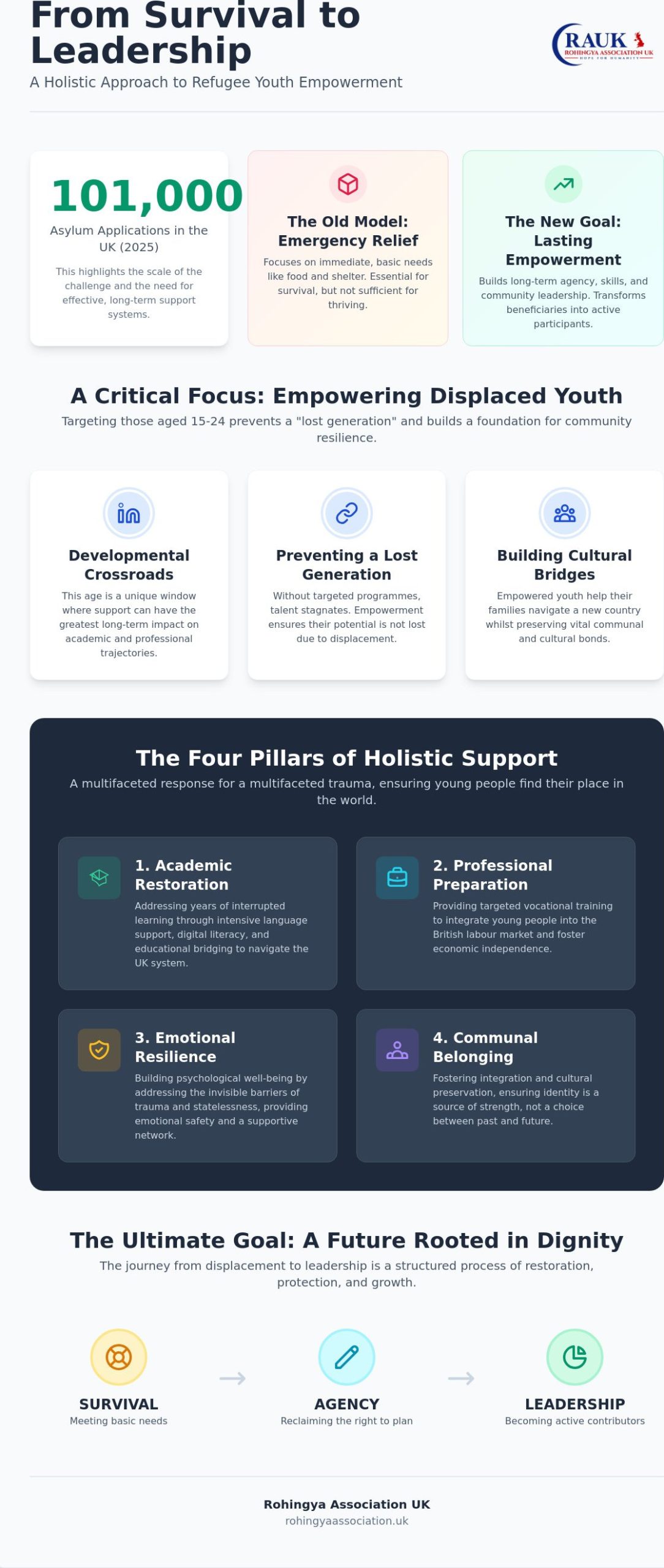
Effective refugee youth empowerment programs operate on the understanding that displacement is a multifaceted trauma requiring a multifaceted response. It is not enough to provide a classroom; one must also provide the emotional safety and social network required to succeed within it. These initiatives rest upon four primary pillars: academic restoration, professional preparation, emotional resilience, and communal belonging. By addressing the whole person, we ensure that young people don’t just find a job, but find their place in the world. We seek to provide a stable foundation of restoration, protection, and growth.
Education and Skills Development
Many young refugees arrive in the UK with years of interrupted learning, having fled conflict zones where schools were often the first casualties of war. Navigating a new, complex education system requires more than just a place in a classroom. It demands intensive language support and digital literacy training. We recognise that English language classes for refugees in Bradford serve as the primary gateway to independence, allowing youth to articulate their needs and aspirations. This local effort aligns with broader national strategies, such as the Refugee Employability Programme, which seeks to integrate displaced individuals into the British labour market through targeted vocational training and support.
True empowerment also requires the preservation of one’s heritage. Whilst some approaches focus solely on economic output, we understand that a young person’s resilience is rooted in their identity. Maintaining a connection to their culture, language, and family traditions provides a stable foundation from which they can explore their new home. It is about building a future that honours the past. This dual focus on modern skills and cultural pride ensures that youth do not feel forced to choose between their history and their future.
Mentorship and Social Connection
Isolation is a silent predator for newly arrived youth. Without a social network, the promise of a new life can feel hollow and unreachable. One-to-one mentorship provides a protective shield against this loneliness, pairing young people with positive adult role models who understand the nuances of the refugee journey. These relationships build "social capital," offering introductions to professional networks and community groups that would otherwise remain closed. Peer-to-peer support amongst those with shared cultural backgrounds further reinforces this bond, creating a space where experiences are validated and strengths are celebrated. By fostering these connections, we help young people move from the margins of society to the centre of community life. If you wish to learn more about our commitment to these young leaders, you can explore the work of the Rohingya Association UK.
Navigating the Invisible Barriers: Trauma and Statelessness
For many displaced young people, the most significant obstacles are not physical borders, but the invisible barriers of trauma and legal invisibility. Statelessness is a profound condition of existence where an individual is denied the basic right to belong to any nation; it is a state of being where one’s identity is officially unrecognised. This erasure of identity creates a unique psychological burden that conventional emergency aid often fails to address. Within refugee youth empowerment programs, we must confront these complexities with a deep sense of moral seriousness, ensuring that every young person feels seen, heard, and valued as a human being with a rightful place in the global community.
The Weight of Statelessness
Statelessness is more than a legal technicality; it’s a fundamental disruption of a person’s sense of future. When a homeland is out of reach or entirely denied, the concept of home must be reconstructed from within the community. We focus specifically on the challenges for Rohingya youth in the UK, who often navigate a landscape of uncertainty regarding their long-term status and identity. Our advocacy efforts ensure these young voices are amplified, granting them the agency to speak on their own human rights and participate in the civic life of their new community. By fostering a sense of belonging in the present, we help them build a bridge to a more stable tomorrow, rooted in strength, heritage, and potential. The broader pursuit of justice for Rohingya people through international legal mechanisms, such as the ongoing case at the International Court of Justice, provides an essential backdrop of accountability that reinforces the dignity and rights of stateless youth navigating life in the UK.
Addressing Mental Health and Resilience
To be truly effective, support must be trauma-informed, acknowledging the weight of the past without allowing it to dictate the trajectory of the future. This is a core tenet of modern refugee youth empowerment programs, where the focus shifts from survival to thriving. We move beyond the "trauma narrative," which often reduces individuals to their suffering, and instead focus on their inherent strengths and cultural pride. This methodology aligns with Refugee Youth Service’s holistic approach, which emphasises child protection and the restoration of rights alongside emotional wellbeing.
We utilise cultural events and heritage preservation as tools for communal healing, creating spaces where shared identity becomes a source of power rather than a mark of exclusion. In this context, resilience is not just enduring, but evolving into a stronger, more capable version of oneself. The goal is to provide a protective shield of community whilst encouraging the growth of individual leadership. By integrating these practices, we ensure that the transition to life in the UK is a process of renewal rather than a loss of self.
Fostering Belonging: Integration within the British Community
Belonging is not a gift bestowed by a host nation; it is a shared achievement built through mutual respect and collective effort. For young people navigating the complexities of life in the UK, integration requires more than just a legal status or a place to live. It demands a deep, local connection to the streets, schools, and community centres they now call home. In cities like Bradford, the presence of robust refugee youth empowerment programs ensures that young people aren’t just residing in a postcode, but are actively woven into the British social fabric. This process relies heavily on community support for displaced families, which provides the necessary stability for youth to explore their new environment with confidence. When a family feels secure, a young person feels free to lead.
Bradford: A Centre for Resilience
Bradford has long stood as a beacon of sanctuary, a city whose identity is defined by its rich history of welcoming those in search of safety. As a key UK resettlement hub, West Yorkshire offers a unique network of local resources and hubs where language, culture, and advice intersect. These spaces act as vital anchors, preventing the isolation that can so easily derail a young person’s progress. By participating in shared local projects and community volunteering, refugee youth demonstrate the values of active British citizenship. They break down the barriers of prejudice through tangible, positive contributions, proving that they are not a burden to be carried, but a resource to be cherished.
Preserving Heritage whilst Integrating
True integration must never be confused with assimilation. For the Rohingya community, maintaining their language and Islamic traditions is not an obstacle to belonging; it is the very source of the resilience required to do so. We believe that a young person who is secure in their heritage is better equipped to engage with the broader British multicultural landscape. This cultural exchange enriches our society, bringing new perspectives and histories into our collective story. By honouring their past whilst embracing their future, these young leaders become bridges between worlds, fostering a sense of pride that benefits both their community and their new country.
The journey from displacement to belonging is long, but it is one we do not have to take alone. You can help us continue this vital work and strengthen the bonds of our local community by choosing to support our community-led initiatives today. Every act of solidarity helps build a future where everyone has a place to belong.
Investing in the Future: The Role of the Rohingya Association UK
At the heart of this movement for justice is the Rohingya Association UK (RAUK), a Bradford-based, community-led charity that understands the nuances of displacement from the inside out. We don’t just provide services; we act as a protective shield and a guiding hand for those who have lost everything. Our refugee youth empowerment programs are designed by individuals with lived experience, ensuring that every initiative is rooted in the actual needs of the community rather than external assumptions. As a registered charity, number 1211433, we operate with a deep sense of moral seriousness and a professional commitment to long-term systemic change.
A Community-Led Vision
Lived experience is our greatest asset, providing us with the intellectual authority and empathy required to lead. It allows us to identify and nurture the next generation of Rohingya leaders who will one day advocate for their people on the global stage. We have seen young people arrive with years of interrupted schooling and leave our programmes with the confidence to pursue higher education or secure meaningful job placements in the British labour market. These milestones represent more than individual success; they are the building blocks of a resilient, self-sufficient community that contributes to the social and economic vibrancy of West Yorkshire.
RAUK serves as a vital bridge, connecting the daily realities of life in the UK with the ongoing humanitarian crisis in Myanmar and Bangladesh. We ensure that whilst our youth integrate into British society, they remain connected to their global diaspora, fostering a sense of collective identity and shared duty. This dual focus prevents the erasure of heritage whilst encouraging active participation in local life, creating a personality that is both traditional and forward-thinking.
How You Can Make a Difference
Public support is the engine of our mission, turning the possibility of renewal into a lived reality. There is a direct, tangible link between the generosity of our supporters and the expansion of our skills development for refugees programmes, which provide the essential tools for independence. You can explore the impact of donations on Rohingya education to see how your contribution transforms lives through English classes, digital literacy, and vocational training. Beyond financial aid, your advocacy for human rights and justice helps us challenge the inequalities that affect stateless youth.
Empowering the displaced is a collective responsibility that requires a long-term commitment to justice, restoration, and renewal. It’s a journey from survival to leadership, and it’s one we must walk together as dedicated partners. We invite you to stand with us, acting as both a shield for the vulnerable and a guide for the aspiring, as we build a future where every young refugee has the opportunity to grow, lead, and thrive.
Restoring Agency and Building Resilience
The journey from displacement to leadership represents a profound shift from mere survival to the full restoration of agency and purpose. We have explored how addressing the holistic needs of young people through education, mentorship, and trauma-informed care ensures they are equipped to navigate the complexities of British life whilst preserving their vital cultural heritage. These refugee youth empowerment programs represent a long-term commitment to justice, systemic change, and the inherent dignity of every individual.
As a community-led, registered UK charity, the Rohingya Association UK provides a vital bridge between local integration in Bradford and the global diaspora. Your solidarity creates a direct impact, providing the resources necessary for skills development and cultural preservation in both the UK and global refugee camps. We invite you to support our youth empowerment programmes with a donation to RAUK. Together, we can build a future where every young person has the strength to lead and the opportunity to thrive.
Frequently Asked Questions
What are refugee youth empowerment programmes exactly?
These initiatives are holistic support systems designed to transition young people from a state of passive survival to one of active leadership and community participation. Unlike emergency aid, which focuses on immediate physical needs, these programmes provide the long-term tools for restoration, protection, and growth. They encompass educational bridging, mentorship, and advocacy to ensure that displaced youth can reclaim their right to dream and plan for a stable future.
How do these programmes help with employment in the UK?
These programmes facilitate entry into the British labour market by offering targeted vocational training, digital literacy, and intensive English language support. By building "social capital" through professional networks and mentorship, we help young people overcome the isolation that often prevents them from finding work. These efforts ensure that refugee youth empowerment programs contribute directly to the economic vibrancy and self-sufficiency of the local community.
Can youth who have missed years of school still participate?
Yes, participation is open to those whose formal schooling was interrupted by conflict or displacement. We provide educational bridging support to help young people navigate the UK’s complex academic system and catch up on missed learning. This tailored approach ensures that past disruptions do not define a young person’s academic trajectory or prevent them from achieving their professional aspirations through dedicated skills development for refugees.
What is the difference between a mentor and a caseworker?
A caseworker typically manages legal status, housing, and statutory requirements, whilst a mentor focuses on social connection and personal growth. Mentors act as positive role models who understand the nuances of the refugee journey, providing a protective shield against isolation. This relationship builds confidence and helps youth navigate the social fabric of their new home through shared experiences, cultural understanding, and consistent, long-term guidance.
How do these programmes address the trauma of displacement?
We address trauma through a "trauma-informed" approach that shifts the focus from suffering to inherent strengths and resilient optimism. By utilising cultural events and heritage preservation as tools for communal healing, we create safe spaces where shared identity becomes a source of power. This methodology ensures that the psychological burden of displacement is met with empathy, professional commitment, and opportunities for emotional restoration within a supportive community.
Are these programmes available for stateless youth without passports?
Yes, these programmes are specifically designed to support stateless youth who often lack official documentation or national recognition. We recognise that statelessness is a profound barrier to belonging, and our advocacy efforts work to amplify the voices of these young people. By providing a sense of community and helping them access their rights, we ensure that legal invisibility does not equate to social or economic exclusion.
How can the local Bradford community get involved with RAUK?
Residents in Bradford and the wider West Yorkshire area can participate through financial donations, volunteering their time, or engaging in advocacy campaigns. As a community-led organisation based in a key resettlement hub, we welcome those who wish to act as partners in our mission of restoration. Every act of solidarity, whether through skills-sharing or public support, helps strengthen the safety net for displaced families and refugee youth empowerment programs.
Do these programmes help youth preserve their original culture?
Cultural preservation is a fundamental pillar of our approach, as we believe that a strong sense of heritage is the foundation of resilience. We encourage the maintenance of the Rohingya language and traditions whilst helping youth integrate into the British multicultural landscape. This dual focus ensures that young people don’t feel forced to choose between their history and their future, fostering a dignified and secure identity.