
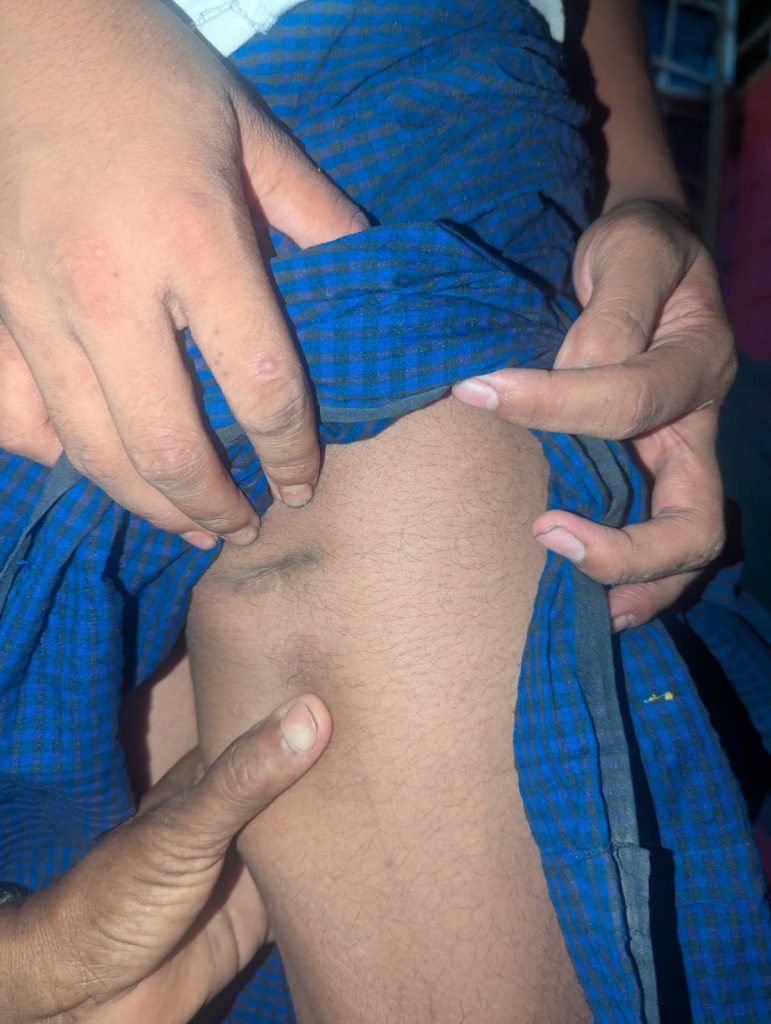
What if the land of your ancestors was transformed into a place of state-sanctioned exclusion, where your identity was systematically erased by the stroke of a legislative pen? For the Rohingya people, this is not a hypothetical scenario but a lived reality of displacement, disenfranchisement, and profound loss. It’s natural to feel overwhelmed by the weight of this humanitarian crisis or confused by the complex historical timelines that define it. You likely recognise that behind every statistic lies a human story, yet the specific challenges for Rohingya refugees in UK cities can often feel distant or difficult to navigate amongst global narratives.
This article promises to clarify the historical, legal, and humanitarian reasons behind this exodus, providing you with a definitive understanding of the 1982 Citizenship Law and the ongoing persecution in Rakhine and Arakan State. We will explore the current landscape of displacement, from the 1.2 million refugees in Cox’s Bazar to over 126,000 seeking safety in Malaysia, whilst detailing how you can support the journey toward justice. By the end of this guide, you will possess the knowledge to advocate for restoration, protection, and growth within your local community.
Key Takeaways
- Discover the deep ancestral roots of the Rohingya in Rakhine and Arakan State and how their identity has been systematically challenged by discriminatory legislation.
- Understand how the 1982 Citizenship Law engineered statelessness by creating a tiered system that intentionally excluded the Rohingya from their own homeland.
- Gain clarity on the scale of the global humanitarian crisis, including verified statistics on the 1.2 million refugees in Cox’s Bazar and the 126,000 in Malaysia.
- Learn about the journey from flight to belonging and the specific challenges for Rohingya refugees in UK cities as they pursue integration and cultural preservation.
- Identify practical ways to take action through advocacy, volunteering, and donations to support the community’s path toward justice and restoration.
The Roots of Displacement: Understanding Rakhine and Arakan State
The history of the Rohingya is inextricably linked to the coastal plains of Western Myanmar, a region known today as Rakhine State but historically referred to as Arakan State. For centuries, this indigenous Muslim ethnic minority has cultivated a rich, distinct culture rooted in the soil of their ancestors. Their presence isn’t a modern phenomenon; it’s a legacy of trade, faith, and community that predates contemporary borders. Understanding this deep-seated history is the essential foundation for any pursuit of justice, as it counters the state-sponsored narrative that labels them as “Bengali” or illegal interlopers.
Whilst the global community often focuses on the immediate humanitarian fallout, the long-term challenges for Rohingya refugees in UK communities often stem from this fundamental erasure of their history. When a person’s very existence is denied by their home state, the journey to belonging in a new country becomes significantly more complex. This exploration of their roots reveals why reclaiming the name of Arakan State is more than just a geographic correction; it’s an act of restoration for a people whose roots run deep.
To better understand the scale of the crisis and the international response, watch this helpful video:
A Legacy of Identity in Arakan State
The Rohingya didn’t simply appear in the region; they are the descendants of various groups who settled in Arakan State over a millennium. This historical continuity is vital. It challenges the institutionalised efforts to rewrite the history of the Rohingya genocide and replace it with a story of recent migration. Preserving this heritage is a form of resistance. It ensures that the dignity of the community remains intact, even when their physical homes have been destroyed. For those now living in the UK, maintaining these ancestral links is a crucial part of their healing process. It provides a sense of continuity and pride that can be easily lost in the struggle for integration.
The Denial of Ethnic Recognition
Systematic exclusion began long before the 2017 exodus. By categorising the Rohingya as “Bengali,” the Myanmar authorities effectively stripped them of their indigenous status, paving the way for institutionalised discrimination. This linguistic exclusion wasn’t accidental; it was a calculated tool of segregation. It restricted their movement, limited their access to education, and curtailed their right to marry. Despite these decades of pressure, the resilience of the Rohingya identity remains unshaken. They continue to assert their rights and their history, refusing to be silenced by the weight of state-sponsored narratives. This enduring strength is what fuels the community as they navigate the challenges for Rohingya refugees in UK cities like Bradford. Here, the focus shifts from mere survival to the restoration of a stolen legacy, ensuring that the next generation understands their true place in the history of Arakan State.
The 1982 Citizenship Law: Engineering Statelessness
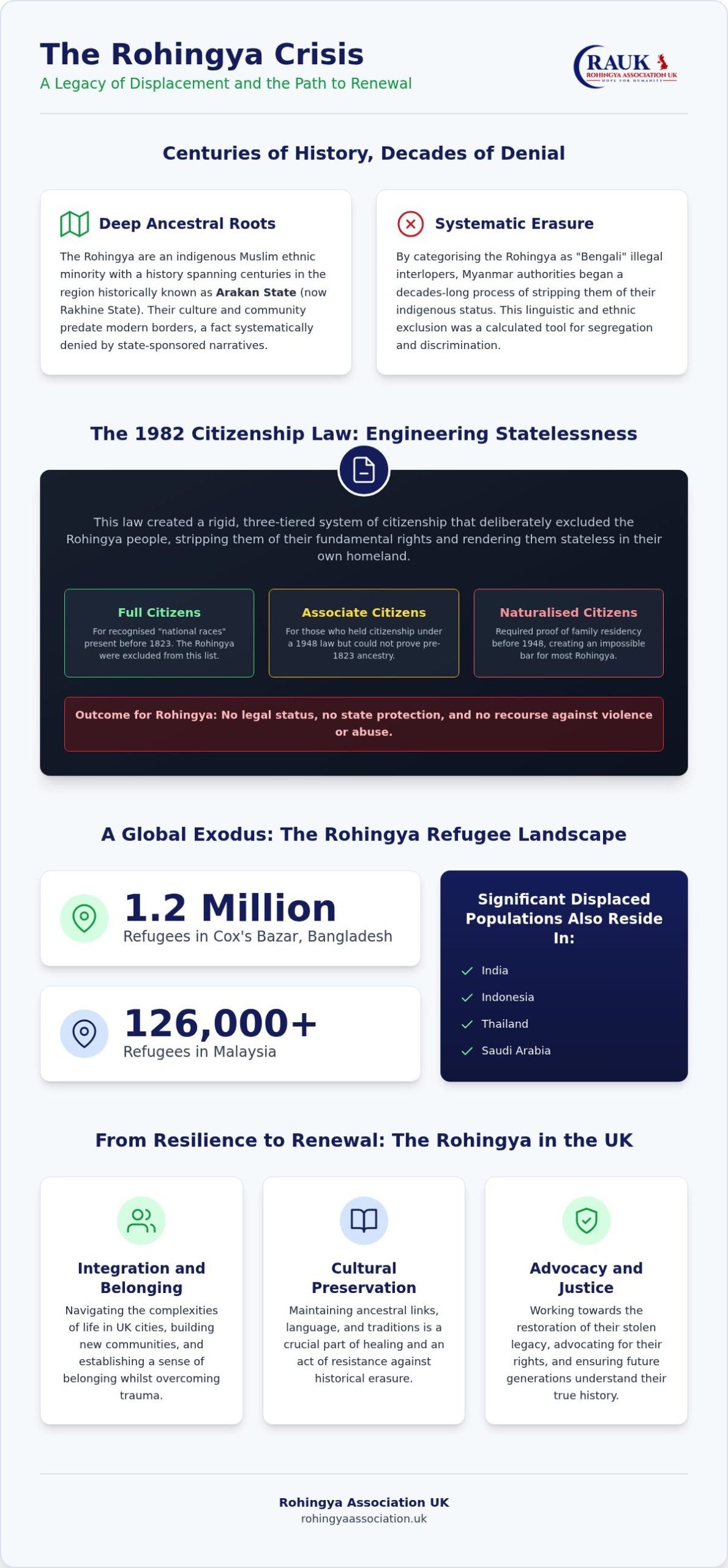
The 1982 Citizenship Law stands as the primary catalyst for the mass displacement of the Rohingya people. It wasn’t merely a piece of administrative legislation; it was a deliberate legal mechanism designed to engineer statelessness on a massive scale. By denying the community’s indigenous status in Arakan State (now Rakhine State), the law effectively stripped millions of their right to have rights. This legal exclusion creates a foundation for exploitation, as individuals without state protection possess no recourse against institutionalised abuse or violence. Understanding this legal history is vital for those addressing the challenges for Rohingya refugees in UK cities today, as many survivors still carry the weight of this bureaucratic erasure.
The Legal Mechanism of Exclusion
The law established a rigid, three-tiered system of citizenship that intentionally marginalised the Rohingya community. To qualify for full citizenship, an ethnic group had to be present in Myanmar before the start of British colonial rule in 1823. The authorities used this arbitrary date to exclude the Rohingya, despite their centuries-long presence in Rakhine (Arakan) State. The tiers included:
- Full Citizenship: Reserved for “indigenous” races.
- Associate Citizenship: For those who applied under the 1948 law.
- Naturalised Citizenship: Requires conclusive evidence of entry before 1948 and fluency in a national language.
This hierarchy didn’t just affect voting rights; it dictated every facet of existence. By the time the House of Commons briefing on the Rohingya crisis detailed the fallout of these policies, the damage was generational. Access to higher education was curtailed, professional employment became impossible, and basic healthcare was often withheld based on legal status.
Life Without a State: The Human Cost
Living as a stateless person within one’s own homeland is a reality defined by constant surveillance and restriction. In Arakan State, the Rohingya faced severe limitations on their freedom of movement, often requiring official permits to travel between villages. Perhaps most invasive were the regulations surrounding family life. The state imposed strict requirements for marriage permits and family planning, making the simple act of starting a family a punishable offence. The result was a community trapped in a cycle of isolation, vulnerability, and poverty. These historical traumas don’t disappear upon arrival in a new country; instead, they manifest as unique challenges for Rohingya refugees in UK integration processes. Recognising these legal scars is the first step toward providing meaningful community support and integration for those seeking a new beginning.
The 2017 Exodus and the Global Refugee Landscape
The year 2017 remains etched in the collective memory of the Rohingya as a period of profound devastation and systemic erasure. What the Myanmar military termed “clearance operations” in Arakan State was, in reality, a brutal campaign of violence that forced approximately 750,000 people to flee their ancestral homes in a matter of weeks. This wasn’t a singular event but the culmination of decades of state-sponsored exclusion. The global landscape of displacement is now vast and complex, with over 1.2 million refugees residing in Cox’s Bazar, Bangladesh. This mass movement has created a permanent humanitarian emergency that requires sustained international attention and a deep sense of moral seriousness.
Cox’s Bazar: Life in the World’s Largest Refugee Settlement
Conditions within the rohingya refugee camp are defined by a precarious balance between survival and incredible resilience. Families reside in cramped, temporary structures that offer little protection against the region’s fierce monsoons or the constant threat of fire. There is an urgent, daily requirement for consistent humanitarian aid and food support to prevent widespread malnutrition amongst the most vulnerable. Crisis intervention projects, ranging from emergency medical care to clean water initiatives, save lives every day. However, aid alone cannot replace the need for a political solution that addresses the root causes of their flight from Arakan State and the restoration of their fundamental rights.
Navigating Documentation in Malaysia
The diaspora’s struggle for safety extends across Southeast Asia and into the Middle East. In Malaysia, where over 126,000 Rohingya have sought refuge, the community faces a shifting and often confusing legal landscape. The Malaysian government is currently rolling out the DPP (Dokumen Pendaftaran Pelarian) system, moving away from a traditional reliance on UNHCR cards for identification. This transition has introduced a new layer of legal precariousness for many who fear that their protections may be diminished under the new framework. Global advocacy is vital to ensure that these documentation changes don’t lead to further exploitation or arbitrary detention. Similar vulnerabilities exist for populations trapped in Thailand, Indonesia, and India, or those living in legal limbo in Saudi Arabia.
For those who eventually find their way to British shores, these global traumas form the backdrop of their new lives. The challenges for Rohingya refugees in UK society are often invisible to the wider public, yet they are deeply felt. Integration is not just about finding housing; it’s about overcoming the psychological weight of multiple displacements and the ongoing fear for relatives left behind in the camps. By understanding the scale of the 2017 exodus, we can better appreciate the resilience required to build a new life amongst the unique challenges for Rohingya refugees in UK cities like Bradford.
From Resilience to Renewal: The Rohingya in the UK
The journey from the displacement camps of Southeast Asia to the streets of West Yorkshire represents a monumental shift from mere survival to the possibility of renewal. Whilst the history of the Rohingya is marked by profound trauma, their presence in the UK is increasingly defined by a narrative of agency and restoration. Bradford has emerged as a vital centre for community support and integration, offering a sanctuary where families can begin the arduous task of rebuilding their lives. This transition is not just about physical relocation; it’s about the gradual process of finding a place to belong after decades of state-sanctioned exclusion.
The Rohingya Association UK (RAUK) acts as a steadfast advocate and a guiding hand for those arriving on British shores. The organisation provides essential housing guidance and facilitates healthcare access, ensuring that the basic foundations of safety and well-being are secured. These are critical steps in addressing the practical challenges for Rohingya refugees in UK society, where navigating complex bureaucratic systems can often feel like an insurmountable barrier. Through these efforts, the community moves from a state of vulnerability to one of stability and growth.
Preserving Heritage in a New Home
Maintaining a connection to Arakan State is not just an act of memory; it’s a vital component of mental health and social cohesion. Cultural events organised by the community serve to strengthen bonds amongst displaced families, providing a space where heritage is celebrated rather than suppressed. Alongside these celebrations, English language classes offer a practical tool for empowerment. By mastering the local tongue, individuals gain the confidence to advocate for themselves and participate fully in civic life. You can find more context on these initiatives in our guide to community support for displaced families.
Empowering the Next Generation
The future of the community rests with its young people, who often navigate the dual identity of their heritage and their new British home. Focused refugee youth empowerment programmes provide the skills training and mentorship necessary to overcome systemic hurdles. Education acts as a powerful shield against inequality, offering a path toward professional stability and leadership. By fostering community leadership within the diaspora, we ensure that the Rohingya voice remains central to the fight for global justice. This resilient optimism is what transforms a history of flight into a future of belonging. To support these vital efforts, explore how you can contribute to our community support and integration programmes today.
How You Can Take Action Today
The systematic erasure of the Rohingya identity, from the legislative exclusion of the 1982 Citizenship Law to the brutal 2017 operations in Arakan State, places a profound moral weight upon the global community. Understanding this history is only the first step; the next is to participate in the restoration of dignity and safety for those who have lost everything. We invite you to transition from a witness of this crisis to a dedicated partner in the pursuit of justice. Your engagement provides the practical resources needed to address the persistent challenges for Rohingya refugees in UK cities whilst sustaining those still trapped in displacement camps abroad. This is a collective responsibility to provide protection, restoration, and a path toward renewal.
Direct Financial Support
One of the most effective ways to facilitate long-term change is through consistent financial contribution. We encourage you to donate your Sadaqah Jariyah to ensure your support has a lasting impact on the lives of displaced families. These contributions directly support our Bangladesh projects in Cox’s Bazar, where 1.2 million people remain dependent on external aid for their most basic needs. Whether it is providing food security, healthcare access, or educational resources, your donation is managed with the highest level of professional commitment. As a registered charity (number 1211433), Rohingya Association UK maintains strict transparency, ensuring that every pound is utilised to empower the community and fight the systemic inequality that has defined their history for decades.
Community Engagement and Advocacy
Action is not limited to financial support; it also requires the strength of human connection and the power of a collective voice. If you are based in West Yorkshire, we invite you to volunteer with Rohingya Association UK at our Bradford centre. By offering your time and skills, you help us provide the housing guidance and integration support that are so vital for overcoming the specific challenges for Rohingya refugees in UK society. Beyond local engagement, participation in our advocacy and awareness campaigns is essential for keeping the Rohingya narrative at the forefront of the global human rights agenda.
You can learn more about the broader impact of these efforts by exploring the current landscape of justice for Rohingya people and how international accountability is evolving. By standing with us, you aren’t just providing aid; you are fighting for systemic change and the recognition of a people whose resilience has outlasted their persecution. Renewal is not just a hope for the future. It’s a reality we build together through dedicated action today.
A Path Toward Restoration and Justice
The systematic marginalisation of the Rohingya, rooted in the denial of their ancestral ties to Arakan State and the legal erasure of the 1982 Citizenship Law, remains a grave humanitarian concern. Whilst the 2017 exodus forced hundreds of thousands into the camps of Cox’s Bazar, the journey toward justice continues through the resilience of the diaspora. Navigating the specific challenges for Rohingya refugees in UK society requires more than just temporary aid; it’s a process that demands a long-term commitment to community-led integration and cultural preservation.
Based in the heart of Bradford, the Rohingya Association UK (Registered Charity number: 1211433) provides essential housing and education support to facilitate true belonging. By partnering with us, you join a mission that serves over 1.2 million refugees globally whilst empowering local families to rebuild with dignity. We invite you to support our mission and donate your Sadaqah Jariyah today. Your contribution ensures that the strength of the Rohingya people is met with the protection and growth they deserve. Together, we can turn a legacy of displacement into a future of hope.
Frequently Asked Questions
Who are the Rohingya and why are they considered stateless?
The Rohingya are an indigenous Muslim ethnic minority with deep ancestral roots in Arakan State, now known as Rakhine State. They are considered stateless because the Myanmar government’s 1982 Citizenship Law effectively stripped them of their nationality. This legislation created a tiered system that intentionally excluded them, denying their right to study, work, or travel freely. Consequently, they possess no legal protection from any state, leaving them vulnerable to institutionalised abuse and exploitation.
What happened in Rakhine State (Arakan State) in August 2017?
In August 2017, the Myanmar military launched what they termed “clearance operations” across Rakhine State, which is historically Arakan State. These operations involved widespread violence, arson, and systemic human rights abuses against the Rohingya community. This brutal campaign forced approximately 750,000 people to flee their homes in a matter of weeks, seeking safety across the border. It remains a defining moment of devastation that triggered the world’s largest and most rapid refugee exodus in recent history.
How many Rohingya refugees are currently living in Bangladesh?
There are currently 1.2 million Rohingya refugees residing in the Cox’s Bazar region of Bangladesh. This area hosts the world’s largest refugee settlement, where families live in temporary shelters and rely entirely on international humanitarian aid. Life in these camps is defined by a constant struggle for food, clean water, and basic healthcare. Addressing these needs requires sustained crisis intervention, professional commitment, and global advocacy to ensure the protection and well-being of the displaced population.
What is the DPP system for Rohingya refugees in Malaysia?
The DPP (Dokumen Pendaftaran Pelarian) is a government-led registration system recently introduced in Malaysia to track and identify the over 126,000 Rohingya refugees residing there. It represents a transition away from the community’s traditional reliance on UNHCR cards for documentation. Whilst intended to provide better oversight, the rollout has created a sense of legal precariousness for many. Refugees fear that this shift might limit their access to essential services or increase their vulnerability to arbitrary detention.
Why does the Myanmar government refer to the Rohingya as “Bengalis”?
The Myanmar government uses the term “Bengali” as a deliberate tool of exclusion to label the Rohingya as illegal immigrants from Bangladesh. This terminology ignores their centuries-long presence in Arakan State and serves to justify their disenfranchisement under the 1982 Citizenship Law. By framing them as foreign interlopers, the state attempts to erase their indigenous identity and legitimate their lack of rights. This narrative is a fundamental barrier to their restoration, protection, and eventual return to their homeland.
How does the Rohingya Association UK support families in Bradford?
Based in Bradford, the Rohingya Association UK acts as a community-led bridge for those rebuilding their lives. We provide essential housing guidance, facilitate healthcare access, and offer English language classes to empower individuals. Our work directly addresses the unique challenges for Rohingya refugees in UK cities, where navigating complex systems can be overwhelming. By offering a combination of practical aid and cultural preservation, we help families move from a state of survival toward a future of belonging and growth.
Can I donate Zakat or Sadaqah Jariyah to support Rohingya refugees?
Yes, you can donate Zakat or Sadaqah Jariyah to support our ongoing humanitarian projects. As a registered charity (number 1211433), we ensure that your contributions are utilised with professional transparency and moral seriousness. These funds support our crisis intervention efforts in Cox’s Bazar and our integration programmes in the UK. Your generosity facilitates the restoration of hope, the protection of vulnerable families, and the long-term empowerment of a community that has endured decades of systemic persecution.
What are the main barriers to Rohingya refugees returning home?
The primary barriers to return include the lack of guaranteed citizenship, ongoing violence in Rakhine State, and the total destruction of ancestral villages. Without the repeal of discriminatory laws, refugees face the risk of further persecution upon their return. These unresolved issues contribute to the long-term challenges for Rohingya refugees in UK communities, as many remain in legal limbo whilst their homeland remains unsafe. True repatriation requires international accountability, the restoration of land rights, and the formal recognition of their ethnic identity.