
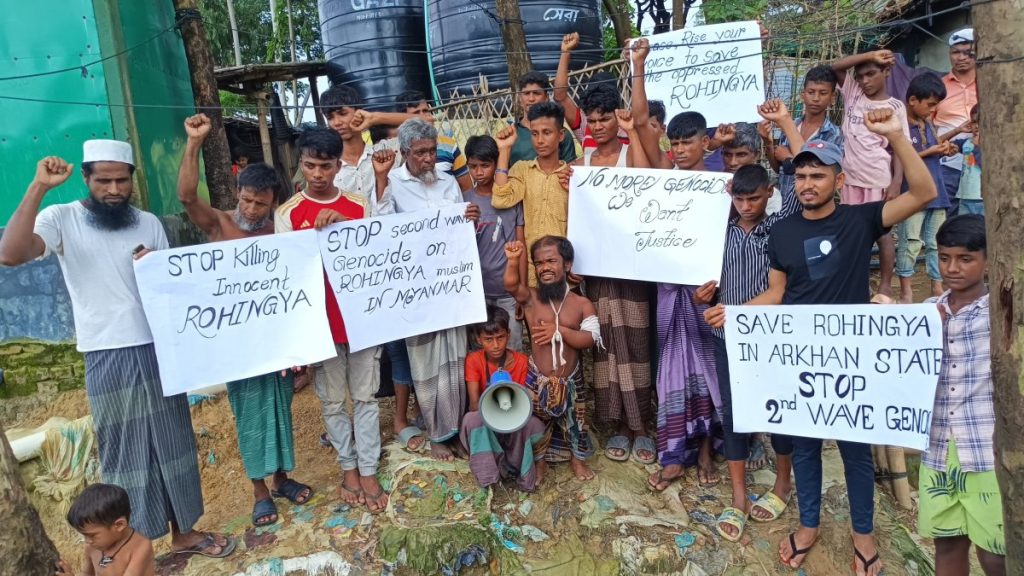
This article provides a detailed analysis of the legal and historical basis for Rohingya self-determination, the mechanisms of state-enforced statelessness, and the non-derogable right to return with full citizenship. It deconstructs the false “Bengali” narrative and outlines the path toward justice and recognition.
Table of Contents
- Defining Indigenous Identity and the Universal Right to Self-Determination
- The 1982 Citizenship Law: Engineering State-Enforced Statelessness
- Deconstructing the ‘Bengali’ Narrative: Historical Truths of Arakan
- State-Enforced Statelessness and the Non-Derogable Right to Return
- How You Can Take Action Today
Defining Indigenous Identity and the Universal Right to Self-Determination
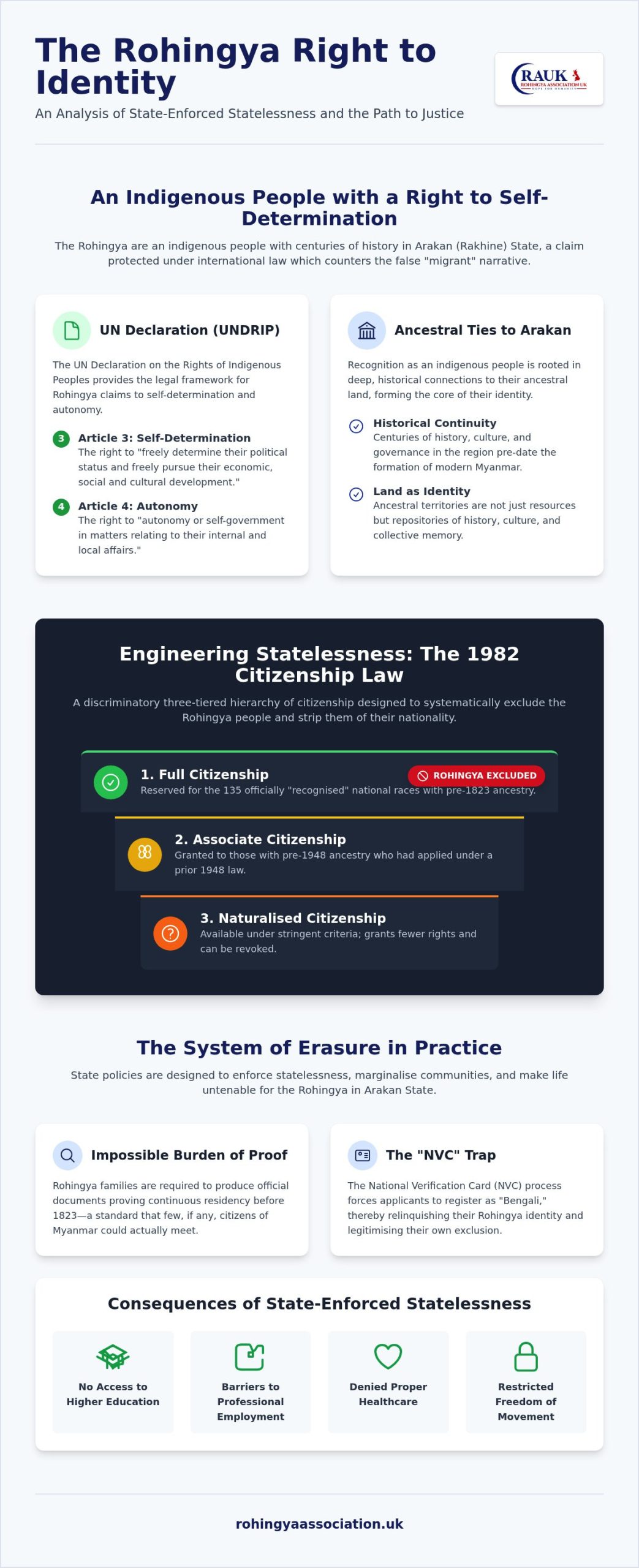
The core of the Rohingya struggle is a demand for the recognition of a fundamental truth: their identity as an indigenous people with ancestral ties to Arakan State (Rakhine State). The term “Indigenous Peoples” is not merely descriptive; it is a legal and political status grounded in international law, defined by historical continuity with pre-colonial societies and a distinct collective identity. For the Rohingya, this identity is rooted in centuries of history, culture, and governance in the Arakan region, long before the formation of modern Myanmar.
The United Nations Declaration on the Rights of Indigenous Peoples (UNDRIP) provides a crucial framework for this claim. Article 3 of the Declaration states unequivocally that “Indigenous peoples have the right to self-determination,” which includes the right to “freely determine their political status and freely pursue their economic, social and cultural development.” Article 4 further reinforces this by establishing the right to autonomy or self-government in matters relating to their internal and local affairs. This right is not a call for secession but a demand for meaningful participation and control over their own destiny within the state.
In the diaspora, from the refugee camps of Bangladesh to community centres in Bradford, this self-determination manifests as a resilient effort to preserve traditional governance structures, cultural practices, and a collective memory. These community-led initiatives are vital acts of resistance against a systematic campaign of erasure.
The Legal Dimensions of Self-Determination
For the Rohingya, self-determination encompasses two interconnected dimensions: internal autonomy and meaningful political participation. Internal autonomy refers to the right to manage local affairs, maintain cultural institutions, and practise customary laws without external imposition. This is intrinsically linked to their claim over ancestral territories in Arakan State (Rakhine State), which forms the geographical and spiritual heartland of their identity.
The concept of “ancestral territories” is a cornerstone of indigenous rights, recognising that the land is not just a resource but a repository of history, culture, and identity. Despite forced displacement and the confiscation of property, the Rohingya community maintains its intricate social structures. Elders, religious leaders, and community organisers continue to provide leadership, resolve disputes, and sustain the social fabric, demonstrating a form of self-governance that persists even in exile.
Indigenous Rights as a Framework for Justice
Recognising the Rohingya as an indigenous people is the most powerful counter-argument to the state-sponsored narrative that labels them as “illegal Bengali migrants.” This false narrative has been the primary justification for decades of persecution, culminating in acts of genocide. By asserting their indigenous status, the Rohingya reclaim their history and expose the political motivations behind their persecution.
Community-led organisations like Rohingya Association UK (RAUK) are at the forefront of this effort, working to preserve and promote Rohingya heritage while advocating for legal recognition on the global stage. Achieving self-determination is not only a matter of justice for the Rohingya; it is an essential component for building a sustainable and inclusive peace in Myanmar. True peace cannot be achieved by erasing a people but only by acknowledging their rights, history, and legitimate place within the nation.
The 1982 Citizenship Law: Engineering State-Enforced Statelessness
The 1982 Burma Citizenship Law is the primary legal instrument used to institutionalise the persecution of the Rohingya people. It is not a neutral piece of legislation but a meticulously designed tool of exclusion that transformed a domestic population into a stateless one. The law created a discriminatory three-tiered hierarchy of citizenship, none of which were made accessible to the Rohingya.
- Full Citizenship: Reserved for members of the 135 officially “recognised” national races, whose ancestors were deemed to have resided in Myanmar before the first Anglo-Burmese War in 1823. The Rohingya were deliberately omitted from this list.
- Associate Citizenship: Granted to those who could not prove pre-1823 ancestry but whose families were present before independence in 1948 and who had applied for citizenship under a previous 1948 law.
- Naturalised Citizenship: Available to individuals who could prove their families lived in Myanmar before 1948 and who meet other stringent criteria, but this status grants fewer rights and can be revoked.
By excluding the Rohingya from the list of 135 recognised ethnic groups, the law effectively stripped them of their nationality overnight. This act of systemic erasure was compounded by the confiscation of existing identity documents, leaving generations without legal proof of their existence and severing their connection to the state.
Mechanisms of Exclusion and Erasure
The 1982 Law places an impossible burden of proof on Rohingya families, requiring them to produce documents proving continuous residency before 1823—a standard that few, if any, citizens of Myanmar could meet. This legal fiction was further weaponised through the “National Verification Card” (NVC) process. Far from being a pathway to citizenship, the NVC is a tool of marginalisation that requires recipients to identify as “Bengali,” thereby forcing them to accept the very narrative used to justify their persecution.
Accepting an NVC means relinquishing one’s Rohingya identity and tacitly admitting to being a foreigner. This state-enforced statelessness has had devastating consequences within Arakan State (Rakhine State), systematically denying the Rohingya access to higher education, professional employment, healthcare, and freedom of movement. It is a form of apartheid designed to make life so untenable that the only option is to flee.
The Global Impact of Statelessness
The consequences of this systemic erasure extend far beyond Myanmar’s borders. Today, over 126,000 Rohingya refugees reside in Malaysia, where they face a precarious existence. The Malaysian government is transitioning away from UNHCR documentation to its own Dokumen Pendaftaran Pelarian (DPP) system, creating uncertainty for a community with no legal status. For more information on this situation, you can read our 2026 update on the Rohingya in Malaysia.
Elsewhere, Rohingya are trapped in a state of legal limbo. Thousands in Saudi Arabia hold expired or invalid documents, unable to work legally or return to a country that denies their existence. These scattered and vulnerable populations are a direct result of a state policy designed to erase a people. This campaign of erasure is a central focus of the broader struggle for justice for Rohingya people, which demands accountability not just for physical violence but for the legal architecture of genocide.
Deconstructing the ‘Bengali’ Narrative: Historical Truths of Arakan
The narrative that labels the Rohingya as “Bengali” illegal immigrants is a modern political fabrication designed to justify ethnic cleansing and land confiscation. Historical evidence overwhelmingly contradicts this claim, demonstrating a continuous Muslim presence in the region for centuries. The Kingdom of Mrauk U, which flourished in Arakan from the 15th to the 18th century, was a multicultural and multi-religious society where Muslims held prominent positions in the royal court and administration.
Evidence of a distinct Rohingya identity and presence in Arakan State (Rakhine State) exists long before the British colonial era shifted borders and migration patterns. The term “Rohingya” itself appears in historical documents from the late 18th century, used by the people to describe themselves. The linguistic and cultural traits of the Rohingya are also distinct from those of neighbouring populations in Bengal, with their own unique language, customs, and traditions developed over centuries of life in Arakan.
The “Bengali” label was weaponised by ultranationalist factions in post-independence Myanmar to portray the Rohingya as a foreign threat. This propaganda served a dual purpose: it stirred ethno-nationalist sentiment and provided a pretext for seizing Rohingya land and resources, ultimately culminating in cycles of violent persecution.
The Pre-Colonial History of Arakan State
The history of Arakan State (Rakhine State) is one of rich diversity, not ethnic purity. For centuries, it was a crossroads of cultures, influenced by trade and interaction with Bengal, the Middle East, and Southeast Asia. Historical records, including census data from the British colonial period, list the Rohingya as a distinct ethnic group native to the region. The “Bengali” narrative was deliberately manufactured after Myanmar’s independence in 1948, gaining political traction as a tool for marginalising the Rohingya and consolidating power along ethnic lines. This false history ignores centuries of peaceful coexistence and shared heritage in favour of a divisive and violent fiction.
Challenging Propaganda with Factual Integrity
Countering the “illegal immigrant” myth requires a commitment to verifiable historical and migration data. The Rohingya did not arrive en masse during the British colonial period; they are an indigenous people whose ancestral lands were divided by colonial borders. The 1982 Citizenship Law was the critical step in transforming this political propaganda into a legal reality, cementing a false narrative into the very fabric of the state.
The Rohingya identity is not a modern invention but a historical reality. For a deeper understanding of the community’s history and resilience, you can explore our comprehensive guide on The Rohingya People. Correcting these false narratives is not just an academic exercise; it is a vital part of the struggle for justice, recognition, and the right to return home.
State-Enforced Statelessness and the Non-Derogable Right to Return
Under international human rights law, the right of a person to return to their own country is considered a non-derogable right. This means it is an absolute right that cannot be suspended, even in times of national emergency. This principle, enshrined in instruments like the Universal Declaration of Human Rights, is fundamental to the plight of the approximately 1.2 million Rohingya refugees currently living in sprawling camps in Cox’s Bazar, Bangladesh, as well as hundreds of thousands more in Malaysia, India, Thailand, and Indonesia.
For the Rohingya, this right to return is inextricably linked to the restoration of their full citizenship. Any repatriation framework that does not address the root cause of their displacement—the 1982 Citizenship Law—is doomed to fail. A return to Myanmar without legal status would mean a return to the same system of apartheid and persecution that they fled. Therefore, the international community has a legal and moral obligation to ensure that Myanmar repeals the discriminatory 1982 law as a prerequisite for any safe and dignified return.
Repatriation with Dignity and Safety
The standard for any refugee return is that it must be voluntary, safe, and dignified. For the Rohingya, these conditions are currently impossible to meet.
- Voluntary: Return cannot be voluntary if the only alternative is indefinite confinement in overcrowded refugee camps with diminishing aid and opportunities.
- Safe: Safety requires not only the absence of immediate violence but also legal protection from future persecution, which is impossible without citizenship.
- Dignified: A dignified return means returning to one’s home, not to newly constructed camps or segregated villages, with full rights to property, movement, and political participation.
The United Nations and the international community must leverage all diplomatic and legal tools to negotiate these terms, insisting that the abolition of the 1982 law is non-negotiable. The dire conditions in the camps, where a generation is growing up without formal education or hope for the future, make the enforcement of this right an urgent necessity.
The Path to Full Citizenship
The journey from state-enforced statelessness to full legal recognition requires a series of concrete steps. First and foremost is the complete repeal of the 1982 Citizenship Law and its replacement with legislation that grants citizenship based on birth in Myanmar (jus soli), in line with international standards. This must be accompanied by the restoration of land rights and property ownership for all displaced Rohingya families in Arakan State (Rakhine State).
Furthermore, full citizenship includes the right to political representation, cultural expression, and equal access to state services. Rohingya Association UK advocates for these systemic changes on a global stage, working to ensure that any discussion about repatriation is centred on justice, rights, and the restoration of indigenous identity. The ultimate goal is not merely to return but to rebuild a future where the Rohingya are recognised and protected as equal citizens in their ancestral homeland.
How You Can Take Action Today
The struggle for Rohingya justice is a global one, and the diaspora community in the UK plays a pivotal role in driving advocacy and support. From community bonding events in Bradford to high-level diplomatic engagement, every action contributes to the restoration of rights and dignity for a people facing systematic erasure. Your support can provide both immediate relief to those in crisis and contribute to the long-term fight for systemic change.
There are clear and impactful pathways for you to contribute to these humanitarian and legal justice efforts. Whether through financial support, volunteering your time, or raising your voice, you can stand in solidarity with those still trapped in state-enforced statelessness and help build a future of hope and resilience.
Support Through Direct Action
Your contribution can provide essential aid and help build sustainable solutions for displaced communities. Consider taking one of these vital steps today:
- Build long-term change: When you donate your Sadaqah Jariyah, you invest in sustainable projects like education and skills development that empower future generations.
- Provide immediate relief: You can directly support our Bangladesh projects, which deliver food, shelter, and medical care to the 1.2 million refugees in Cox’s Bazar.
- Assist with local integration: If you are in the UK, you can volunteer with Rohingya Association UK to help newly arrived families in Bradford access housing, education, and community support.
Advocacy and Awareness
Countering misinformation and advocating for policy change are crucial components of the fight for justice. You can become an effective advocate by:
- Sharing verified facts: Educate your network about the 1982 Citizenship Law and the historical reality of the Rohingya in Arakan to combat false narratives.
- Contacting local representatives: Urge your elected officials to support international pressure on Myanmar to repeal the 1982 law and guarantee a safe, dignified, and voluntary right to return.
- Supporting community-led advocacy: Follow and amplify the work of RAUK as we continue our unwavering commitment to restoring indigenous identity, securing full citizenship, and achieving justice for the Rohingya people.