
This article offers an authoritative analysis of the Rohingya crisis in Malaysia, examining the legal shift to the DPP system, the impact of family arrests, and the urgent need for community-based education to secure a future for the next generation.
Table of Contents
- The Rohingya Journey in Malaysia: From Arakan State to the Search for Safety
- The Current Humanitarian Landscape: Recent Arrests and Family Detentions
- The Fundamental Right to Education: Community-Based Learning Centres
- Urging a Comprehensive Global Response: Beyond Temporary Aid
- How You Can Take Action Today: Supporting the Rohingya Diaspora
- Frequently Asked Questions
The Rohingya Journey in Malaysia: From Arakan State to the Search for Safety
The story of the Rohingya in Malaysia is one of profound resilience in the face of protracted statelessness. For decades, they have fled systematic persecution, violence, and ethnic cleansing in their ancestral homeland of Arakan State (formerly Rakhine State) in Myanmar. Seeking refuge from a state that denies them citizenship and basic human rights, many have undertaken perilous journeys by land and sea, with Malaysia emerging as a significant destination within Southeast Asia. It hosts one of the largest Rohingya diaspora communities, a testament to the enduring search for safety and stability.
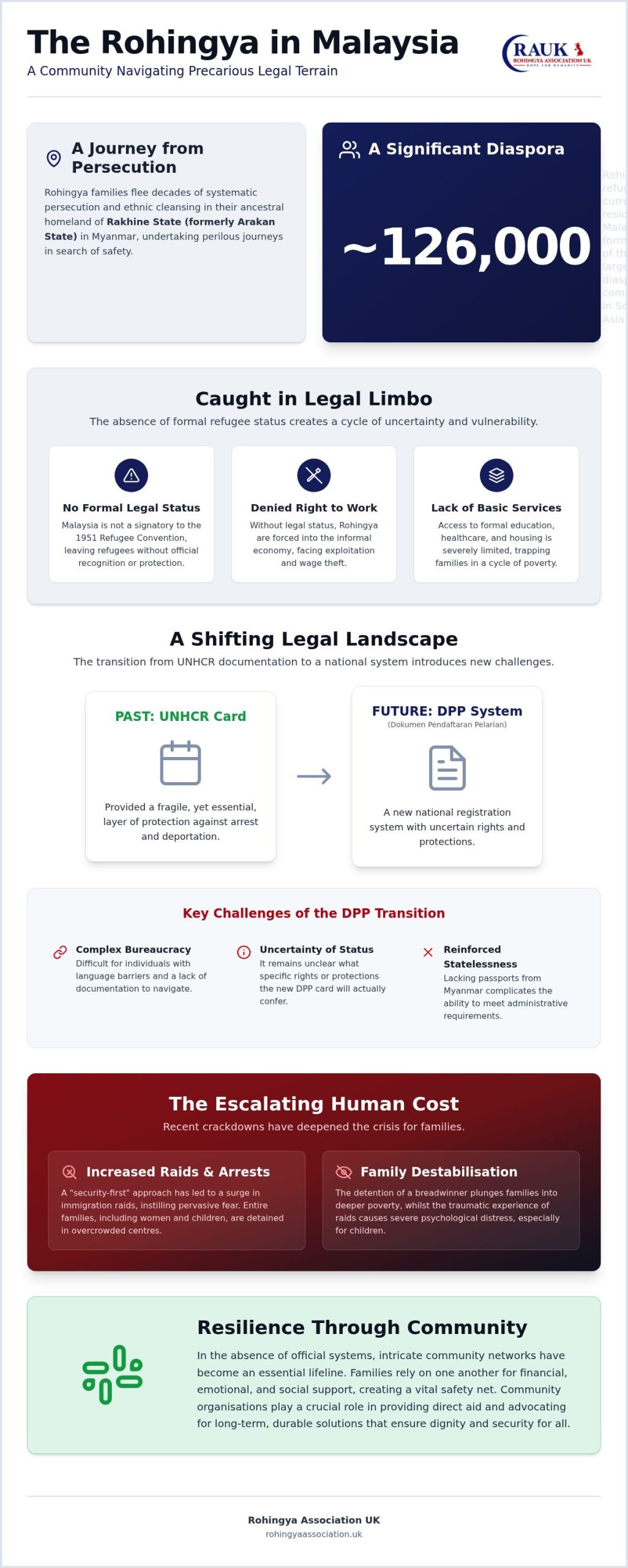
Currently, approximately 126,000 Rohingya refugees reside in Malaysia. Despite the country not being a signatory to the 1951 Refugee Convention, it has historically offered a degree of informal tolerance. However, this has not translated into formal legal status, leaving the community in a precarious state of limbo. They are a people caught between a past they cannot return to and a future they are not permitted to build. Yet, within this uncertainty, the Rohingya have established intricate community networks, demonstrating an unwavering commitment to preserving their heritage and supporting one another in the absence of official state protection.
The Legal Shift: From UNHCR to the DPP System
For many years, the primary form of identification for Rohingya refugees in Malaysia was a card issued by the United Nations High Commissioner for Refugees (UNHCR). This document offered a fragile layer of protection, often serving as the only defence against arrest or deportation. However, the legal landscape is currently undergoing a significant transformation with the Malaysian government’s phased introduction of its own registration system, the Dokumen Pendaftaran Pelarian (DPP).
This transition represents a pivotal moment, shifting the administrative responsibility for refugee registration from an international body to a national one. Whilst the stated aim may be to create a more organised system, the process is fraught with challenges for already vulnerable families:
- Navigating Bureaucracy: The new registration process can be complex and inaccessible for individuals who may lack documentation, face language barriers, or fear interaction with authorities.
- Uncertainty of Status: It remains unclear what specific rights or protections the DPP will confer, leaving many to question whether it will offer a meaningful improvement over the UNHCR card.
- Implications of Statelessness: As a stateless people, the Rohingya lack passports or national identity documents from Myanmar, complicating their ability to meet the administrative requirements of any new system and reinforcing their legal invisibility.
Life in Limbo: The Reality of Temporary Protection
The absence of formal refugee status in Malaysia has profound consequences for the daily lives of the Rohingya. Denied the legal right to work, many are forced into the informal economy, where they are vulnerable to exploitation, unsafe working conditions, and wage theft. This economic precarity makes it incredibly difficult for families to afford basic necessities such as housing, healthcare, and food, trapping them in a cycle of poverty.
In this environment, community networks become an essential lifeline. Families rely on one another for financial support, childcare, and emotional solidarity, creating a vital safety net where official systems are absent. Organisations like Rohingya Association UK (RAUK) play a crucial role in this ecosystem, not only by providing direct support where possible but also by conducting sustained advocacy for durable solutions. The goal is to move beyond temporary, insecure protection and towards a future where Rohingya refugees can live with dignity, security, and the right to contribute formally to the society that hosts them.
The Current Humanitarian Landscape: Recent Arrests and Family Detentions
In recent times, the already precarious existence of Rohingya families in Malaysia has been further destabilised by a surge in immigration raids and arrests. This “security-first” approach, often prioritising enforcement over humanitarian protection, has instilled a pervasive sense of fear within the community. Raids on homes and workplaces have led to the detention of entire families, including women and children, who are then held in overcrowded immigration detention centres.
The vulnerability of these families was starkly illustrated by a recent, highly publicised incident where a family, having just been expelled from their rented home, sought protection and support at a UNHCR office. Instead of receiving the shelter they desperately needed, they were arrested by government authorities. This event sent a chilling message throughout the community, signalling that even places of supposed sanctuary offer no guaranteed safety. These actions are enabled by legal gaps that leave refugees exposed to the constant threat of sudden deportation or indefinite detention, perpetuating a cycle of trauma and instability.
The Impact of Detention on Family Unity
The arrest and detention of a family member, particularly a primary breadwinner, has a devastating ripple effect that destabilises the entire community structure. The sudden loss of income plunges families deeper into poverty, making it impossible to pay for rent or food. The psychological toll is immense, especially on children, for whom the experience of a raid and the subsequent separation from a parent can be deeply traumatic. This re-traumatisation compounds the suffering they have already endured in their flight from Myanmar.
Children caught in the detention system are uniquely vulnerable. Deprived of education, adequate nutrition, and a stable environment, their development is severely impacted. The dignified, human-centred approach required by international law is often absent, with families treated as security threats rather than as people seeking protection. The trauma of displacement is thus repeated, not by a hostile regime in their homeland, but through the enforcement policies of a country they had hoped would be a safe haven.
Advocating for the Right to Liberty
The arbitrary detention of refugees and asylum seekers is prohibited under international human rights law. Every individual has a right to liberty and security of person. In response to the current crackdown, it is imperative to advocate for a change in policy. Human rights organisations, including RAUK, call on the Malaysian authorities to prioritise humanitarian alternatives to detention, such as community-based reporting or supervised release, especially for families with children.
Furthermore, ensuring access to legal aid is critical. Detained individuals must have the ability to challenge the legality of their detention and understand their rights. Transparency within the DPP registration process is equally vital; a clear and accessible system would reduce the number of undocumented individuals and, in turn, their vulnerability to arrest. The ultimate goal is a system that manages migration with compassion and in full compliance with its international human rights obligations.
The Fundamental Right to Education: Community-Based Learning Centres
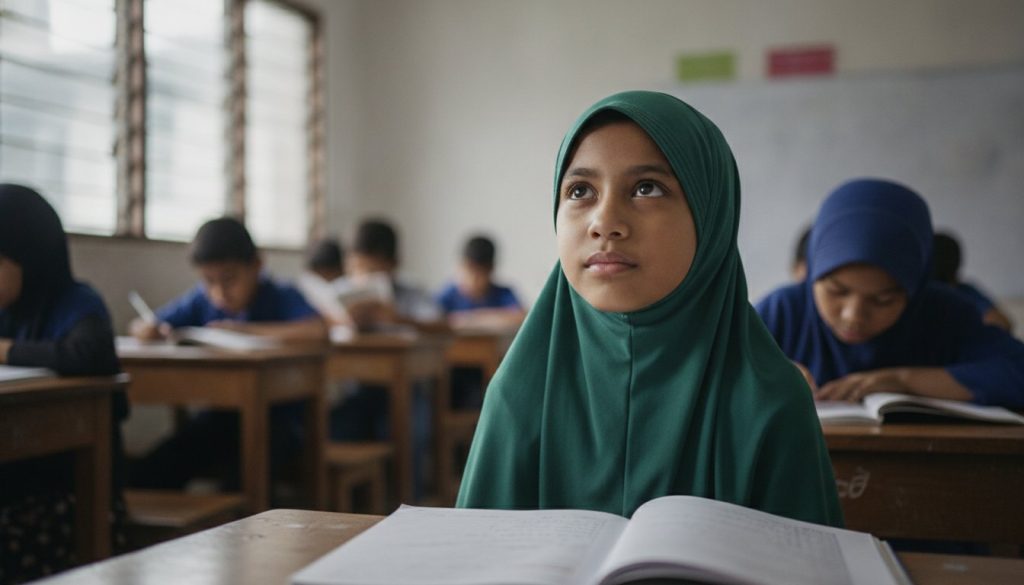
Education is not a privilege; it is a fundamental, non-negotiable human right for every child, including those of the Rohingya. However, in Malaysia, this right remains largely inaccessible. Because they lack official documentation and legal status, Rohingya children are barred from attending formal government schools. This systemic exclusion threatens to create a “lost generation”—an entire cohort of young people denied the opportunity to build a future, develop their potential, and break the cycle of poverty.
In the face of this systemic barrier, the Rohingya community has demonstrated extraordinary resilience by creating its own solution: the Community-Based Learning Centre (CLC). These centres, often operating in simple, rented spaces with minimal resources, are a vital lifeline. They are organised and run by Rohingya teachers and community leaders who are determined to provide their children with an education. In these classrooms, children not only learn core subjects like mathematics, science, and English but also preserve their unique cultural identity, language, and heritage, fostering a sense of belonging that is crucial for their well-being.
Overcoming Barriers to Learning
Despite their importance, CLCs face immense challenges. They operate on shoestring budgets, relying on small community contributions and support from non-governmental organisations. Teachers are often volunteers or receive a minimal stipend. A significant hurdle is the lack of formal certification; because the CLCs are not recognised by the government, the education a child receives there does not lead to official qualifications that can be used for higher education or formal employment.
Nonetheless, the determination of Rohingya teachers and students is remarkable. They organise classes in informal settings, adapting curricula to meet the specific needs of a displaced community. A key focus is the acquisition of the English language, which is rightly seen as a gateway to future opportunities and a tool for self-advocacy on a global stage. These centres are more than just schools; they are beacons of hope and symbols of the community’s refusal to surrender its children’s future.
The RAUK Vision for Educational Empowerment
The challenges faced by Rohingya children in Malaysia mirror the struggles of displaced youth globally. Rohingya Association UK believes that empowering the next generation is the most critical long-term investment in the community’s future. Our work in the UK, particularly through our refugee youth empowerment programmes, provides a model for how targeted educational support can help young people overcome trauma and build brighter futures.
Supporting CLCs in Malaysia today is a direct intervention to prevent a lost generation. The needs are clear and urgent: funding for teacher stipends, learning materials, rent for classroom spaces, and the development of curricula that include not only basic literacy but also essential digital skills. By investing in education, we are investing in the future leaders, advocates, and storytellers of the Rohingya people, equipping them with the tools they need to navigate a complex world and advocate for their own rights.
Urging a Comprehensive Global Response: Beyond Temporary Aid
The situation for the 126,000 Rohingya in Malaysia cannot be viewed in isolation. It is a direct consequence of the larger, unresolved crisis that has left approximately 1.2 million refugees living in sprawling camps in Cox’s Bazar, Bangladesh, and a persecuted minority remaining in Myanmar. The challenges in Malaysia are a symptom of a catastrophic failure of the international community to hold the Myanmar regime accountable and address the root causes of the crisis.
Temporary humanitarian aid, while essential for survival, is insufficient. It is a stopgap measure that does not address the underlying political and legal problems. What is urgently needed is a strategic, long-term, and unified global response. The international community must move beyond statements of condemnation and provide concrete, durable solutions, including pathways for safe and legal resettlement. Addressing the root causes requires a sustained push for justice for Rohingya people, ensuring that the perpetrators of genocide are held accountable and that conditions are created in Myanmar for a safe, dignified, and voluntary return.
A Call to the Bali Process and ASEAN
Regional bodies, particularly the Association of Southeast Asian Nations (ASEAN) and members of the Bali Process, bear a special responsibility to protect vulnerable populations within their borders. They must work collaboratively to develop a humane and coordinated response to maritime arrivals and the presence of refugees. This includes abandoning policies of pushbacks at sea and establishing clear, predictable disembarkation and reception procedures.
Key policy changes are needed to stabilise the situation for refugees already in the region. Granting the legal right to work would allow refugees to support themselves, contribute to the local economy, and live in dignity whilst they await a long-term solution. A unified regional registration system, harmonised across countries like Malaysia, Thailand, and Indonesia, would provide greater protection and prevent refugees from falling through administrative cracks.
Global Responsibility and Accountability
The burden of hosting large refugee populations cannot fall solely on neighbouring countries. Western nations have a critical role to play in sharing this responsibility. This must include a significant increase in financial support for host countries like Malaysia and Bangladesh to fund essential services, particularly education and healthcare in places like the rohingya refugee camps. Furthermore, these nations must expand their own resettlement programmes, offering a tangible lifeline to the most vulnerable refugees.
Ultimately, the Rohingya crisis is a test of the world’s commitment to the principle of “Never Again.” The failure to act decisively in the face of genocide has created a protracted humanitarian disaster with regional and global consequences. A comprehensive response requires a multi-pronged approach: sustained humanitarian aid, diplomatic pressure on Myanmar, robust accountability mechanisms, and a shared commitment to providing safe haven for those who have fled.
How You Can Take Action Today: Supporting the Rohingya Diaspora
Reading this guide is an important first step, but moving from awareness to action is what creates meaningful change. The challenges facing the Rohingya community can feel overwhelming, but collective action, composed of individual contributions, builds a powerful movement for justice and dignity. We invite you to join the mission of Rohingya Association UK to restore hope and empower displaced families.
Direct Financial Support and Sadaqah
Your financial contribution can provide the resources needed for long-term, sustainable projects. When you donate your Sadaqah Jariyah, you are investing in programmes that have an enduring impact, such as funding the community-led learning centres that are vital for the next generation. These funds directly support our Bangladesh projects and our regional advocacy efforts for those in Malaysia. As a community-led charity (Registered Charity number: 1211433), RAUK ensures that all funds are managed with transparency and directed to where the need is greatest.
Volunteerism and Local Advocacy
If you are based in the United Kingdom, your time and skills can make a significant difference. We invite you to volunteer with Rohingya Association UK and assist with our local integration efforts in Bradford, from language support to community events. You can also become an advocate by writing to your local Member of Parliament, raising awareness of the situation in Malaysia and urging the UK government to take a stronger diplomatic stance. Finally, sharing this guide and other verified information is a simple yet powerful way to combat misinformation and build a wider community support for displaced families.
Frequently Asked Questions
How many Rohingya refugees are currently living in Malaysia?
Approximately 126,000 Rohingya refugees are currently registered and residing in Malaysia, making it one of the largest host countries for the Rohingya diaspora in the world.
What is the Malaysian DPP system and how does it affect refugees?
The DPP (Dokumen Pendaftaran Pelarian) is a new registration document being introduced by the Malaysian government to replace the cards previously issued by the UNHCR. The transition creates uncertainty for refugees, as the specific rights and protections associated with the DPP are not yet fully clear.
Why are Rohingya families being arrested in Malaysia recently?
There has been a recent increase in immigration raids and enforcement actions targeting undocumented individuals. As Malaysia is not a signatory to the 1951 Refugee Convention, refugees lack formal legal status and are vulnerable to arrest, detention, and deportation, even if registered with the UNHCR or DPP.
Do Rohingya children have the right to attend government schools in Malaysia?
No, Rohingya children are barred from attending formal government schools in Malaysia because they lack the required legal documentation. Their only access to education is through informal Community-Based Learning Centres (CLCs) run by the refugee community.
How can I support education for Rohingya children in community centres?
You can support these vital learning centres by donating to organisations like Rohingya Association UK, which channel funds directly to cover costs for teachers, rent, and learning materials. This support is crucial for preventing a “lost generation.”
What is the difference between Rakhine State and Arakan State?
Arakan State is the historical name for the region in Myanmar that is the ancestral homeland of the Rohingya people. The name was changed to Rakhine State by the military government. Using “Arakan State” honours the Rohingya’s historical connection to the land.
How does Rohingya Association UK use donations to help those in Malaysia?
Whilst RAUK’s direct projects are based in the UK and Bangladesh, donations are used to fund global advocacy efforts that directly address the policy issues affecting Rohingya in Malaysia. This includes calling for regional protection, legal rights, and an end to detentions.
What is the international community doing to stop the crisis in Myanmar?
The international response has included sanctions against the Myanmar military, humanitarian aid for refugees, and legal cases at the International Court of Justice. However, advocates argue that these efforts have been insufficient to hold the regime accountable or create conditions for the safe return of refugees.