
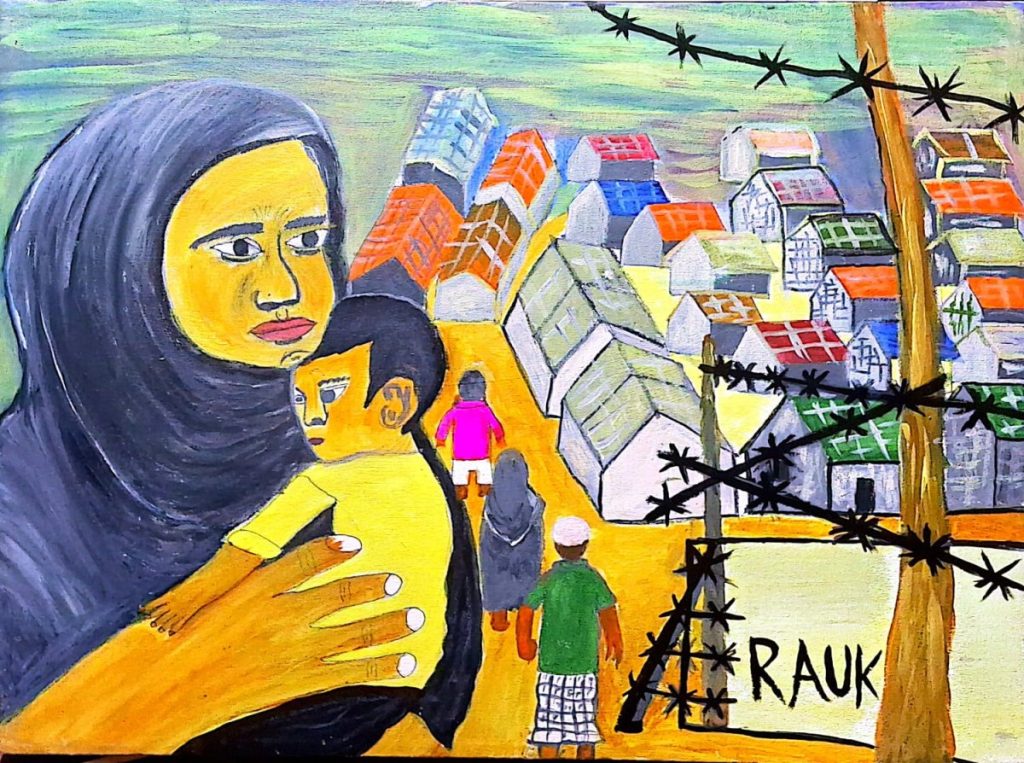
With over 1.3 million people now entirely dependent on humanitarian assistance, the plight of the Rohingya has become one of the defining moral challenges of our time. It’s natural to feel a sense of profound helplessness when witnessing the scale of this crisis from afar; it’s easy to feel lost amongst the statistics of sea crossings and camp populations. Yet, behind every figure is a story of survival. Understanding the lived reality of Rohingya families in exile requires us to look beyond the headlines and acknowledge the deep-seated trauma of statelessness. It’s a journey defined by loss, resilience, and an unwavering hope for justice.
You may find yourself confused by the legal status of those who belong nowhere on a map, or perhaps you’re seeking local ways to support integration. We promise to clarify these complexities, offering a nuanced perspective on how statelessness impacts daily life right here in the UK. This guide explores the vital role of community-led support in fostering integration, preserving heritage, and securing rights. We’ll preview the practical ways you can participate in restoration, advocacy, and empowerment. Together, we can move from passive observation to active, principled leadership that honours the strength of those seeking a place to call home.
Key Takeaways
- Gain a deeper understanding of statelessness and the profound impact the denial of legal identity has on the stability of displaced family units.
- Explore the psychological landscape of displacement and the vital role of resilient optimism in maintaining mental health amongst stateless communities.
- Identify the primary barriers to integration for Rohingya families in exile, including the critical challenges of housing, language, and healthcare access.
- Learn a practical four-step framework for transitioning from immediate crisis intervention to sustainable, long-term empowerment and agency.
- Discover how community-led initiatives restore dignity and belonging by grounding professional support in shared cultural heritage and advocacy.
The Global Reality of Rohingya Families in Exile: Statelessness and Survival
To understand the plight of Rohingya families in exile, one must first confront the systemic erasure of their identity. Statelessness isn’t just a legal technicality; it’s a profound denial of the right to exist within the framework of a nation-state. For the Rohingya, this means living without the protection of laws, the security of borders, or the dignity of a state recognising their heritage. It’s a condition that leaves families vulnerable, stripped of the basic rights most people take for granted, and forced into a life of perpetual uncertainty.
To better understand the lived experience of this displacement and the concept of a life without a country, watch this helpful video:
The 1982 Citizenship Law and the Origin of Displacement
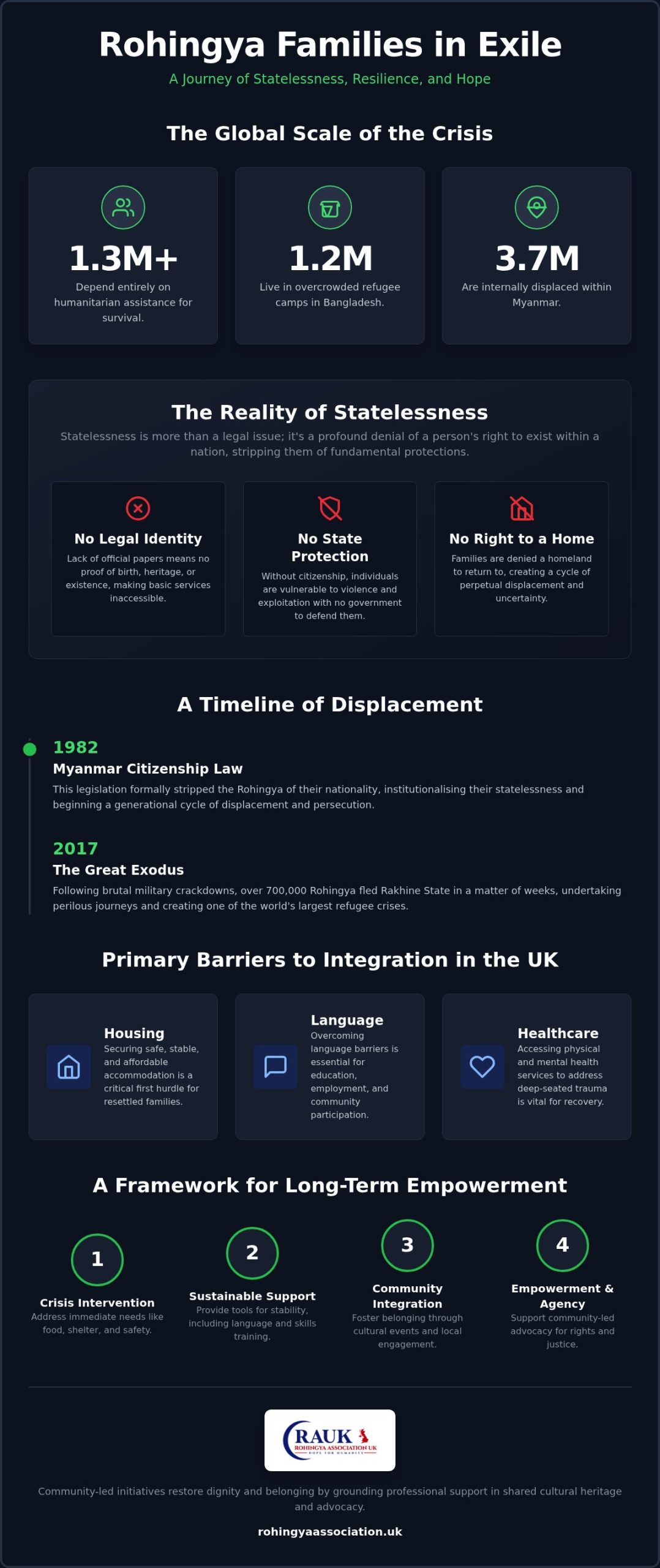
The roots of this crisis lie in the 1982 Citizenship Law, a piece of legislation that effectively stripped the Rohingya of their nationality in Myanmar. This legal exclusion created a generational cycle of displacement where children are born into a world that refuses to acknowledge their name or their history. Families face a tripartite struggle: a lack of papers to prove their birth, a lack of protection from state violence, and a lack of a homeland to return to. Statelessness is a human rights vacuum that RAUK seeks to fill.
The 2017 Exodus: A Turning Point for a Million Souls
The events of August 2017 remain a somber milestone in this history. Over 700,000 people fled Rakhine State in a matter of weeks, undertaking perilous journeys across the Bay of Bengal and through dense, unforgiving jungles. Families were torn apart during the flight; parents lost children in the chaos, and siblings were separated by borders they never chose to cross. This history of trauma informs the modern movement for justice for Rohingya people, as the community demands accountability for the atrocities of the past.
By 2026, the Global Reality of Rohingya Families remains one of precarious survival. In Bangladesh, nearly 1.2 million people reside in overcrowded camps; meanwhile, over 3.7 million people are internally displaced within Myanmar itself. The physical journey may have ended for some, but the psychological weight of being “in exile” lingers. This creates a state of perpetual limbo that tests the very limits of human endurance, shifting the struggle from physical survival to the preservation of the soul.
The Psychological Landscape of Displacement: Identity Amongst Stateless Communities
Living in a state of perpetual transit creates a unique psychological burden that few other humanitarian crises can match. For Rohingya families in exile, the absence of a legal identity often translates into a feeling of being suspended in time, caught between a past that was stolen and a future that remains unwritten. This limbo is not merely about physical location; it’s about the psychological exhaustion of living without a clear path to either a safe return or full citizenship. It’s the constant, gnawing uncertainty of what tomorrow brings, yet within this gravity, there’s a remarkable thread of resilient optimism. This isn’t a simple lack of awareness; it’s a deliberate, courageous choice to maintain hope.
Faith serves as the anchor in this storm, providing a moral compass when all other directions seem blocked. Islamic traditions and communal prayers offer a stable foundation, creating a sense of continuity and order amidst the chaos of displacement. These practices aren’t just religious rituals; they’re essential tools for maintaining mental health and communal cohesion. It’s a common misconception that these families are passive recipients of aid, waiting for external solutions. On the contrary, they demonstrate immense agency every day. Whether it’s through self-organised education in the camps or advocating for their rights in new host countries, the Rohingya are active participants in building their own futures of dignity and belonging.
Preserving Heritage in a Foreign Land
Identity is often carried in the tongue. The Rohingya language acts as a vessel for cultural memory, ensuring that the history of Rakhine State isn’t lost. Traditional art and storytelling are more than entertainment; they’re vital instruments for emotional restoration. RAUK acts as a principled leader here, organising cultural and Islamic events that strengthen communal bonds and ensure heritage remains a source of pride rather than a painful memory.
The Weight of Uncertainty: Mental Health in Exile
The stressors facing stateless families are multifaceted. Beyond the trauma of flight, there’s the persistent fear of deportation. Navigating the Challenges of Resettlement requires more than administrative help; it demands empathy for these psychological scars. Community-led safe spaces are essential for trauma processing. We provide housing, education, and advocacy to honour the strength of survivors. Learn how we support community integration to help families thrive.
Navigating the Challenges of Resettlement: From Cox’s Bazar to the United Kingdom
For many, the transition from the bamboo shelters of a Rohingya refugee camp to the urban landscapes of the United Kingdom represents a shift from acute physical peril to chronic social uncertainty. Whilst the immediate threat of violence recedes, it’s replaced by the daunting task of building a life within a society that operates on vastly different legal, social, and cultural frameworks. Resettlement isn’t an end point; it’s a new, complex chapter for Rohingya families in exile. This journey requires immense fortitude to overcome the structural barriers that often prevent displaced people from truly finding a sense of home.
Navigating the UK Home Office systems requires a level of administrative literacy that is difficult for any newcomer to master, let alone those who have spent years in a state of legal erasure. Academic research into Rohingya children’s rights in refugee camps highlights how early trauma and educational gaps create long-term hurdles for integration. In cities like Bradford, local support networks are essential to counteract this. We act as a principled leader, providing the steady guidance and professional expertise required to transform a precarious existence into a life of stability and contribution.
Housing and Healthcare: The Pillars of Stability
Securing a safe place to live is the first step toward restoration, yet the complexities of UK refugee housing guidance can be overwhelming. Families often find themselves in temporary accommodation, struggling to understand their rights or the long-term path to permanent residency. Healthcare presents an equally significant barrier. Those with uncertain legal status frequently face administrative friction when attempting to access the NHS, leading to delayed treatment for both physical ailments and deep-seated trauma. RAUK provides practical, hands-on assistance to help families navigate these essential services, ensuring they receive the protection and care they deserve.
Language as a Bridge to Integration
Proficiency in the English language is the most powerful tool for individual agency. Without it, families remain trapped in a cycle of isolation, unable to communicate with doctors, engage with their children’s schools, or advocate for their own legal rights. Our English language programmes are designed to do more than teach grammar; they’re intended to reduce social isolation and build the confidence necessary for local integration. By bridging the linguistic gap, we empower families to move beyond the role of aid recipients and become active, vocal members of their new communities. This cultural and linguistic transition is vital for the long-term success and dignity of the Rohingya diaspora.
Practical Support Frameworks: How to Foster Integration and Agency
Supporting Rohingya families in exile requires a paradigm shift in how we approach humanitarian aid. While immediate crisis intervention is essential during the initial flight from Rakhine State, the focus must rapidly evolve toward long-term empowerment. This transition ensures that families aren’t merely surviving in a state of dependency but are actively reclaiming their agency and building lives of purpose. A sophisticated approach to charity prioritises dignity over pity, recognising the immense strength these individuals have already demonstrated. We operate through a structured four-step framework designed to move families from the trauma of displacement to the stability of self-sufficiency.
Step 1: Facilitating Access to Education and Skills
Education is the most potent tool for dismantling the barriers of legal and social exclusion. For stateless youth, gaining a qualification is more than an academic milestone; it’s a way to secure a recognised identity in a world that has previously denied them one. Our skills development programmes are designed to lead directly to economic independence, allowing individuals to contribute their talents to the UK workforce. Vocational training doesn’t just improve job prospects; it provides the psychological and financial stability necessary for a family to thrive in a new environment. By focusing on practical skills, we help individuals transition from being recipients of aid to being providers for their own households.
Step 2: Strengthening Community Bonds Through Culture
Social isolation is a silent crisis for many families. In Bradford, Islamic community events serve as a vital lifeline, fostering a sense of belonging that transcends the trauma of displacement. These gatherings offer a tripartite benefit: they preserve cultural heritage, forge new social connections, and provide moments of genuine joy amongst the challenges of resettlement. Participation in local refugee support groups is encouraged as a primary method for breaking the cycle of loneliness. When families feel connected to their neighbours and their culture, they’re better equipped to navigate the complexities of life in a foreign land.
The final stages of our framework involve Step 3: Fostering Leadership and Step 4: Systemic Advocacy. We believe that the most effective advocates for the Rohingya are the Rohingya themselves. This is why our refugee youth empowerment programmes are so critical. By training the next generation in leadership, public speaking, and community organising, we ensure that the community’s voice is heard in the halls of power. These young leaders move from being the subjects of policy to the authors of change, ensuring a future where their rights are protected and their contributions are valued. Join us in our mission to empower displaced families and build a future of lasting restoration.
Restoring Hope through Community: The Mission of the Rohingya Association UK
The Rohingya Association UK (RAUK) stands as a principled leader, serving as the central hub for community support for displaced families. Our model is distinct; it’s community-led, professionally managed, and deeply rooted in a shared cultural heritage. We don’t just provide services; we build a sanctuary where the weight of statelessness is met with the strength of collective effort. For Rohingya families in exile, RAUK represents more than aid. It’s a promise of continuity, a shield against inequality, and a guiding hand toward a future defined by dignity rather than displacement. We invite you to look beyond the statistics and join a movement dedicated to the possibility of renewal.
Local Support, Global Advocacy
Our work operates on a dual plane, reflecting our commitment to local support and global hope. In the streets of Bradford, we facilitate integration through housing assistance, English classes, and cultural events that preserve our unique identity. Simultaneously, we carry the voices of the stateless to the international stage, demanding justice, recognition, and systemic change from global institutions. Giving a voice to those whom the world has tried to silence is a moral imperative that we approach with professional gravity. We bridge the gap between immediate local needs and broader global hope, ensuring that the struggle for human rights remains a community endeavour. This model ensures that Rohingya families in exile are never forgotten, regardless of their geographic location.
Joining the Journey of Renewal
Renewal is a collective journey that requires steadfast partners rather than distant benefactors. Public contributions are the lifeblood of our mission, directly funding crisis intervention, youth empowerment, and the essential education required for long-term independence. We approach this work with a sophisticated blend of somber gravity for the past and resilient optimism for the future. You can engage with our ongoing work through advocacy or financial support, helping us transform a state of limbo into a stable foundation for growth. Every donation provides more than food or shelter; it invests in the restoration of a people and the protection of their heritage. We offer a clear path for those who wish to move from understanding to action, providing the resources needed to foster true agency.
We envision a day when the term “exile” is merely a historical footnote. Our mission concludes only when every Rohingya family feels a true sense of belonging, whether in a restored homeland or a welcoming new community. By standing with us, you aren’t just helping refugees; you’re fighting for a world where no one is denied a legal identity or a safe harbour. Together, we can turn the tide of history, replacing the trauma of statelessness with the enduring peace of home. It’s time to build a future where the Rohingya are no longer defined by what they have lost, but by the dignity of where they belong.
Building a Future of Dignity and Belonging
The journey of Rohingya families in exile is defined by immense hardship, yet it’s also a testament to the enduring power of the human spirit. We’ve explored the profound complexities of statelessness, the psychological toll of displacement, and the practical frameworks required to foster true integration within the UK. It’s clear that while structural barriers like housing and language are significant, they aren’t insurmountable when met with principled leadership and communal solidarity. Every step taken toward education and cultural preservation is a vital step toward reclaiming a stolen identity.
The Rohingya Association UK (Registered Charity number: 1211433) remains at the forefront of this effort. As a community-led organisation with active projects across the UK, Myanmar, and Bangladesh, we provide the essential bridge between immediate aid and long-term empowerment. Your participation is vital to this mission. You can support the restoration of hope and dignity by donating to the Rohingya Association UK today. By contributing to our work, you’re investing in a future where heritage is celebrated and every family has a safe harbour. Together, we can ensure that the resilience of today becomes the stability of tomorrow.
Frequently Asked Questions
What is the current legal status of Rohingya families in exile in the UK?
Most Rohingya in the UK hold refugee status or are asylum seekers, yet they remain legally stateless because Myanmar does not recognise their citizenship. This lack of a country of origin complicates administrative processes, from travel documents to proof of heritage. Our advocacy work focuses on ensuring these families receive the protection they’re entitled to under international law, helping them navigate the complexities of the UK immigration system with dignity.
How many Rohingya refugees are currently living in Bangladesh in 2026?
As of early 2026, the refugee population in Bangladesh stands at almost 1.2 million people. Over half of these individuals are children, many of whom have spent their entire lives within the confines of temporary shelters. The camps remain overcrowded and entirely dependent on humanitarian assistance, with significant funding gaps reported in the 2026 response plans. This high concentration of people requires sustained international attention and principled local leadership to manage the ongoing crisis.
Can stateless Rohingya families ever return to Myanmar safely?
Safe return to Myanmar is currently not possible for the vast majority of displaced people. Although Myanmar’s government verified 308,797 former residents by July 2026, the escalating civil war and the 1982 Citizenship Law continue to block a path to safe, dignified repatriation. Until fundamental rights and security are guaranteed in Rakhine State, families remain in a state of exile, seeking restoration and protection in host countries like Bangladesh and the United Kingdom.
How does the Rohingya Association UK support families in Bradford?
We operate as a principled leader in Bradford by providing hands-on assistance with housing, healthcare, and education. Our community-led approach ensures that support is culturally sensitive, offering English language classes and skills development tailored to the needs of the diaspora. By organising cultural and Islamic events, we help families bridge the gap between their heritage and their new lives in the UK, fostering a genuine sense of local belonging and communal pride.
What are the biggest barriers to integration for displaced Rohingya families?
The primary hurdles for Rohingya families in exile involve language barriers, administrative friction in accessing healthcare, and the enduring trauma of statelessness. Without a recognised nationality, even simple tasks like opening a bank account or proving educational history can become insurmountable challenges. These barriers are often compounded by social isolation, which is why our integration programmes focus on building community bonds and providing the tools necessary for individual and collective agency.
How can I support Rohingya youth education programmes in the UK?
You can support youth education by contributing to our dedicated empowerment programmes which provide vocational training and academic support. These projects are designed to prevent the emergence of a lost generation by equipping young people with the skills needed for the UK job market. Your donations directly fund English tuition and mentorship, helping displaced youth move from a state of dependency to one of leadership and economic independence within their new communities.
Is the Rohingya crisis still considered an active emergency in 2026?
The situation remains a critical emergency, with one-third of Myanmar’s population-approximately 19.9 million people-requiring humanitarian assistance in 2026. Inside the camps, over 1.3 million people rely entirely on aid for survival, whilst dangerous sea journeys continue to claim lives at record rates. For Rohingya families in exile, the crisis is not a past event but a daily reality of navigating survival, making sustained advocacy and crisis intervention more urgent than ever before.