
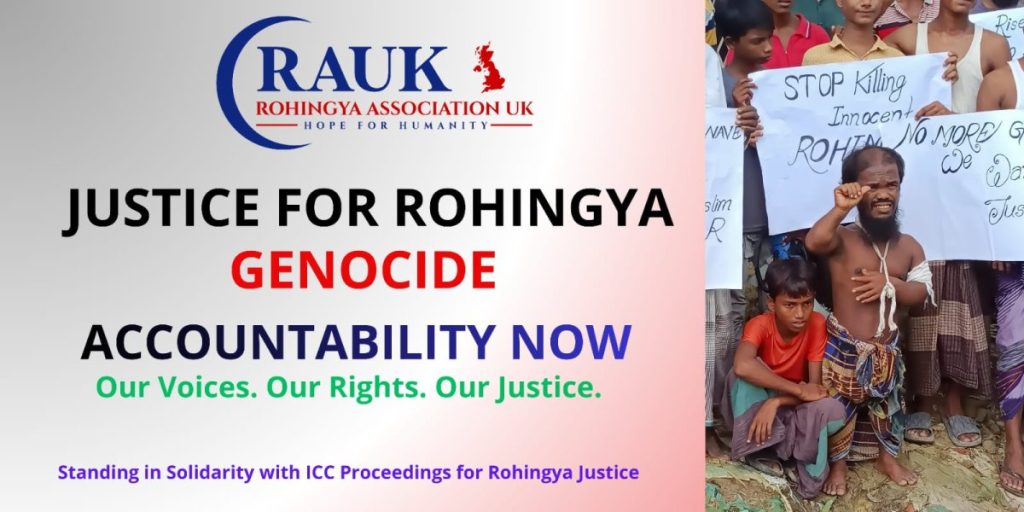
Advocacy is the only force capable of transforming the quiet endurance of a displaced people into a resilient, undeniable demand for justice. It’s natural to feel overwhelmed by the magnitude of a crisis that has seen nearly 1.2 million people seeking refuge in Bangladesh, leaving many to wonder if a single voice can truly influence global policy. You likely feel a deep sense of empathy yet remain uncertain about the distinction between providing immediate humanitarian aid and engaging in long-term Rohingya human rights advocacy. This guide explores how strategic influence bridges the gap between abstract international frameworks and the local restoration of a community’s dignity, safety, and heritage. We will examine the current advocacy landscape in 2026, identify the methods that actually sway decision-makers, and outline how you can contribute to systemic change from within the UK. By moving from reactive charity to proactive justice, we can help secure a future defined by rights, recognition, and permanent peace.
Key Takeaways
- Distinguish between temporary humanitarian relief and the strategic legal frameworks necessary for the permanent restoration of the Rohingya people.
- Explore how Rohingya human rights advocacy leverages rigorous documentation and international law to hold perpetrators accountable on a global stage.
- Navigate the tension between the deliberate pace of institutional justice and the immediate, resilient power of community-led grassroots action.
- Identify practical, high-impact ways to support the community from the UK by amplifying survivor-led narratives and sharing verified evidence.
- Learn how local integration efforts in cities like Bradford serve as a foundation for influential international advocacy and systemic change.
Understanding the Landscape of Rohingya Human Rights Advocacy in 2026
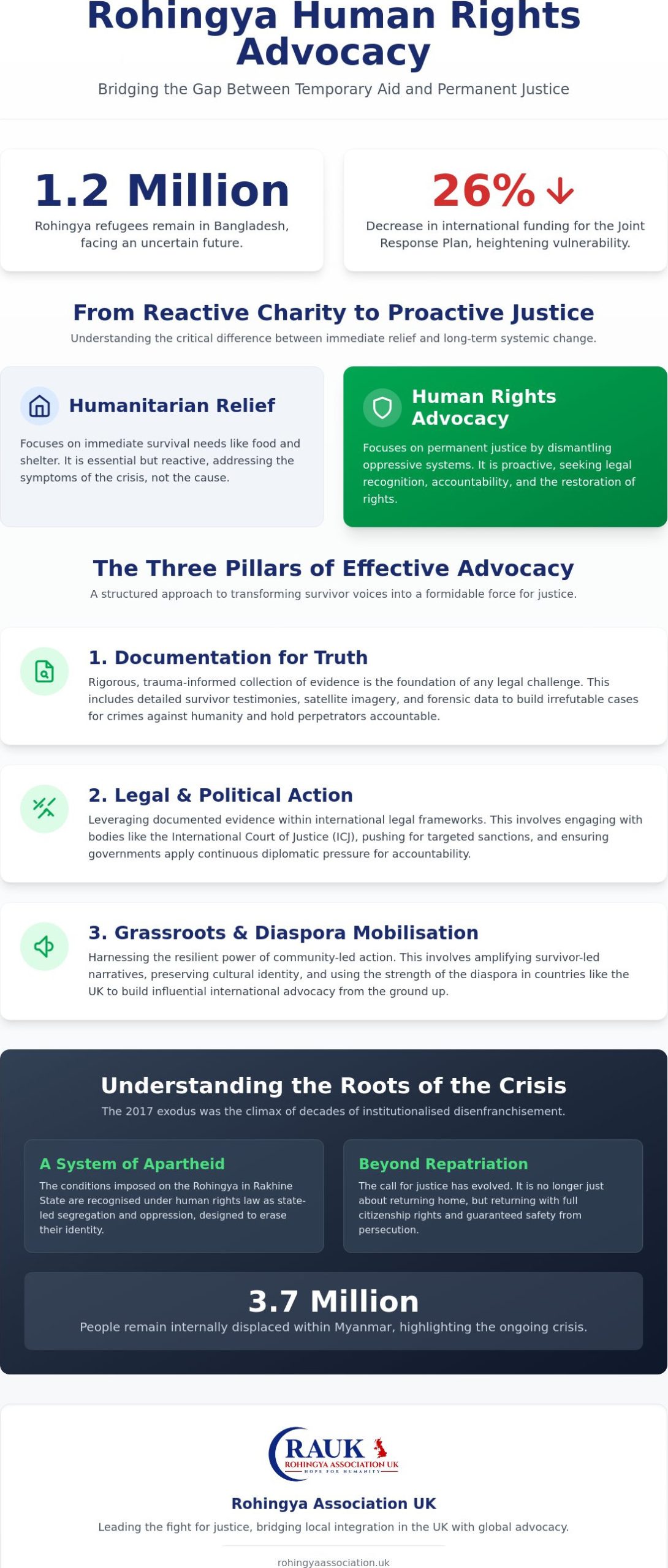
Rohingya human rights advocacy is far more than a reaction to historical atrocity; it’s a systematic, multi-layered pursuit of legal recognition, physical safety, and the restoration of a stolen heritage. In 2026, the landscape of this struggle has shifted into a period of critical urgency. Whilst the refugee population in Bangladesh remains steady at nearly 1.2 million people, international funding for the Joint Response Plan has seen a sharp 26% decrease compared to previous years. This “hyper-prioritisation” of aid leaves hundreds of thousands of families vulnerable, making advocacy the essential bridge that moves the community from mere survival toward permanent justice. It’s the mechanism that ensures the world doesn’t just feed the hungry, but also dismantles the systems that made them refugees in the first place.
The UK occupies a pivotal position amongst the international community in 2026. As a diplomatic hub and home to a vibrant diaspora, the UK serves as a centre for legal strategy and policy influence. Effective advocacy here focuses on ensuring that the plight of the Rohingya isn’t sidelined by newer global conflicts. By connecting local support in cities like Bradford to international legal frameworks, advocates create a continuous chain of pressure that demands accountability from the Myanmar military regime and protection from host nations.
The Evolution of the Rohingya Crisis and the Call for Justice
The roots of today’s statelessness lie in decades of institutionalised disenfranchisement within Myanmar. Under human rights law, the conditions imposed upon the Rohingya in Rakhine State are frequently recognised as a system of apartheid, a term that describes the intentional, state-led segregation and oppression of a specific group. This historical context is vital for understanding why the 2017 exodus was not an isolated event but the climax of a long-term campaign of exclusion. For a deeper look at these events, you may consult this Rohingya genocide overview. Today, with 3.7 million people internally displaced within Myanmar, the call for justice has evolved from seeking simple return to demanding a return with full citizenship and guaranteed safety.
Why Advocacy Matters for the Diaspora Community
For those living in the UK, Rohingya human rights advocacy is a vital tool for preserving a cultural identity that the Myanmar state has sought to erase. Being a stateless person creates a unique set of challenges; it’s a condition where one’s very existence isn’t legally recognised by any nation. Advocacy provides a voice for this “invisible” population, ensuring they receive international protection and the right to rebuild their lives with dignity. Community-led organisations like the Rohingya Association UK (RAUK) in Bradford act as both a protective shield and a guiding hand. We bridge the gap by providing local refugee settlement and integration services whilst simultaneously campaigning for systemic change on the global stage, proving that the strength of the diaspora is the greatest asset in the fight for restoration.
The Three Pillars of Effective Humanitarian Advocacy
Effective Rohingya human rights advocacy is not a singular action but a structured architecture built upon three interconnected pillars. These pillars ensure that the voices of survivors aren’t lost amongst the bureaucratic noise of international politics but are instead transformed into a formidable force for justice. By understanding these mechanisms, supporters can move beyond the feeling of being overwhelmed and see how strategic influence leads to tangible human rights protection for Rohingya. This framework bridges the gap between documented atrocities and the eventual restoration of a community’s dignity.
Documentation as a Tool for Truth
The first pillar is the rigorous, trauma-informed collection of evidence. This process involves recording detailed testimonies from survivors in Cox’s Bazar and, where possible, from those remaining in Rakhine State. Data is the foundation of any legal challenge; without precise records of dates, locations, and specific actions, claims of “crimes against humanity” remain difficult to prove in court. These Human Rights Watch reports on Rohingya provide essential empirical evidence, such as satellite imagery and survivor accounts, that helps the international community track the systematic destruction of villages. Recent findings, including reports like “Ashes of Rakhine”, serve as vital historical records that ensure the truth cannot be erased by those in power.
International Law and the Path to Accountability
The second pillar focuses on using international frameworks to challenge the culture of impunity. The ongoing case at the International Court of Justice (ICJ), initiated by The Gambia, remains a landmark effort to hold Myanmar accountable for genocide. Whilst international law often moves slowly, it applies constant diplomatic pressure that isolates the military regime and influences global trade relations. Additionally, the principle of “Universal Jurisdiction” has become a powerful tool. This legal concept allows national courts in third-party countries to prosecute individuals for international crimes, regardless of where the crimes were committed. This ensures that perpetrators find no safe haven and that the legal net continues to tighten around those responsible for the violence. For a detailed analysis of how these legal mechanisms are evolving, explore our justice for Rohingya people trend analysis of global accountability in 2026.
The final pillar is the transformation of the public narrative. Advocacy must shift the conversation from one of “victimhood” to one of “resilience and rights”. When we view the Rohingya as active agents in their own struggle rather than passive recipients of aid, we build a more sustainable and respectful movement. This shift is essential for maintaining the momentum of Advocacy & Awareness Campaigns in the UK. By focusing on the strength of the community, we ensure that our support is rooted in a long-term commitment to systemic change and the total restoration of human rights.
Navigating the Challenges: Grassroots Resilience vs. Institutional Change
The most common criticism of Rohingya human rights advocacy is that it moves at a glacial pace whilst lives are lost in real-time. It’s an understandable frustration. Whilst the International Court of Justice deliberates on complex legal definitions, families in the camps continue to face the daily reality of restricted movement and diminishing resources. This perceived impasse often leads to a false choice between immediate humanitarian aid and long-term justice. In reality, these two efforts are symbiotic. Institutional change is the slow-moving target, but it’s the constant, high-pressure pulse of grassroots activism that keeps that target in sight. Without the noise of the community, the machinery of global justice would simply grind to a halt.
We must contrast the “slow justice” of the UN with the “immediate impact” of local action. Advocacy isn’t just about high-level policy; it’s about the community support for displaced families that provides the stability needed for survivors to speak out. When a family in the UK finds secure housing and their children enter school, they gain the platform to become advocates themselves. This local restoration strengthens the collective voice, ensuring that the human element isn’t lost in technical legal briefs. As noted in the USCIRF Factsheet on Rohingya Refugees, the conditions in host nations remain precarious, making the link between local integration and international pressure more vital than ever.
Overcoming Advocacy Fatigue in 2026
The emotional weight of pursuing justice for a stateless community can be exhausting. To maintain resilient optimism, supporters must celebrate incremental victories. A single policy shift in the UK government regarding refugee status or a successful community event in Bradford is a tangible win. These moments prove that the system is not impenetrable. By focusing on these “small wins”, we build the endurance required for the long-term struggle, ensuring our commitment remains a steady flame rather than a fleeting reaction to a news cycle.
The Power of the Local Voice in Global Politics
UK residents hold significant leverage through their local representatives. History shows that “bottom-up” advocacy is often more sustainable than mandates handed down from international bodies. In Bradford, for instance, local campaigns have successfully pushed the Rohingya crisis onto the floor of the British Parliament. When you write to your MP or participate in a local awareness event, you aren’t just acting locally; you’re providing the political oxygen needed for the UK to take a principled stand on the world stage. This grassroots pressure is what transforms abstract human rights ideals into concrete government action.
A Practical Guide to Becoming an Effective Advocate for the Rohingya
Advocacy is not a passive state of being; it’s a series of deliberate, informed choices that move the needle of justice. Whilst the scale of the crisis can feel insurmountable, the transition from a concerned observer to an active participant begins with manageable, high-impact steps. By grounding your efforts in Rohingya human rights advocacy, you contribute to a global movement that refuses to let this community be forgotten. Transformation requires more than just empathy; it demands a structured approach to influence and restoration.
- Step 1: Educate yourself with verified facts. Avoid the pitfalls of misinformation by seeking data from community-led organisations like RAUK. Understanding the nuance of statelessness is the first step toward effective persuasion.
- Step 2: Amplify survivor-led stories. Use your platform to share the narratives of those who have lived through the crisis. When survivors speak for themselves, they reclaim the agency that persecution sought to strip away.
- Step 3: Engage with political representatives. Consistent communication with your MP ensures the Rohingya remain a priority in UK foreign policy.
- Step 4: Support community-led organisations. Focus your energy on groups that provide both immediate crisis intervention and long-term advocacy campaigns.
- Step 5: Participate in cultural events. Humanise the crisis by celebrating Rohingya heritage. Events in Bradford and across the UK help the public see a vibrant people rather than just a tragic statistic.
Effective Communication: How to Share the Rohingya Story
Sharing information on social media is a double-edged sword. To be an effective advocate, you must prioritise accuracy over engagement. Use dignified language that respects the strength and resilience of the community, avoiding imagery or descriptions that lean into “poverty porn.” It is vital to connect the daily struggles found in a rohingya refugee camp to universal human rights that every person deserves. By highlighting common aspirations for education, safety, and family life, you make the crisis relatable to a wider audience, fostering a deeper sense of shared humanity.
Political Engagement: Moving from Awareness to Action
In the UK, your voice has a direct line to the legislative process. Writing to your MP is one of the most powerful tools at your disposal. Don’t just express concern; ask for specific actions, such as supporting parliamentary debates or early day motions regarding aid and accountability. Public petitions also play a critical role; once they reach certain thresholds, they can trigger formal responses or debates in the House of Commons. This keeps the pressure on the government to maintain a principled stance against the atrocities in Myanmar. You can start making a difference today by joining our Advocacy & Awareness Campaigns to help drive systemic change.
How the Rohingya Association UK Leads the Fight for Justice
The Rohingya Association UK (RAUK) occupies a unique and vital position within the international landscape of Rohingya human rights advocacy. As a community-led organisation based in Bradford, our authority is rooted in the lived experiences of the diaspora we serve. We don’t speak for the community from a distance; we are the community. This proximity allows us to act as both a protective shield for those arriving in the UK and a persistent, guiding hand in the halls of power. By combining local refugee settlement and integration with high-level international campaigns, we ensure that the restoration of rights remains a practical reality rather than an abstract goal.
Our focus on Education & Youth Empowerment represents a core strategy for long-term justice. We believe that empowering the next generation with knowledge, skills, and a strong sense of identity is the most sustainable form of advocacy. When young people are equipped to articulate their own history and rights, they become the most persuasive voices for change. This work in Bradford directly informs our global strategy, providing a blueprint for how a displaced people can reclaim their agency and influence the international community’s response to the ongoing crisis in Rakhine State.
Bridging the Gap: From Bradford to Bangladesh
Our mission extends far beyond the borders of the UK, encompassing active crisis intervention and humanitarian aid projects within the camps of Bangladesh and Myanmar. We understand that effective Rohingya human rights advocacy must be supported by tangible relief. Whilst our teams on the ground provide food support and tackle inequality, our UK-based team works to preserve our rich heritage through cultural and community events. These gatherings are not merely social; they are acts of resilience against cultural erasure. By showcasing our traditions and stories, RAUK provides a platform for Rohingya voices in the UK media, ensuring that the narrative remains focused on our resilience, our culture, and our right to a safe future.
Your Role in Our Collective Mission
The path toward justice requires a collective effort, a shared identity, and a steadfast commitment to the principles of human rights. Every contribution to RAUK supports a dual mission of immediate aid and systemic advocacy. Whether through our Skills Development programmes or our awareness campaigns, your involvement helps us provide the stability and resources necessary for the Rohingya to advocate for themselves. We invite you to stand with us as a dedicated partner in this fight for restoration and peace. Your support is the fuel that drives our work forward, turning empathy into action and documented atrocities into legal accountability. Support Rohingya human rights advocacy with RAUK today.
Securing a Future of Dignity and Rights
The journey toward restoration is built upon the persistent, collective efforts of those who refuse to accept silence as a solution. By understanding the critical intersection between immediate community support and long-term legal accountability, we move closer to a world where the Rohingya are no longer defined by their displacement but by their rights and resilience. Rohingya human rights advocacy serves as the essential architecture for this change, transforming individual survivor testimonies into a formidable demand for global justice. We’ve explored how documentation, political engagement, and diaspora-led initiatives create a continuous chain of pressure that challenges impunity and fosters hope.
As a community-led registered charity (No. 1211433), the Rohingya Association UK remains a steadfast partner for families in Myanmar, Bangladesh, and the UK. Our proven impact in local resettlement and international advocacy is driven by the strength of the people we serve through direct partnerships and dedicated care. You have the power to influence this narrative and support the systemic change necessary for permanent peace. Join our mission to secure justice for the Rohingya people. Together, we can ensure that the path toward restoration is walked with confidence, dignity, and the unwavering promise of a better tomorrow.
Frequently Asked Questions
What is the primary goal of Rohingya human rights advocacy?
The primary goal of Rohingya human rights advocacy is to secure permanent legal recognition, physical safety, and the full restoration of citizenship for the Rohingya people. It seeks to dismantle the systemic structures of apartheid and disenfranchisement that have forced millions into displacement. By influencing global policy and international law, advocacy aims to move beyond temporary relief toward a sustainable future where the community can return to their homeland with dignity and guaranteed protection.
How can I support the Rohingya people from the UK?
You can support the community by engaging with community-led organisations like the Rohingya Association UK in Bradford through volunteering, donating, or participating in awareness campaigns. Writing to your local MP is a powerful way to ensure the UK government maintains a principled stance on foreign aid and international justice. Additionally, attending cultural events and sharing survivor-led stories helps humanise the crisis and keeps the issue on the legislative agenda, ensuring that the plight of the Rohingya remains a national priority.
What is the difference between humanitarian aid and human rights advocacy?
Humanitarian aid focuses on the immediate provision of life-saving essentials such as food, shelter, and medical care to ensure survival during a crisis. In contrast, human rights advocacy addresses the root causes of that crisis by seeking systemic change, legal accountability, and policy reform. Whilst aid addresses the symptoms of persecution, advocacy works to end the persecution itself. Both are essential; aid keeps people alive today, whilst advocacy secures their right to live freely and safely tomorrow.
Why are the Rohingya people considered stateless?
The Rohingya are considered stateless because the Myanmar government stripped them of their citizenship through the 1982 Citizenship Law, which failed to recognise them as one of the country’s “national races.” This legal exclusion has left nearly 1.2 million refugees in Bangladesh and hundreds of thousands within Myanmar without a passport, legal protection, or a country to call home. Statelessness creates a cycle of vulnerability where individuals are denied basic rights to education, employment, and freedom of movement.
Does the UK government provide support for Rohingya refugees?
The UK government provides support through international aid contributions and by offering resettlement for a limited number of refugees through official schemes. However, much of the practical, day-to-day support for those arriving in the UK is provided by community-led charities like RAUK, which assist with housing, education, and integration. Advocacy remains crucial to ensure the government continues to fund the Joint Response Plan and uses its diplomatic influence to hold perpetrators of violence accountable.
How can advocacy help those living in the Cox’s Bazar refugee camps?
Advocacy helps those in Cox’s Bazar by pressuring the international community to maintain funding levels and by demanding better living conditions and educational opportunities for the nearly 1.2 million residents. It ensures that the voices of those in the camps are heard by decision-makers who can influence the security and management of these sites. By keeping the crisis in the public eye, Rohingya human rights advocacy prevents the hyper-prioritisation of aid that often leaves the most vulnerable without support.
Is it possible to donate Zakat or Sadaqah towards advocacy efforts?
Yes, many supporters choose to direct their Zakat or Sadaqah towards both humanitarian aid and the advocacy efforts that seek to end the suffering of the Rohingya people. Contributions support crisis intervention, food support, and the educational programmes that empower the next generation of advocates. By donating to a registered charity like RAUK, you ensure that your funds are used ethically to provide both immediate relief and a long-term path toward justice, restoration, and communal growth.
What role does the International Court of Justice play in the Rohingya crisis?
The International Court of Justice (ICJ) is currently hearing a landmark case brought by The Gambia against Myanmar concerning the alleged violation of the Genocide Convention. The court’s role is to determine state responsibility and to issue binding orders that protect the Rohingya from further acts of violence. Whilst the legal process is deliberate and lengthy, the ICJ provides a vital international framework for accountability, ensuring that the atrocities committed are documented, judged, and condemned on the world stage. To understand the latest developments in this historic case and broader justice for Rohingya people across global accountability mechanisms in 2026, our in-depth trend analysis explores how these legal pathways are evolving.