
Table of Contents
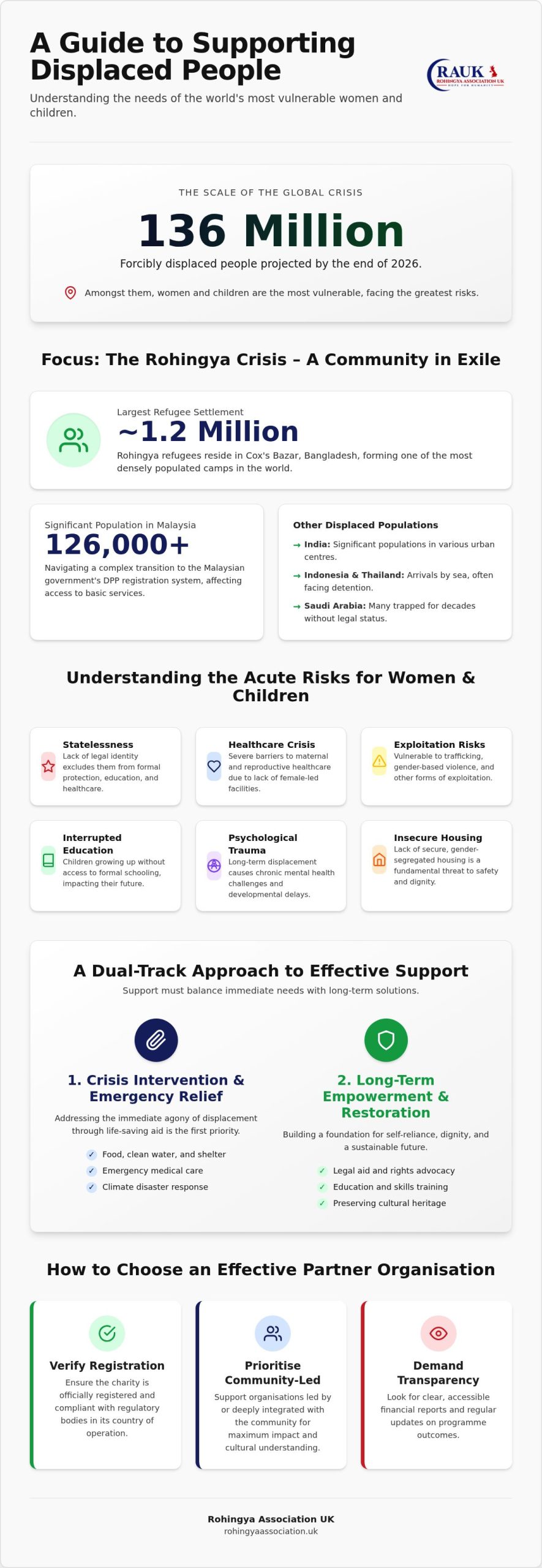
By the close of 2026, the global population of forcibly displaced people is projected to reach a staggering 136 million; a figure that represents a profound loss of home, safety, and heritage. Within this vast number, women and children remain the most vulnerable, facing heightened risks of gender-based violence and interrupted education whilst navigating a world that often feels indifferent to their plight. It’s understandable if you feel overwhelmed by the magnitude of these humanitarian challenges or uncertain about where your contribution can make the most significant impact. If you’re seeking clarity on how to support displaced women and children, this guide offers a practical, evidence-based framework for providing protection, education, and long-term hope.
We’ll explore the unique requirements of families in Rakhine State (Arakan State), assess the impact of the UK’s new 30-month temporary protection status, and highlight community-led organisations that deliver genuine results. You’ll discover how to identify transparent partners, learn the nuances of local advocacy, and find meaningful ways to volunteer within your own community. This is a journey from empathy to action, designed to help you move beyond a fleeting emotional reaction toward a stable, principled commitment to restoration and justice.
Key Takeaways
- Identify the specific protection gaps and health crises affecting families in Rakhine State (Arakan State) and high-density camps like Cox’s Bazar.
- Discover evidence-based strategies on how to support displaced women and children through a balance of immediate humanitarian relief and long-term empowerment programmes.
- Understand the complexities of the UK resettlement landscape, including how to facilitate integration through housing, healthcare, and community-led support.
- Learn how to evaluate charitable organisations by verifying their registration status and prioritising community-led leadership for maximum impact.
- Find practical ways to take action today, from providing vital financial aid to volunteering your skills within your local community.
Understanding the Vulnerabilities of Displaced Women and Children
Displacement is rarely a gender-neutral experience. For the millions forced to flee their homes, the journey is defined by a systemic lack of protection that disproportionately affects women and children. These groups face acute protection gaps, ranging from the absence of secure housing to a complete breakdown in maternal healthcare. Understanding these nuances is the first step in learning how to support displaced women and children effectively. Currently, the Rohingya crisis remains one of the most pressing examples of this vulnerability; there are approximately 1.2 million refugees residing in Cox’s Bazar, Bangladesh, and over 126,000 in Malaysia.
In Southeast Asia, the legal landscape is shifting. Those in Malaysia are navigating a complex transition from prior documentation issued by international bodies to the Malaysian government’s DPP (Dokumen Pendaftaran Pelarian) system. This change impacts their ability to access basic services and reinforces the precarious nature of their stay. Whether an individual is classified as a refugee or an Internally displaced person (IDP), the lack of a recognised legal identity remains a primary barrier to safety and self-sufficiency.
The Crisis in Rakhine State (Arakan State)
The roots of this displacement lie in Rakhine State (Arakan State), where the Rohingya people have faced decades of systemic exclusion. Preserving their cultural heritage and communal bonds is a vital act of resilience whilst they remain in exile. Beyond the major hubs in Bangladesh and Malaysia, significant populations are scattered across several regions:
- India: Significant populations residing in urban centres across the country.
- Indonesia: Groups arriving via maritime routes, often facing precarious coastal conditions.
- Thailand: Vulnerable individuals frequently held in immigration detention centres.
- Saudi Arabia: Large numbers of people trapped for decades without formal residency or legal status.
For children in these regions, the psychological impact of long-term displacement is profound. Growing up without a sense of place or legal status often leads to developmental delays and chronic mental health challenges, as the stability required for a healthy childhood is replaced by the constant threat of eviction or detention.
Gender-Specific Challenges in Refugee Camps
Within the high-density environment of Cox’s Bazar, women face severe barriers to maternal and reproductive healthcare. The lack of female-led medical spaces often discourages women from seeking necessary treatment, leading to preventable health crises. Statelessness compounds these issues. Without a legal identity, women and children are frequently excluded from formal protection frameworks, making them prime targets for exploitation and trafficking. Providing secure, gender-segregated housing and community-led protection initiatives isn’t just a logistical necessity; it’s a fundamental human rights requirement for restoring dignity to those who have lost everything.
Effective Ways to Support Displaced Families Globally
True humanitarian support requires a dual-track approach that addresses both the immediate agony of displacement and the long-term necessity of self-reliance. We can’t simply provide a temporary blanket; we must build a foundation. This holistic perspective is the core of how to support displaced women and children effectively. It’s a commitment that begins with life-saving aid and matures into the restoration of legal rights and human dignity. For the 1.2 million refugees in Cox’s Bazar, this means moving beyond survival toward a future where they can sustain their own families and preserve their cultural identity.
Crisis Intervention and Emergency Relief
Refugee camps are often situated in regions highly susceptible to climate-related disasters. In Bangladesh, the monsoon season brings the constant threat of landslides and flooding, which can dismantle years of progress in an afternoon. Rapid response is vital to protect the most vulnerable households, particularly those headed by women who may struggle to access traditional aid queues. When you support our Bangladesh projects, you’re providing more than just food and clean water; you’re ensuring that emergency medical supplies and temporary shelters are ready the moment disaster strikes.
Long-term infrastructure represents the next stage of this journey. By constructing semi-permanent housing with robust sanitation systems, we reduce the spread of waterborne diseases that frequently claim the lives of children. Sustainable energy solutions, such as solar-powered street lighting, provide a protective shield for women navigating the camps at night. These improvements aren’t just logistical upgrades; they’re essential tools for safety and community stability.
Advocating for Legal and Human Rights
Aid without advocacy is merely a temporary reprieve. To create lasting change, we must push for global accountability and justice for Rohingya people on the international stage. This involves the meticulous documentation of human rights abuses within Rakhine State (Arakan State) to ensure that the truth of these atrocities is never erased. Without a clear record of the past, there can be no fair path toward the future.
Simultaneously, we must address the legal shifts occurring in Southeast Asia. We closely monitor the transition from UNHCR documentation to the Malaysian government’s DPP system to ensure that the 126,000 refugees in Malaysia aren’t stripped of their remaining protections. Advocacy ensures that displaced families aren’t just fed, but are also seen and protected by the law. You can help build this lasting hope for the future when you donate your Sadaqah Jariyah to fund these critical infrastructure and advocacy efforts.
Supporting Refugee Integration and Empowerment in the UK
Transitioning from the camps of Cox’s Bazar to the streets of a UK city like Bradford presents a jarring shift in environment but not in the need for steadfast advocacy. For those arriving under the UK’s 2026 protection rules, the first 30 months are a critical window for stability. This period is often fraught with uncertainty as families navigate a system that has become increasingly temporary and conditional under the Immigration and Asylum Bill 2026. Understanding the mechanics of local integration is essential for anyone looking into how to support displaced women and children as they attempt to rebuild lives that were fractured in Rakhine State (Arakan State).
Housing and Healthcare Navigation
Securing a safe home is the prerequisite for all other forms of recovery. New arrivals often face significant hurdles in accessing stable accommodation, frequently risking homelessness without intervention from local community-led charities. Accessing the NHS is equally vital yet complex; language barriers and a lack of documentation can prevent displaced women from receiving culturally sensitive maternal care or mental health support. Providing clear, practical guidance on these systems is a cornerstone of effective community support for displaced families, ensuring that the basic right to health and shelter is upheld from day one.
Skills Development and English Language Learning
Language proficiency isn’t just a skill; it’s the primary tool for social and economic agency. Without English, displaced women remain isolated, unable to advocate for their children in schools or enter the workforce. In Bradford, community-led workshops offer a dual benefit: they provide vocational training and act as a sanctuary for social cohesion. This localised approach is a practical example of how to support displaced women and children by fostering the independence needed to thrive in a new landscape whilst gaining the confidence to participate in their local community.
Children and young people require specific, targeted interventions to overcome the trauma of displacement. Many have spent their formative years in camps or in transit, missing out on formal education and the stability of a classroom. By investing in refugee youth empowerment programmes, we provide the mentorship and academic support necessary to bridge these gaps. These initiatives don’t just help with homework; they foster a sense of belonging and agency, proving that a child’s future can be defined by their potential rather than their past status as a refugee.
How to Choose a Charity to Support
Selecting a partner for your humanitarian efforts is a decision that requires both moral clarity and rigorous scrutiny. With global displacement figures rising, the question of how to support displaced women and children effectively often hinges on the integrity of the organisation you choose. It isn’t enough to simply give; one must ensure that the contribution reaches the intended destination and facilitates genuine renewal. To ensure your support is utilised with maximum efficiency and empathy, follow these essential steps:
- Verify registration: Confirm the charity’s status and financial transparency via the Charity Commission; this ensures the organisation is held to strict legal and fiscal standards.
- Prioritise community leadership: Look for organisations where displaced people have a direct voice in leadership; those who have lived the experience are best positioned to design the solution.
- Evaluate the balance of aid: Ensure the charity provides immediate relief whilst simultaneously investing in long-term empowerment and self-reliance.
- Assess local and global impact: Check if the organisation supports refugees within your own UK community as well as those in camps abroad.
- Check cultural competence: Verify that the charity respects the heritage, religious needs, and sensitive history of the people from Rakhine State (Arakan State).
The Value of Community-Led Advocacy
Organisations like RAUK occupy a unique position as a bridge between the UK diaspora and families remaining in Southeast Asia. This community-led model ensures that aid isn’t just delivered; it’s delivered with an understanding of the specific cultural nuances and traumas associated with the Rohingya experience. Trust is the currency of effective humanitarian work. When an organisation is deeply embedded within the community it serves, it can navigate protection gaps that larger, more distant NGOs might overlook. This proximity allows for the preservation of cultural identity and heritage, which are often the first things lost in the chaos of resettlement.
Sustainable Giving and Sadaqah Jariyah
While one-off crisis donations are vital during disasters, sustainable change requires a shift toward long-term investment. In many traditions, this is understood as Sadaqah Jariyah; an everlasting charity that continues to provide benefits long after the initial gift. When you choose to donate your Sadaqah Jariyah, you’re funding the infrastructure of hope, such as schools, clean water systems, and vocational training centres. These projects don’t just solve a temporary problem; they provide displaced women and children with the tools to build a dignified future. Investing in a child’s education or a mother’s skill set creates a legacy of resilience that can break the cycle of poverty and statelessness. You can begin this journey of restoration today by choosing to volunteer with Rohingya Association UK and offering your time to those rebuilding their lives in Bradford.
How You Can Take Action Today
The transition from understanding the crisis to actively participating in its resolution is a profound step toward global justice. While the scale of displacement across Rakhine State (Arakan State) and Southeast Asia can feel insurmountable, your agency remains a powerful tool for restoration. Knowing how to support displaced women and children involves a combination of immediate financial relief, local advocacy, and communal solidarity. By channelling your resources and time through established, community-led frameworks, you ensure that your contribution fosters protection, growth, and long-term hope.
Direct Financial Support
Financial contributions remain the most immediate way to sustain life-saving operations in high-density environments like Cox’s Bazar, where 1.2 million refugees rely on external aid for survival. Direct funding allows for the procurement of medical supplies, the construction of secure housing, and the maintenance of educational centres. You may choose to donate your Sadaqah Jariyah to support these permanent infrastructure projects; creating a legacy of empowerment that outlasts a single crisis. Setting up a monthly gift provides the stability needed for long-term planning, whilst earmarking your donation for maternal healthcare or children’s schooling ensures your values are reflected in the aid delivered.
Local Volunteering and Advocacy
In the UK, particularly within cities like Bradford, the human element of support is irreplaceable. You can volunteer with Rohingya Association UK to provide the practical mentorship that newly arrived families require to navigate their first 30 months of temporary protection. Whether you offer your skills as an English language tutor, a cultural guide, or a youth mentor, your presence helps bridge the gap between isolation and integration. These personal connections are the foundation of a resilient, welcoming community that prioritises human dignity over bureaucratic process.
Advocacy is equally vital for systemic change. Raising your voice to share verified facts about the ongoing humanitarian situation in Rakhine State (Arakan State) helps prevent the world from turning a blind eye to these atrocities. You can take direct political action by writing to your MP, urging them to support fairer human rights protections for stateless people and more robust integration pathways. Finally, organising or attending community fundraisers and cultural events builds the local solidarity necessary to sustain this movement. Together, we can act as a protective shield for the vulnerable, ensuring that every displaced woman and child has the opportunity to reclaim their heritage and build a future rooted in safety.
Building a Legacy of Resilience and Hope
The path toward restoration for those displaced from Rakhine State (Arakan State) requires a principled, long-term commitment that transcends immediate crisis relief. We’ve explored the necessity of documenting human rights abuses, the complexities of the UK’s 2026 protection status, and the transformative power of community-led integration. By prioritising transparency and cultural competence, you now possess a clearer framework for how to support displaced women and children both globally and within our own local communities in Bradford.
Rohingya Association UK (Registered Charity 1211433) remains a steadfast bridge between donors and families in need, operating active projects across the UK, Myanmar, and Bangladesh. As a diaspora-led organisation, we’re uniquely positioned to ensure that every contribution facilitates genuine empowerment and preserves precious heritage. Your agency can be the catalyst for renewal, turning a fleeting emotional reaction into a stable foundation for a family’s future. You can support this vital mission when you donate your Sadaqah Jariyah. Together, we can replace the uncertainty of displacement with the enduring strength of community and justice.
Frequently Asked Questions
How many Rohingya refugees are currently displaced globally?
There are approximately 1.5 million Rohingya refugees displaced across the globe; the majority reside in the Cox’s Bazar region of Bangladesh. Beyond the 1.2 million in Bangladesh and 126,000 in Malaysia, significant populations are found in India, Indonesia, Thailand, and Saudi Arabia. These figures represent a profound humanitarian challenge, as many families remain trapped in a cycle of statelessness without formal recognition or legal protection in their host countries.
What is the difference between Rakhine State and Arakan State?
Rakhine State and Arakan State refer to the same geographic region in western Myanmar, though the names carry different historical and political connotations. “Arakan” is the traditional name favoured by the Rohingya and many historians to preserve their cultural heritage and ancestral ties to the land. “Rakhine” is the official designation implemented by the Myanmar government. Using both names ensures historical context is preserved whilst acknowledging the current administrative reality of the region.
What is the Malaysian DPP system for refugees?
The DPP (Dokumen Pendaftaran Pelarian) is the Malaysian government’s official registration system for refugees, which is currently replacing the previous UNHCR documentation framework. This transition marks a shift toward state-led management of displaced populations within Malaysia. Whilst it aims to provide a more structured legal status, it also presents new challenges for families navigating the change. It’s a critical area where understanding how to support displaced women and children involves monitoring their continued access to basic services.
How can I volunteer to help refugees in Bradford?
You can support local integration by offering your time as a mentor, language tutor, or community advocate through organisations like the Rohingya Association UK. Based in Bradford, we provide English classes and skills development programmes that rely on dedicated volunteers. By participating in cultural events or assisting with administrative tasks, you help create a welcoming environment that allows displaced families to rebuild their lives with dignity and a sense of belonging.
Is it better to donate money or physical goods to refugee camps?
Financial contributions are generally more effective than donating physical goods due to the significant logistical costs and challenges of international shipping. Money allows organisations to purchase supplies locally, which supports the regional economy and ensures that aid is tailored to the immediate, specific needs of the camp. It also provides the flexibility required to respond to sudden emergencies, such as climate-related disasters or health crises, without the delays of transporting physical items.
What are the specific needs of children in Cox’s Bazar?
Children in Cox’s Bazar require a stable combination of formal education, nutritional support, and specialised psychosocial care to overcome the trauma of displacement. Many have spent their entire lives in high-density camps where protection from exploitation is a constant concern. Providing safe spaces for play and learning is essential for their development. These interventions help ensure that their potential isn’t stifled by the harsh realities of statelessness, offering a path toward a more hopeful future.
How does RAUK support the integration of women in the UK?
RAUK facilitates the integration of women in the UK through targeted English language classes, vocational training, and cultural orientation workshops. These programmes are designed to bridge the gap between isolation and independence; empowering women to navigate the NHS, support their children’s schooling, and enter the workforce. By fostering a strong communal bond, we help displaced women regain their agency and participate fully in the social and economic life of their new communities.
What is Sadaqah Jariyah and how does it help displaced families?
Sadaqah Jariyah is a form of “everlasting charity” that provides continuous benefits to both the donor and the recipient through long-term projects. In the context of displacement, this involves funding sustainable infrastructure such as clean water systems, permanent housing, and educational facilities. This type of giving is central to how to support displaced women and children because it builds the foundation for self-reliance; ensuring that the support provided today continues to yield positive outcomes for generations.