
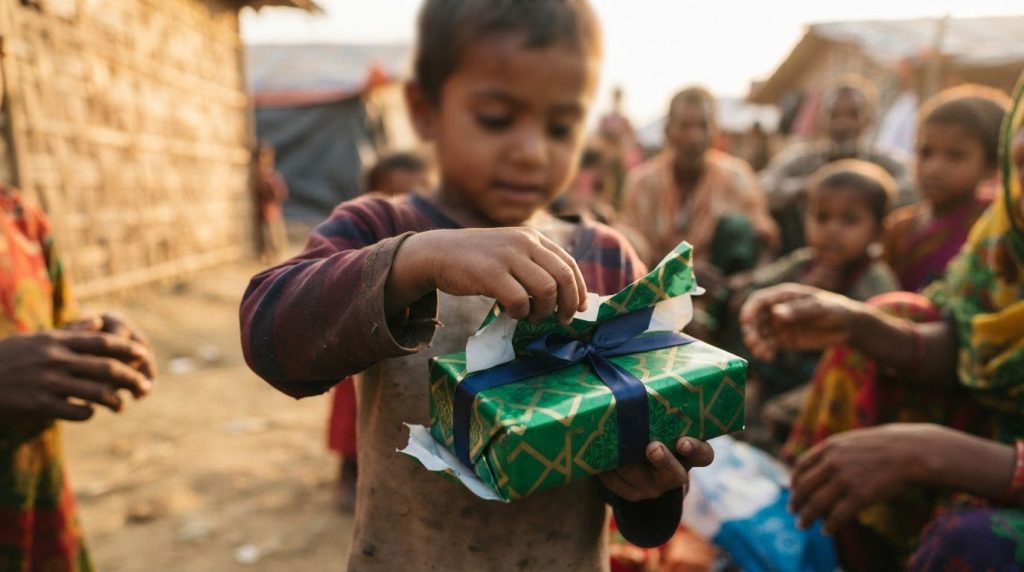
Imagine a child waking on the morning of Eid al-Fitr, surrounded by the grey reality of a displacement camp, yet still harbouring the quiet hope of a festive celebration. For the more than 600,000 Rohingya children currently living in the settlements of Cox’s Bazar, the tradition of receiving new clothes or a small toy is often a distant memory or an unfulfilled dream. You likely feel a deep responsibility to ensure your charity reaches those most in need, especially when fulfilling your religious duty of Sadaqah. This guide explains how to donate Eid gifts for refugee children through a transparent, community-led process that prioritises cultural dignity, local empowerment, and genuine joy.
We understand the worry that your donation might be lost in corporate bureaucracy or lack a personal connection to the recipient. You deserve to know that your generosity provides more than just a physical object; it offers a sense of belonging, restoration, and protection for a generation facing hardship. We will walk you through the essential steps to ensure your gift is impactful, culturally appropriate, and delivered with the respect these families deserve. By focusing on grassroots initiatives, you can help provide the festive garments, educational tools, and traditional treats that define a child’s experience of Eid.
Key Takeaways
- Understand the vital role festive traditions play in restoring dignity and psychological stability for displaced families during Eid-ul-Fitr and Eid-ul-Adha.
- Learn to distinguish between obligatory Zakat al-Fitr and voluntary Sadaqah to ensure your contributions meet both religious requirements and specific humanitarian needs.
- Discover how to donate Eid gifts for refugee children through ethical channels that prioritise local sourcing and transparent distribution to support camp economies.
- Identify the most effective donation models, ranging from one-off gift packs to recurring sponsorships, across the UK, Myanmar, and Bangladesh.
- Gain insight into why community-led organisations are best positioned to provide culturally appropriate aid that respects the heritage and strength of the Rohingya diaspora.
The Significance of Eid Gifts for Displaced and Orphaned Children
Eid-ul-Fitr and Eid-ul-Adha are not merely dates on a calendar. For children in refugee camps, they represent a rare window of respite from the daily grind of displacement. Whilst most of the year is spent in a state of survival, these festivals offer a chance to reclaim a sense of childhood that is often buried under the weight of statelessness. The emotional weight of these days is profound; they are moments where the absence of a home is felt most acutely, yet they also provide the strongest opportunity for communal healing.
When you choose to donate Eid gifts for refugee children, you provide more than a simple parcel. You offer a psychological bridge between the trauma of the past and a hopeful future. This is particularly vital for the thousands of orphaned children who lack the traditional family support systems to facilitate these celebrations. Without parents to provide the customary “Eidi”, these children can feel doubly marginalised during what should be the most joyous time of the year. Community support steps in to fill this void, ensuring no child is left to witness the festivities from the sidelines.
Restoring Cultural Identity Through Celebration
For the Rohingya diaspora, maintaining heritage is an act of defiance. Displaced families often struggle to pass down traditions when they are stripped of their land and history. Community-led organisations understand that a gift is not just an object; it is a vessel for cultural preservation. By providing traditional garments or specific treats, we ensure that children remain connected to their roots. This celebration acts as a form of collective resilience, proving that even in the face of systemic hardship, the community’s spirit remains unbroken. It moves the narrative away from being “victims” and restores their status as celebrated members of a vibrant culture.
The Psychological Impact of a Personal Gift
Humanitarian aid often focuses on the immediate requirements of nutrition and shelter. Whilst these are essential, the emotional well-being of a child requires more than just calories. Receiving a brand-new set of clothes or a toy provides a profound sense of dignity. This practice reflects the traditional custom of Eidiyah, where the act of giving fosters a communal bond. For a child who has only ever known hand-me-downs or survival rations, a personal gift signals that they are seen and valued. This transition from survival mode to celebration mode is a cornerstone of community support for displaced families, offering a moment of genuine joy amongst the shadows of the camp.
Spiritual Rewards: Sadaqah and Zakat al-Fitr for Children
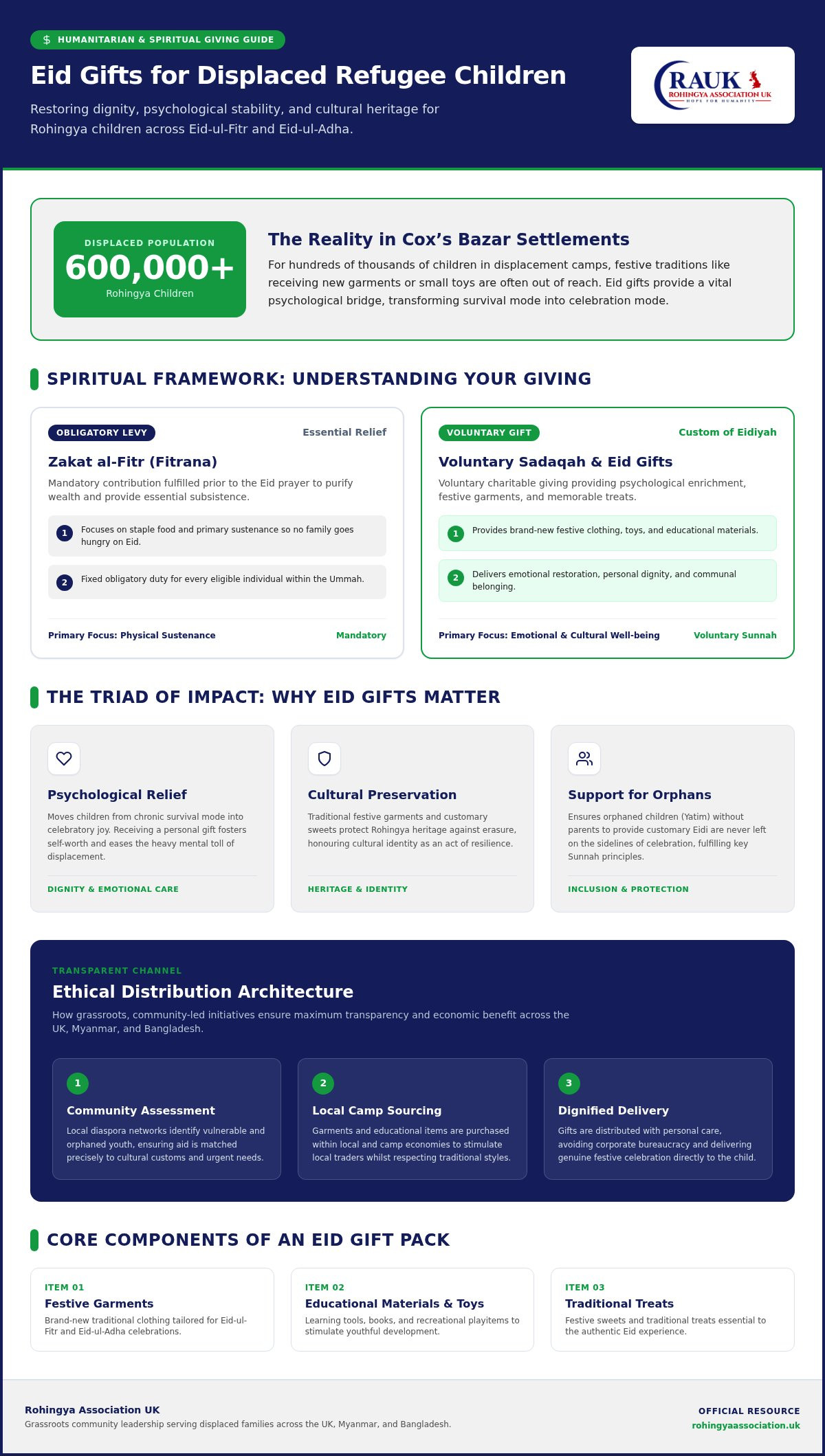
Giving during the sacred days of Eid is a profound act of worship that transcends simple charity. It’s a structured religious obligation designed to purify the wealth of the giver whilst providing for the most vulnerable members of the Ummah. Within this framework, it’s essential to distinguish between Zakat al-Fitr, or Fitrana, and voluntary Sadaqah. Whilst Fitrana is a mandatory levy intended specifically to provide staple nutrition so that no one goes hungry on the day of Eid, voluntary Sadaqah allows for the traditional custom of Eidiyah. When you donate Eid gifts for refugee children, you are offering this secondary layer of joy, ensuring that the emotional and psychological needs of displaced youth are met alongside their physical requirements.
The rewards for supporting an orphan, or Yatim, are particularly emphasised in the Sunnah. Prophetic tradition promises a unique closeness to the Messenger for those who care for the fatherless, a bond described as being as near as two fingers on a hand. For children in the Rohingya camps who have lost their primary protectors, your gift serves as a vital shield. It provides a sense of security, belonging, and hope that is often absent in the harsh environment of a refugee settlement. RAUK ensures that every contribution is handled with the gravity it deserves, maintaining strict transparency, accountability, and cultural insight in every distribution.
Giving with Intention (Niyyah)
Intentionality is the heart of Islamic charity. When you select a partner for your giving, you aren’t just choosing a logistics provider; you’re choosing a representative of your values. Supporting a community-led organisation ensures that your Niyyah is translated into action that respects the recipient’s dignity. This form of giving often acts as a Sadaqah Jariyah, as providing a child with educational tools or a sense of normalcy can have a ripple effect on their future development. It’s a Fard Kifayah, a communal obligation, to look after those amongst us who have been stripped of their homes and heritage. You can begin this journey by supporting our community-led projects today.
Ensuring Your Donation is Zakat-Eligible
For many donors, ensuring that funds reach those who truly meet the criteria for Zakat is a primary concern. In the context of refugee camps in Bangladesh and Myanmar, the vast majority of families fall under the categories of the poor (al-fuqara) and the needy (al-masakin), making them eligible recipients for religious funds. RAUK uses its deep grassroots network to identify the most vulnerable households, ensuring that your religious obligations are fulfilled with precision. We maintain our status as a registered charity, and you can verify our credentials and financial reporting through the Charity Commission register on GOV.UK. This level of scrutiny ensures that every pound donated is used to restore, protect, and empower the children we serve.
Evaluating Ethical Donation Channels: What to Look For
Choosing where to donate Eid gifts for refugee children is a moral decision that requires careful discernment. It’s not simply about the act of giving; it’s about the ecosystem your donation supports. Large, corporate NGOs often operate from a distance, managing logistics through multiple layers of bureaucracy that can dilute the impact of your gift. In contrast, community-led organisations are embedded within the settlements, possessing the lived experience necessary to navigate the complex social and historical contexts of the Rohingya diaspora. These organisations prioritise the dignity of the recipient, ensuring that marketing materials avoid the pitfalls of “poverty tourism” and instead honour the resilience of the families they serve.
A principled approach to giving also involves scrutinising how a charity presents its work. Ethical channels focus on empowerment rather than pity, using imagery and narratives that protect the privacy and status of displaced children. By facilitating these moments of normalcy, we adhere to WHO guidance on refugee mental health and community support, which underscores how social inclusion and the restoration of festive traditions act as vital buffers against the chronic stressors of displacement. When donors choose a partner that understands these nuances, they ensure their contribution fosters long-term psychological stability rather than a fleeting emotional reaction.
The Power of Local Procurement
Sustainability in aid is often overlooked, yet it’s a critical component of ethical giving. Rather than shipping physical goods from the UK, which incurs high carbon costs and potential customs delays, impactful charities procure gifts directly in Bangladesh or Myanmar. This method supports local Rohingya businesses and artisans, injecting much-needed capital into the regional economy near the camps. It ensures that the toys, clothes, and treats are culturally relevant and immediately available. By buying locally, we reduce the administrative overhead and ensure that a larger proportion of your donation goes directly towards the restoration and protection of the children’s well-being.
Transparency and Reporting Standards
Transparency is the cornerstone of a stable, long-term commitment between a donor and a charity. When evaluating a channel, you should look for clear evidence of UK Registered Charity status, such as RAUK’s registration (1211433). A reliable organisation provides detailed annual reports that move beyond surface-level statistics to show the tangible impact of their projects. This financial openness is part of a broader movement for justice for Rohingya people, where global accountability and community-led leadership work together to fight for systemic change. Verification through official registers ensures that your religious and moral duties are fulfilled with the highest level of integrity.
How to Donate Eid Gifts for Refugee Children: A Step-by-Step Guide
Transforming your compassionate intention into a tangible reality is a straightforward yet profound process. When you donate Eid gifts for refugee children, you are participating in a methodical effort to restore dignity to those who have been forcibly displaced. Our community-led approach ensures that your contribution bypasses unnecessary bureaucracy, reaching the hands of children in Bradford, Myanmar, or the camps of Cox’s Bazar with precision and respect. By following a clear, verified giving process, you can ensure your Sadaqah provides the maximum possible benefit to those enduring the hardship of statelessness.
- Identify your donation type: Decide whether you wish to provide a one-off festive gift or establish a recurring sponsorship to support a child’s holistic needs throughout the year.
- Select the geographic focus: You may choose to support newly arrived families integrating into the UK or provide aid directly to those enduring the harsh conditions of overseas settlements.
- Complete the secure form: Use our encrypted online portal to submit your donation, ensuring your funds are protected, tracked, and correctly allocated to our active projects.
- Receive impact updates: Once the distribution drives are complete, we provide confirmation and reports that detail the success of the handover and the collective joy your gift helped create.
- Multiply your reward: Share the campaign amongst your social and professional networks to act as a steadfast advocate for the Rohingya cause, encouraging others to join this mission of restoration.
Selecting the Right Gift Programme
It’s important to distinguish between the various ways your support can manifest. Our “Eid Gift Packs” are specifically designed for the festive period, containing new clothing, traditional treats, and toys that allow a child to participate fully in the celebration. In contrast, our education kits focus on long-term empowerment, providing the tools necessary for learning and growth beyond the holiday season. For those seeking to make a stable, long-term commitment, year-round sponsorship covers a child’s health, education, and social integration. These initiatives are a core part of our refugee youth empowerment programmes, which aim to build resilient futures for the next generation.
Tracking Your Impact
Transparency is not just a policy; it’s a promise to our donors. RAUK provides regular updates on our distribution drives, often sharing insights from our volunteers who manage the handovers on the ground. These dedicated individuals ensure that every gift is delivered with the cultural sensitivity and warmth that a distant NGO might struggle to achieve. The timeline typically begins weeks before the festival, allowing for local procurement and careful organisation. This ensures that when the morning of Eid arrives, the children we serve are already prepared to celebrate. You can donate now to join our latest campaign and help us reach more families this year.
Why Supporting the Rohingya Association UK Makes a Difference
RAUK’s identity as a community-led organisation is more than a label; it’s a commitment to authentic representation and effective advocacy. When you donate Eid gifts for refugee children through our programmes, you’re supporting a team that possesses the lived experience necessary to navigate the complexities of displacement. We don’t approach the Rohingya crisis as distant observers but as a dedicated partner deeply embedded in the community’s struggle and its triumphs. This unique position allows us to deliver aid that is culturally precise, logistically efficient, and fundamentally respectful of the people we serve. It ensures that every pound donated is used to restore, protect, and empower a generation that has lost so much.
Our dual-impact model creates a vital bridge between the diaspora in Bradford and those enduring the harsh realities of the camps in Bangladesh and Myanmar. We understand that the needs of a newly arrived family in the UK differ significantly from those living in a bamboo shelter, yet the desire for dignity and cultural preservation remains universal. By supporting RAUK, you contribute to a stable, long-term commitment that addresses these varied landscapes with equal gravity. We aren’t just providing relief; we’re fighting for justice and systemic change, ensuring that the Rohingya community is never defined solely by its trauma.
From the Community, For the Community
Representation in humanitarian work is essential for maintaining the dignity of those we serve. Because RAUK is led by the Rohingya themselves, we possess an intrinsic understanding of the nuances that external NGOs might overlook. We know the specific traditional colours, the preferred festive treats, and the social protocols that make a gift feel like a gesture of love rather than a handout. By understanding the specific social and historical context of life in a rohingya refugee camp, we ensure that every festive pack is a tool for cultural preservation. This approach restores agency to the community, fostering trust and proving that we are the masters of our own recovery and future.
Beyond the Gift: A Path to Empowerment
Whilst the immediate joy of an Eid gift is profound, our vision extends far beyond the festive season. These gifts serve as a critical gateway to our broader integration and empowerment programmes, connecting families with education, crisis intervention, and youth empowerment initiatives. We’re building a future where refugee children possess the skills, confidence, and opportunities to move beyond a reliance on external aid. Our mission is to transform survival into growth, protection into agency, and hardship into resilience. By joining us, you’re not just providing a gift; you’re investing in a path to long-term dignity and systemic change. Together, we can ensure that every child’s hope is met with a tangible opportunity for a brighter, more stable life.
Empower a Generation Through Meaningful Giving
The act of giving during Eid is a profound statement of solidarity, restoration, and faith. We’ve explored how a simple gift pack can bridge the gap between survival and celebration, ensuring that displaced children maintain their cultural heritage and emotional well-being. By choosing to donate Eid gifts for refugee children, you’re supporting a transparent, community-led framework that prioritises the dignity of the Rohingya diaspora. As a Registered Charity (1211433), we manage projects across the UK, Myanmar, and Bangladesh to ensure your Sadaqah reaches those who need it most.
This isn’t just about a single day; it’s about building a future where every child feels seen, valued, and protected. Your contribution provides the festive garments, educational tools, and traditional treats that define a dignified childhood. Let’s work together to turn these moments of joy into a lifelong path of empowerment and resilience. You have the power to transform a child’s experience of displacement into a story of communal support and hope.
Donate an Eid Gift Today and Restore a Child’s Joy
Frequently Asked Questions
Can I choose what goes into the Eid gift pack?
Our team standardises the contents of each gift pack to ensure fairness, logistical efficiency, and cultural appropriateness across our project sites. By procuring items locally in Bangladesh and Myanmar, we select products that meet the immediate needs of the children whilst supporting regional economies. This approach ensures every child receives a gift of equal quality. Whilst you cannot select individual items, your contribution allows our community-led team to provide the most impactful resources for restoration.
Is my Eid gift donation Zakat-eligible?
Yes, your donation can be Zakat-eligible if the recipients meet the necessary religious criteria for poverty and need. Most families within the displacement camps are classified as al-fuqara or al-masakin, making them eligible for these funds. We maintain a strict policy to ensure that religious levies are distributed according to Shariah principles. When you donate Eid gifts for refugee children, you can specify your contribution type to ensure correct allocation to our active projects.
How does RAUK ensure the gifts reach the most vulnerable children?
We utilise our deep grassroots networks and local knowledge to identify households facing the most acute hardships. As a community-led organisation, our volunteers are embedded within the settlements in Cox’s Bazar and Myanmar, allowing them to verify the status of orphaned and displaced children. This direct presence eliminates the guesswork often associated with large-scale aid. We prioritise those without family support systems, ensuring that our distribution drives reach the children who are most at risk.
Can I donate an Eid gift on behalf of a deceased loved one?
Yes, donating an Eid gift on behalf of a deceased family member is a beautiful form of Sadaqah Jariyah. This act of voluntary charity provides ongoing spiritual rewards for the departed whilst offering immediate relief and joy to a child in need. Many donors find comfort in this tradition, as it honours the memory of their loved ones through the protection, restoration, and empowerment of vulnerable lives. We provide confirmation of your gift to acknowledge this contribution.
What is the deadline for donating an Eid gift before the celebration?
We recommend submitting your donation at least two weeks before the expected date of Eid al-Fitr or Eid al-Adha. This timeframe allows our local teams in Bangladesh and Myanmar to procure items, organise the logistics, and prepare for the distribution drives. Whilst we strive to process late contributions, early giving ensures that every child receives their gift in time for the celebration. Timely donations are vital for our methodical approach to community support and festive integration.
Does RAUK support refugee children living in the UK as well?
Yes, we operate a dual-impact model that provides essential support to refugee children integrating into the UK, specifically in the Bradford area. Our domestic projects focus on education, English language classes, and cultural events that help children navigate their new lives with dignity. By supporting our work, you help us address the unique challenges faced by newly arrived families whilst maintaining our commitment to those remaining in camps. This approach ensures we serve the Rohingya diaspora globally.
How much of my donation goes directly to the gift distribution?
We are committed to financial transparency and ensure that the vast majority of your contribution goes directly to procurement and distribution. As a registered charity (1211433), we provide detailed annual reports that outline our expenditure and the tangible impact of our projects. By keeping administrative overheads low and utilising a dedicated volunteer network, we maximise the value of every pound. This principled leadership ensures that your generosity results in the direct restoration of joy for displaced children.
What items are typically included in a refugee child’s Eid gift?
A typical gift pack is designed to provide a comprehensive sense of celebration and normalcy for the recipient. When you donate Eid gifts for refugee children, your contribution often funds brand-new festive clothing, traditional footwear, and culturally appropriate toys. These items are selected to restore a sense of dignity, religious identity, and happiness. For many displaced children, these are the only new possessions they receive all year, making the contents of each pack a vital tool for psychological well-being.