

Imagine a life where your identity is a legal shadow; a state of being where no nation claims you, no passport protects you, and no border welcomes you home. For those supported by charities for stateless people Bradford, this isn’t a theoretical exercise but a daily reality of exclusion, silence, and uncertainty. You likely feel the weight of this global crisis and wonder how a single person can possibly make a difference against such systemic erasure. It’s natural to feel overwhelmed by the complexity of shifting Home Office policies or the scale of human displacement.
We promise that by understanding the local landscape, you’ll see that restoration is possible through collective action. This guide illuminates how community-led support in Bradford bridges the gap between legal isolation and social belonging. We’ll clarify what statelessness means in a British context, showcase the power of cultural preservation, and offer practical ways for you to stand as a steadfast advocate for your neighbours. Together, we can foster a city that offers protection, provides opportunity, and restores hope.
Key Takeaways
- Distinguish between the legal definitions of refugees and statelessness to understand the unique challenges faced by those without a national identity.
- Explore the historical resilience of the Rohingya people and the essential role played by charities for stateless people Bradford in restoring their dignity.
- Implement a holistic framework of support that focuses on practical intervention, educational empowerment, and social belonging.
- Understand how integration serves as a mutual process, requiring active participation from both stateless individuals and the host community in Bradford.
- Identify the unique value of community-led advocacy where lived experience informs long-term commitment to justice and cultural preservation.
What Does it Mean to be a Stateless Refugee in the UK?
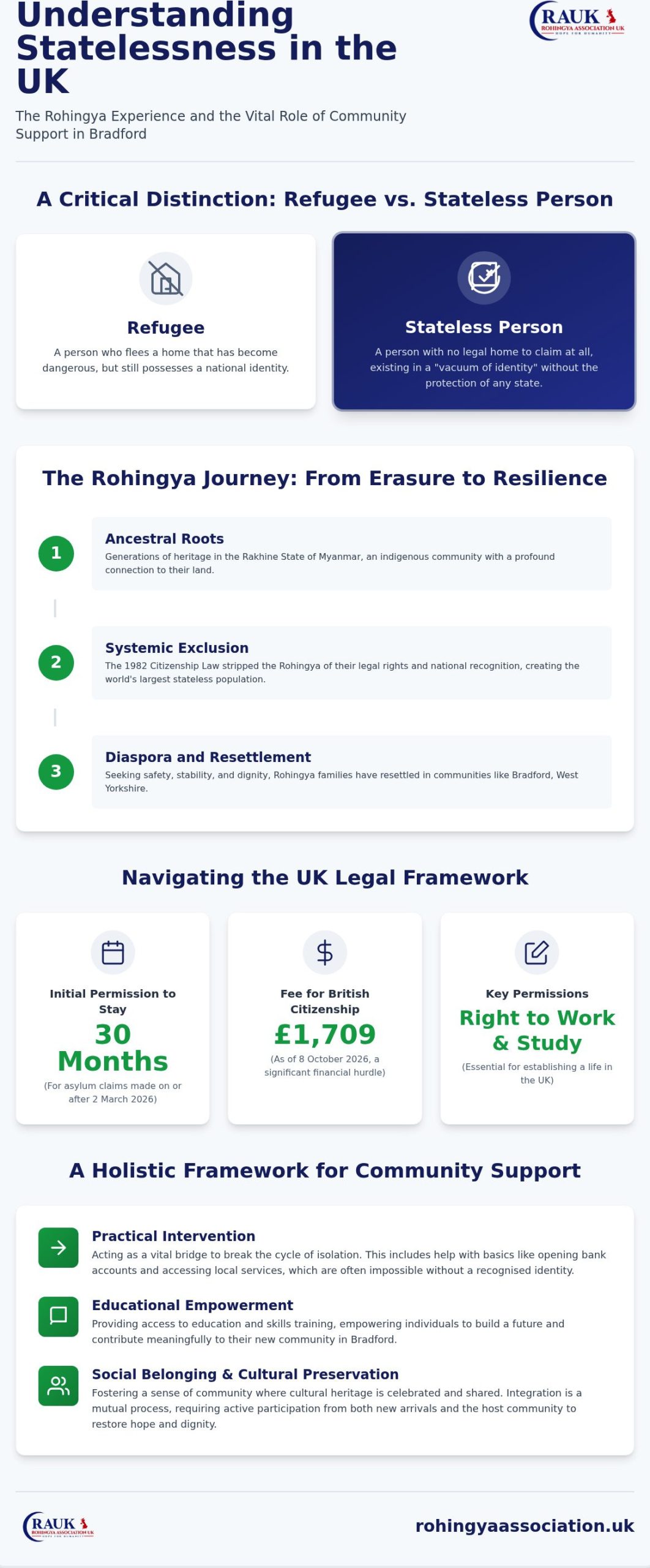
To belong to a nation is to possess a shield of rights, a history of recognition, and a future of security. However, the international definition of statelessness describes a person who is not considered a national by any state under the operation of its law. In the British context, the distinction between a refugee and a stateless person is subtle yet profound. Whilst a refugee flees a home that has become dangerous, a stateless person often has no legal home to claim at all. They exist in a vacuum of identity, lacking the fundamental bond between an individual and a state that guarantees protection and belonging.
This condition creates a somber reality where individuals are often born into a legal shadow without choice or agency. They are trapped in a cycle of invisibility; they cannot open bank accounts, they cannot travel across borders, and they cannot access the basic services that many take for granted. It’s a life of waiting, where the absence of a passport becomes a barrier to every milestone of human growth. Through the dedicated work of charities for stateless people Bradford, these individuals are finally seen, heard, and supported as they seek to reclaim their dignity.
To better understand the lived experience of those seeking safety in our community, watch this helpful video:
The Hidden Crisis of Statelessness in Britain
Statelessness often remains a hidden crisis, overshadowed by more visible humanitarian emergencies. In the UK, the Rohingya community represents one of the most significant groups affected by this systemic denial of citizenship. Having been stripped of their nationality in their ancestral lands, they arrive in cities like Bradford seeking a stability that has been denied to them for generations. Providing community support for displaced families is essential to breaking the cycle of isolation that statelessness imposes. Local charities for stateless people Bradford act as a vital bridge, offering the cultural preservation and social connection necessary for true integration.
The Legal Framework: Navigating Leave to Remain
The legal landscape for those seeking recognition is rigorous and frequently changing. For asylum claims made on or after March 2, 2026, successful applicants are typically granted an initial period of 30 months’ permission to stay. This status is subject to review and replaces the previous five-year grant, creating a shorter window for individuals to establish their lives before facing further scrutiny. Whilst this status provides the right to work and study, the path to permanent settlement remains arduous. For instance, as of October 8, 2026, the fee for naturalisation as a British citizen stands at £1,709; a significant financial hurdle for families surviving on limited asylum support. Understanding these frameworks is the first step toward providing effective, principled advocacy for our neighbours.
The Rohingya Experience: A Journey of Resilience and Identity
The Rohingya people carry a heritage rooted in the Rakhine State of Myanmar, where they have lived for generations as an indigenous community. Their history is one of profound connection to their ancestral lands, yet it is marred by the 1982 Citizenship Law that stripped them of their legal rights and recognition. This systemic exclusion created the world’s largest stateless population, forcing millions into a life without national protection or basic human security. Despite the gravity of this historical trauma, the diaspora in West Yorkshire exemplifies a resilient optimism. Local efforts in the UK are deeply connected to the global pursuit of justice for Rohingya people, ensuring that the struggle for accountability remains a priority even thousands of miles from home.
From Myanmar to Bradford: The Diaspora Path
Rohingya families have settled in West Yorkshire through various resettlement programmes, seeking the safety and stability that a stateless status denies. Transitioning from rural life or refugee camps to a Western urban centre presents unique challenges, particularly regarding the maintenance of cultural heritage. Many families fear the loss of their language and traditions amongst the pressures of a new society. In this context, charities for stateless people Bradford provide more than just practical aid; they offer a sanctuary where identity is protected and celebrated. Community-led organisations serve as guardians of the Rohingya story, ensuring that the journey from Myanmar to Bradford is documented with dignity and respect.
Preserving Heritage Whilst Integrating
For a people denied a state, cultural preservation becomes a powerful form of resistance against erasure. It is not merely about looking backward; it is about grounding the next generation in their history so they can navigate the future with confidence. Identifying and overcoming barriers to integration and belonging is often tied to how well an individual’s own culture is respected by their new community. The Rohingya Association UK organises specific cultural events and educational programmes to keep the Rohingya identity vibrant for the youth, balancing the honouring of ancestral roots with the building of a productive life in Britain. By celebrating their unique heritage, refugees can contribute to the rich tapestry of Bradford’s multicultural society without losing their sense of self. Supporting charities for stateless people Bradford ensures that this diaspora doesn’t just survive, but truly thrives within our community.
How to Support Stateless Refugees UK: A Practical Framework
Supporting those without a nation requires more than a signature on a legal document; it demands a commitment to the restoration of human dignity. Effective advocacy moves beyond the bureaucratic mechanics of leave to remain to address the person as a whole. By focusing on a holistic framework, charities for stateless people Bradford ensure that families aren’t just processed through a system, but are welcomed into a community. This support is built upon three essential pillars: practical stability, educational empowerment, and social connection. When assistance is grounded in lived experience, it avoids the pitfalls of paternalism and instead fosters genuine agency. We must prioritise initiatives that empower individuals to lead their own journeys toward renewal.
Essential Practical Assistance
The initial days for a newly arrived family are often defined by a dizzying array of administrative hurdles. Navigating local council protocols and securing stable refugee housing requires expert guidance that understands the specific barriers stateless individuals face. For those surviving on just £49.18 per week in self-catered accommodation, as per the June 2026 rates, the margin for error is non-existent. Access to healthcare is equally critical, particularly for those who have endured the trauma of displacement. Crisis intervention must be immediate, compassionate, and professional, ensuring that basic needs like food and shelter are met with dignity whilst longer-term settlement plans are established.
Empowerment Through Education
Education serves as the bridge between a state of survival and a life of contribution. Learning the English language is the first and most vital step toward social integration, allowing refugees to advocate for themselves and connect with their neighbours. For the next generation, refugee youth empowerment programmes provide the necessary foundation to overcome historical disadvantages and build brighter futures. These initiatives go beyond the classroom, offering skills development and vocational training that prepare individuals for the British workforce. By investing in the potential of the youth, charities for stateless people Bradford transform a legacy of exclusion into a future of leadership and shared prosperity. This methodical approach ensures that every individual has the tools to move from a legal shadow into the light of full participation in society.
Overcoming the Barriers to Integration and Belonging
Integration is frequently mischaracterised as a one-way street, an obligation placed solely upon the shoulders of the displaced. True belonging is a mutual process; it’s a shared covenant between the individual and the city that welcomes them. The Bradford host community plays an indispensable role in this transformation, acting as a protective shield, a guiding hand, and a welcoming neighbour. Whilst policy often dictates the legal terms of stay, it’s the warmth of local connections that determines the quality of life. Charities for stateless people Bradford serve as the vital architects of this social bridge, ensuring that integration is rooted in respect rather than mere assimilation. When we create spaces where neighbours meet as equals, we dismantle the barriers of “othering” that statelessness often imposes.
The impact of national policy on mental wellbeing cannot be ignored. The 2026 introduction of 30-month reviewable permission to stay has created a landscape of temporary protection that often leaves individuals in a state of perpetual uncertainty. This legal limbo exacerbates the trauma of past persecution, making it difficult for families to truly ground themselves. To break the cycle of social isolation, we must prioritise community bonding as the primary tool for restoration. This approach focuses on the possibility of renewal, protection, and growth for every individual who calls our city home.
Tackling the Language and Skills Gap
Language serves as the fundamental key to accessing basic human rights, from healthcare to fair employment. Without the ability to communicate, even the simplest interaction becomes a source of profound frustration and exclusion. RAUK provides tailored English language classes that acknowledge the specific linguistic heritage of the Rohingya people, ensuring that learning is both accessible and dignified. In the landscape of 2026, digital literacy has also become an essential pillar of survival. Navigating the UK’s digitised public services requires a level of technical proficiency that many newly arrived families lack. By providing these critical skills, we empower individuals to advocate for themselves and participate fully in British life.
Mental Health and Wellbeing in Displaced Communities
We must approach the mental health of stateless refugees with a deep sense of empathy and moral seriousness. The somber reality of PTSD and historical trauma is a constant companion for many who have fled systemic violence. Generic support services often lack the cultural sensitivity required to address these complex needs effectively. Peer-led support groups and culturally informed healthcare are essential for long-term healing. For many in our community, shared faith and Islamic events offer a vital spiritual anchor, providing a sense of continuity and peace amidst the upheaval of displacement. These gatherings are more than social events; they are spaces of collective renewal, strength, and sanctuary.
If you wish to participate in these vital efforts, you can support our community-led integration programmes to help restore hope to our neighbours in Bradford.
Rohingya Association UK: A Steadfast Advocate in Bradford
The Rohingya Association UK (RAUK) stands as a principled leader within the humanitarian landscape of West Yorkshire. Unlike many organisations that approach displacement from an external perspective, RAUK is a community-led registered charity (1211433) rooted in the lived experience of its founders and staff. This unique position allows us to act as both a protective shield and a guiding hand for those navigating the profound complexities of statelessness. Our work spans the entire spectrum of the refugee experience, from providing immediate housing guidance in Bradford to conducting vital advocacy for those still residing in rohingya refugee camps abroad. We invite you to move beyond the role of a distant observer and become a dedicated partner in this mission of restoration and hope.
Local Impact: Supporting Families in West Yorkshire
In the streets of Bradford, the transition from a state of survival to a true sense of belonging is a delicate journey. We provide the practical assistance that families need to anchor themselves in a new environment, focusing on housing stability, healthcare access, and social integration. Our youth empowerment programmes and English language classes aren’t merely educational tools; they’re the foundations for future leadership and agency. Consider the journey of a family who arrived in our city overwhelmed by the digital requirements of UK life and the isolation of their status. Through RAUK’s intervention, they secured stable housing, the children entered local schools with confidence, and the parents began participating in our cultural events. This is how charities for stateless people Bradford transform legal shadows into vibrant, participating members of society.
How You Can Help: A Call to Action for 2026
As we navigate the challenges of 2026, the need for sustained, professional support has never been more urgent. The shift toward temporary protection statuses and the rising costs of naturalisation fees place immense pressure on stateless families already living on the margins. Your voluntary charitable donations directly fund our crisis intervention projects, ensuring that no family is left without essential support during their most vulnerable moments. Beyond financial contributions, getting involved with local refugee support groups in Bradford allows you to participate in the collective effort of community renewal. Whether you offer your time, your voice, or your resources, your engagement helps us tackle inequality at its root. We remain committed to a future where every person in our city is granted the dignity, protection, and opportunity they deserve.
Fostering a Future of Belonging in Bradford
Statelessness is a profound legal challenge, yet it isn’t an insurmountable barrier to human connection. We have explored how the absence of national identity creates a vacuum of rights, and why a holistic approach to integration is essential for true restoration. By focusing on practical stability, educational empowerment, and social connection, we can bridge the gap between legal isolation and social belonging. The work of charities for stateless people Bradford remains a vital lifeline for families seeking to rebuild their lives with dignity and purpose. Through community-led advocacy, we ensure that the voices of the diaspora are not just heard, but are leading the way toward systemic change.
The Rohingya Association UK (Registered Charity No. 1211433) is a steadfast partner in this mission, offering support rooted in lived experience. Our direct impact reaches from local housing guidance in West Yorkshire to humanitarian aid in Myanmar and Bangladesh. We invite you to support the Rohingya Association UK and help restore hope to stateless families today. Together, we can build a city where every neighbour is protected, valued, and empowered to thrive. Your commitment ensures that the possibility of renewal remains a reality for all.
Frequently Asked Questions
What is the difference between a refugee and a stateless person in the UK?
A refugee is someone fleeing persecution from their home country, whereas a stateless person is not considered a national by any state under the operation of its law. In the UK, this distinction is critical because it dictates the specific legal pathways available for protection. Whilst refugees seek asylum from a known state, stateless individuals often exist in a legal vacuum where no nation accepts responsibility for their welfare, identity, or safety.
Can stateless refugees work in Bradford while their application is processed?
Most individuals awaiting a decision on their status are not permitted to work. However, there are specific conditions under which permission to work may be granted, typically if the application has been pending for over 12 months through no fault of the applicant. Charities for stateless people Bradford focus on providing humanitarian aid and food support during this period of forced inactivity to alleviate the financial strain on families surviving on limited support.
How long does it take to get a decision on a statelessness application in 2026?
Processing times for statelessness applications are subject to Home Office capacity and the complexity of individual cases. In 2026, many applicants face extended periods of uncertainty whilst their identity and lack of nationality are verified. During this time, community organisations provide essential social and educational support to help individuals maintain their wellbeing. It is advisable to consult official government updates or a qualified legal professional for the most current processing estimates for this status.
How can I support a stateless family in my local Bradford community?
Supporting a stateless family requires a holistic approach that prioritises dignity and integration. You can contribute by volunteering with local support groups, donating to crisis intervention projects, or participating in community bonding events. Providing a welcoming environment helps break the cycle of social isolation. Many people find that supporting charities for stateless people Bradford is the most effective way to ensure their contributions reach those in need through structured programmes like English language classes.
What services does the Rohingya Association UK provide in Bradford?
The Rohingya Association UK provides a comprehensive range of services including housing guidance, healthcare access, and refugee settlement support. We deliver education through English language classes and youth empowerment programmes designed to build brighter futures. Additionally, our team organises cultural and Islamic community events to preserve heritage and strengthen communal bonds. As a community-led organisation, we combine practical aid with global advocacy to ensure the protection and growth of the Rohingya people in West Yorkshire.
Are there specific education grants for stateless youth in the UK?
Education grants for stateless youth often depend on their specific leave to remain status and the policies of individual educational institutions. Whilst some universities offer scholarships for sanctuary seekers, access to standard student finance can be restricted until settled status is achieved. RAUK focuses on youth empowerment by providing skills development and educational support locally, helping young people navigate these hurdles and prepare for future academic or vocational success within the British education system.
Why are so many Rohingya people considered stateless?
The majority of Rohingya people are stateless due to the 1982 Citizenship Law enacted in Myanmar, which effectively stripped them of their nationality. This systemic denial of citizenship transformed them into the world’s largest stateless population, leaving them without legal protection or a recognised home. This historical trauma is why our work in Bradford and abroad focuses so heavily on cultural preservation and the pursuit of international justice to restore the identity of this community.
How do voluntary donations help stateless families in Bradford?
Voluntary charitable donations are the lifeblood of our crisis intervention and integration projects. These funds are used to provide humanitarian aid, food support, and essential practical assistance to families arriving in West Yorkshire with nothing. Donations also sustain our long-term programmes, such as English language classes and youth empowerment initiatives, which are crucial for tackling inequality. Every contribution helps us act as a steadfast advocate for those seeking to rebuild their lives with dignity.