
Table of Contents
- Understanding the Spiritual and Humanitarian Weight of Water Charity
- The Acute Water Crisis in Cox’s Bazar and Rakhine (Arakan) State
- Evaluating Charities: Transparency and Community-Led Impact
- The Journey of Your Donation: Construction and Maintenance
- How You Can Take Action Today: Supporting Rohingya Communities
In July 2026, catastrophic floods across Cox’s Bazar and Rakhine State, formerly known as Arakan State, damaged more than 29,000 water points, leaving hundreds of thousands without a safe source of life. You understand that a donation is a sacred trust; you rightly expect it to serve as a permanent lifeline rather than a fleeting gesture. Identifying the best charity for Sadaqah Jariyah water wells requires a partner that values transparency and long-term maintenance as much as you do. It’s about ensuring that every pound donated transforms into a reliable source of life for the world’s most persecuted communities. This guide provides the clarity you need to navigate the complexities of international aid. We’ll examine how to provide verified, clean water to the 1.2 million Rohingya refugees in Bangladesh whilst maintaining infrastructure through the harshest climates. You’ll discover how to move past the fear of mismanagement by connecting directly with community-led initiatives that prioritise dignity, safety, and the preservation of human life.
Key Takeaways
- Learn why water is prioritised in Islamic tradition as the ultimate form of “ever-flowing” charity and how it serves as a foundation for community restoration.
- Understand the acute water scarcity facing 1.2 million refugees in Cox’s Bazar and the historical deprivation of resources in Rakhine State; also known as Arakan State.
- Discover how to identify the best charity for Sadaqah Jariyah water wells by evaluating transparency, maintenance protocols, and the unique benefits of community-led intervention.
- Gain insight into why deep tube wells are critical in coastal regions to combat salinity and ensure your gift provides safe, clean water for years to come.
- Explore practical ways to combine your resources with others to fund major infrastructure projects that offer long-term protection for persecuted families.
Understanding the Spiritual and Humanitarian Weight of Sadaqah Jariyah Water Wells
Within Islamic tradition, the act of giving is not merely a social obligation but a profound spiritual investment. Understanding Sadaqah Jariyah involves recognising it as a form of “voluntary charity” that yields continuous rewards for the donor, even after they have passed from this life. When you seek the best charity for Sadaqah Jariyah water wells, you aren’t just looking for a construction partner; you’re choosing a custodian for your spiritual legacy. This form of giving ensures that as long as a person, animal, or plant benefits from the water provided, the rewards continue to flow back to the giver. It’s a powerful way to ensure your wealth serves a purpose far beyond your own lifetime.
The Concept of Eternal Reward in Islam
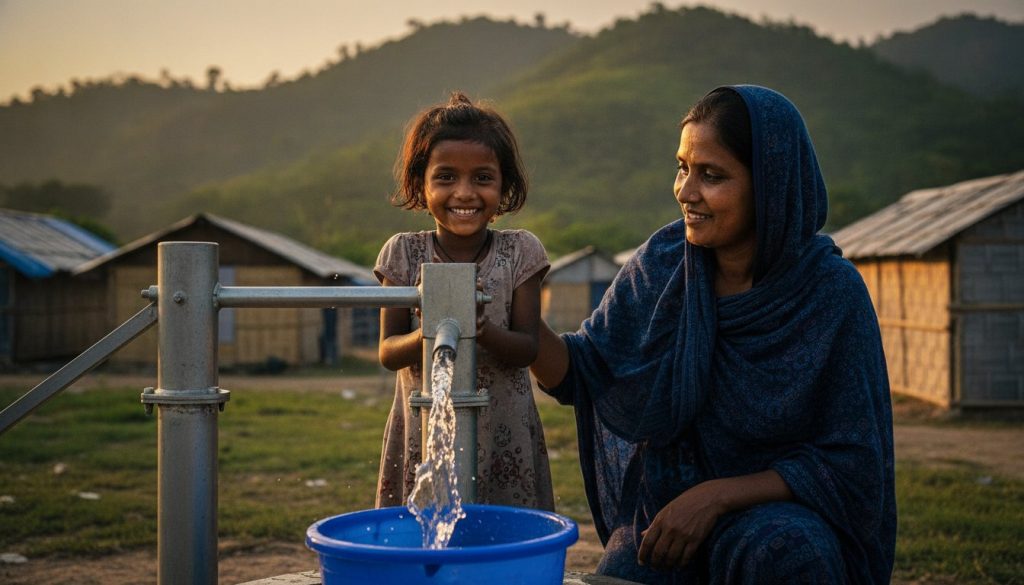
The Prophet Muhammad (peace be upon him) identified providing water as the best form of charity. This prioritisation reflects water’s status as the most essential element of life. For those living in displaced communities, such as the 1.2 million Rohingya refugees in Cox’s Bazar, a reliable water source is the difference between survival and systemic neglect. Quenching the thirst of the vulnerable is an act of mercy that carries immense weight in the scales of justice. Sadaqah Jariyah acts as a bridge between immediate relief and long-term community resilience. Your intention, or niyyah, transforms a simple physical structure of pipes and pumps into a lasting testament of faith and compassion.
Water as a Human Right and Religious Duty
Access to clean water is a fundamental human right, yet it remains a tool of deprivation in many conflict zones. In the context of Islamic stewardship, or Khilafah, we’re tasked with the protection and equitable distribution of natural resources. Clean water is vital for maintaining dignity, ensuring hygiene, and performing ritual purity (Wudu). Without it, the spiritual and physical health of a community withers. When refugees are forced to choose between contaminated water and no water at all, the religious duty to intervene becomes urgent.
Professional organisations today categorise water projects based on geological needs and communal impact to ensure sustainability. When evaluating the best charity for Sadaqah Jariyah water wells, look for those that integrate social justice with humanitarian aid. This intersection moves the needle from temporary charity to systemic empowerment, allowing persecuted families to reclaim their health and their future. By providing the means for Wudu and clean drinking water, you support both the physical survival and the spiritual practice of those in need.
The Acute Water Crisis in Cox’s Bazar and Rakhine State (Arakan)
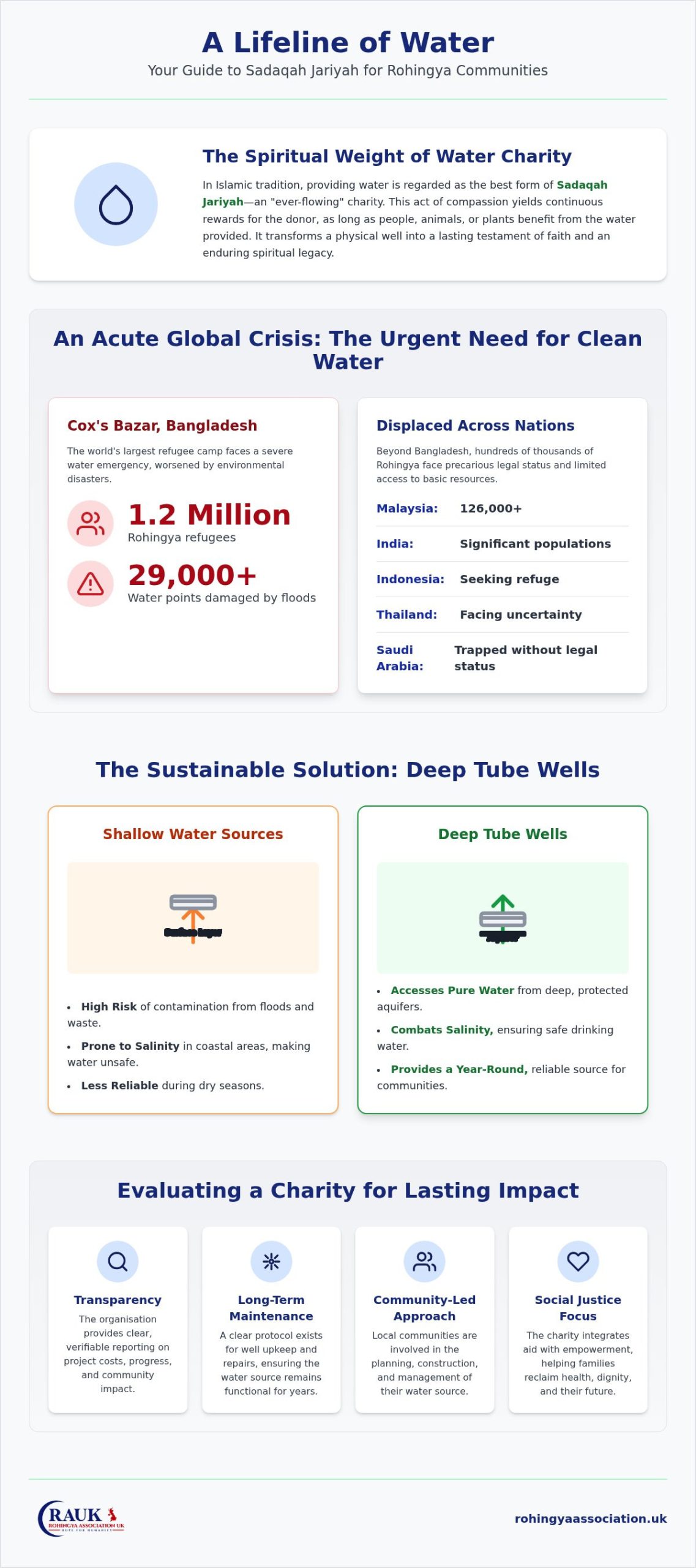
The scale of the humanitarian emergency facing the Rohingya people is a global crisis that extends far beyond the borders of Myanmar. Whilst the 1.2 million refugees in Cox’s Bazar, Bangladesh, represent the largest concentration of displaced families, the struggle for survival is felt amongst the diaspora across Southeast Asia and the Middle East. In Malaysia, over 126,000 Rohingya now navigate a complex legal transition as the state moves from previous international documentation to the Malaysian government’s DPP (Dokumen Pendaftaran Pelarian) system. Similar populations remain in a state of precariousness in India, Indonesia, and Thailand, whilst thousands more remain trapped in Saudi Arabia without legal status. Finding the best charity for Sadaqah Jariyah water wells requires an organisation that recognises this global displacement and the unique regional barriers to clean water access.
Life in the World’s Largest Refugee Camp
In the overcrowded camps of Cox’s Bazar, the environment is as hostile as the political landscape. The sheer density of the population has placed an unsustainable burden on local aquifers, leading to a rapid decline in the water table. The following metrics illustrate the severity of the crisis as of July 2026:
- Impact of July 2026 Floods: Heavy monsoon rains and landslides affected 182,015 people in Cox’s Bazar, damaging or contaminating 29,076 water points.
- Groundwater Depletion: Water levels in Ukhiya and Teknaf upazilas are dropping by 4 to 12 metres annually due to the daily extraction of 20 to 25 million litres.
- Infrastructure Loss: Across the 33 Rohingya camps, 42,934 individuals were directly affected by the July weather events, which destroyed 36,550 latrines and vital sanitation hubs.
These statistics highlight why deep extraction is no longer optional but a necessity for survival. Understanding life and resilience in the Rohingya refugee camp involves acknowledging that without safe water, the community’s health and dignity remain under constant threat.
Systemic Challenges in Rakhine (Arakan) State
In Rakhine State, formerly known as Arakan State, the crisis is exacerbated by a history of systemic resource deprivation. Conflict and political instability have left hundreds of villages submerged during floods, affecting an estimated 98,282 people in July 2026 alone. This “water apartheid” has historically restricted the Rohingya’s access to permanent infrastructure, forcing reliance on contaminated ponds. As detailed in research on Drinking Water Security Challenges, the lack of protected sources leads to a high prevalence of water-borne diseases. By choosing the best charity for Sadaqah Jariyah water wells, you help bypass these barriers through the construction of resilient, arsenic-free deep tube wells. To help us restore these vital lifelines, you can support our Bangladesh projects and provide immediate relief to those in the greatest need.
Evaluating Charities: Transparency, Accountability, and Community-Led Impact
Selecting the best charity for Sadaqah Jariyah water wells requires a discerning eye for operational integrity. Donors often face a choice between large, impersonal organisations and smaller, community-led initiatives. Whilst international NGOs possess vast resources, they frequently lack the granular, culturally nuanced understanding required to navigate the complex social landscape of a refugee camp. True accountability goes beyond financial statements; it’s found in the enduring functionality of the well and the dignity of the people it serves. Many donors are drawn to a “100% donation policy,” but this is often a marketing tool that masks the essential costs of maintenance, logistics, and professional oversight. Without a dedicated budget for operational expenses, charities cannot employ the engineers and field officers necessary to ensure a well doesn’t fall into disrepair. A sustainable project requires investment in staff who can monitor water quality and repair mechanical failures years after the initial construction.
The Advantage of Local Expertise
Being community-led allows the Rohingya Association UK (RAUK) to navigate the intricate logistics of Cox’s Bazar and Rakhine State, formerly known as Arakan State, with unparalleled precision. Our leadership, rooted in the Rohingya diaspora in Bradford, ensures that every project is prioritised based on the actual needs of displaced families rather than administrative convenience. This cultural bond facilitates smoother integration and ensures that aid is delivered with the respect and sensitivity it deserves. By leveraging the insights of those with lived experience of displacement, we identify the most acute needs in areas where water has been used as a tool of systemic deprivation. You can learn more about our approach to community support for displaced families through our dedicated guide.
Transparency and Reporting Standards
Verification is the cornerstone of trust in humanitarian work. A high-quality completion report shouldn’t just be a receipt; it must include precise GPS coordinates, high-resolution photographs, and detailed beneficiary data to prove the well is serving its intended purpose. True accountability involves regular audits, consistent monitoring, and direct feedback from camp leaders to ensure the water remains safe and accessible. This methodical approach prevents well failure and protects the health of the community from water-borne diseases. It’s this level of detail that transforms a simple donation into a permanent spiritual legacy. When you choose a partner that values transparency, you ensure your gift continues to provide life-saving relief for generations.
The Journey of Your Donation: From Well Construction to Sustainable Maintenance
When you partner with the best charity for Sadaqah Jariyah water wells, your contribution initiates a rigorous technical and social process that prioritises longevity over speed. It isn’t just about digging a hole in the ground; it’s about engineering solutions that withstand the environmental pressures of coastal Bangladesh and the political pressures of Rakhine State, formerly known as Arakan State. Site selection is our first critical step. We identify areas where the water table is most recessed and where displacement has created the highest density of need, ensuring that every well serves the maximum number of families in the most desperate conditions.
The Engineering of Hope: Deep Tube Wells
In coastal regions like Cox’s Bazar, shallow wells are frequently prone to salinity and arsenic contamination. To counter this, we drill to depths often exceeding 200 metres to reach safe, potable aquifers that remain protected from surface pollutants. This process requires high-grade materials, such as galvanised steel and heavy-duty PVC, to resist the corrosive, humid climate of the Bay of Bengal. Whilst building fewer, higher-quality wells is more capital-intensive, it ensures that your Sadaqah Jariyah remains a functional lifeline for decades. A shallow well might provide immediate relief, but a deep tube well provides a permanent legacy. We categorise our projects by their geological suitability, ensuring that the infrastructure we build is perfectly matched to the specific terrain of the camp or village.
Empowering Communities through Maintenance
A well without a management plan is a temporary fix. We ensure sustainability by organising local water committees and providing training in basic plumbing and pump repair for the residents themselves. This creates a powerful sense of ownership amongst the beneficiaries, transforming them from passive recipients of aid into active custodians of their own resources. These wells become hubs for broader communal growth; they support hygiene education in local schools and provide the clean water necessary for medical centres to operate safely. This work is a vital component of our broader mission of seeking justice for Rohingya people, as it restores the basic rights that have been systemically denied to them for generations. To ensure your donation provides a lasting impact for those in need, you can donate your Sadaqah Jariyah to our verified water projects today.
How You Can Take Action Today: Supporting Rohingya Communities through Water
Restoring access to life’s most basic necessity is an act of profound moral significance. As we’ve explored, the challenges in Cox’s Bazar and Rakhine State, formerly known as Arakan State, are immense; however, the possibility for renewal remains within our reach. By choosing to partner with the best charity for Sadaqah Jariyah water wells, you’re not just funding a construction project. You’re participating in a broader movement for justice and the restoration of human dignity for 1.2 million displaced people. Whether you choose to fund an individual deep tube well or contribute to a large-scale water filtration system, your agency creates a tangible shift in the daily survival of a persecuted family.
Collective giving is a cornerstone of our community-led model. We believe that every contribution, regardless of its size, possesses the power to effect systemic change when pooled with the efforts of others. You might involve your local mosque or community centre in a fundraiser, turning a personal act of worship into a shared communal legacy. This collaborative approach allows us to fund major infrastructure that a single donor might find daunting, providing protection for entire camp sectors against the threat of water-borne diseases and environmental degradation.
Donate Your Sadaqah Jariyah
Your journey with us begins with a simple, transformative decision. You can donate your Sadaqah Jariyah directly to our verified water projects. We prioritise these funds for the most urgent sectors in the camps, where water scarcity is most acute and the risk to health is highest. Many of our supporters choose to dedicate a well in the name of a loved one, creating a gift of eternal mercy that serves as a permanent spiritual bridge between the donor and the beneficiaries. It’s a way to ensure your wealth continues to grow in reward whilst providing a lifeline to those who have lost everything.
Support Our Bangladesh Projects and Volunteer
Sustainability requires more than a one-off donation; it demands a long-term commitment to the Rohingya people. We invite you to support our Bangladesh projects through regular, monthly giving, which allows us to maintain existing wells and respond rapidly to emergencies. Beyond financial aid, your voice and time are invaluable. You can volunteer with Rohingya Association UK either through our Bradford-based leadership team or remotely from anywhere in the world. Join us in our steadfast mission to provide global hope through local support, ensuring that no family is left to suffer the indignity of thirst.
Building a Legacy of Resilience and Hope
Providing clean water is a profound act of mercy that secures both physical survival and spiritual reward. We’ve explored how deep tube wells offer a permanent solution to the water crisis in Cox’s Bazar and Rakhine State, formerly known as Arakan State. By prioritising technical integrity and community-led maintenance, you ensure your donation isn’t just a temporary fix but a lasting foundation for health and dignity. As a registered UK charity (1211433), Rohingya Association UK provides direct access to 1.2 million refugees, ensuring every pound is used where it’s needed most.
Choosing the best charity for Sadaqah Jariyah water wells means finding a partner that understands the unique needs of the Rohingya diaspora. Our community-led structure ensures that your gift is managed with the cultural sensitivity and long-term oversight required for true success. It’s time to transform your compassion into a tangible lifeline for those who have been systemically deprived of their rights for far too long. Donate your Sadaqah Jariyah to provide clean water today. Together, we can restore hope and build a future where every family has the safe, clean water they deserve.
Frequently Asked Questions
How much does it cost to build a water well in Cox’s Bazar in 2026?
Costs for constructing a water well in Cox’s Bazar in 2026 fluctuate based on the specific depth required and the logistical challenges of the camp sector. Deep tube wells are more expensive than shallow pumps due to the heavy machinery needed to reach safe aquifers. We recommend viewing our current projects to understand the specific funding requirements for different regions. Every donation contributes to a permanent, life-saving infrastructure for displaced families.
Can I donate Sadaqah Jariyah in the name of a deceased relative?
You can certainly donate Sadaqah Jariyah in the name of a deceased relative as a gift of eternal mercy. In Islamic tradition, the rewards for providing water continue to benefit the deceased as long as the well remains functional. This act of “ever-flowing” charity serves as a beautiful tribute, ensuring their legacy provides life and dignity to vulnerable communities in Rakhine State, formerly known as Arakan State.
What is the difference between a shallow well and a deep tube well?
Shallow wells typically extract water from the top 30 metres of the water table, whereas deep tube wells reach depths of 200 metres or more. In coastal regions like Bangladesh, shallow sources are often contaminated by arsenic or seasonal salinity. To be the best charity for Sadaqah Jariyah water wells, we prioritise deep extraction to ensure the water is safe, sustainable, and protected from surface pollutants.
How does RAUK ensure that water wells are maintained long-term?
Long-term maintenance is secured through our community-led structure and the formation of local water committees. We don’t just build the well; we train residents in basic plumbing and mechanical repairs to foster a sense of ownership. This grassroots approach ensures that the infrastructure remains operational for years, providing a reliable source of clean water for the 1.2 million refugees currently residing in the camps of Cox’s Bazar.
Is my donation for a water well eligible for Gift Aid in the UK?
Yes, donations for water projects are eligible for Gift Aid if you’re a UK taxpayer. This allows us to reclaim an extra 25p for every £1 you give, at no extra cost to you. This additional funding is vital for our crisis intervention and humanitarian aid projects. It ensures that your contribution goes even further in tackling inequality and providing essential resources to persecuted Rohingya communities across Southeast Asia.
How long does it typically take from donation to the completion of a well?
The timeline from donation to completion typically ranges from three to six months. This duration accounts for site surveys, procurement of high-grade materials, and the actual drilling process. External factors, such as the heavy monsoon rains that affected 1.28 million people in July 2026, can occasionally cause delays. We prioritise quality and safety over speed to ensure the well serves the community for many years to come.
Will I receive a report with photos and the location of the well I funded?
You’ll receive a comprehensive completion report once the project is finalised. This document includes high-resolution photographs of the well, its specific GPS coordinates, and data regarding the number of beneficiaries served. Transparency is a core pillar of our advocacy work. Providing these details allows you to verify the impact of your donation and see the tangible restoration of dignity your gift has provided to displaced families.
What happens if a water well breaks down or becomes contaminated?
If a well breaks down or becomes contaminated, our local water committees are the first line of response. These trained residents handle minor repairs immediately using a dedicated maintenance fund. For more complex issues, our field teams in Bangladesh and Myanmar provide professional intervention. This proactive monitoring is why selecting the best charity for Sadaqah Jariyah water wells is essential for ensuring your spiritual legacy remains functional.