
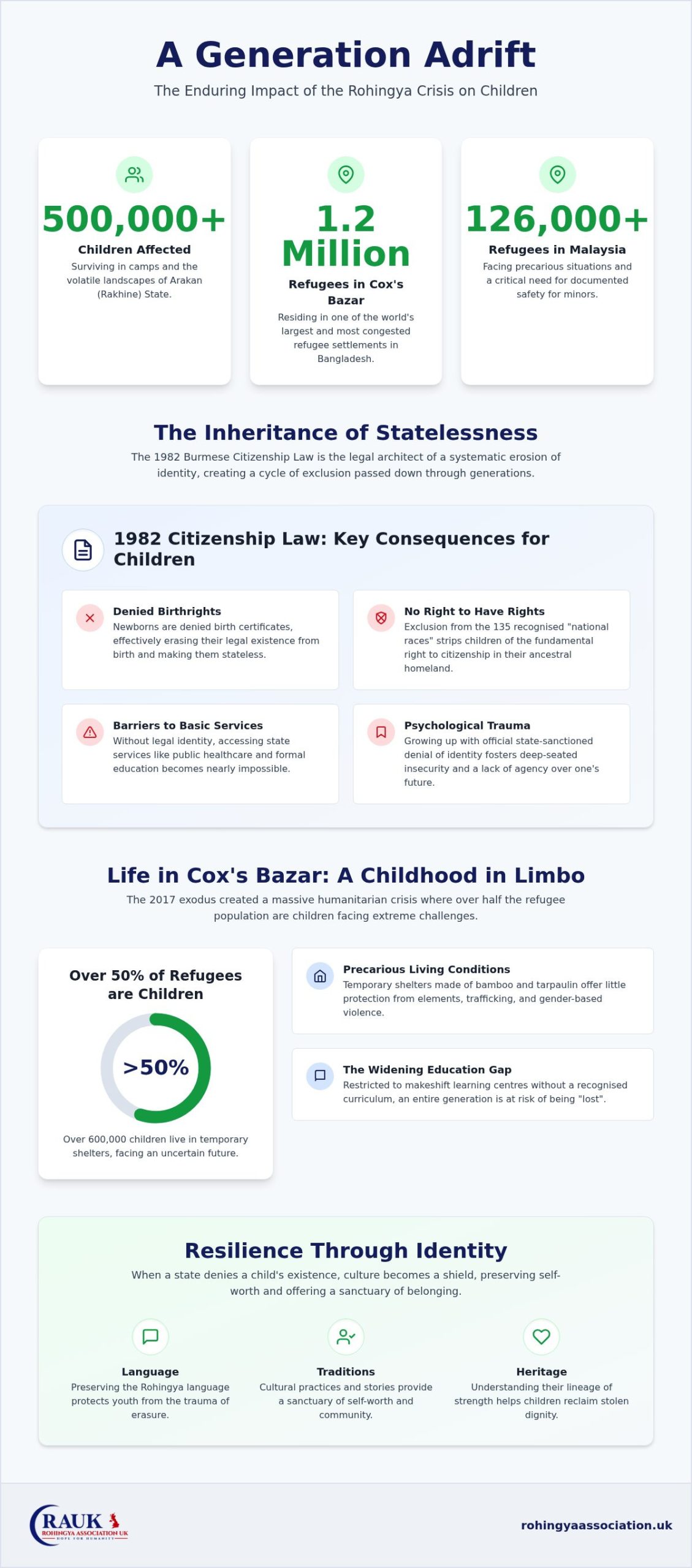
What does it mean to grow up in a world that refuses to recognise your very existence? For over half a million minors surviving in the camps of Cox’s Bazar and the volatile landscapes of Arakan State, also known as Rakhine State, this is not a philosophical query but a lived reality. The impact of Rohingya crisis on children extends far beyond the immediate trauma of displacement; it’s a systematic erosion of identity, safety, and future potential. You’ve likely encountered the harrowing headlines and felt a profound sense of exhaustion as the cycle of violence remains unbroken.
We recognise that the sheer scale of this humanitarian catastrophe often feels overwhelming, particularly when reports lack historical context or clear paths for intervention. This article provides a definitive analysis of how decades of statelessness have shaped a generation, offering the clarity required to move from silent empathy to meaningful action. We’ll examine the legal roots of child statelessness, explore the education gap amongst 1.2 million refugees, and identify how supporting local UK charities like RAUK can facilitate genuine recovery in 2026.
Key Takeaways
- Uncover the legal origins of statelessness in Arakan State, also known as Rakhine State, and how the 1982 Citizenship Law denied children their birthright.
- Analyse the long-term impact of Rohingya crisis on children residing amongst the 1.2 million refugees in Cox’s Bazar, focusing on the widening education gap.
- Review the precarious situation for 126,000 refugees in Malaysia and the critical need for documented safety for minors across Southeast Asia.
- Identify the vital role of community-led organisations like RAUK in fostering integration and providing youth empowerment for families in the UK.
- Gain actionable insights into supporting sustainable recovery efforts that prioritise cultural preservation and long-term stability for the next generation.
Historical Roots: Statelessness and Stolen Childhoods in Arakan State
The Rohingya are an indigenous Muslim ethnic minority with deep ancestral roots in Arakan State, now officially known as Rakhine State. For generations, their presence was a vibrant thread in the region’s social fabric, yet political shifts have sought to unravel this history. The 1982 Citizenship Law serves as the primary architect of this erasure. It didn’t just target adults; it effectively criminalised the existence of future generations by stripping children of their birthright and national identity. This legal exclusion has profoundly shaped the impact of Rohingya crisis on children, creating a psychological landscape where youth grow up feeling like intruders in their own ancestral homes. When a child’s identity is officially denied by their own government, the resulting trauma manifests as a deep-seated sense of insecurity and a lack of agency over their own future.
The Inheritance of Statelessness
Statelessness is a burden passed from parent to child like a shadow. Without legal recognition, newborns are denied birth certificates, which makes accessing basic state services like healthcare or primary education nearly impossible. The 1982 law established three tiers of citizenship: full, associate, and naturalised. By design, the Rohingya were excluded from all three, as they weren’t listed amongst the 135 “national races” deemed indigenous. This institutionalised rejection forces children into a state of perpetual vulnerability. They aren’t just lacking a passport; they’re lacking the right to have rights. Addressing these legal barriers is central to the ongoing pursuit of justice for Rohingya people, as legal restoration is the only way to break the cycle of inherited exclusion. Without a legal identity, these children remain trapped in a perpetual state of “nowhere,” unable to move, study, or work legally.
Cultural Identity as a Form of Resilience
Despite the systematic attempt to erase their presence from Arakan State (Rakhine State), the Rohingya people maintain a rich cultural heritage that dates back centuries. For children, this identity is a shield. When a state tells a child they don’t belong, their language, traditions, and stories provide a sanctuary of self-worth. Preserving the Rohingya language and heritage protects youth from the trauma of erasure, ensuring they understand they come from a lineage of strength rather than just a history of victimhood. This is why the Rohingya Association UK (RAUK) prioritises cultural education within the diaspora. By connecting global advocacy to local heritage projects, we ensure that the impact of Rohingya crisis on children doesn’t result in the loss of their soul. Restoration begins with remembering who they are and reclaiming the dignity that was stolen by discriminatory laws.
The 2017 Exodus and the Humanitarian Crisis in Cox’s Bazar
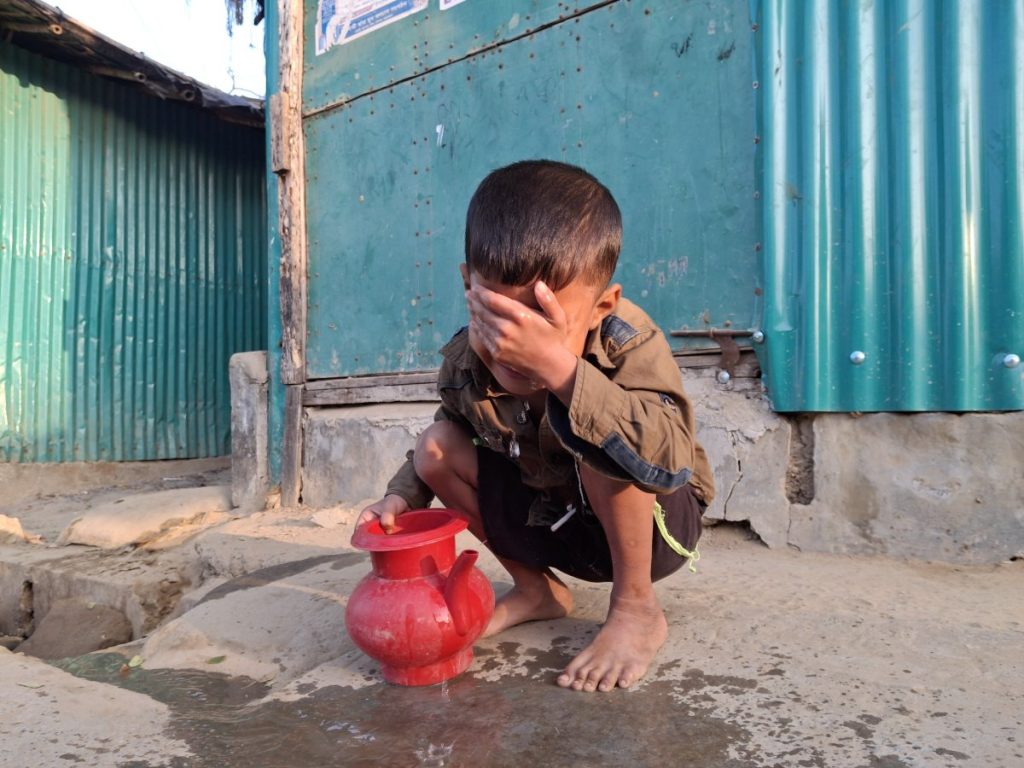
In August 2017, a brutal campaign of violence in Rakhine State (Arakan State) forced hundreds of thousands of families to flee across the border in search of safety. Today, approximately 1.2 million Rohingya refugees reside in the sprawling, congested camps of Cox’s Bazar, creating one of the most complex humanitarian landscapes in the world. Amongst this population are over half a million children who live in temporary shelters constructed of bamboo and tarpaulin. These structures offer very little protection against the elements or the complex social dangers inherent in such high-density environments. The impact of Rohingya crisis on children is perhaps most visible here, where the lack of secure infrastructure creates significant protection gaps. Children face heightened risks of trafficking and exploitation, whilst girls are particularly vulnerable to gender-based violence. Understanding these dangers is essential for anyone looking inside the rohingya refugee camp to grasp the daily reality of displacement.
Education Gaps in the Largest Refugee Settlement
Education is a cornerstone of recovery, yet for Rohingya youth in Cox’s Bazar, formal and accredited schooling remains largely out of reach. For years, children were restricted to a makeshift learning centre model that lacked a recognised curriculum, threatening to create a “lost generation” without the qualifications needed for self-sufficiency. This systemic gap stifles the future of the Rohingya people and limits their ability to eventually rebuild their communities. RAUK supports educational initiatives designed to bridge these humanitarian voids, ensuring that children can access structured learning that respects their heritage, promotes their dignity, and prepares them for a life beyond the camp boundaries. We believe that knowledge is a form of resistance against the cycle of poverty and exclusion.
Environmental and Health Risks for Children
The geography of Cox’s Bazar presents its own set of lethal challenges for the young. During the monsoon season, heavy rains frequently trigger mudslides that threaten the fragile shelters where families sleep, often with devastating consequences. For children, the environmental risks are compounded by a lack of clean water and sanitation, leading to a high prevalence of waterborne diseases that can be fatal in such cramped conditions. Access to healthcare is not a luxury; it is a fundamental human right that remains precarious for displaced minors. When clinics are overwhelmed or inaccessible due to flooded paths, children suffer the most. Promoting health and safety is a core part of our mission at RAUK. You can learn more about how we facilitate humanitarian aid and food support for those most at risk in these challenging conditions.
Regional Displacement: The Plight of Children in Malaysia and Beyond
While the camps of Cox’s Bazar represent the most visible face of the humanitarian crisis, the struggle for survival extends deep into Southeast Asia and the Middle East. Over 126,000 Rohingya refugees currently seek safety in Malaysia, yet their presence is often met with legal ambiguity rather than sanctuary. The impact of Rohingya crisis on children in these regions is defined by a lack of status that leaves them vulnerable to detention and exploitation. In India, Indonesia, and Thailand, youth navigate a world without formal protections, whilst those in Saudi Arabia remain trapped in a cycle of residency barriers. For many, the path to these countries involves crossing the Bay of Bengal, a journey where the risk of maritime exploitation and human trafficking is an ever-present threat. These children are fleeing the trauma of Rakhine State, also known as Arakan State, only to find themselves in a different kind of peril.
Malaysia and the Transition to the DPP System
Malaysia has recently begun transitioning from UNHCR documentation to the Dokumen Pendaftaran Pelarian (DPP), a government-led registration system. This shift has profound consequences for the stability of refugee families. Whilst the DPP system aims to organise the refugee population, it has created new hurdles for child healthcare and schooling access. Many parents find themselves hesitant to engage with state systems, fearing that registration might lead to increased surveillance rather than support. Historically, Malaysian policy changes have dictated the level of safety a family feels. For children, these shifts determine whether they can access a doctor or a desk in a community learning centre. RAUK monitors these transitions closely to ensure families understand their rights during these bureaucratic changes.
The ‘Forgotten’ Children of the Diaspora
Thousands of Rohingya youth in Saudi Arabia and India live in the shadows of international attention. These children often lack the basic humanitarian aid infrastructure found in major camp systems, leaving them to face extreme poverty and social exclusion alone. A critical challenge for stateless families is the inability to register births in transit countries. When a child is born without a recognised nationality, they’re legally invisible from their first breath. This lack of documentation makes it nearly impossible to prove their lineage or claim rights in the future. The impact of Rohingya crisis on children is thus amplified by a global failure to provide legal identity to those born in exile. We must ensure these children are not forgotten in the broader fight for justice and restoration.
Healing and Empowerment: Supporting Rohingya Youth in the UK
For those who have reached the shores of the United Kingdom, the journey towards healing is a methodical and deeply personal process. The Rohingya Association UK (RAUK), rooted in the community of Bradford, serves as a vital anchor for families navigating this complex transition. Whilst the immediate impact of Rohingya crisis on children often involves physical displacement and trauma, the long-term challenge is one of psychological and social restoration. We provide a pathway from initial crisis intervention to comprehensive community support for displaced families, ensuring that every child has the tools to thrive. Our approach is grounded in the belief that empowerment is the most effective antidote to the legacy of statelessness.
Integration and Youth Leadership in Bradford
Practical assistance forms the foundation of our work in West Yorkshire. We facilitate school enrolment, assist with healthcare navigation, and provide essential guidance on housing to ensure family stability. However, our vision extends beyond mere survival. Through targeted refugee youth empowerment programs, we cultivate leadership skills amongst the younger generation. English language classes and vocational workshops foster a sense of independence that was previously denied to them in the camps. This collective effort prevents the isolation often felt by displaced youth, replacing it with a sense of purpose and communal pride. We don’t just help children settle; we help them lead.
Preserving Heritage as a Tool for Recovery
True recovery requires a balance between integration and preservation. Maintaining the Rohingya language is a vital component of psychological resilience, providing a linguistic link to ancestral roots in Arakan State, also known as Rakhine State. RAUK organises cultural and Islamic events that allow children to celebrate their identity with dignity and joy. These gatherings are not merely social; they’re acts of cultural preservation that protect the next generation from the trauma of erasure. By connecting with their history, children understand they’re part of a resilient heritage that transcends their current status. We believe that a child who understands their past is better equipped to build a stable, successful future in the UK. Join us in our mission to provide education and youth empowerment for the next generation of Rohingya leaders.
How You Can Take Action Today
Transforming empathy into tangible change requires a shift from passive observation to active partnership. When you choose to support a community-led organisation like the Rohingya Association UK, you aren’t just providing aid; you’re investing in a team with the lived experience necessary to navigate this complex humanitarian landscape. Our unique position as both a local Bradford charity and a global advocate allows us to address the impact of Rohingya crisis on children at every stage of their journey. By prioritising community-led initiatives, you ensure that resources are directed where they can facilitate the greatest restoration and growth. We believe that collective action is the only way to secure a future for a generation that has known only displacement.
Support Our Global and Local Projects
Direct intervention is the most immediate way to alleviate suffering. We invite you to support our Bangladesh projects, which provide emergency relief and stabilisation for families in the most congested settlements of Cox’s Bazar. For those seeking to create a lasting legacy of empowerment, you can donate your Sadaqah Jariyah to fund our long-term education and housing programmes. These contributions are fundamental to securing the rights of children trapped in the volatile conditions of Rakhine State, also known as Arakan State, where crisis intervention remains a daily necessity. Purposeful giving transforms survival into stability.
Volunteer and Advocate for Change
Change is also driven by local action and the power of a collective voice. You can volunteer with Rohingya Association UK at our Bradford centre, where your time can directly assist families with integration and youth leadership development. Beyond physical support, advocacy remains a potent tool for justice. Sharing factual, historical information helps counter the misinformation that often clouds public perception of the crisis. By keeping the needs of Rohingya children on the political agenda, we collectively act as a protective shield for a generation at stake. This sustained pressure is essential to mitigating the long-term impact of Rohingya crisis on children across the globe. Principled leadership, combined with your commitment, ensures that the path toward recovery remains open and well-supported.
Restoring a Stolen Future for the Next Generation
The systematic denial of legal identity in Arakan State and the subsequent humanitarian crisis in Cox’s Bazar have created a legacy of exclusion that no child should have to bear. We’ve explored how the impact of Rohingya crisis on children manifests through widening education gaps, severe health risks, and the precarious nature of regional displacement. Yet, the resilience of the Rohingya people remains a powerful force for renewal. By focusing on cultural preservation, youth leadership, and local integration, we can begin to dismantle the barriers that have stifled a generation’s potential and restore their sense of belonging.
The Rohingya Association UK (RAUK) stands as a principled leader in this effort. As a community-led charity (Registered Charity: 1211433) founded by individuals with lived experience, we operate direct aid projects in Cox’s Bazar, Malaysia, and Bradford. Our mission is to provide the protection, education, and advocacy necessary for these children to reclaim their dignity and thrive. Your participation is a vital component of this restoration. We invite you to Support our Bangladesh projects and help displaced families today. Together, we can ensure that a generation at stake becomes a generation empowered.
Frequently Asked Questions
Who are the Rohingya people and why are they in Arakan State?
The Rohingya are an indigenous Muslim ethnic minority whose presence in Arakan State, now known as Rakhine State, spans many centuries. They are native to this coastal region of Myanmar; they developed a distinct language, culture, and social structure over generations of settlement. Their presence is rooted in ancestral heritage, though they have faced decades of systematic efforts to de-legitimise their indigenous status and historical ties to the land.
How many Rohingya children are currently refugees in 2026?
Approximately half a million children are currently surviving as refugees in the camps of Cox’s Bazar, Bangladesh, amongst a total displaced population of 1.2 million. These minors represent nearly half of the entire refugee community in the region. Thousands more are scattered across Malaysia, India, and Thailand. This significant demographic underscores the profound impact of Rohingya crisis on children as they navigate a childhood defined by displacement.
What is the significance of the 1982 Citizenship Law for children?
The 1982 Citizenship Law is the legal instrument that rendered the Rohingya people stateless by excluding them from the list of recognised national races. For children, this legislation means they are born without a nationality; it prevents them from obtaining birth certificates or any form of legal identity. This inherited statelessness blocks their access to state schools and formal healthcare, effectively criminalising their existence from birth.
How does the DPP system in Malaysia affect Rohingya child documentation?
The Dokumen Pendaftaran Pelarian (DPP) is a Malaysian government-led registration system that replaces older UNHCR documentation for refugees. For children, the transition to the DPP system determines their legal visibility and their ability to access community-based education and medical services. Whilst it aims to provide a formal framework for the 126,000 refugees in Malaysia, it often creates bureaucratic hurdles that families must navigate to maintain stability.
What happened in Rakhine State (Arakan State) in August 2017?
In August 2017, a widespread campaign of targeted violence in Rakhine State, also known as Arakan State, triggered a massive exodus of over 700,000 people. Families were forced to flee their homes to escape atrocities, crossing the border into Bangladesh under extreme duress. This event transformed the regional landscape and led to the creation of the world’s largest refugee settlement in Cox’s Bazar, where families remain in temporary shelters today.
Can I donate Sadaqah Jariyah to support Rohingya education projects?
Yes, you can donate Sadaqah Jariyah to fund long-term education and youth empowerment initiatives through the Rohingya Association UK. Because education provides a lasting benefit that empowers children to rebuild their lives, it is a highly appropriate form of continuous charity. Your contributions help establish learning centres and vocational training programmes that provide displaced youth with the skills needed to break the cycle of poverty and inherited statelessness.
How does the Rohingya Association UK support families in Bradford?
RAUK provides comprehensive community support for families in Bradford, focusing on housing assistance, school enrolment, and healthcare navigation. We act as a bridge between displaced families and local services, ensuring that children can integrate successfully into the UK education system. Our centre also hosts cultural and Islamic events that allow youth to preserve their heritage whilst building new lives as confident members of the British diaspora.
Why is the Rohingya crisis often called a ‘child rights’ emergency?
The crisis is termed a child rights emergency because minors constitute a disproportionately large percentage of the displaced population and face unique vulnerabilities. The impact of Rohingya crisis on children includes the systematic denial of the right to a nationality, education, and safety. When an entire generation is raised in temporary shelters without legal status, it creates a fundamental breach of international human rights frameworks designed to protect youth.