
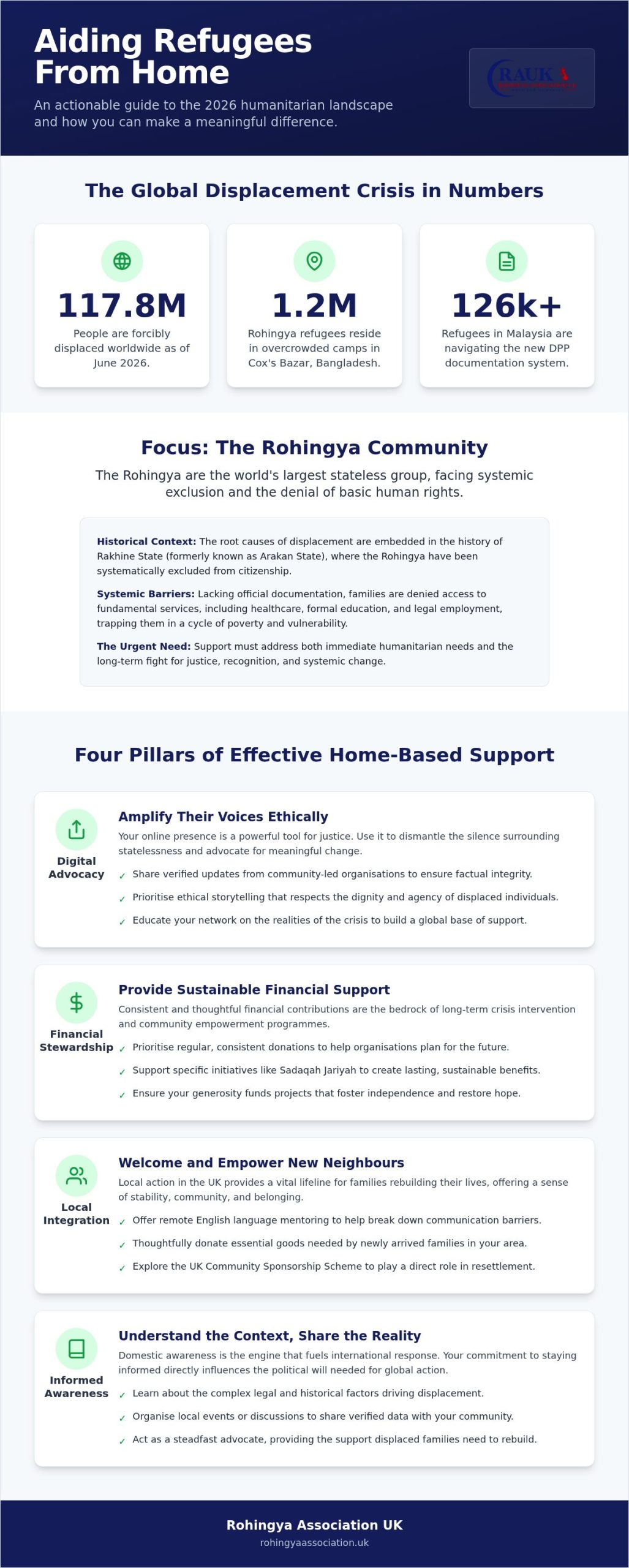
As of June 2026, the number of forcibly displaced people worldwide stands at 117.8 million. Whilst this figure has finally begun to decrease, the sheer scale of the global crisis often leaves individual supporters feeling powerless and uncertain about where to begin. You might wonder if the best way to help refugees from home is actually enough to spark meaningful change for families in Rakhine State, formerly known as Arakan State, or those in overcrowded camps. It’s a common fear that small, domestic actions cannot possibly reach those in the greatest need.
We understand that you want your generosity to be both effective and dignified. This comprehensive guide promises to bridge the gap between your desire to help and the ground reality in places like Cox’s Bazar, where 1.2 million Rohingya refugees currently reside. We’ll explore how you can leverage the new UK Community Sponsorship Scheme, navigate the complexities of the Immigration and Asylum Bill 2026, and support the restoration of hope for stateless communities. By the end of this article, you’ll have a clear list of actionable steps to protect, empower, and restore the lives of the displaced without leaving your house.
Key Takeaways
- Gain a precise understanding of the 2026 humanitarian landscape, including the challenges facing 1.2 million Rohingya in Cox’s Bazar and those navigating the DPP system in Malaysia.
- Master the art of digital advocacy to amplify the voices of the stateless whilst maintaining factual integrity through verified, community-led organisations.
- Identify the best way to help refugees from home by prioritising consistent, impactful financial stewardship that sustains long-term crisis intervention and growth.
- Explore dignified methods of local integration, ranging from remote English language mentoring to the thoughtful donation of essential goods for UK-based families.
- Develop a clear, actionable strategy to support displaced families in Rakhine State, also known as Arakan State, through sustainable advocacy and aid.
Understanding the Global Refugee Landscape in 2026
Global forced displacement has reached a staggering 117.8 million people. Whilst this figure represents a slight decrease for the first time in a decade, the scale of the crisis remains a profound weight on our collective conscience. This number isn’t just a statistic; it represents millions of individual stories of survival, loss, and the enduring hope for a safe place to call home. Amongst these displaced populations, the Rohingya remain the world’s largest stateless group, a people defined by their incredible resilience despite being denied the basic right to a nationality. Their struggle is a sombre reminder of the work required to ensure every human life is protected, valued, and restored.
The geography of this crisis is concentrated in specific regions where the need for stable, long-term commitment is most urgent. In Cox’s Bazar, Bangladesh, approximately 1.2 million Rohingya refugees live in overcrowded conditions, relying on international aid for their most basic survival. Meanwhile, in Malaysia, over 126,000 refugees navigate an evolving legal landscape. A critical shift is currently underway in Malaysia as the government transitions from existing international agency documentation to its own DPP (Dokumen Pendaftaran Pelarian) system. Understanding these administrative changes is essential for those who wish to support our Bangladesh projects or advocate for policy changes that respect the dignity of displaced families.
- Global Forcibly Displaced: 117.8 million people.
- Rohingya in Cox’s Bazar: 1.2 million individuals.
- Refugees in Malaysia: Over 126,000, currently transitioning to the DPP system.
- Countries of Origin: 72% of all refugees originate from just seven countries, including Venezuela, Palestine, and Ukraine.
The Crisis in Rakhine State (Arakan State)
To understand the present, we must acknowledge the history of Rakhine State, formerly known as Arakan State. The root causes of displacement here are deeply embedded in a human rights framework that has systematically excluded the Rohingya from citizenship and safety. Families in this region haven’t only fled active conflict; they’ve been pushed out by decades of legal erasure and state-sanctioned inequality. Today, the legal status of stateless families remains precarious, as they lack the documentation necessary to access healthcare, education, or formal employment. This systematic denial of rights is why we must continue to fight for justice and systemic change alongside providing immediate humanitarian aid.
Why Home-Based Support is Vital
You might feel that the distance between your living room and a camp in Bangladesh renders your efforts insignificant, but the best way to help refugees from home is to recognise your role in a global advocacy network. Domestic awareness is the primary engine that fuels international response. When you choose to educate your community, you’re directly influencing the political will needed to sustain funding and protection. Individual actions, such as sharing verified data or organising local events, create a groundswell of support that reaches far beyond UK borders. By acting as a steadfast advocate, you provide the protective shield and guiding hand that displaced families need to begin the difficult journey toward renewal and independence.
Digital Advocacy: Raising Your Voice for the Stateless
Digital advocacy serves as a vital bridge between the quiet safety of our homes and the urgent needs of displaced communities. In an era where information travels instantly, your online presence can become a powerful tool for restoration and justice. By using social media platforms to amplify the voices of the Rohingya, you help dismantle the silence that often surrounds statelessness. Many often ask what the best way to help refugees from home is, and the answer frequently lies in the power of digital advocacy; it’s a commitment to justice that transcends physical borders.
Following and sharing updates from community-led organisations is essential for maintaining factual integrity. These groups provide the ground reality from places like Cox’s Bazar, where 1.2 million people face daily uncertainty. When you share their content, you aren’t just posting; you’re validating their struggle and bringing their stories to a global audience that has the power to demand change. This steady build-up of momentum is what eventually leads to systemic shifts in how the international community perceives and responds to the crisis.
Ethical Storytelling and Awareness
Dignity must be the cornerstone of your advocacy. It’s vital to prioritise representations that honour the strength and heritage of refugees rather than relying on sensationalist or pitiable imagery. When discussing the conditions in Rakhine State, formerly known as Arakan State, focus on the human rights framework and the legal metrics of their displacement. Educating your social circle on the legal distinction between refugees and asylum seekers is a small but significant act of clarity. This knowledge counters misinformation and fosters a more informed, compassionate public discourse that respects the resilience of those seeking safety.
Joining Global Campaigns
Active participation in digital events that celebrate Rohingya culture is a profound way to support communal bonds. These events offer a space for empowerment and renewal, shifting the narrative from one of constant crisis to one of cultural pride. Beyond celebration, your platform can be used to seek justice for Rohingya people by supporting online petitions that call for legal accountability in Myanmar. Principled leadership in this space requires a long-term commitment rather than a fleeting emotional reaction.
Engaging with political structures is equally impactful. Writing to your local MP regarding human rights protections for the Rohingya ensures that these issues remain on the legislative agenda in the UK. You might also consider how you can volunteer with Rohingya Association UK to help manage these digital campaigns, ensuring that every message sent contributes to a stable, protective shield for those who have lost everything. Advocacy is a collective effort; it requires us to stand as dedicated partners in the fight for a world where every family is safe.
Financial Stewardship: Making Every Donation Count
Giving is an act of profound empathy, yet its effectiveness depends on strategic choice. Many donors find that the best way to help refugees from home is through consistent financial stewardship that prioritises long-term restoration over fleeting relief. Whilst one-off contributions are vital during acute emergencies in Rakhine State, formerly known as Arakan State, small and regular donations provide the stable foundation needed for crisis intervention. This reliable income allows organisations to plan essential services, from food distribution to healthcare, ensuring that aid doesn’t falter when the news cycle moves on.
Transparent reporting is the hallmark of a principled leader in humanitarian advocacy. You should seek charities that provide clear data on how funds are utilised amongst the 1.2 million refugees in Cox’s Bazar. By funding education and skills development, you aren’t just providing aid; you’re investing in the future autonomy of stateless families. This forward-looking approach shifts the focus from mere survival to the possibility of renewal and shared identity. It represents a shift from being a distant benefactor to a dedicated partner in the pursuit of systemic change.
- Direct Aid Ratio: The percentage of your donation that directly reaches the ground in camps.
- Impact Reporting: The frequency and detail of updates regarding specific project milestones.
- Community Agency: Evidence that displaced families are involved in prioritising their own needs.
The Power of Sadaqah Jariyah
Sadaqah Jariyah represents a form of voluntary, ongoing charity that continues to benefit the recipient and the donor long after the initial gift. Unlike immediate relief, this model focuses on sustainable growth and protection. Funding a deep-water well or a temporary classroom in a camp provides lasting benefits to families who have lost everything. When you donate your Sadaqah Jariyah, you’re building a legacy of safety and heritage that empowers the next generation of Rohingya children to thrive despite their displacement.
Supporting International Projects
Effective aid delivery requires a deep understanding of local logistics and social conditions. When you support our Bangladesh projects, your contributions are directed toward the ground reality in Cox’s Bazar. This includes the complex coordination of medical aid and food support, where community-led distribution is prioritised to ensure that resources reach the most vulnerable households. By working with partners embedded in the community, we ensure that aid isn’t just delivered but is done so with the dignity and respect that every human being deserves.
Community Integration: Helping Refugees in the UK
Whilst global advocacy remains essential, for many, the best way to help refugees from home involves direct, personal engagement with families already residing in our local communities. This transition from international awareness to local integration is where the abstract concept of human rights becomes a lived reality. By offering remote mentoring or English language practice, you provide the linguistic and social tools necessary for displaced individuals to navigate their new environment with confidence. These interactions aren’t merely charitable acts; they’re the building blocks of a resilient, inclusive society that values every member’s contribution.
You can also support local resettlement programmes by donating high-quality household items that turn a temporary shelter into a genuine home. Beyond material goods, choosing to patronise businesses and social enterprises run by displaced individuals directly fuels their economic empowerment and social mobility. Organising or attending cultural events further strengthens these communal bonds, allowing for a shared celebration of heritage and resilience that counters the isolation often felt by those far from their origins. This local support acts as a vital bridge toward long-term restoration and communal growth.
- Language Support: Dedicate one hour a week to conversational English via video call.
- Resource Sharing: Donate functional laptops or tablets to help children access educational resources.
- Economic Advocacy: Review and provide feedback on CVs to help refugees access the UK job market.
Volunteering Your Skills
Professional guidance in areas such as CV writing, IT skills, or navigating the complexities of UK healthcare and housing systems can be transformative. Providing this expert guidance is often the best way to help refugees from home when you have professional experience to share. These specific contributions help dismantle the barriers to employment and stability that many families face upon arrival. If you’re looking to make a direct impact, you can volunteer with Rohingya Association UK to support local families in Bradford, acting as a guiding hand during their initial months of settlement.
Fostering Cultural Understanding
True integration requires a mutual commitment to learning and growth. Taking the time to understand the rich heritage of the families arriving in your community fosters a sense of belonging and respect. You can champion this by promoting refugee youth empowerment programs within your local schools and community centres. Encouraging social inclusion through shared meals and communal events provides a protective shield against prejudice; it ensures that the next generation grows up in an environment defined by empathy rather than division.
How You Can Take Action Today
Knowledge serves as the foundation for advocacy, but it’s through direct action that we truly honour the resilience of displaced families. Transitioning from a sympathetic observer to a dedicated partner requires a shift in focus from the scale of the crisis to the tangible impact of your own agency. The best way to help refugees from home is to move beyond passive awareness and commit to a structured path of support. By integrating small, meaningful actions into your weekly routine, you contribute to a global network of protection that sustains those in the most precarious conditions.
Your first step should be a commitment to one digital advocacy action this week. Whether it’s sharing a verified report or writing to your local representative, these efforts ensure that the plight of stateless communities remains a priority on the national agenda. For those who can provide financial stability, setting up a recurring donation is a powerful method of long-term commitment. These regular funds allow for consistent crisis intervention and the restoration of safety for families still trapped in Rakhine State, formerly known as Arakan State. Every contribution helps maintain the vital infrastructure of aid that displaced populations rely upon for survival.
Education remains a cornerstone of effective advocacy. To truly understand the gravity of the situation and the strength of the human spirit, we encourage you to read about life inside the Rohingya refugee camp. Gaining this perspective ensures your support is rooted in the ground reality of Cox’s Bazar and beyond.
Immediate Steps for Impact
You don’t need to wait for a global summit to make a difference; change begins with the decisions you make today. Consider these immediate actions to expand the reach of your support:
- Follow for Updates: Join Rohingya Association UK on social media to receive real-time data and stories from our ground teams.
- Expand the Network: Share this 2026 guide with three friends or colleagues to foster a broader community of informed advocates.
- Local Search: Identify refugee support groups in your region that offer remote volunteering opportunities, such as digital mentoring or administrative support.
Partnering with Rohingya Association UK
Our work is rooted in the belief that community-led initiatives are the most effective way to drive systemic change. From our Bradford-based centre, we provide essential community support for displaced families, helping them navigate the complexities of life in the UK whilst maintaining their cultural identity. Our advocacy projects continue to push for legal accountability and justice on the global stage, acting as both a protective shield and a guiding hand for the stateless. We invite you to stand with us as a principled leader. You can donate your Sadaqah Jariyah today to empower stateless families and ensure that every child has the opportunity for a future defined by safety and dignity.
Restoring Hope Through Sustained Collective Action
The global displacement crisis of 2026 requires more than fleeting sympathy; it demands a stable, long-term commitment to justice and restoration. We’ve seen how informed digital advocacy, strategic financial stewardship, and local community integration create a protective shield for the stateless. Whether you’re amplifying voices from Rakhine State, formerly known as Arakan State, or mentoring a family in Bradford, your individual agency is a vital component of a global support network.
Finding the best way to help refugees from home starts with choosing a partner that’s deeply embedded in the communities it serves. Rohingya Association UK is a registered charity led by those with lived experience, providing a direct link between your domestic support and crisis intervention in Cox’s Bazar, where 1.2 million people still seek safety. Your involvement ensures that heritage and dignity are preserved for families navigating the difficult transition to safety.
Support stateless families by donating your Sadaqah Jariyah today. It’s through these principled actions that we move from being distant observers to dedicated partners in the pursuit of a world where every family is safe and every community can thrive.
Frequently Asked Questions
Is it better to donate money or physical goods from home?
Financial contributions are typically more effective than physical goods because they allow for local procurement, which reduces shipping costs and supports local economies. Whilst donating items is valuable for local UK resettlement, money provides the flexibility needed for crisis intervention in places like Cox’s Bazar. This ensures that aid is tailored to the immediate, shifting needs of the 1.2 million refugees currently residing there.
How can I ensure my donation actually reaches Rohingya refugees in Bangladesh?
You should prioritise registered UK charities that provide transparent reporting and are led by individuals with lived experience. Look for organisations that operate directly in the camps and can provide specific data on their Bangladesh projects. This transparency ensures your support reaches the most vulnerable families. It’s often the best way to help refugees from home with the confidence that your generosity is facilitating genuine restoration.
Can I help refugees in the UK if I do not live in a major city?
Remote support is entirely possible regardless of your geographic location. Digital advocacy and remote English language mentoring allow you to provide essential integration tools from any part of the UK. You can also support national campaigns that fight for systemic change and human rights protections. These domestic efforts are vital for fostering a broader network of social inclusion and shared identity across the country.
What is the most effective way to advocate for refugees on social media?
The most effective method is to share verified data and ethical stories that honour the dignity of displaced families. Avoid sensationalism and instead focus on the human rights frameworks and legal metrics of the crisis. Tagging your local MP in posts regarding the situation in Rakhine State, formerly known as Arakan State, ensures that the plight of the stateless remains a priority within the UK’s political discourse.
How much of my donation goes directly to aid projects in Cox’s Bazar?
Most reputable charities aim for a high direct aid ratio, where the vast majority of funds reach the ground. For instance, community-led organisations often have lower overheads, ensuring that more of your contribution supports food, healthcare, and education for the 1.2 million people in Bangladesh. You should always review a charity’s annual reports to verify their financial stewardship and commitment to transparent aid delivery.
Are there ways to help refugee children with their education from my home?
You can support education by funding the construction of temporary classrooms or providing digital learning resources. Remote tutoring in ESOL or IT skills is another impactful way to empower the next generation. These educational initiatives are the best way to help refugees from home to break the cycle of inequality and provide children with the tools needed for a future defined by agency and growth.
What is the difference between Sadaqah and Zakat when helping refugees?
Zakat is an obligatory form of almsgiving representing 2.5% of one’s wealth, whilst Sadaqah is a voluntary act of charity that can be given at any time. Sadaqah Jariyah is particularly impactful as it provides ongoing benefits, such as funding a permanent well or a school. Both forms of giving are essential for sustaining long-term crisis intervention and supporting the specific needs of stateless families in Arakan State.
How can I help refugees find housing or jobs in the UK from home?
You can assist by offering professional guidance on CV writing and UK job application processes through remote mentoring sessions. Supporting social enterprises that employ displaced individuals also provides a direct path to economic empowerment. Whilst you may not provide the housing itself, advocating for fair housing policies and supporting organisations that specialise in settlement and integration helps dismantle the systemic barriers many families face.