

Master the transition from asylum support to independent living with this step-by-step guide to securing a safe, permanent home in the UK. For newly recognised refugees, the moment of receiving status is one of profound relief, yet it also marks the beginning of a daunting new challenge: navigating the complex housing system within a high-pressure timeframe. This guide is designed to be your trusted companion through that journey, transforming a period of uncertainty into a clear, manageable process. Securing housing is not just a bureaucratic hurdle; it is the foundational step in restoring dignity, stability, and a sense of belonging for displaced families. Here, we combine authoritative legal guidance with compassionate, community-led expertise to empower you to build your new life in the United Kingdom.
Understanding the UK Refugee Housing Landscape
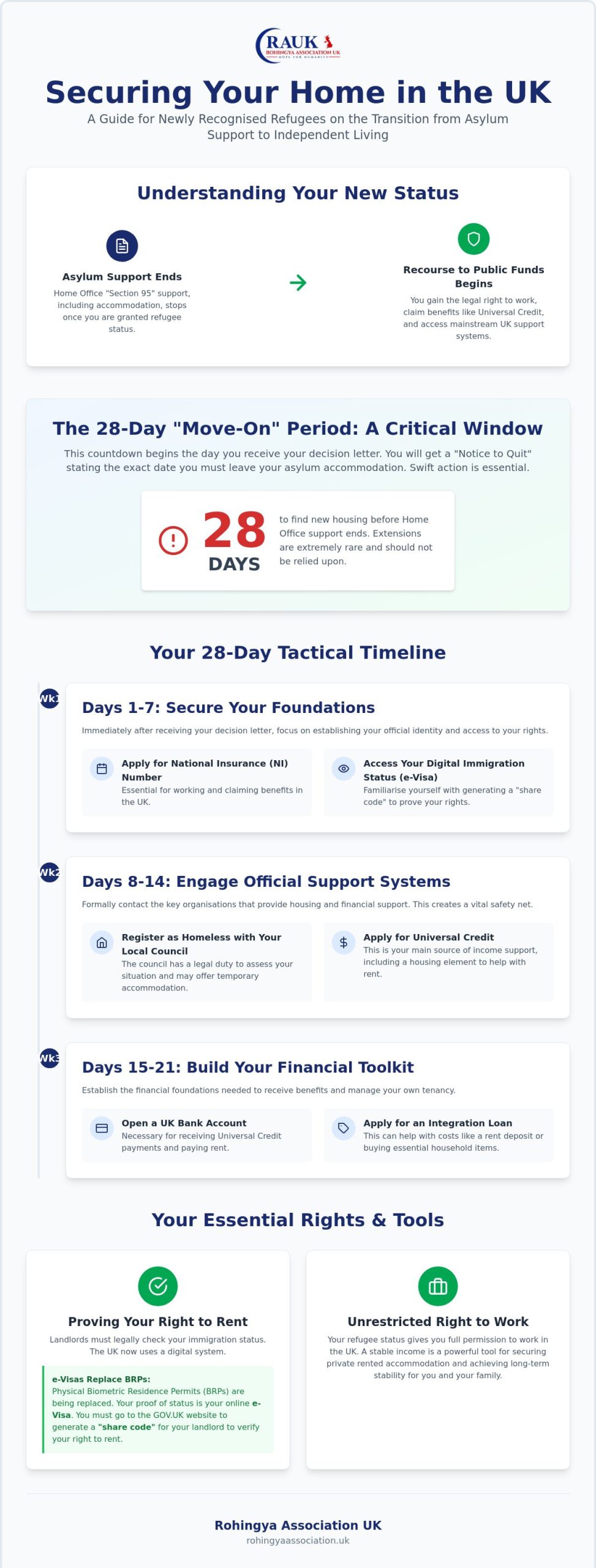
The journey to securing a home in the UK begins with understanding a critical legal and practical shift. Once you are granted refugee status, your relationship with the state changes fundamentally. You move from being supported by the Home Office as an asylum seeker to having “recourse to public funds,” which unlocks the support systems available to UK residents. This transition is the key to your independence, but it requires swift and informed action.
- Distinguishing between asylum support and refugee housing: Whilst you were waiting for a decision on your asylum claim, you likely received “Section 95” support, which included basic accommodation where you had no choice of location. Upon being granted refugee status, this support ends, and you must find your own housing, supported by the mainstream welfare system.
- The legal shift: Gaining “Recourse to Public Funds”: This term means you are now legally entitled to claim benefits, such as Universal Credit and Housing Benefit, and to work without restriction. This financial independence is crucial for renting a property and building a self-sufficient life.
- The role of your digital immigration status in proving your Right to Rent: The UK is moving away from physical Biometric Residence Permits (BRPs) to a digital immigration system. Your proof of status is now an online record, or e-Visa. Landlords are legally required to check that all prospective tenants have the right to rent in the UK. You will prove this by generating a “share code” through the official GOV.UK online service, which the landlord can use to verify your status instantly.
- Why local connection matters when choosing where to settle: When you apply to a local council for housing assistance, they will often assess your “local connection” to the area. This can be based on having lived there, having close family in the area, or working there. Whilst you can choose to live anywhere in the UK, establishing a local connection can sometimes strengthen your application for social housing or homelessness support.
The Move-On Period: A Critical Window
The “move-on period” is the official timeframe you are given to leave your Home Office asylum accommodation after you have been granted refugee status. This period is notoriously short—currently 28 days—and creates immense pressure on individuals and families to secure new housing immediately.
- Defining the move-on period: This 28-day countdown begins from the day you receive your status decision letter. It is the gap between Home Office support ending and mainstream benefits beginning.
- Identifying the “Notice to Quit”: You will receive a formal letter, often called a “Notice to Quit,” from the accommodation provider (such as Serco, Mears, or Clearsprings). This letter will state the date by which you must leave the property. You must act as soon as you receive this.
- Common misconceptions about housing extensions: It is extremely rare for the Home Office to grant an extension to your stay in asylum accommodation. You should not rely on this possibility. The expectation is that you will either find private accommodation or approach the local council for homelessness assistance within the 28 days.
Your Rights as a Newly Recognised Refugee
Gaining refugee status endows you with significant rights that are essential for securing housing and integrating into society. Understanding these rights is the first step toward advocating for yourself and your family.
- Accessing the DWP for housing-related benefits: You have the right to apply for Universal Credit from the Department for Work and Pensions (DWP). This is a single monthly payment to help with your living costs, which includes a housing element to help you pay rent.
- The right to work: Your new status gives you the unrestricted right to work in the UK. A stable income can significantly improve your chances of securing private rented accommodation and is a key part of long-term settlement.
- Defining the “Right to Rent” check: The “Right to Rent” check is a legal requirement for all UK landlords to verify that their tenants have the legal right to live in the UK. As a refugee, you pass this check by providing your landlord with a “share code” from the government’s online service, proving your immigration status.
The 28-Day Move-On Strategy: A Tactical Timeline
The 28-day move-on period is a race against time. A structured, day-by-day approach can make the process feel less overwhelming and increase your chances of a successful outcome. This timeline provides a clear, chronological action plan to guide you through this critical month.
- Day 1-7: Secure Your Foundations. As soon as you receive your decision letter, your first priorities are to secure your identity and financial access. Apply for your National Insurance (NI) number, which is essential for working and claiming benefits. At the same time, familiarise yourself with accessing your digital immigration status online. You will need this to prove your rights to landlords, employers, and banks.
- Day 8-14: Engage with Official Support Systems. This is the week to formally register as homeless with your local authority (council). Even if you hope to find private accommodation, taking this step creates a crucial safety net. The council has a legal duty to assess your situation and may provide temporary accommodation if you are eligible. Begin your application for Universal Credit during this week.
- Day 15-21: Build Your Financial Toolkit. Focus on opening a UK bank account, which is necessary to receive Universal Credit payments. You should also use this week to apply for an Integration Loan if you need it. This loan can be vital for covering a rental deposit or buying essential household items.
- Day 22-28: Finalise Your Housing Solution. In this final week, you will be working with the local council on emergency or temporary accommodation arrangements if you have been unable to secure a private tenancy. If you have found a private property, this is the time to sign the tenancy agreement, pay the deposit (using savings or the Integration Loan), and arrange your move.
Applying for the Refugee Integration Loan
The Integration Loan is an interest-free government loan specifically designed to help newly recognised refugees with the initial costs of setting up a home and integrating into UK life. It is an empowering tool, but it is essential to understand how it works.
- How the loan can be used: The loan is flexible and can be used for rental deposits, rent in advance, essential furniture, household items (like kitchenware or bedding), and even work-related expenses like tools or training courses.
- Eligibility criteria and the application process: You can apply if you are a recognised refugee or have humanitarian protection. The application is made through the Home Office, and you must apply within a specific timeframe after receiving your status.
- Repayment terms: The loan is repaid in small, manageable instalments that are deducted from your benefits or paid directly if you are working. It is designed to be an empowering tool, not a financial burden, but you must factor the repayments into your monthly budget.
Opening a UK Bank Account
A UK bank account is non-negotiable for receiving benefits and paying rent. However, many refugees face a significant hurdle: providing “Proof of Address” when they are living in temporary asylum accommodation. Fortunately, there are solutions.
- Challenges with “Proof of Address” and how to overcome them: Many banks now understand the situation of newly recognised refugees. Your decision letter from the Home Office, along with your digital status confirmation, can often be used as proof of identity. Some banks may accept a letter from your asylum accommodation provider or a local charity supporting you.
- Recommended banks with inclusive policies: High-street banks like HSBC, Barclays, and Lloyds have specific policies or guidance for helping refugees open accounts. It is worth visiting a branch in person to explain your situation.
- The link between your bank account and receiving housing benefits: Your Universal Credit payments, including the housing element, will be paid directly into your bank account. Without an account, you cannot receive this vital support.
How to Apply for Social Housing and Homelessness Assistance
For many refugees, particularly those with families or vulnerabilities, applying to the local council is the most viable path to securing stable housing. This process is governed by law, and understanding the terminology is vital for navigating the system effectively. This differs from the system in Scotland, and this guide focuses on the duties for councils in England and Wales.
- Understanding the “Homelessness Duty”: If you are homeless or will be within 56 days (which you are, as you have a “Notice to Quit”), the local council has a legal duty to assess your case and work with you to prevent or relieve your homelessness.
- The “Priority Need” test: The council will assess whether you are in “priority need” for accommodation. You are generally considered in priority need if you have dependent children, are pregnant, or are vulnerable due to age, disability, or other specific reasons. This is a critical test that determines the level of help you receive.
- The “Intentional Homelessness” trap: A council can refuse to provide long-term housing if they decide you have made yourself “intentionally homeless.” This is highly unlikely to apply to a refugee leaving asylum accommodation, as you have no choice but to leave. However, it is important not to refuse any suitable offer of temporary accommodation, as this could be seen as making yourself intentionally homeless.
- Navigating the Social Housing Register: If the council accepts a long-term housing duty, you will be placed on the Social Housing Register. You may need to “bid” for available properties online. Waiting times for social housing can be very long, often years, so this is rarely an immediate solution.
The Local Authority Assessment Process
When you approach the council, they will conduct a formal assessment. Being prepared for this interview can make a significant difference to the outcome.
- Preparing for your homelessness interview: Gather all your essential documents, including your Home Office decision letter, your digital status confirmation, the “Notice to Quit” from your asylum accommodation, and identification for everyone in your household.
- Temporary accommodation (TA): If the council determines you are in priority need, they must offer you temporary accommodation whilst they assess your full application. This could be in a hostel, a B&B, or a self-contained flat. The quality can vary significantly, but it provides an essential roof over your head. The stark difference between this and the conditions in displacement settings, such as those detailed in guides on life inside a Rohingya refugee camp, underscores the importance of this first step towards stability in the UK.
- Challenging a council decision: If the council makes a decision you believe is wrong—for example, that you are not in priority need—you have the right to request a review. It is highly recommended that you seek legal advice from a housing solicitor or a charity like Shelter if you need to challenge a decision.
Housing for Stateless Families and Large Households
The UK’s housing stock is often poorly equipped to handle the needs of larger families, a challenge frequently faced by communities like the Rohingya. Advocating for your specific needs is crucial.
- Specific challenges for larger Rohingya families: Finding social or private housing with enough bedrooms for a large family is a significant barrier. This can lead to overcrowding or pressure to split the family, which goes against deep-seated cultural values.
- Advocating for culturally appropriate housing: It is important to communicate your needs clearly to the council or landlord. This includes the number of bedrooms required and the importance of proximity to community networks, mosques, and cultural centres for your family’s well-being.
- For more guidance on building these vital connections, our guide on community support for displaced families offers a broader context for integration and restoring hope.
Securing Private Rented Accommodation: A Practical Guide
The private rented sector offers more choice and flexibility than social housing but comes with its own set of challenges, particularly the need for a deposit and a financial track record. With the right strategy, these obstacles can be overcome.
- Where to look: Use online property portals like Rightmove, Zoopla, and OpenRent. You can sometimes filter for landlords who accept tenants on benefits (often listed as “DSS accepted” or “Housing Benefit accepted”).
- The role of Guarantors: Many landlords require a UK-based guarantor—someone who agrees to pay your rent if you cannot. Most refugees do not have this. We will explore alternatives in the next section.
- Understanding Tenancy Agreements: An Assured Shorthold Tenancy (AST) is the most common type. It will likely be a “fixed-term” tenancy, usually for 6 or 12 months, after which it may become a “periodic” (rolling) tenancy. Read this document carefully before signing.
- Budgeting for your home: Your costs will include more than just rent. You must also budget for Council Tax (you may be eligible for a discount), gas, electricity, water, and internet bills.
Dealing with Private Landlords and Agents
Presenting yourself as a reliable and desirable tenant is key to securing a private rental. Your refugee status, far from being a disadvantage, can be framed as a mark of stability.
- How to present your refugee status: Explain clearly that you have a permanent right to rent in the UK. Emphasise that you have a secure, government-backed income source through Universal Credit to cover the rent. Provide your share code promptly to demonstrate you are organised and transparent.
- Negotiating rent in advance: If you do not have a guarantor, one of the most effective strategies is to offer to pay several months’ rent in advance. You can use your Integration Loan for this purpose. This gives the landlord financial security and shows you are a serious applicant.
- Spotting “rogue landlords”: Be wary of landlords who ask for cash payments, refuse to provide a tenancy agreement, or fail to protect your deposit in a government-approved scheme. A legitimate landlord will follow the correct legal procedures. You have a right to a safe and well-maintained home.
Financial Support for Private Renting
Several streams of financial support are available to make private renting more affordable. Knowing what to apply for is essential.
- Local Housing Allowance (LHA): This is the name for the housing element of Universal Credit when you are renting privately. The amount you receive depends on the area you live in and the number of bedrooms your household is deemed to need. You can check your local LHA rates on your council’s website. Note that LHA may not cover the full market rent.
- Discretionary Housing Payments (DHP): If your LHA does not cover your full rent, you can apply to your local council for a DHP. These are extra payments from a limited fund to help people who are struggling with housing costs. They can also sometimes be used to help pay for a deposit or rent in advance.
- Charitable grants and local schemes: Many local charities and community groups offer grants or “starter packs” to help newly housed families with the cost of furniture, white goods (like a fridge or cooker), and other essentials. Your local council or refugee support organisation can often direct you to these schemes.
How RAUK Supports Your Journey to a Permanent Home
At the Rohingya Association UK (RAUK), we understand that finding a house is about more than bricks and mortar; it is about rebuilding a sense of security, community, and belonging. Our work is led by those with lived experience of the resettlement journey, providing a guiding hand through the complexities of the UK housing system.
- RAUK’s housing guidance services: We provide practical, one-to-one advice to help families from the Rohingya diaspora understand their rights, complete housing applications, and prepare for meetings with councils and landlords.
- Bridging the gap: We connect newly arrived families with established community support groups, particularly in our home city of Bradford, ensuring no one has to navigate this process alone.
- Cultural and Islamic community events: We believe a home is built within a community. Our events help preserve precious cultural heritage and forge strong bonds, creating a supportive network that is essential for long-term well-being.
- Advocacy for systemic change: Beyond individual support, we campaign for fairer refugee housing policies that recognise the specific needs of stateless and displaced communities. This work is part of our wider mission of Rohingya human rights advocacy, aiming for justice and restoration.
Our Presence in Bradford and Beyond
Our deep roots in Bradford give us unparalleled local knowledge to help refugees find not just a property, but a true sense of belonging in West Yorkshire.
- Local knowledge for lasting settlement: We guide families to areas with strong community ties, appropriate local amenities, and welcoming schools, helping to ease the integration process. Our work providing English language classes for refugees in Bradford is a key part of this local integration support.
- Collaborating with local authorities: We have established relationships with local councils and housing providers, allowing us to advocate effectively to ensure fair and culturally sensitive treatment for our community members.
Restoring Hope through Resettlement Support
Our housing guidance is one pillar of a holistic resettlement programme designed to empower families to move from crisis to stability and, ultimately, to flourish.
- From crisis to career: We provide support that extends from initial crisis intervention to long-term skills development, education, and employment advice, helping individuals build a prosperous future.
- Empowering families, preserving heritage: Your donations enable us to run projects that help families maintain their unique cultural identity whilst successfully integrating into British society.
- Call to action: Support our housing advocacy work with a donation and help us empower a displaced family to build a safe and permanent home in the UK.
Frequently Asked Questions (FAQs)
- How long does a refugee have to leave their accommodation after getting status?
-
Once you are granted refugee status, you have 28 days to leave your Home Office-provided asylum accommodation. This is known as the “move-on period.”
- Can I choose which city I live in as a recognised refugee?
-
Yes. Once you have refugee status, you have freedom of movement and can choose to live anywhere in the UK. However, if you need homelessness assistance from a local council, they may consider your “local connection” to their area.
- What is an Integration Loan and how do I apply for it?
-
The Integration Loan is an interest-free government loan to help with costs like a rental deposit, furniture, or work-related items. You apply through the GOV.UK website within a specific timeframe after being granted status.
- What happens if the local council says I am not in priority need?
-
If the council finds you are not in “priority need,” they still have a duty to provide you with advice and assistance to find housing, but they will not have a duty to provide you with temporary or long-term accommodation. You have the right to request a review of this decision and should seek legal advice immediately.
- Do I need a UK guarantor to rent a flat in the private sector?
-
Many landlords ask for one, but it is not a legal requirement. If you do not have a guarantor, you can strengthen your application by offering several months’ rent in advance (using an Integration Loan) or by using a guarantor scheme if one is available in your area.
- How do I prove my Right to Rent now that BRP cards are being phased out?
-
You prove your Right to Rent using the Home Office’s online service. You will need to go to the ‘View and prove your immigration status’ page on the GOV.UK website to generate a “share code.” You give this code and your date of birth to the landlord or letting agent, who can then verify your status online.
- Can I get help with furniture and kitchen appliances for my new home?
-
Yes. You can use the Integration Loan for these costs. Additionally, many local charities and community projects (sometimes called Furniture Re-use Networks) provide low-cost or free essential household items to people on low incomes. Your local council or refugee support worker can provide details.
- Is there specific housing support for Rohingya refugees in Bradford?
-
Yes, the Rohingya Association UK (RAUK) is based in Bradford and provides dedicated housing guidance and settlement support for the Rohingya community. We offer practical help with applications and connect families with local services to ensure a smoother transition to life in the UK.