

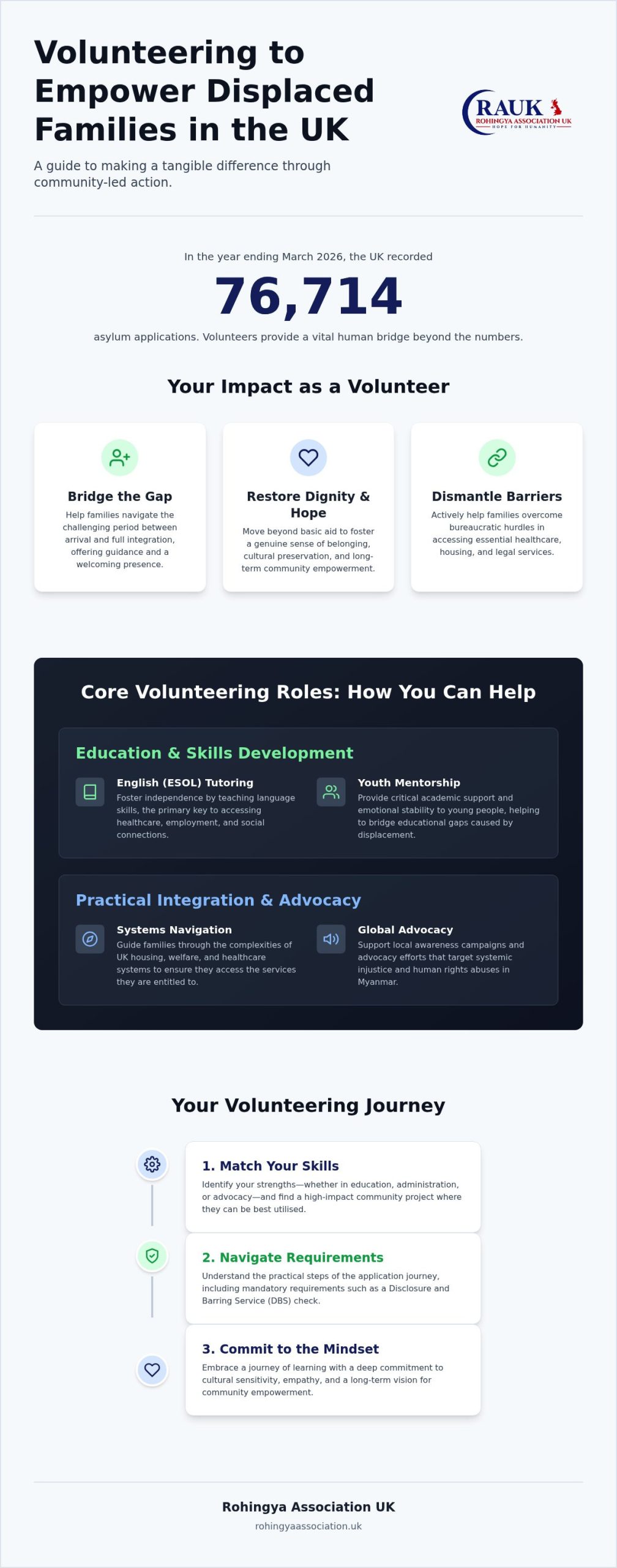
The global refugee crisis often feels like a tide too vast to stem from a single doorstep. It’s natural to feel paralysed by the scale of displacement, particularly when 76,714 asylum applications were recorded in the UK in the year ending March 2026. You may worry that your personal skills aren’t enough or that the complex bureaucracy of the asylum system will stifle your desire to help. However, the decision to volunteer with refugee charity UK organisations is a powerful rejection of indifference. It represents a commitment to restoration, protection, and the shared dignity of our common humanity.
We believe that every individual possesses the agency to spark renewal within their own community. This guide will show you how your time and skills can empower displaced families and help restore the heritage of the Rohingya people in the UK. You’ll learn how to find high-impact local roles that bypass unnecessary red tape, allowing you to develop new skills whilst building lasting bonds. Together, we can move from the gravity of the crisis toward a future defined by resilient optimism, collective strength, and a steadfast commitment to justice.
Key Takeaways
- Understand the critical role of volunteers in bridging the gap between arrival and full integration, helping to restore dignity, safety, and belonging for displaced families.
- Discover how to volunteer with refugee charity UK organisations through diverse roles, including English language (ESOL) tutoring, youth mentorship, and healthcare navigation.
- Learn the unique benefits of supporting community-led, diaspora-driven charities that offer deep cultural expertise and direct grassroots impact within local neighbourhoods.
- Gain clarity on the practical steps of the application journey, from navigating mandatory DBS requirements to matching your specific skills with high-impact community projects.
- Explore how your personal agency can help preserve the heritage of the Rohingya people through dedicated local action in Bradford and global digital advocacy.
Why Volunteer with a Refugee Charity in the UK?
The arrival of a displaced person is often marked by a profound sense of isolation. Whilst the history of UK refugee resettlement shows a pattern of diverse communities seeking safety, the path to true integration remains fraught with structural barriers. Choosing to volunteer with refugee charity UK organisations provides a vital human bridge. It’s not just about providing a service; it’s about dismantling the walls of bureaucracy that prevent families from accessing essential healthcare or finding stable housing guidance. For the Rohingya community, these challenges are amplified by the weight of statelessness. Without a home country to advocate for them, the role of local volunteers becomes a matter of moral urgency and principled leadership. Community-led advocacy ensures that support isn’t just a top-down delivery of aid, but a collaborative fight for systemic change and social justice.
The Impact of Local Action on Global Crises
Action taken in a local Bradford community centre resonates far beyond West Yorkshire. When you support local initiatives, you’re directly contributing to a global network of protection that spans from the UK to the camps in Cox’s Bazar and the villages of Myanmar. Refugee volunteering acts as a vital catalyst for social cohesion by transforming strangers into neighbours through shared purpose. These efforts are essential for providing community support for displaced families, ensuring that the hope for a better life isn’t lost in the struggle for survival. It’s a way to turn global tragedy into local agency. By grounding global issues in local action, we create a stable, long-term commitment that survives the fleeting attention of the news cycle.
Beyond Basic Aid: Restoring Dignity and Hope
Effective support must look past immediate crisis intervention. While food and shelter are foundational, true restoration requires long-term community empowerment and resilience. Volunteers play a central role in fostering a genuine sense of belonging for those who’ve lost everything. This process requires a deep commitment to cultural sensitivity, particularly when supporting Rohingya heritage and identity. It’s about more than integration; it’s about ensuring that families can flourish without being forced to abandon their roots. By choosing to volunteer with refugee charity UK groups, you’re helping to build a protective shield that honours the strength of the people it serves. We don’t just aim to help people survive; we strive to help them thrive as proud, active participants in British society.
Core Volunteering Roles: How You Can Make a Difference
The decision to volunteer with refugee charity UK organisations offers a profound opportunity to translate empathy into tangible agency. Each role within a community-led framework serves a specific, vital purpose in the journey toward restoration. Whether your strengths lie in education, administration, or advocacy, your contribution helps dismantle the barriers that keep displaced families in a state of perpetual uncertainty. By offering your time, you become a partner in a long-term commitment to dignity and safety.
Education and Skills Development
Assisting in ESOL (English for Speakers of Other Languages) environments in Bradford is one of the most immediate ways to foster independence and confidence. Language serves as the primary key to accessing healthcare, securing employment, and building social connections within the local neighbourhood. Beyond adult education, mentoring youth is critical to bridging the profound educational gaps caused by years of displacement and interrupted schooling. By participating in refugee youth empowerment programmes, volunteers provide the academic support and emotional stability necessary for young people to envision a future defined by their potential rather than their past.
Practical Integration and Advocacy
Practical integration involves guiding families through the complex labyrinth of UK housing, welfare, and healthcare systems. This work is methodical, grounded, and essential; it ensures that families can access the protection and services they are entitled to under British law. Simultaneously, volunteers support global advocacy efforts that target systemic injustice and human rights abuses in Myanmar. Organising local awareness events helps educate the British public on the specific nuances of the Rohingya crisis, moving the conversation from abstract statistics to human stories of resilience and strength.
Cultural Preservation and Community Bond
A unique aspect of this work involves the protection of heritage. For a stateless community, cultural preservation is a powerful act of resistance against erasure. Volunteers assist in organising community events that celebrate Rohingya traditions and Islamic festivals, creating safe spaces where identity is cherished and shared. These gatherings are not merely social; they are essential acts of communal healing, pride, and continuity. If you feel called to support these vital efforts, you can explore how to get involved with the Rohingya Association UK. Your skills in event planning, digital advocacy, or community outreach can directly contribute to the growth and protection of this vibrant diaspora.
National NGOs vs. Community-Led Charities: Finding Your Fit
When looking to volunteer with refugee charity UK organisations, the choice often falls between national NGOs and local, diaspora-led charities. Large organisations manage vast logistics and national policy influence; however, they can sometimes feel distant or bureaucratic to those seeking a more personal connection. In contrast, community-led charities operate at the heart of the neighbourhoods they serve. These organisations provide a direct, unmediated connection to the people they support, ensuring that aid is responsive to real-time needs. By choosing a grassroots approach, you ensure your efforts contribute to a model built on deep cultural insight, immediate response, and shared identity. It’s a choice between being a cog in a large machine and being a vital thread in a local safety net.
The Strength of the Community-Led Model
The community-led model represents a fundamental shift from traditional charity toward genuine empowerment. At the Rohingya Association UK (RAUK), support isn’t a top-down delivery; it’s a collaborative effort led by the Rohingya diaspora themselves. This structure ensures that every project, from housing assistance to health advocacy, is shaped by lived experience rather than external assumptions. When you volunteer within this framework, you aren’t just providing aid. You’re participating in a movement that respects the agency of displaced people. It creates a unique bond where volunteers work alongside the community, fostering a sense of mutual respect and collective resilience. It is a partnership defined by protection, dignity, and progress.
Why Bradford is a Hub for Refugee Support
Bradford has long served as a sanctuary, with a rich history of West Yorkshire welcoming those fleeing persecution and conflict. This local expertise makes the city an ideal environment for effective integration efforts. Local action in Bradford doesn’t just stay within the city limits; it ripples outward to influence the pursuit of justice for Rohingya people on a global stage. By joining a local volunteer with refugee charity UK project, you tap into a network of established partnerships with healthcare providers, schools, and social services. This deep-rooted local knowledge ensures that every hour you give is used efficiently to restore dignity and safety to families making their home in the UK. You’re not just helping individuals; you’re strengthening the fabric of a welcoming city.
Preparing to Volunteer: Requirements and Mindset
Entering this space requires a sophisticated blend of professional readiness and deep emotional openness. To volunteer with refugee charity UK organisations, you must move beyond a fleeting emotional reaction toward a grounded, long-term commitment. This preparation ensures that your agency acts as a reliable support rather than an intermittent presence in the lives of those seeking sanctuary. It involves a methodical approach to requirements, ensuring every action is rooted in safety, respect, and the possibility of restoration. Approaching this work with cultural humility is paramount; it means honouring the diverse traditions and faiths of the Rohingya community whilst acknowledging the strength they’ve shown in the face of statelessness.
The Disclosure and Barring Service (DBS) provides the essential framework for safeguarding within the UK humanitarian sector. A Basic DBS check is typically sufficient for those working with adult refugees, whilst an Enhanced DBS check is mandatory for anyone supporting children or vulnerable youth. If you’re an asylum seeker yourself looking to give back, be aware that the process may involve a fingerprinting process if standard documentation is unavailable. This rigour isn’t a bureaucratic hurdle; it’s a protective measure for the community we serve, ensuring that every volunteer is vetted and prepared for the moral seriousness of the role.
Practical Steps to Get Started
Your unique skills—whether in IT, administration, teaching, or driving—are the tools of community renewal. Identifying these transferable assets is the first step in finding a high-impact role that suits your capacity. The application journey typically moves from an initial enquiry to a formal interview and project matching. Consistency is the foundation of trust in these environments. For instance, a community mentor role generally requires a commitment of two to four hours each week to provide the stability displaced families need. If you’re ready to begin this journey, you can apply to join our volunteer network and start making a tangible difference in your local area.
The Importance of Safeguarding and Privacy
Protecting the privacy of displaced people is both a legal mandate and a moral duty. Under current UK regulations, including the 2026 shifts to temporary 30-month protection statuses, the legal landscape for refugees is increasingly complex and sensitive. Volunteers receive specific training on how to handle information regarding asylum claims and personal histories with the utmost discretion. Maintaining professional boundaries is vital; it allows you to provide genuine friendship and support whilst ensuring the safety and dignity of the individuals remain paramount. This balance of empathy and professionalism creates a stable environment where families can begin to rebuild their lives with confidence.
Join the Rohingya Association UK: How to Apply
The journey from empathy to action culminates in a deliberate choice to participate. When you decide to volunteer with refugee charity UK organisations like RAUK, you aren’t merely filling a vacancy; you’re joining a principled movement for justice, restoration, and growth. Our application process is designed to be thorough yet supportive, ensuring that your unique skills are matched with the projects where they can achieve the most profound impact. It begins with a simple enquiry, followed by a formal interview and a comprehensive induction period that prepares you for the moral seriousness of our shared mission. Every step of this journey is an invitation to exercise your agency in the service of others.
Our Current Volunteering Priorities
We are currently seeking dedicated individuals to fill several high-priority roles within our Bradford-based and national teams. The need for youth mentors and education assistants is particularly urgent as we strive to bridge the educational gaps faced by young people in our community. For those with professional expertise in social media, fundraising, or event planning, your skills can help amplify our voice and secure the resources necessary for our long-term survival. Additionally, remote volunteers play a critical role in global advocacy and research, providing the data and digital presence needed to keep the Rohingya crisis at the forefront of the international agenda. Whether you’re an ESOL tutor or a digital advocate, your contribution is a vital thread in our safety net.
Every hour contributed by a volunteer supports a dual mission of local integration and global awareness. Your efforts in the UK provide a direct ripple effect that reaches Cox’s Bazar refugees by sustaining the advocacy networks that fight for their rights and safety. By helping a family in Bradford navigate a healthcare appointment or assisting a student with their English studies, you’re contributing to a global framework of protection and renewal. This is the first step towards building a society that is not only more inclusive but fundamentally more just. It’s a commitment to a future where every individual is treated with the dignity they deserve.
Become a Partner in Our Mission
Becoming a regular volunteer with RAUK offers the opportunity to witness the possibility of renewal first-hand. We invite you to visit our centre in Bradford to see our work, meet the community, and understand the depth of the bonds we’re building together. This is more than a transactional exchange of time; it’s a dedicated partnership rooted in duty, heritage, and cultural pride. We don’t view our volunteers as distant benefactors but as steadfast advocates and partners in a long-term commitment to human dignity. If you’re ready to volunteer with refugee charity UK projects that offer high-impact change, we encourage you to Contact the Rohingya Association UK today to begin your journey of meaningful community action.
Build a Legacy of Restoration and Hope
Choosing to volunteer with refugee charity UK organisations is a transformative act that shifts the narrative from global crisis to local community action. We’ve explored how your specific skills can bridge the gap for displaced families, the unique benefits of diaspora-led grassroots action, and the practical requirements for safe, impactful engagement. This is not merely an act of kindness; it’s a principled stand for justice and the shared dignity of our common humanity. It represents a commitment to restoration, protection, and the possibility of renewal.
As a registered UK Charity (1211433) led by the Rohingya diaspora in Bradford, our active projects across the UK, Myanmar, and Bangladesh rely on the steadfast commitment of partners like you. It’s a journey of collective growth. Your agency is the catalyst for a more inclusive society where every individual can thrive. Volunteer with the Rohingya Association UK and help build a brighter future. We look forward to welcoming you into our community as a dedicated advocate for change and a partner in our mission of hope.
Frequently Asked Questions
Can I volunteer with a refugee charity if I do not have specialist skills?
You don’t need specialist qualifications to volunteer with refugee charity UK projects. Whilst some roles like ESOL tutoring require specific language skills, many others rely on your ability to provide empathy, organisation, or practical assistance. Whether you’re helping with community events or providing administrative support, your willingness to learn is your most valuable asset. We value the diverse life experiences that every volunteer brings to our mission of restoration and community growth.
Can people seeking asylum volunteer in the UK?
People seeking asylum have the legal right to volunteer at any stage of their application process in the UK. This activity is encouraged as it fosters integration and allows individuals to contribute to their new communities whilst their claims are processed. However, this must not constitute unpaid work or breach any specific conditions of their asylum status. Volunteering provides a vital sense of agency and purpose during a period often defined by uncertainty and waiting.
What is the minimum time commitment for volunteering with RAUK?
The minimum time commitment depends on the specific project, though we generally ask for two to four hours per week for community mentor roles. Consistency is vital for building trust with displaced families who’ve experienced significant instability. For event-based or digital advocacy roles, the commitment can be more flexible. We work with you to ensure that your contribution remains sustainable and balances well with your personal and professional schedule.
Do I need a DBS check to volunteer with refugees?
You will likely require a Disclosure and Barring Service (DBS) check to volunteer with refugee charity UK organisations. For those working with adults, a Basic DBS check is often sufficient; however, an Enhanced DBS check is mandatory for roles involving children or vulnerable youth. This process is a standard safeguarding requirement that protects both the community and the volunteers. We provide guidance on how to navigate these essential checks during your initial application journey.
Are there remote volunteering opportunities available for refugee charities?
Remote volunteering opportunities are available for those who cannot travel to our Bradford centre. Digital advocates, research assistants, and fundraising coordinators can provide high-impact support from anywhere in the UK. These roles are essential for maintaining our global advocacy reach and ensuring the Rohingya crisis remains visible on the international stage. Remote action allows you to exercise your agency and support our mission even if you live outside West Yorkshire.
How does community-led volunteering differ from larger organisations?
Community-led organisations like RAUK are driven by the lived experience of the diaspora they serve. Unlike larger national NGOs that manage broad logistics, we focus on direct grassroots support and cultural preservation. This model ensures that aid is never top-down but is instead a collaborative effort built on mutual respect and shared identity. It allows volunteers to see the immediate, tangible impact of their work within a specific local neighbourhood or community group.
Can I volunteer if I only speak English?
Speaking only English is a significant asset, particularly for our ESOL and youth mentorship programmes. Your native or fluent English skills help displaced families navigate the complexities of UK social services and healthcare systems. Whilst some roles benefit from bilingualism, the primary goal of many projects is to help refugees develop the language confidence they need to flourish in their new homes and achieve long-term independence through clear communication.
How does RAUK support volunteers with their training and development?
RAUK provides comprehensive training and ongoing development for every volunteer. This begins with a detailed induction covering safeguarding, cultural humility, and the specific needs of the Rohingya community. We offer ongoing support through regular project matching and skill-sharing sessions to ensure you feel confident in your role. Our goal is to help you develop new skills whilst you contribute to the restoration and empowerment of displaced families in the UK and beyond.