
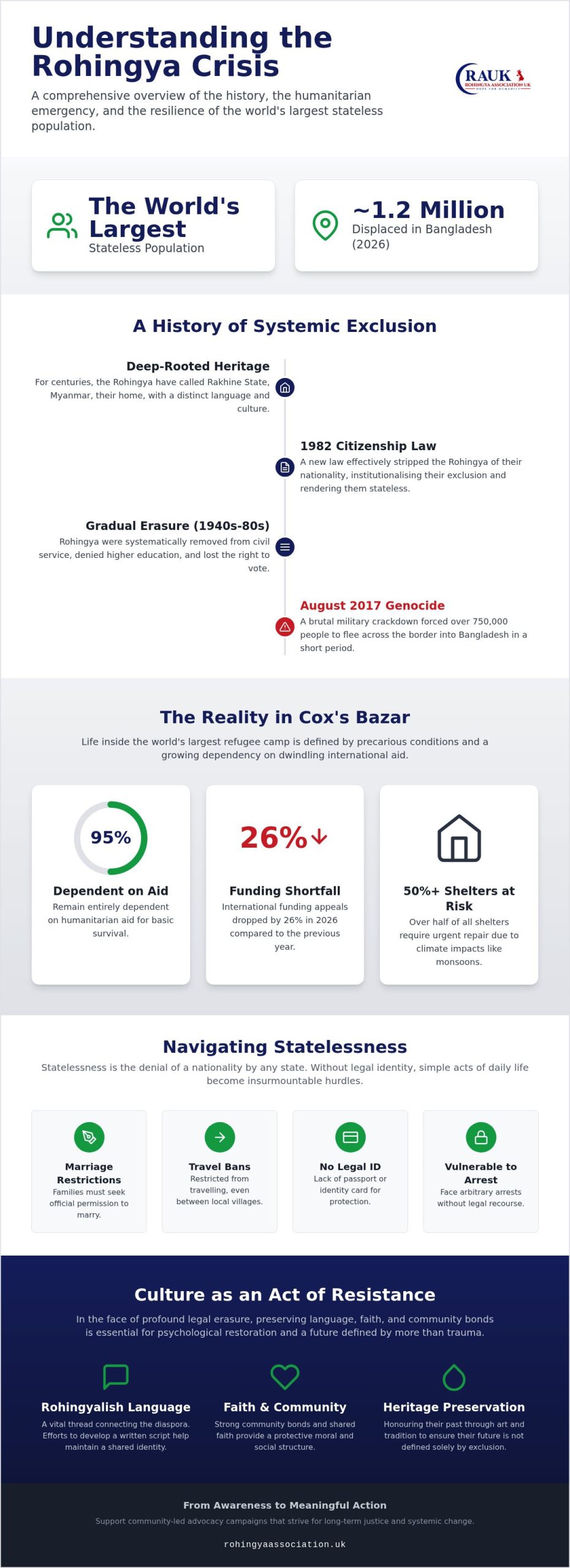
To be Rohingya is to carry the weight of being the world’s largest stateless population, a people denied the basic right to belong by the very land they call home. You’ve likely seen the harrowing news reports or felt overwhelmed by the dense, conflicting accounts of historical ethnic tensions that surround this humanitarian disaster. It’s natural to feel a sense of helplessness when confronted with the scale of a crisis that has left nearly 1.2 million people displaced in Bangladesh alone as of 2026. Understanding the Rohingya crisis requires us to look past the statistics and witness the profound resilience of a community fighting for restoration, protection, and growth.
This article provides a comprehensive path towards understanding the Rohingya crisis, from its deep historical roots to the modern struggle for human rights and community integration. You’ll gain a clear timeline of the conflict, a precise grasp of the legal term statelessness, and a vision for the future of those seeking safety. We will explore the path to international justice whilst highlighting actionable ways you can support the community here in Britain through education, advocacy, and shared heritage. Together, we can move from awareness to meaningful action.
Key Takeaways
- Trace the historical presence of the Rohingya in Myanmar’s Rakhine State to appreciate their deep-rooted cultural heritage and ethnic identity.
- Deepen your understanding the Rohingya crisis by examining the 2017 genocide and the current humanitarian landscape within the temporary shelters of Cox’s Bazar.
- Explore the legal definition of statelessness and how international frameworks can be used to advocate for the fundamental human rights of those denied citizenship.
- Discover the resilience of the Rohingya diaspora in Britain and the unique ways communities in cities like Bradford navigate refugee settlement and integration.
- Identify practical ways to transition from awareness to action by supporting community-led advocacy campaigns that strive for long-term justice and systemic change.
Who are the Rohingya? The Origins of a Stateless People
The Rohingya are an ethnic Muslim minority who have called Rakhine State, Myanmar, their home for centuries. To begin understanding the Rohingya crisis, one must first recognise that this community is not a recent phenomenon or a group of “illegal immigrants,” as some historical revisionism suggests. Their presence in the region, formerly known as Arakan, is documented through generations of trade, settlement, and cultural exchange. They possess a distinct language, a rich oral tradition, and a deep connection to the land that borders the Bay of Bengal.
Despite this deep-rooted history, the community faced a cataclysmic shift in 1982 with the introduction of a new Citizenship Law. This legislation effectively stripped the Rohingya of their nationality, rendering them the largest stateless population on earth. By failing to recognise them as one of the country’s “national races,” the state institutionalised their exclusion. This was not an isolated event but rather the culmination of decades of rising tension and the systematic erasure of their legal identity.
A History of Systemic Exclusion
The journey toward the Rohingya genocide did not begin in 2017; it was a slow, deliberate erosion of rights that gained momentum between the 1940s and the 1980s. During this period, the Rohingya were gradually removed from civil service positions, restricted from higher education, and eventually denied the right to vote. These restrictions created a framework of apartheid that dictated every facet of their existence. Statelessness is the denial of a nationality by any state. Without a legal identity, simple acts of daily life become insurmountable hurdles. Families must seek official permission to marry, are restricted from travelling between villages, and face arbitrary arrests without the protection of a national passport or identity card.
Cultural Identity and Heritage
In the face of such profound legal erasure, the preservation of culture becomes an act of resistance. The Rohingya language, often referred to as Rohingyalish, serves as a vital thread connecting the diaspora to their ancestral roots. Whilst it has historically been an oral tongue, recent efforts to develop a written script have become central to maintaining a sense of shared identity in displacement. Faith and community bonds also act as a protective shield, providing a moral and social structure that remains unbroken despite the physical destruction of their villages.
Preserving these traditions is essential for the psychological restoration of the community. You can explore how these elements of art and identity are being kept alive through Rohingya heritage preservation initiatives. By honouring their past, the Rohingya ensure that their future is defined by more than just the trauma of their exclusion.
The 2017 Genocide and the Reality of Cox’s Bazar
In August 2017, the world witnessed a violent military crackdown that forced over 750,000 people across the border into Bangladesh. This event, which has since been formally recognised as a genocide, transformed a long-standing struggle into an acute humanitarian emergency. For anyone seeking a deeper Rohingya crisis overview, this period represents the most brutal chapter of state-sponsored displacement in modern history. It left a community uprooted, traumatised, and confined to the hills of Cox’s Bazar, where they remain nearly a decade later.
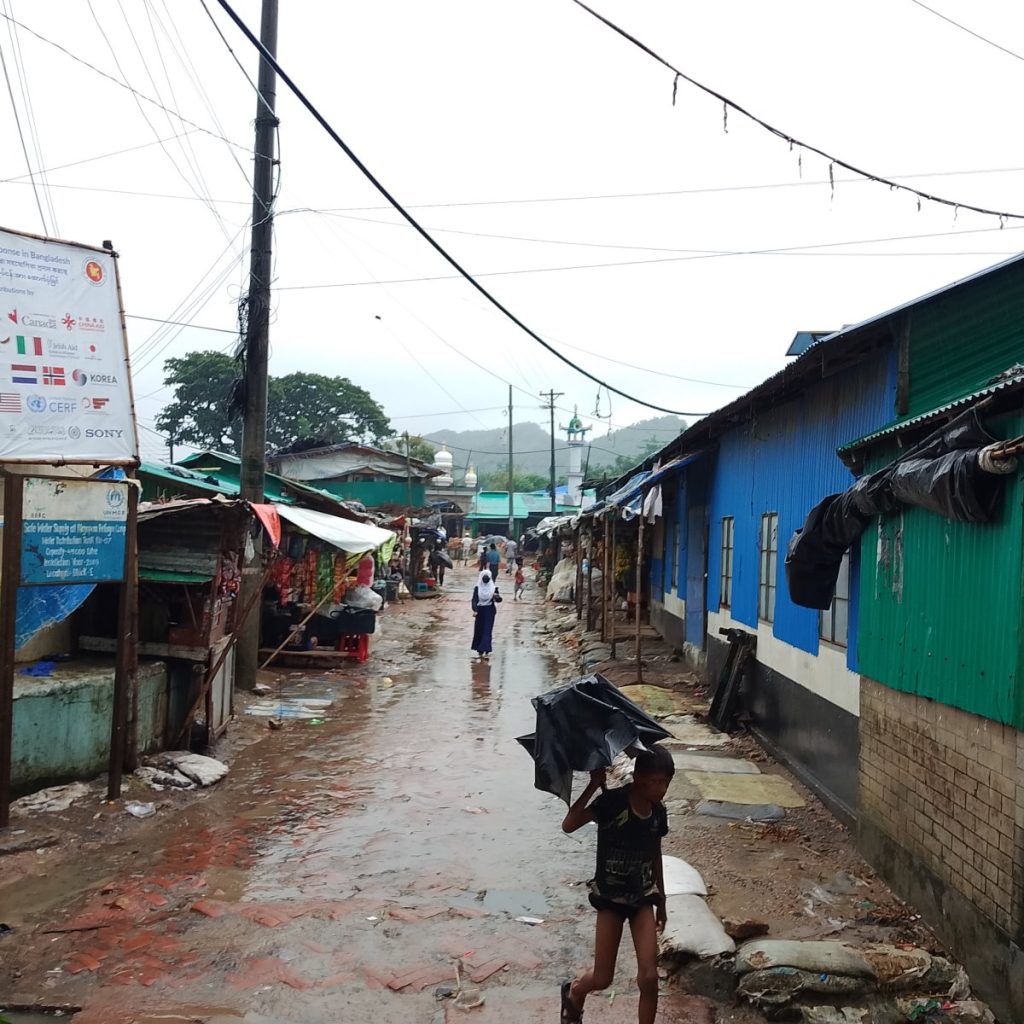
Today, nearly 1.2 million refugees reside in these camps, making it the largest refugee settlement in the world. As we move through 2026, the reality of life here is defined by a state of permanent temporariness. Families live in shelters constructed from bamboo and plastic tarpaulin; structures that are ill-equipped to withstand the region’s harsh climate. Over 50% of these shelters currently require urgent repair following recent monsoon floods. Understanding the Rohingya crisis means acknowledging that 95% of this population remains entirely dependent on humanitarian aid for their basic survival, whilst international funding appeals for 2026 have dropped by 26% compared to the previous year.
Life Inside the Largest Refugee Camp
The physical conditions in Cox’s Bazar are precarious and often life-threatening. Between July 5 and 19, 2026, over 630 climate-related emergencies were recorded, including landslides and flash floods that displaced thousands. Beyond weather, the threat of fire in overcrowded blocks remains a constant anxiety. Maintaining basic human dignity in such an environment requires continuous crisis intervention and food support. For a detailed look at these daily struggles, you can read our guide inside the Rohingya refugee camp.
The Resilience of the Displaced
Despite these hardships, the camps are not merely sites of suffering. Refugees have organised themselves into community networks to provide mutual support, protection, and informal education. There is a fierce drive for learning amongst the youth, even as 235,000 children remain out of formal schooling. Resilience is the cornerstone of the Rohingya spirit. This strength allows families to maintain their heritage and look toward a future beyond the tarpaulin walls of Cox’s Bazar, driven by a shared hope for justice and return.
Navigating Statelessness: Legal Barriers and Human Rights
A stateless person is defined under the 1954 Convention as someone who is not considered as a national by any State under the operation of its law. For the Rohingya, this legal invisibility is the root of their suffering. Without a nationality, they lack what is often called the “right to have rights,” leaving them without the protection of a government, a passport, or a legal voice. Developing a profound understanding the Rohingya crisis involves recognising that this status isn’t an accident of history; it’s a deliberate tool of exclusion used to justify decades of persecution.
One of the most persistent and damaging misconceptions is the claim that the Rohingya are “illegal immigrants” from Bangladesh. This narrative was used by the Myanmar military to strip the community of their citizenship in 1982, despite their ancestral roots in Rakhine State stretching back centuries. By framing an indigenous population as outsiders, the state institutionalised a system of apartheid that continues to block any path toward domestic justice or civil participation. It’s a strategy designed to erase a people’s history and their right to exist on their own land.
The Fight for Global Accountability
In the absence of national protection, the international community has stepped in to seek accountability. The International Court of Justice (ICJ) is currently reviewing cases regarding the atrocity crimes committed against the community, with a focus on state responsibility for genocide. Achieving justice for Rohingya people is a prerequisite for any long-term solution. Without legal guarantees of safety and the restoration of citizenship, the cycle of displacement will only continue. Accountability acts as a protective shield, ensuring that those responsible for systemic violence are held to answer before the world.
Barriers to Repatriation
Whilst the Myanmar military occasionally makes “security” claims to encourage return, the reality on the ground remains hostile. As of June 2025, an estimated 400,000 Rohingya remain in Rakhine State, with nearly 145,000 confined to internment camps in central Rakhine. Forced conscription of Rohingya individuals into the very military that persecuted them has become a terrifying trend in 2026. A dignified and voluntary return is only possible when the following conditions are met:
- Restoration of full citizenship rights and legal recognition.
- Guaranteed physical safety and freedom of movement.
- Restitution of land and property seized during the 2017 exodus.
Until these fundamental human rights are secured, the path home remains closed. The focus must remain on international protection and the pursuit of systemic change that honours the dignity of every individual.
The Rohingya Diaspora in the UK: Integration and Community
Whilst much of the global dialogue focuses on the camps in South East Asia, a vital part of understanding the Rohingya crisis involves recognising the resilience of the diaspora settled here in Britain. For many families, the United Kingdom represents a sanctuary where the long process of restoration can finally begin. Communities have established roots in several urban centres, with Bradford emerging as a primary hub for Rohingya life, culture, and advocacy. These individuals bring with them a profound strength, yet they face the immense task of rebuilding lives from the ground up in an entirely unfamiliar environment.
The process of refugee settlement and integration in the UK is fraught with systemic hurdles that require dedicated, community-led navigation. New arrivals often struggle to access essential services due to language barriers, the lingering effects of trauma, and a lack of familiarity with British bureaucracy. Community-led organisations are essential in this transition, providing clear guidance on housing applications, facilitating healthcare access within the NHS, and ensuring that families aren’t left to navigate these complexities in isolation. Central to this journey is the provision of English language classes, which serve as the foundation for social inclusion, economic mobility, and personal agency.
Building a New Home in Bradford
In the heart of West Yorkshire, the Rohingya Association UK (RAUK) acts as a protective shield and a guiding hand for those arriving in the region. Our approach to community support for displaced families is rooted in lived experience, ensuring that every individual is treated with the dignity they were so long denied. We believe that integration is not just about logistics; it’s about fostering a genuine sense of belonging. By organising cultural and Islamic events, we provide a space where heritage is celebrated and communal bonds are reinforced. These gatherings offer a vital connection to home, allowing the community to preserve its identity whilst embracing its new future in Britain. You can support our community integration work to help us provide this essential stability.
Empowering the Next Generation
The future of the community rests with its youth, who often act as the bridge between their parents’ heritage and their own British identity. Navigating the UK education system can be daunting for families who have spent years deprived of formal schooling. Our refugee youth empowerment programs are designed to close this gap by providing academic support, mentorship, and vocational skills training. We focus on equipping young people with the tools they need to succeed, ensuring they have the confidence to pursue higher education and professional careers. By investing in these bright futures, we move beyond crisis intervention and toward a sustainable model of growth, protection, and leadership within the UK.
Supporting the Path to Justice: How You Can Help
Knowledge is a prerequisite for change, but it’s only the first step. Once we move beyond understanding the Rohingya crisis through its historical and legal lenses, the moral responsibility shifts toward active participation. The resilience of the community is remarkable, yet they shouldn’t have to carry the burden of restoration alone. By standing as a bridge between UK supporters and the global Rohingya cause, we can ensure that the call for justice remains loud, clear, and impossible to ignore. Translating empathy into agency is how we move from witnessing a tragedy to facilitating a future defined by dignity and safety.
Our Advocacy & Awareness Campaigns are designed to keep this crisis on the global agenda, preventing it from becoming a forgotten conflict in the eyes of the international community. When you share these stories or participate in our initiatives, you’re helping to dismantle the invisibility that statelessness imposes. Voluntary Charitable Donations play an equally critical role; they provide the resources needed for both immediate crisis intervention in the camps and long-term refugee settlement and integration here in the UK. This collective effort ensures that families have access to the healthcare, education, and housing guidance they need to rebuild their lives.
Faithful Giving and Social Justice
For many in our community, the act of giving is rooted in a deep sense of spiritual duty and social justice. Directing your Zakat or Sadaqah Jariyah towards Rohingya families is a powerful way of tackling inequality and providing a lifeline to those who have lost everything. These contributions aren’t merely financial transactions; they’re investments in the restoration, protection, and growth of a people. Whether it’s providing food support in Bangladesh or funding English language classes in Bradford, every contribution fosters hope. It sends a clear message to the stateless that they’re seen, valued, and supported by a global family that refuses to look away.
Taking the First Step
You can begin making a tangible difference today by choosing to partner with the Rohingya Association UK. Whether you decide to offer your time as a volunteer to support our local welfare services or provide a one-off donation, your involvement is vital. Staying informed is just as important; we encourage you to sign up for our newsletters and advocacy updates to track the progress of global accountability efforts. Standing in solidarity with the Rohingya means more than just acknowledging their pain; it means committing to a long-term journey of empowerment. Together, we can fight for systemic change and honour the strength of a community that continues to strive for justice against all odds.
Restoring Dignity and Securing a Future for the Stateless
True understanding the Rohingya crisis requires us to look beyond the history of exclusion and witness the incredible strength of a people determined to survive. We’ve explored how the legal chains of statelessness were forged and how the diaspora is now forging a new path of renewal in cities like Bradford. Justice isn’t just a legal concept; it’s a daily practice of providing safety, education, and a sense of belonging to those who were once denied a home. By acknowledging the past and supporting the present, we participate in the vital work of restoration.
As a community-led organisation (Registered Charity 1211433), the Rohingya Association UK (RAUK) provides a protective shield for families navigating life in Britain whilst delivering direct aid to those still in Cox’s Bazar. Your contribution ensures that we can continue our mission of tackling inequality and building brighter futures. Support the Rohingya community today by donating to RAUK and join us in this steadfast commitment to justice. Together, we can turn empathy into action and ensure that no one is left to face displacement alone.
Frequently Asked Questions
What caused the Rohingya crisis in Myanmar?
The crisis was triggered by decades of state-sponsored exclusion, culminating in the 1982 Citizenship Law which stripped the Rohingya of their nationality. This institutionalised discrimination created a framework of apartheid in Rakhine State. Tensions escalated into a full-scale humanitarian disaster following the 2017 military crackdown, which the international community has recognised as a genocide. These events forced hundreds of thousands to flee their ancestral homes in search of safety.
How many Rohingya refugees are there in the world in 2026?
As of the start of 2026, the total displaced Rohingya population is estimated at 1,329,300 individuals. The vast majority, nearly 1.2 million people, reside in refugee camps in Bangladesh, primarily within Cox’s Bazar. Other significant populations are located in Malaysia (125,500), India (22,700), and Indonesia (2,600). These figures highlight the immense scale of the displacement and the urgent need for sustained international support and humanitarian aid.
Is the Rohingya crisis still ongoing?
Yes, the crisis remains an active humanitarian emergency in 2026. Conditions in Myanmar continue to deteriorate due to intensifying conflict and the forced conscription of Rohingya individuals. Meanwhile, those in refugee camps face a “triple crisis” of shrinking international aid, vulnerability to climate-related disasters, and the lack of a safe path home. Developing a deep understanding the Rohingya crisis involves recognising that the struggle for safety and justice is a daily reality.
What does it mean to be a stateless person?
A stateless person is someone who is not considered a national by any state under the operation of its law. For the Rohingya, this means they lack a passport, legal identity, and the “right to have rights” that citizenship provides. This status restricts their ability to travel, access higher education, or seek legal protection. It effectively renders an entire ethnic group invisible in the eyes of international and domestic law.
How many Rohingya people live in the UK?
Whilst exact national census figures for the Rohingya diaspora in Britain are difficult to isolate, significant communities are established in urban hubs such as Bradford. These families have arrived through various resettlement programmes and independent asylum routes. Organisations like the Rohingya Association UK work directly with these residents to facilitate refugee settlement and integration, ensuring they can access essential healthcare, housing guidance, and educational opportunities within their new local communities.
How can I help Rohingya refugees in my local community?
You can provide support by engaging with community-led organisations like the Rohingya Association UK. Practical ways to help include:
- Offering your time as a volunteer for local welfare services.
- Contributing voluntary charitable donations to fund integration projects.
- Supporting English language classes and youth empowerment programmes.
- Participating in advocacy and awareness campaigns to keep the issue visible.
These actions help bridge the gap between new arrivals and their local British surroundings.
What is the difference between a refugee and a stateless person?
A refugee is someone forced to flee their country due to a well-founded fear of persecution. In contrast, a stateless person has no legal nationality in any country. Whilst many refugees eventually return to their home nation, stateless people often have no recognised “home” to return to. The Rohingya are unique because they are both refugees and stateless, meaning they face dual barriers to finding permanent safety and legal recognition.
Can the Rohingya people ever return to their homes in Myanmar?
Return is only possible if it is voluntary, safe, and dignified. Currently, conditions in Myanmar remain too dangerous for repatriation due to ongoing violence and systemic discrimination. For a successful return, the Myanmar government must restore full citizenship rights, ensure physical security, and provide restitution for seized property. Achieving a lasting solution for understanding the Rohingya crisis depends on these fundamental human rights being secured through international pressure and legal accountability.