
Table of Contents
- Defining Rohingya Statelessness
- The Human Cost of Legal Invisibility
- The Generational Cost of Statelessness
- Global Displacement Contexts
- How You Can Take Action Today
Imagine waking up in a world where no country claims you; where your birthright is a legal void and your children’s future is written in the shifting sands of a temporary camp. You likely feel overwhelmed by the scale of global displacement or find that dense legal terminology creates a distance between your heart and the reality on the ground. This article explores the fundamental impact of statelessness on Rohingya refugees, illustrating how the denial of citizenship serves as a systemic tool of erasure that dictates where a person can walk, how they can work, and whether they can heal.
We’ll examine the historical weight of the 1982 Citizenship Act and the precarious status of populations in India, Indonesia, Thailand, and Saudi Arabia. We’ll share lived experiences from Rakhine State, formerly known as Arakan State, whilst providing clear pathways for you to support restoration. It’s through understanding these legal barriers that we can honour the strength and heritage of a people refused a home. Discover how we move from witnessing a crisis to building a future defined by belonging and shared humanity.
Key Takeaways
- Understand how the 1982 Citizenship Act systematically stripped the Rohingya of their legal identity, transforming a settled community into the world’s largest stateless population.
- Examine the daily impact of statelessness on Rohingya refugees, specifically how legal invisibility increases vulnerability to exploitation, trafficking, and the denial of basic freedom of movement.
- Identify the long-term risks facing a “lost generation” of children who are barred from accessing recognised education and formal qualifications due to their lack of status.
- Gain clarity on global legal transitions, including the implementation of the Dokumen Pendaftaran Pelarian (DPP) system in Malaysia and its implications for refugee protection in 2026.
- Discover practical, community-led strategies to restore dignity and support integration for stateless families settled within the United Kingdom and in camps abroad.
The Right to Have Rights: Defining Rohingya Statelessness
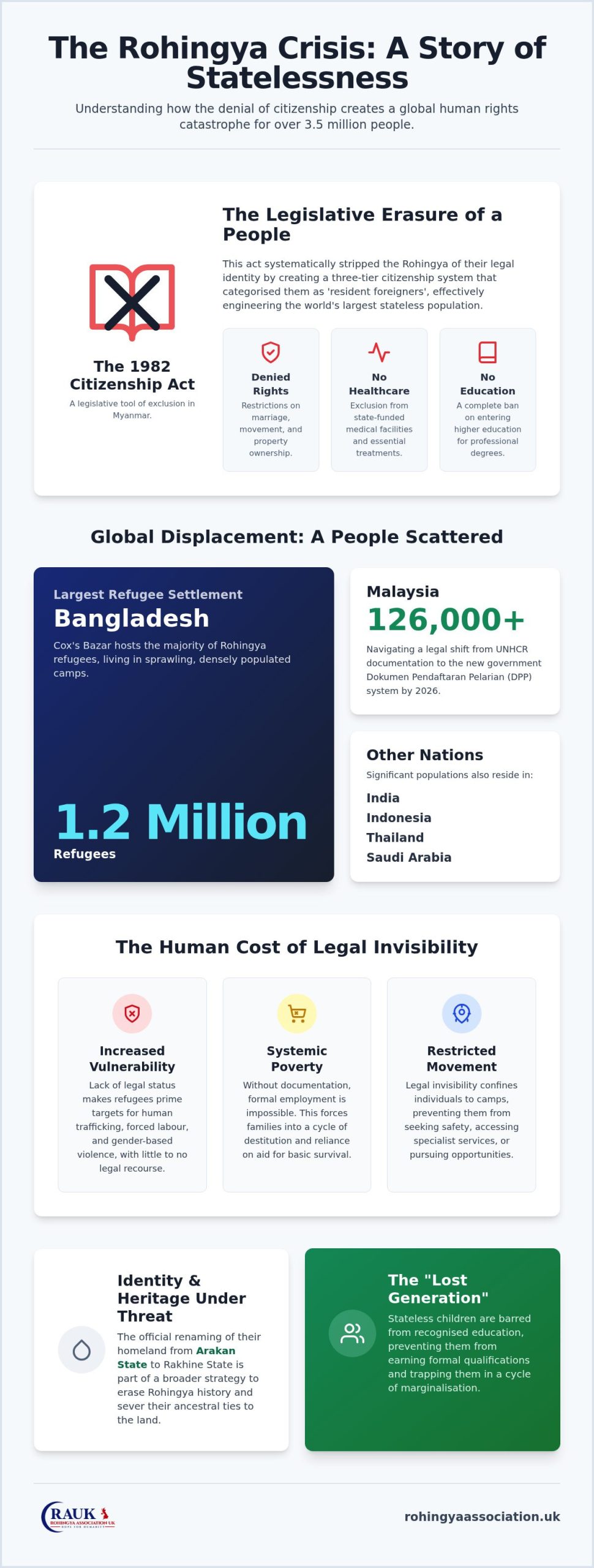
Statelessness is more than a legal technicality; it’s a profound erasure of a person’s place in the world. At its core, it represents the absolute absence of a legal bond between a state and an individual, leaving a person without the protection, recognition, or shadow of any government. The impact of statelessness on Rohingya refugees is particularly severe, as it has rendered over 3.5 million people globally legally invisible. This lack of status isn’t an accident of history but a calculated result of legislative exclusion that denies the very right to have rights.
The 1982 Citizenship Act: A Tool of Exclusion
The 1982 Citizenship Act in Myanmar functioned as a systematic mechanism of disenfranchisement by establishing a rigid, three-tier citizenship system. This hierarchy prioritised “indigenous” races, whilst categorising the Rohingya as resident foreigners. Under this law, the community was stripped of basic entitlements that many take for granted. The loss of status resulted in immediate, tangible barriers to survival:
- Healthcare: Exclusion from state-funded medical facilities and life-saving treatments.
- Education: A total ban on entering higher education for professional degrees, such as medicine or engineering.
- Civil Life: Severe restrictions on marriage, movement, and the right to own property.
The 1982 Citizenship Act stands as the definitive legislative foundation of the modern Rohingya crisis and the subsequent Rohingya genocide that forced millions to flee their ancestral lands. It didn’t just remove a passport; it removed the legal shield that protects humans from state-sponsored violence.
Identity and Heritage in Arakan State
For the Rohingya, the land they call home is Arakan State, now officially referred to by the Myanmar government as Rakhine State. Preserving the name Arakan is a vital act of cultural resistance; it anchors their identity to a specific history, a language, and a defined ancestral territory. When a state denies a people’s history, it creates a prerequisite for denying their citizenship. It’s a process of unmaking a community by deleting their records and renaming their geography.
The impact of statelessness on Rohingya refugees is inextricably linked to this loss of ancestral land rights. Without legal standing, families cannot claim the farms, homes, or villages their ancestors occupied for centuries. This erasure of heritage ensures that displacement becomes permanent. Restoration of dignity for the Rohingya must, therefore, involve more than just aid; it requires a global recognition of their history and their right to belong to the land of Arakan State.
The Human Cost: How Legal Invisibility Impacts Survival
Legal invisibility isn’t just a bureaucratic hurdle; it’s a physical cage that dictates the boundaries of a person’s life. For the 1.2 million refugees currently residing in Cox’s Bazar, Bangladesh, existence is defined by a state of suspended animation. Without a recognised legal identity, these individuals are denied the basic freedom of movement required to seek safety, employment, or even a sense of normalcy. This restriction on movement directly compromises physical security, as it prevents families from moving away from environmental hazards or areas of communal tension.
The impact of statelessness on Rohingya refugees manifests most cruelly as a self-perpetuating cycle of poverty and peril. Without documentation, legal employment remains an impossibility; this forced exclusion from the formal economy leads to systemic destitution. This vulnerability is frequently exploited by criminal networks. Men, women, and children are targeted for human trafficking, forced labour, and Sexual and Gender-Based Violence (SGBV). Perpetrators often act with impunity, knowing their victims lack the state protection necessary to seek justice.
Health and Protection in the Camps
The absence of identification documents creates a formidable barrier to essential services. Whilst basic aid is provided, specialist medical referrals often require documentation that refugees simply don’t possess; this can turn treatable conditions into life-threatening crises. Beyond physical ailments, we must consider the psychological weight of “inherited statelessness.” Children are born into a world that refuses to acknowledge their existence, a burden that shapes their identity and mental well-being from birth. Recognising that healthcare access for displaced people is a fundamental human right is the first step toward restoring their dignity.
The Vulnerability of the Undocumented
Within Rakhine State, previously known as Arakan State, approximately 600,000 Rohingya remain in a condition of extreme precariousness. They are frequently subjected to forced labour and arbitrary detention, serving as a captive workforce without the ability to protest their treatment. In the displacement camps of Bangladesh, the lack of legal standing means that victims of crime have almost no recourse. Many choose not to report abuses because they fear that any interaction with authorities might lead to further penalisation due to their undocumented status. We must act as a bridge between this isolation and the support these families deserve. You can support our Bangladesh projects to help provide the advocacy and intervention needed to break this cycle of silence.
Education and Aspiration: The Generational Cost of Statelessness
Statelessness doesn’t just restrict a person’s present; it systematically dismantles their future. For the youth, the impact of statelessness on Rohingya refugees is a barrier that prevents them from reaching their full potential. Without a birth certificate or a recognised national ID, thousands of children are excluded from formal school systems across the globe. By the beginning of 2026, data indicated that over 235,000 Rohingya refugee children between the ages of 5 and 17 remained out of school in the Bangladesh camps. This exclusion creates a “lost generation” of adolescents who are denied the tools to lead their community or contribute to a global economy. When a child is told their education doesn’t count because they don’t legally exist, the psychological toll is as heavy as the economic one.
Barriers to Higher Education
In Myanmar, specifically within Rakhine State (formerly Arakan State), the requirement for “citizenship evidence” acts as a gatekeeper to universities. Rohingya students are frequently barred from enrolling in professional courses like medicine or law, regardless of their academic merit. This policy intentionally creates a permanent underclass of unskilled labourers, tethered to poverty by the lack of a diploma. We believe that education serves as a vital form of intellectual repatriation. It’s the only asset a refugee can carry across borders that no authority can confiscate; it’s the foundation of a life built on merit rather than permission.
Skills Development and Self-Reliance
To counter this systemic erasure, the diaspora has shifted its focus toward vocational training and community-led initiatives that bypass formal state restrictions. In places like Bradford, we see how learning English or acquiring a trade provides a “mobile identity” for those without a passport. These skills offer a sense of agency and a pathway to integration that statelessness tries to steal.
- Language Proficiency: English classes allow refugees to navigate legal systems and advocate for their rights independently.
- Vocational Training: Tailoring, carpentry, and digital skills foster economic independence and resilience.
- Cultural Preservation: Community-led schools ensure that the Rohingya language and history aren’t forgotten in displacement.
Providing these opportunities is central to our mission as a community-led organisation. Our refugee youth empowerment programmes focus on building these brighter futures right here in the UK. By organising English language classes and cultural events, we help families bridge the gap between their heritage and their new lives. You can help us sustain these efforts when you support our Bangladesh projects or volunteer with Rohingya Association UK to mentor a young person in their journey toward self-reliance.
Global Displacement: Navigating the Malaysian and British Contexts
Displacement has scattered the Rohingya far beyond the borders of Rakhine State, previously known as Arakan State, into a global landscape of varying legal protections. The impact of statelessness on Rohingya refugees is not uniform; it’s shaped by the specific policies and documentation systems of the nations that receive them. Whilst some countries offer a path toward residency, others maintain a state of permanent temporariness that leaves families in a constant state of legal anxiety. This crisis of rights is felt acutely across the diaspora, from those categorised as illegal migrants in India and Thailand to thousands trapped in a state of indefinite detention or legal limbo in Saudi Arabia. In Indonesia, despite the lack of a formal national legal framework, local communities often provide the only safety net for those arriving by sea, demonstrating a resilience that counters state-level exclusion.
The Malaysian Context: The Shift to DPP
Malaysia currently hosts more than 126,000 Rohingya refugees, making it one of the most significant host nations in Southeast Asia. Historically, the community relied on international refugee documentation for a measure of protection against arrest and deportation. However, the Malaysian government is now prioritising the transition to the Dokumen Pendaftaran Pelarian (DPP) system. This shift represents a move toward state-led management of displaced populations, but it doesn’t currently grant the right to formal employment or full citizenship. Life in Kuala Lumpur remains precarious; refugees are often trapped in the informal labour market where they lack the legal standing to challenge wage theft or unsafe working conditions. Without the stability of a recognised identity, even basic tasks like renting a flat or opening a bank account become insurmountable hurdles that keep families tethered to poverty.
The Journey to Belonging in the UK
For the families that eventually settle in the United Kingdom, particularly in cities like Bradford, the challenges of statelessness follow them in different forms. Navigating British bureaucracy is a daunting task for those who’ve spent decades without any official recognition or protection. Many arrive with no papers or proof of identity, which can complicate their initial interactions with the Home Office and delay their access to essential services. Providing refugee resettlement support UK is a core part of our mission, as we help families bridge the gap between their traumatic past and a more secure, integrated future.
The psychological relief of finally obtaining a secure legal status cannot be overstated. It’s the transformative moment a person stops being a “case file” and starts being a citizen with protected rights and a recognised voice. We’ve seen how cultural events and community gatherings help mitigate the trauma of displacement, allowing families to celebrate their heritage whilst integrating into their new homes. You can help us provide this vital bridge to belonging and agency when you volunteer with Rohingya Association UK to support local integration, mentoring, and advocacy efforts.
How You Can Take Action Today
The impact of statelessness on Rohingya refugees is a profound challenge that requires more than passive sympathy; it demands sustained, community-led action. For families living in the camps of Cox’s Bazar or navigating the complexities of life in the UK, your support serves as a vital lifeline. We work as a bridge between the isolation of legal invisibility and the dignity of a recognised identity. By standing with us, you help ensure that the strength and heritage of the Rohingya people are protected against the forces of erasure and neglect.
Support Our Global and Local Projects
Financial contributions are the foundation of our ability to intervene in crises and provide long-term stability. When you donate your Sadaqah Jariyah, you aren’t just providing a meal; you’re funding the education and advocacy programmes that help break the cycle of poverty. Monthly contributions are particularly impactful, as they allow us to plan and execute long-term strategies that challenge systemic inequality. These funds provide a safety net for the stateless, offering protection when state systems fail. We invite you to support our Bangladesh projects to ensure that the 1.2 million people in Cox’s Bazar aren’t forgotten as the global news cycle moves on. Your generosity directly translates into classrooms, medical aid, and the preservation of communal memory.
Volunteer and Advocate
Advocacy is a powerful tool in the fight against legal erasure. Raising awareness about the discriminatory nature of the 1982 Citizenship Act is essential to building a global movement for justice. For those based in the Bradford area, we invite you to volunteer with Rohingya Association UK. Whether it’s helping families navigate local bureaucracy or assisting with our cultural events, your time helps build a community where everyone belongs. Every conversation you start about the history of Rakhine State, previously known as Arakan State, helps counter the narrative of exclusion.
The journey toward restoring rights is long and fraught with difficulty. It’s a path that requires patience, commitment, and a deep sense of moral duty. Whilst the scale of the crisis in 2026 remains vast, our collective efforts provide the hope necessary for renewal. We remain a steadfast advocate for those who have been refused a home, and we invite you to join us in this essential mission. Together, we can work toward a future where justice is restored and the right to belong is no longer a privilege, but a guaranteed reality for every Rohingya individual.
Restoring Dignity and Belonging
The journey from legal invisibility to a life of recognised dignity is arduous, but it’s a path we must walk together. We’ve explored how the 1982 Citizenship Act serves as a foundation for exclusion and how the resulting lack of documentation bars access to education and physical safety. Ultimately, the impact of statelessness on Rohingya refugees is a systemic attempt to erase a people’s history and future. Yet, through community-led advocacy and direct support, we can counter this erasure with resilience and hope.
As a registered charity (number 1211433), Rohingya Association UK is uniquely positioned to act as a bridge to belonging. Being community-led by those with lived experience, we operate direct aid projects across the UK, Myanmar, and Bangladesh. Your participation turns awareness into action. Please support our mission to empower stateless families: Donate your Sadaqah Jariyah today. Together, we can ensure that heritage is preserved, rights are restored, and no child is born into a world that refuses to acknowledge their existence. Let’s build a future defined by justice.
Frequently Asked Questions
What does it mean to be a stateless person?
A stateless person is someone who isn’t considered a national by any state under the operation of its law. This lack of a legal bond means they possess no passport, no right to vote, and no government protection. For the Rohingya, this status was formalised by the 1982 Citizenship Act. Without a legal identity, individuals are left in a state of permanent vulnerability, unable to access the basic protections that citizenship provides to others.
Why are the Rohingya considered the most persecuted minority in the world?
They’re considered the most persecuted minority due to decades of systematic exclusion, state-sponsored violence, and the total denial of citizenship in their ancestral home. The United Nations has previously described the military operations against them as a textbook example of ethnic cleansing. This persecution is rooted in a refusal to recognise their history and heritage, leading to the severe impact of statelessness on Rohingya refugees that we see today.
How many Rohingya refugees are currently living in Cox’s Bazar?
There are approximately 1.2 million Rohingya refugees currently living in Cox’s Bazar, Bangladesh. Most of these individuals arrived after the escalation of violence in 2017, fleeing their homes in Rakhine State, formerly known as Arakan State. They live in highly congested, temporary shelters and remain entirely dependent on humanitarian aid for food and healthcare because their stateless status prevents them from seeking formal employment or moving freely outside the camps.
Can stateless Rohingya refugees work or go to school in the UK?
Stateless Rohingya refugees can only work or access higher education in the UK once they’ve been granted a secure legal status, such as refugee status or humanitarian protection. Until then, their lack of documentation creates significant barriers to integration. Our programmes in Bradford help families navigate these bureaucratic hurdles, providing English classes and youth empowerment to ensure they can eventually contribute fully to British society once their legal rights are established.
What is the difference between Rakhine State and Arakan State?
Rakhine State and Arakan State refer to the same geographic region in western Myanmar. Arakan is the historical name that the Rohingya community uses to preserve their ancestral heritage and communal memory. The Myanmar government changed the name to Rakhine State to align with their national narrative. We use both names to ensure historical context is preserved whilst acknowledging the current political landscape that defines the impact of statelessness on Rohingya refugees.
How does the Malaysian DPP system affect Rohingya refugees?
The Dokumen Pendaftaran Pelarian (DPP) is a government-led registration system in Malaysia that transitions away from UNHCR documentation. Whilst it provides a degree of official recognition for the 126,000 Rohingya in the country, it doesn’t grant them the right to formal work or a path to citizenship. Refugees remain in a precarious position, often forced into the informal economy where they lack legal protection against exploitation or arbitrary arrest by authorities.
How can I help a stateless family in my local community?
You can help a stateless family by supporting local integration initiatives and raising awareness of their specific legal challenges. In Bradford, you can volunteer with Rohingya Association UK to assist families with language skills or navigating local services. Small acts of community support help mitigate the trauma of displacement. Advocacy is also vital; educating others about the root causes of their statelessness helps build the pressure needed for systemic change.
Is my donation to the Rohingya Association UK tax-deductible?
Yes, donations to the Rohingya Association UK are eligible for Gift Aid, which allows us to reclaim the basic rate of tax on your gift. As a registered charity (number 1211433), we ensure that your financial contributions are used efficiently to support our projects in the UK, Bangladesh, and Myanmar. Whether you provide a one-off gift or a monthly contribution, your support provides a vital safety net for those who have no state to protect them.