
Table of Contents
With approximately 1.2 million refugees currently seeking safety in the camps of Cox’s Bazar, the sheer scale of this displacement can often feel immobilising. You might feel overwhelmed by the complexity of legal terminology or uncertain about which organisations are truly community-led. It’s a natural response to a crisis of this magnitude; however, your desire to see systemic change remains a powerful force for justice. This guide will show you how strategic Rohingya advocacy campaigns are driving international accountability and supporting the restoration of rights for a population that has endured decades of erasure.
We’ll examine the shifting legal landscape in 2026, including Malaysia’s transition to the DPP registration system, and identify reliable ways to support refugees both in the UK and across the border in Rakhine State, also known as Arakan State. By understanding the current momentum of global justice, you can move from uncertainty to principled action. We’ll explore the collective tools of restoration and protection that are shaping a future where the Rohingya people don’t just survive but thrive with dignity and peace.
Key Takeaways
- Understand the historical context of Rakhine State, also known as Arakan State, to better advocate for the restoration of citizenship and human rights.
- Identify the core pillars of successful Rohingya advocacy campaigns, including legal accountability through the International Court of Justice and strategic political lobbying.
- Navigate the complex shifts in refugee documentation for the 126,000 individuals in Malaysia, specifically the transition to the government’s DPP system.
- Recognise the vital role of community-led leadership and youth empowerment in driving sustainable, systemic change from within the displaced community.
- Access a structured framework of actionable steps to support the 1.2 million refugees in Cox’s Bazar and contribute to long-term global justice.
The Enduring Crisis in Rakhine State (Arakan State) and the Necessity of Advocacy
Rohingya advocacy campaigns represent far more than a simple plea for humanitarian assistance. They are the professional and disciplined pursuit of justice, citizenship, and the restoration of fundamental human rights for a population systematically denied a place in the global order. For centuries, the region now known as Rakhine State, traditionally referred to as Arakan State, was a place of diverse heritage and communal history. Today, that history is under threat. The scale of the displacement is immense, requiring a response that moves beyond temporary aid toward long-term systemic change.
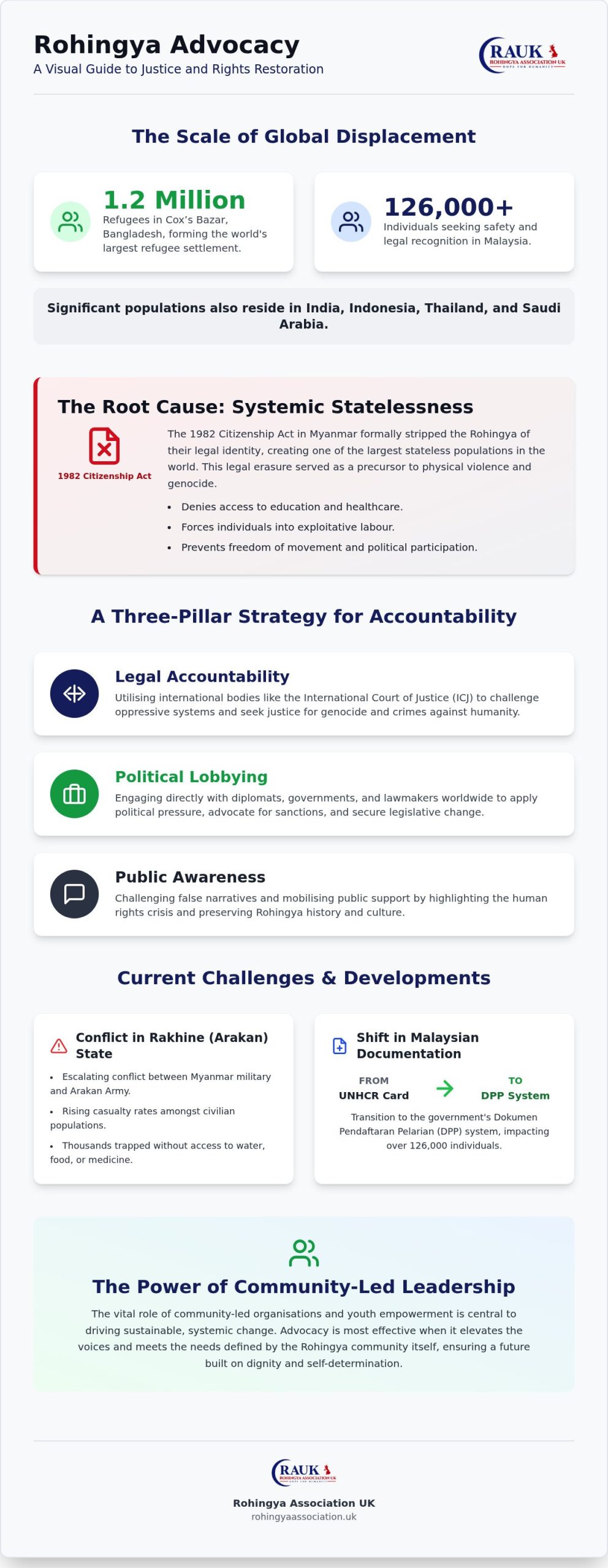
- Cox’s Bazar, Bangladesh: Approximately 1.2 million refugees living in camp settlements.
- Malaysia: Over 126,000 individuals seeking safety and legal recognition.
- Regional Impact: Significant populations also reside in India, Indonesia, Thailand, and Saudi Arabia.
Advocacy acts as the essential bridge between survival and stability. Whilst food and shelter address the immediate symptoms of displacement, strategic campaigning targets the root causes of the crisis. It’s the primary tool for shifting the international focus toward the permanent restoration of rights. This process involves challenging the narratives that have long sought to delegitimise the Rohingya identity and demanding a seat at the table where their future is decided.
The Legal Framework of Statelessness
The architecture of exclusion was formalised by the 1982 Citizenship Act. This legislation effectively stripped the Rohingya of their legal identity, rendering them one of the largest stateless populations on earth. This status isn’t just a legal abstraction; it’s a daily reality that prevents children from attending school, stops families from accessing healthcare, and forces workers into exploitative labour. The moral gravity of this situation is underscored by the Rohingya genocide, where legal erasure served as a precursor to physical violence. Restoring citizenship is not an act of charity. It’s a global responsibility for justice that requires dismantling the legislative barriers that hold millions in limbo.
Current Challenges in Rakhine State (Arakan State)
In 2026, the situation on the ground in Rakhine State, or Arakan State, remains volatile and dangerous. The escalating conflict between the Myanmar military and the Arakan Army continues to trap civilians in a cycle of violence and displacement. Verified reports from early 2026 indicate that casualty rates amongst non-combatants have risen as hostilities move into populated centres. Thousands of families are currently trapped without access to clean water or medicine, whilst those who flee often find themselves in internal displacement camps with no hope of return. Advocacy in this context means fighting for political recognition whilst simultaneously working to protect the cultural heritage and physical safety of those remaining in their homeland.
Global Rohingya Advocacy Campaigns: Strategies for Accountability
Successful Rohingya advocacy campaigns in 2026 are built upon a sophisticated tripartite structure: awareness, mobilisation, and legislative change. This methodology ensures that emotional resonance is converted into tangible political and legal outcomes. It works. By categorising advocacy into political lobbying, legal accountability, and public awareness, campaigners can target specific pressure points within the international community. These efforts aim to move beyond simple aid. They seek to dismantle the systems of oppression that persist in Rakhine State, traditionally known as Arakan State.
International bodies like the United Nations and the International Court of Justice (ICJ) serve as the primary arenas for these battles. Advocacy isn’t just a grassroots movement. It’s a professionalised pursuit of justice that requires constant engagement with diplomats and lawmakers. By aligning local voices with international standards, these campaigns ensure the crisis remains a priority on the global stage.
International Legal Accountability
The pursuit of justice for Rohingya people has seen significant milestones through the genocide case at the ICJ. This legal mechanism provides a formal platform to challenge the impunity of the Myanmar military. Alongside this, the principle of universal jurisdiction allows courts in third-party nations to prosecute individuals for international crimes, regardless of where they were committed. This ensures that those responsible for atrocities cannot find sanctuary abroad; these legal avenues are vital for the long-term restoration of dignity and the eventual safe return of refugees to their ancestral lands.
Corporate and Economic Pressure
Modern advocacy extends into the boardrooms of multinational corporations and tech giants. Campaigns now prioritise identifying and severing financial links between global businesses and entities associated with the military regime. Council on Foreign Relations reports on the Rohingya have consistently shown how targeted sanctions can cripple the financial resources required to sustain state-sponsored violence. These campaigns demand rigorous transparency in supply chains to ensure that no consumer unwittingly funds the oppression in Arakan State.
Public petitions and consumer pressure play a decisive role in shaping corporate social responsibility. When tech firms are held accountable for the spread of hate speech or when energy companies are pressured to exit sanctioned markets, the economic cost of complicity rises. By focusing on these economic levers, advocacy campaigns create an environment where genocide is no longer a profitable venture. If you want to contribute to these systemic shifts, you can volunteer with Rohingya Association UK to help amplify these global calls for transparency and reform.
Legislative Milestones and the Evolving Documentation Landscape
The success of Rohingya advocacy campaigns depends heavily on the legal frameworks established by host nations and international bodies. Without a recognised legal identity, the restoration of rights remains an elusive goal. Documentation isn’t merely a piece of paper; it’s a shield that protects individuals from arbitrary arrest, exploitation, and refoulement. As we move through 2026, the landscape of refugee registration is undergoing a significant transformation, particularly within Southeast Asia. These shifts represent both a challenge and an opportunity for advocates to secure more stable protections for the displaced.
Accurate documentation is a vital component of advocacy because it provides the data necessary to demand systemic change. When refugees are invisible to the law, they are excluded from the social contract. Formalised registration offers several tangible benefits for families:
- Legal Security: Reduced risk of detention and harassment by authorities.
- Access to Services: A pathway to healthcare, education, and essential humanitarian aid.
- Economic Agency: The ability to seek safe, legal employment without fear of exploitation.
- Data Integrity: Providing a clear count of the population to inform long-term policy and aid distribution.
The Shift to the DPP System in Malaysia
In Malaysia, the government has commenced a pivotal transition from UNHCR-led documentation to its own Dokumen Pendaftaran Pelarian (DPP) system. This rollout, which began in January 2026, directly affects the over 126,000 Rohingya currently residing in the country. Whilst the government suggests this system will better manage the refugee population, Rohingya advocacy campaigns are focused on ensuring the DPP offers genuine protection rather than just a mechanism for surveillance. According to The Rohingya Crisis backgrounder, the lack of formal legal status in host countries remains a primary driver of vulnerability. Advocacy efforts are currently prioritised toward ensuring that this new system guarantees access to basic services and upholds the principle of non-refoulement.
Global Refugee Protection Acts
Beyond regional documentation, global legislative acts like the GAP Act provide a framework for international aid and accountability. These acts penalise perpetrators of violence in Rakhine State, also known as Arakan State, whilst providing the financial resources needed for camp maintenance and education. In the UK, advocacy is increasingly focused on encouraging the British parliament to adopt similar robust legislative frameworks. By using verifiable data from the ground, advocates can shape policies that are both compassionate and practical. This legislative work ensures that the international response isn’t just a fleeting reaction but a sustained commitment to justice and human rights.
Grassroots Advocacy: The Power of Community-Led Leadership
The most impactful Rohingya advocacy campaigns aren’t those managed from a distance; they’re the ones rooted in the lived experience of the community itself. Community-led organisations possess a unique legitimacy. They carry the cultural nuances, the linguistic precision, and the personal histories that external agencies often miss. This direct connection ensures that advocacy remains authentic and prioritises the actual needs of those displaced from Rakhine State, also known as Arakan State. It transforms survivors from passive recipients of aid into active architects of their own future.
By investing in refugee youth empowerment programs, we’re cultivating the next generation of principled leaders. These young advocates bridge the gap between their heritage and their current homes in the diaspora. Cultural preservation plays a decisive role here; it’s not just about remembering the past, but about maintaining a distinct identity that refuses to be erased by the violence they’ve escaped. This resilience is the bedrock of sustainable advocacy.
Empowering the Diaspora Voice
Language is the primary tool of agency. At RAUK, we provide English language classes and skills development to ensure that refugees can tell their own stories with confidence and clarity. When an individual can articulate their history and their hopes in a global language, they move from the margins of the conversation to the centre. This transition is vital. It allows the diaspora to act as a protective shield for those still trapped in Arakan State, using their platform to demand international intervention and systemic change. We don’t just provide aid; we provide the tools for leadership.
Local Actions for Global Impact
Local support in the UK, particularly in cities like Bradford, creates a direct ripple effect that reaches the camps in Bangladesh. Organising community events allows the wider public to engage with the crisis on a human level, moving beyond headlines to real connection. Islamic community events are especially significant, as they connect the values of faith with the pursuit of social justice. These local efforts generate the resources needed to fund critical projects inside the rohingya refugee camp, ensuring that resilience on the ground is matched by solidarity abroad.
If you’re looking for ways to contribute to this movement, there are several practical paths you can take within your own community:
- Host Awareness Sessions: Use your local community centre to share the history and current status of the Rohingya people.
- Support Youth Initiatives: Mentor young refugees as they develop digital advocacy skills.
- Engage in Faith-Based Giving: Organise collections during religious festivals to support long-term restoration projects.
- Advocate Locally: Write to your MP to ensure that Rohingya rights remain a priority in British foreign policy.
Your involvement at a local level is what fuels the momentum of global Rohingya advocacy campaigns. To start making a difference in the lives of those seeking safety and justice, you can volunteer with Rohingya Association UK today.
How You Can Take Action Today
Advocacy isn’t a one-off event; it’s a marathon that requires a stable, long-term commitment. It works. Strategic Rohingya advocacy campaigns rely on a foundation of community-led leadership to ensure that every pound spent and every hour volunteered drives genuine systemic change. By moving beyond fleeting emotional reactions, we can build a future rooted in restoration and dignity. This is a collective effort that requires us to act as both a protective shield and a guiding hand for those who have been marginalised for far too long.
Direct Financial Contributions
When you choose to provide financial support, you’re investing in the physical and social infrastructure of a community. You can donate your Sadaqah Jariyah to fund long-term projects like education centres and skills development programmes that empower individuals to become self-sufficient. These contributions aren’t just about aid; they’re about building the capacity for future leadership. To address immediate needs in the settlements, you can support our Bangladesh projects, which provide emergency food support and essential crisis intervention in Cox’s Bazar. RAUK maintains a strict commitment to factual integrity and transparency, ensuring that every contribution is utilised effectively for the benefit of those in Rakhine State, traditionally known as Arakan State, and the wider diaspora.
Volunteering and Awareness
Change also requires the gift of time and the power of a clear voice. We invite you to volunteer with Rohingya Association UK to assist with our local integration efforts in Bradford or to help amplify our global awareness initiatives. In an era of digital misinformation, sharing verified data is a revolutionary act. By distributing accurate reports on the situation in Rakhine State, formerly known as Arakan State, you help combat the dehumanising hate speech that often serves as a precursor to violence. We follow a tripartite structure of engagement:
- Learn: Educate yourself and others about the historical roots of the 1982 Citizenship Act and the current legal landscape.
- Give: Provide the financial and material resources necessary to sustain community-led advocacy and empowerment.
- Act: Participate in local cultural events and political lobbying to keep the restoration of rights on the legislative agenda.
The path to global justice is long, but it’s a journey we don’t take alone. By supporting Rohingya advocacy campaigns, you’re joining a resilient network of advocates dedicated to the restoration of rights and the protection of a unique heritage. Together, we can transform the somber gravity of the current crisis into a future of agency, safety, and peace. Let’s continue this work with the confidence of those who know that justice, whilst often delayed, is never impossible when pursued with a steadfast heart.
Building a Future of Restoration and Rights
The journey toward global justice requires a decisive shift from temporary humanitarian relief to the permanent restoration of human rights. By understanding the evolving legal landscape, including the ICJ proceedings and Malaysia’s transition to the DPP system, we can better serve the 1.2 million refugees in Cox’s Bazar and those still in Rakhine State, traditionally known as Arakan State. Strategic Rohingya advocacy campaigns are the most effective way to ensure that the diaspora’s voice is prioritised in international policy. Community-led leadership remains the essential bridge between local solidarity and systemic change. It works.
As a community-led diaspora organisation (Registered Charity number: 1211433), we manage active projects in the UK, Bangladesh, and Myanmar to protect our heritage and people. Your commitment is the catalyst for this renewal. We invite you to support our global advocacy and donate your Sadaqah Jariyah today. Together, we can move beyond the gravity of the crisis toward a future defined by agency, safety, and peace. Every action you take is a vital contribution to the restoration of a people who refuse to be erased.
Frequently Asked Questions
What are the main goals of current Rohingya advocacy campaigns?
The primary objectives of current Rohingya advocacy campaigns include the restoration of citizenship under the 1982 Act, securing legal accountability for atrocities, and ensuring the safe, dignified return of displaced families. These campaigns seek to move beyond temporary aid toward systemic justice. By targeting international legal bodies and corporate supply chains, advocates work to dismantle the architecture of statelessness that has marginalised the community for decades and prioritised the restoration of fundamental rights.
How can I support Rohingya refugees living in the UK?
You can provide direct assistance by engaging with community-led organisations like the Rohingya Association UK in Bradford. We prioritise local integration through ESOL classes, skills development, and youth empowerment programmes. These initiatives help refugees transition from recipients of aid to principled leaders within their new communities. To get involved in our local awareness events or integration support, you can volunteer with Rohingya Association UK today and help build a stronger diaspora voice.
Is it better to donate to international NGOs or local community-led charities?
Whilst international NGOs provide large-scale relief, local community-led charities offer deep cultural nuance and lived experience that ensures advocacy remains authentic. RAUK is led by the Rohingya diaspora, meaning our projects are designed by those who understand the crisis intimately. This approach prioritises the community’s dignity and long-term self-sufficiency. When you donate your Sadaqah Jariyah to a community-led charity, you ensure your contribution builds lasting infrastructure and empowers the next generation directly.
What is the Dokumen Pendaftaran Pelarian (DPP) system in Malaysia?
The Dokumen Pendaftaran Pelarian (DPP) is the Malaysian government’s new registration system introduced in early 2026 to manage the over 126,000 Rohingya refugees in the country. It is intended to replace the previous UNHCR documentation process. Advocacy efforts are currently focused on ensuring this system provides genuine legal protection, prevents arbitrary detention, and allows refugees to access essential services like healthcare and safe employment without fear of being forced back into a conflict zone.
How does the ICJ case help the Rohingya people in Rakhine State?
The International Court of Justice (ICJ) case establishes a formal legal record of genocide, creating a pathway for international accountability. For those remaining in Rakhine State, also known as Arakan State, the case provides a layer of international scrutiny that can deter further military violence. It signals that the world is watching, whilst laying the groundwork for the eventual restoration of rights and citizenship for the approximately 600,000 Rohingya still residing within the region.
Can I volunteer for advocacy if I do not have a legal background?
Legal expertise is not a prerequisite for effective advocacy. Many successful Rohingya advocacy campaigns rely on diverse skills such as digital storytelling, event organising, and local fundraising. You can contribute by sharing verified facts to combat online hate speech or by assisting with community integration projects. If you want to use your unique skills to drive social justice and systemic change, you can volunteer with Rohingya Association UK and join our network.
How do advocacy campaigns ensure that aid reaches those in Cox’s Bazar?
Advocacy campaigns ensure aid effectiveness by funding direct, community-led projects that bypass bureaucratic delays. For the 1.2 million refugees in Cox’s Bazar, this means resources are prioritised for education, sanitation, and emergency crisis intervention. Transparency is maintained through verified data and regular reporting from the camps. To contribute to these essential life-saving initiatives and help build resilience on the ground, you can support our Bangladesh projects directly and see the impact of your generosity.
Why is the term Arakan State used alongside Rakhine State?
Using the term Arakan State alongside Rakhine State preserves the historical and cultural identity of the region as it was known before the 1989 military name changes. In a human rights advocacy framework, this terminology is vital for acknowledging the heritage and ancestral ties of the Rohingya people. It ensures that the narrative of the crisis remains rooted in historical accuracy, resisting efforts to erase the community’s long-standing connection to their ancestral homeland.