
Seeking asylum is a desperate act of survival, yet true resettlement remains a profound act of restoration, protection, and growth. You likely recognise that for many displaced people, arriving on safe shores is merely the beginning of a complex, often exhausting journey. The initial relief of safety is frequently eclipsed by the density of Home Office bureaucracy, the pain of social isolation, and the immense difficulty of securing stable housing or healthcare. Without dedicated refugee resettlement support UK, the gap between simply being present and truly belonging can feel impossible to bridge.
This guide provides a clear pathway through the current landscape of UK resettlement, offering a comprehensive look at the schemes designed to facilitate a new start. You’ll discover how community-led organisations act as a vital shield and guiding hand, ensuring that cultural identity is preserved whilst new roots are planted. We’ll explore the mechanics of integration, the importance of heritage, and the specific ways you can contribute to a future where every refugee finds not just a house, but a home.
Key Takeaways
- Understand the fundamental shift from seeking safety to achieving true belonging within the broader global humanitarian landscape.
- Navigate the official legal frameworks and specific pathways that constitute refugee resettlement support UK to better understand the arrival process.
- Identify how stable housing, accessible healthcare, and inclusive education serve as the necessary foundations for restoring a sense of agency and dignity.
- Explore the unique role of community-led organisations in providing culturally sensitive support that honours a refugee’s heritage whilst fostering integration.
- Discover actionable ways to support these vital efforts through dedicated advocacy, volunteering, or meaningful financial contributions.
Table of Contents
Understanding the Landscape of Refugee Resettlement in the UK
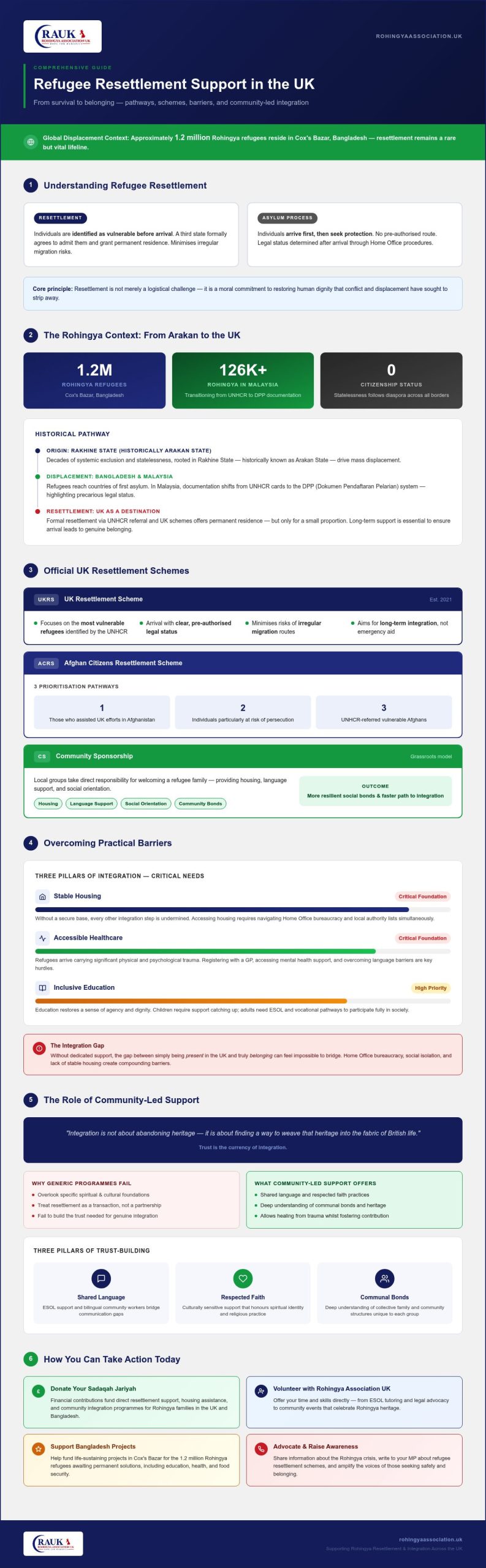
Refugee resettlement is a formal, legal process of transferring individuals from a country of asylum to a third state that has agreed to admit them and grant them permanent residence. It differs fundamentally from the asylum process, where individuals arrive and then seek protection. In the context of the United Kingdom, this structured approach ensures that individuals are identified as vulnerable before they arrive. Providing effective refugee resettlement support UK is not merely a logistical challenge; it is a moral commitment to restoring the human dignity that conflict and displacement have sought to strip away.
The scale of the global displacement crisis is staggering. Currently, approximately 1.2 million Rohingya refugees reside in Cox’s Bazar, Bangladesh, living in conditions that test the limits of human endurance. For these individuals, resettlement represents a rare and vital lifeline. It moves beyond the basic provision of food and shelter, aiming for a holistic restoration of life where families can finally envision a future. This process requires a stable, long-term commitment from the host nation to ensure that survival is transformed into genuine belonging.
The Rohingya Context: From Arakan to the UK
The history of the Rohingya is deeply rooted in Rakhine State, which was historically known as Arakan State. For decades, this community has faced systemic exclusion, leading to a state of profound statelessness. This lack of legal identity follows the diaspora across borders, creating layers of complexity in every new territory they inhabit. In Malaysia, where over 126,000 Rohingya have sought safety, there is a significant ongoing transition in documentation. Refugees are moving from UNHCR-issued papers to the Malaysian government’s DPP (Dokumen Pendaftaran Pelarian) system. This shift highlights the precarious nature of legal status and the constant need for stable, long-term settlement solutions that offer more than temporary reprieve.
The Importance of Culturally-Sensitive Support
Generic integration programmes often fail because they overlook the specific spiritual and cultural foundations of the people they serve. For a refugee, integration is not about abandoning heritage; it is about finding a way to weave that heritage into the fabric of British life. Trust is the currency of integration. It is built through shared language, respected faith practices, and a deep understanding of communal bonds. By prioritising community support for displaced families, we ensure that resettlement is a partnership rather than a transaction. This sensitive approach allows individuals to heal from trauma whilst contributing their unique skills and perspectives to their new British communities.
Official UK Resettlement Schemes and Legal Frameworks
The Home Office manages the entry of refugees through several structured programmes designed to provide safety and legal certainty. The cornerstone of these efforts is the UK Resettlement Scheme (UKRS), which was established in 2021. This scheme focuses on the most vulnerable refugees identified by the UNHCR, ensuring they arrive with a clear legal status. By providing a pre-authorised route to safety, the UKRS minimises the risks associated with irregular migration and offers a stable foundation for long-term integration.
Another critical framework is the Afghan Citizens Resettlement Scheme (ACRS). This programme operates through three specific pathways, prioritising those who assisted UK efforts in Afghanistan or are particularly at risk. Whether through the UKRS or ACRS, the provision of refugee resettlement support UK is a collaborative effort between the national government and local delivery partners. These schemes are designed to move beyond emergency aid, focusing instead on the long-term restoration of a person’s rights and agency.
Community Sponsorship offers a different, more personal approach to integration. It empowers local groups to welcome a refugee family directly into their neighbourhood. These groups take on the responsibility of providing housing, language support, and social orientation, creating a direct bridge between the new arrivals and the wider community. This grassroots involvement often results in more resilient social bonds and a faster path to true belonging.
Pathway to Settlement and Citizenship
The legal journey from arrival to citizenship is a structured process. Most resettled refugees are granted Indefinite Leave to Remain (ILR) either upon arrival or after a five-year period of limited leave. This status is essential for accessing the labour market, allowing individuals to use their skills and contribute to the economy. Despite this legal right, many face significant hurdles when transitioning from government support to independent living. Understanding the UK tax system, managing utility bills, and navigating the private housing market require more than just a visa; they require dedicated guidance and mentorship.
The Role of Local Authorities
Local councils are responsible for the practicalities of a family’s new life. They organise housing, secure school places for children, and facilitate access to local healthcare services. This work is most effective when councils partner with community-led organisations that understand the specific cultural and religious needs of displaced populations. Strategic Migration Partnerships act as the regional coordinators that manage the distribution of refugees across various council areas to ensure local infrastructure can support new arrivals. You can learn more about how we facilitate these local connections when you volunteer with Rohingya Association UK to support our integration projects.
Overcoming Practical Barriers: Housing, Healthcare, and Education
Secure housing is the essential foundation of a stable life. For families arriving through refugee resettlement support UK, the initial provision of a roof is only the first step toward genuine belonging. The transition from government-supported accommodation to the private rental sector often presents a significant hurdle. Landlords may be unfamiliar with refugee documentation; the absence of a traditional credit history can lead to immediate exclusion. Accessing specialised refugee housing guidance UK is vital for families to navigate these complexities, ensuring they find safe, sustainable homes within their new communities.
Beyond physical shelter, the restoration of health and the pursuit of knowledge are the pillars upon which a successful future is built. These areas require more than just access; they require a system that understands the profound weight of the refugee experience. When these practical barriers are dismantled, individuals can move from a state of mere survival to one of active participation in British society.
Navigating the UK Healthcare System
Registering with a General Practitioner (GP) is a fundamental right within the NHS, yet the process can be daunting for those unfamiliar with British bureaucracy. For survivors of the atrocities in Rakhine State, healthcare needs are often multifaceted, encompassing both physical ailments and deep-seated psychological trauma. Language barriers shouldn’t prevent access to these essential services. Community advocates play a critical role here, acting as cultural bridges to translate medical needs and ensure that patients feel heard, respected, and understood. Mental health support is not a luxury; it’s a necessary component of the healing process that allows individuals to reclaim their agency.
Education and English Language Proficiency
Education remains the most powerful tool for long-term empowerment and social mobility. For adults, English for Speakers of Other Languages (ESOL) classes are not merely about vocabulary; they are about economic agency, social connection, and communal confidence. Proficiency in English directly impacts employability and the ability to advocate for one’s own family. Similarly, children entering the British school system require a sensitive environment that acknowledges their previous educational disruptions. Investing in refugee youth empowerment programs helps ensure the next generation can build a future defined by opportunity rather than displacement. These programmes provide the following benefits:
- Language Acquisition: Accelerated learning through peer support and tailored tutoring.
- Social Integration: Safe spaces to build friendships and understand British cultural norms.
- Career Aspirations: Mentorship that connects young people with vocational and academic pathways.
The Role of Community-Led Support in Achieving Integration
Community-led organisations offer a nuanced layer of refugee resettlement support UK that statutory services often struggle to replicate. Because these groups are frequently rooted within the diaspora itself, they possess an inherent understanding of the trauma, language, and faith that define the refugee experience. This “lived experience” is not merely a perspective; it’s a vital tool for designing integration programmes that actually work. When support comes from a peer who has navigated the same bureaucracy and felt the same loss, trust is established instantly. This bond acts as both a protective shield and a guiding hand, moving beyond the transactional nature of government aid to create a sense of genuine partnership.
Building social capital is equally essential for long-term stability. Peer-to-peer mentoring and regular community events allow individuals to share knowledge, navigate local systems, and form the support networks necessary for resilience. These connections are the invisible threads that hold a community together, ensuring that no family is left to face the challenges of a new life in isolation. By fostering these relationships, community-led initiatives help refugees move from being passive recipients of aid to active, empowered members of British society.
Preserving Heritage in a New Home
Integration is not a process of cultural erasure. True belonging occurs when an individual feels safe enough to maintain their cultural heritage whilst embracing a new British identity. Organising cultural and Islamic events is a strategic act of resilience; these gatherings maintain community bonds and prevent the profound “isolation of displacement” that often leads to mental health decline. The Rohingya community in Bradford serves as a powerful model for this successful balance. By establishing a dedicated presence in the city, the community has created a space where traditional customs and British civic participation coexist, proving that heritage preservation is a foundation for, rather than a barrier to, integration.
Skills Development and Economic Independence
Moving beyond crisis intervention requires a purposeful shift toward long-term skills training and economic agency. For stateless individuals who may have been denied the right to work or access education for decades, tailored employment support is a prerequisite for dignity. This involves more than just job placements; it requires vocational training and CV workshops that respect their unique life journeys. Rohingya Association UK facilitates local volunteer opportunities for refugees, allowing them to gain vital British work experience whilst contributing to the society that has welcomed them. If you wish to support these community-driven efforts, you can volunteer with Rohingya Association UK to help bridge the gap between arrival and belonging.
How You Can Take Action Today
The journey from displacement to belonging is rarely a solitary one. It requires a collective effort that spans local neighbourhoods and global advocacy networks. By providing robust refugee resettlement support UK, we don’t just offer temporary aid; we invest in the long-term restoration of human dignity. Every action, whether it involves a financial gift, a donation of time, or a commitment to advocacy, serves to strengthen the protective shield we build around the vulnerable. Your participation is a direct reflection of a shared moral seriousness that refuses to look away from the humanitarian challenges of our time.
Sustainable community projects are the only way to ensure that integration is permanent rather than fleeting. These initiatives provide the infrastructure for education, the stability of housing, and the warmth of communal bonds. When you align your personal values with the mission of the Rohingya Association UK, you become a partner in a stable, long-term commitment to justice and renewal. This is an invitation to move beyond empathy and into the realm of principled action. Your support ensures that survival is merely the first step on a path toward a life of agency and contribution.
Financial Contributions and Faith-Based Giving
Financial support provides the essential resources needed to maintain crisis intervention and long-term empowerment programmes. You can donate your Sadaqah Jariyah to help build the lasting infrastructure that displaced families rely on for their survival and growth. These contributions are managed with strict financial transparency, ensuring that every gift reaches those in the greatest need. Regular donations allow for predictable planning in education and youth empowerment, creating a cycle of opportunity that can transform entire generations. Your generosity acts as a catalyst for restoration, providing the means for families to rebuild their lives with dignity and independence.
Volunteering and Advocacy
Time is often as valuable as financial support. We encourage those in the Bradford area to volunteer with Rohingya Association UK, providing direct assistance to families as they navigate their new lives in the city. For those further afield, you can support our Bangladesh projects by raising global awareness about the 1.2 million refugees in Cox’s Bazar. Advocacy remains a powerful tool for systemic change; it is vital to continue pushing for justice for Rohingya people at a governmental level. By combining local action with global advocacy, we ensure that refugee resettlement support UK is part of a broader movement toward human rights and accountability.
Restoring Dignity through Collective Action
True integration is a long-term commitment that begins with safety but only flourishes through genuine community belonging. We’ve explored how navigating the complexities of legal frameworks, securing stable housing, and accessing healthcare are the necessary foundations for a new life. However, the most resilient outcomes are achieved when refugee resettlement support UK is led by those who understand the weight of displacement. By bridging the gap between official policy and lived experience, we ensure that the heritage of the Rohingya people is preserved whilst they build a future in British society.
As a community-led registered charity, we provide direct impact within the Bradford community and for the 1.2 million refugees in Cox’s Bazar. Our advocacy for stateless people is grounded in a professional, dignified approach that prioritises empowerment over pity. You can play a vital role in this restoration of hope and agency. Support our mission to empower displaced families; donate your Sadaqah Jariyah today. Together, we can transform the pain of displacement into a story of resilient renewal and lasting belonging.
Frequently Asked Questions
What is the difference between an asylum seeker and a resettled refugee in the UK?
An asylum seeker is someone who has arrived in the United Kingdom and is waiting for a decision on their claim for international protection. In contrast, a resettled refugee is identified as vulnerable by the UNHCR whilst still abroad and arrives with a pre-authorised legal status. This distinction is critical because it determines the level of refugee resettlement support UK authorities provide immediately upon arrival.
How long does the UK government provide support for resettled refugees?
The government generally funds intensive support for the first twelve months following a family’s arrival. This initial period focuses on securing housing, organising school places, and facilitating access to healthcare. Whilst local authority funding typically tapers after the first year, the ultimate objective is to provide a stable foundation that allows individuals to transition toward independent living and full participation in British society.
Can I choose where I am resettled within the UK?
Individuals generally don’t have the opportunity to choose their specific resettlement location. The Home Office works with Strategic Migration Partnerships to distribute families across various regions based on the availability of suitable housing and local infrastructure. This methodical approach ensures that local councils can provide the necessary services without overextending their resources, whilst also striving to keep extended family units together where possible.
How does the Community Sponsorship scheme work for local groups?
Community Sponsorship empowers local volunteers to take direct responsibility for a refugee family’s integration. Groups must be registered as a charity or community interest company and are required to provide housing and social support for a minimum of two years. It is a deeply personal model of restoration that allows local residents to act as a protective shield and guiding hand for new arrivals.
What specific support is available for Rohingya refugees in the UK?
Rohingya refugees can access specialised assistance through community-led organisations that understand their unique cultural and spiritual needs. This includes help navigating the healthcare system for trauma related to persecution in Rakhine State, formerly Arakan State, and support in maintaining their heritage. We work to ensure that resettlement programmes are culturally sensitive, providing a bridge between official government schemes and the specific requirements of the diaspora.
Are resettled refugees allowed to work immediately upon arrival?
Yes, resettled refugees are granted the legal right to work from the day they arrive in the UK. Because they arrive with a settled status, such as Indefinite Leave to Remain, they have full access to the labour market. Securing meaningful employment is prioritised as a vital step toward economic agency and is a core component of successful refugee resettlement support UK.
How can I help a refugee family in my local area?
You can offer support by volunteering with local organisations to provide language practice, transport assistance, or social orientation. Many families face profound isolation and benefit immensely from simple acts of friendship and guidance. Whether it’s helping a neighbour understand a utility bill or explaining local school systems, your time helps dismantle the barriers that prevent a family from truly belonging to their new community.
What happens to refugees who are stateless, such as the Rohingya?
Statelessness creates an additional layer of legal complexity, as individuals lack a recognised nationality and the protections it affords. For the Rohingya, this status has historically led to systemic exclusion in Rakhine State, formerly Arakan State. In countries like Malaysia, where over 126,000 Rohingya reside, many are currently transitioning from UNHCR documentation to the government’s DPP system, highlighting the constant, urgent need for stable settlement in third states.