
Can a signature change a person’s citizenship, or help change the political conditions that deny it? A petition for Rohingya citizenship rights can bring a clear demand into public view, show decision-makers that people are paying attention and help sustain pressure for change. But it cannot grant citizenship or replace the legal and political action needed to secure rights.
That distinction matters. Citizenship, legal status and protection are connected, but they are not interchangeable. Understanding exactly what a petition asks for is essential to judging what it could achieve. It is also reasonable to want to know who organised it, whether it is current and whether it represents Rohingya voices respectfully.
This article explains where petitions can have influence, where their power ends and how to assess a campaign before supporting it. It also compares petitions with other forms of advocacy and community support, so you can take informed, practical steps that respect Rohingya agency and contribute to sustained efforts for justice.
Key takeaways
- Understand how a petition for Rohingya citizenship rights can voice a public demand, while recognising that signatures alone cannot grant citizenship or change the law.
- See how petitions, community-led advocacy, public education and legal processes can contribute in different ways, each with its own purpose and limits.
- Use a practical checklist to assess who organised a petition, what it asks for, whom it addresses and whether its information is current.
- Learn why effective advocacy should listen to Rohingya communities and respect their agency, rather than speak over them.
- Explore how Rohingya Association UK supports people in Bradford and beyond through advocacy and community work. RAUK partners with Fuel Bank and HACT, is a member of National Energy Action (NEA), and provides energy advice and support.
What does a petition for Rohingya citizenship rights mean?
A public advocacy petition is a request for a defined change, addressed to a government, institution or other decision-maker. It may gather signatures and draw attention to a shared demand. A court filing is different: it is submitted through a legal process and asks a court to consider a case or remedy. A petition for Rohingya citizenship rights, in the public advocacy sense, calls for action on legal recognition and belonging. It is not itself a legal application, judgement or grant of citizenship.
A citizenship-rights petition gives a public voice to a demand for legal recognition, but cannot itself confer citizenship or guarantee a policy change. Citizenship means formal legal membership of a state, with rights and responsibilities determined by that state’s laws. Those rights may include recognition in law and access to forms of participation, but their precise scope depends on the relevant legal system.
Why citizenship rights matter to Rohingya people
Legal recognition can affect whether people are recognised by public institutions and able to assert rights under a state’s laws. Documentation may help establish identity or legal status in particular circumstances, but having a document alone does not guarantee safety, equal treatment or access to every service. Its practical effect depends on the rules and how they are applied.
For Rohingya people, citizenship is also tied to recognition, security and the ability to shape decisions about their futures. Their history and present circumstances are complex. The Rohingya people overview offers a starting point for understanding their identity, statelessness and persecution. Citizenship is one vital concern, not a substitute for protection, humanitarian assistance, education or meaningful participation in decisions that affect Rohingya communities.
Citizenship, statelessness and refugee status are not interchangeable
Citizenship is a person’s formal legal membership of a country. Statelessness describes a situation in which a person is not considered a national by any state under its law. Refugee status concerns protection for someone who has fled their country and meets the relevant criteria; it does not make that person a citizen of the country providing refuge.
Myanmar’s 1982 Citizenship Law remains in effect as of October 2026. The law is widely identified as a basis for the exclusion of Rohingya from citizenship, including through the absence of recognition as one of Myanmar’s official ethnic groups. Its application and consequences are part of a wider history of discrimination, not a complete account of Rohingya lives or the barriers they face.
Being recognised as a refugee abroad does not, by itself, restore or resolve citizenship in Myanmar. Protection in a host country and legal belonging in a country of origin are distinct matters, even though both can be central to a person’s security and future.
How can a petition for Rohingya citizenship rights influence change?
A petition can turn a broad concern into a clearly expressed request directed at a particular audience. For example, organisers might ask a government to raise citizenship rights in diplomatic discussions, or urge an institution to publicly support equal legal recognition. The request is most useful when it identifies who is being asked to act and what action is sought, rather than relying on a general appeal for support.
A petition for Rohingya citizenship rights may help show that an issue has public attention, provide a focal point for discussion and give supporters a shared way to express concern. Its influence is possible, not automatic. Signatures do not, by themselves, change a law, require an authority to act or determine the outcome of a legal case.
From public signatures to decision-makers
Depending on the campaign, organisers may share a petition with the named recipient, include it in correspondence or raise it in a meeting. The route matters: a petition addressed to an institution with relevant influence may be more directly connected to the request than one sent to an audience without a clear role. There is no universal signature total that guarantees a response or outcome.
Visibility can still matter. A concise, well-supported request may help decision-makers, journalists or the wider public understand what supporters are asking for and why. Evidence gives that request context. For background on documented concerns affecting Rohingya communities, readers can consult Human Rights Watch reports on Rohingya. A source can inform advocacy, but it does not establish that a particular petition has been formally received or acted upon.
Follow-up is another part of the picture. Organisers might provide updates on whether the request was delivered, any response received and what further action is planned. If a campaign does not report these steps, the number of signatures alone may tell readers little about what happened after people signed.
Why a petition is one part of longer-term advocacy
Petitions can amplify a demand, but they cannot guarantee its adoption. Sustained advocacy may also involve community-led engagement, public education, dialogue with decision-makers and diplomatic work. These approaches have different audiences and purposes: education can build understanding, while policy discussions can address proposals through established political channels.
Legal processes also have their own requirements, decision-makers and timescales. A public petition cannot replace a court filing, determine a legal question or compel a court to reach a particular conclusion. Nor can it substitute for listening to Rohingya people, whose perspectives and priorities should inform advocacy that concerns their rights and future.
To follow the issue responsibly, look for clear updates, credible supporting material and evidence that organisers remain engaged beyond a campaign’s launch. Readers can also explore Rohingya advocacy and awareness work as one part of learning about ongoing community-led advocacy.
Petitions and other advocacy routes: what can each contribute?
A petition is one way to express a public demand, but it serves a different purpose from community leadership, public education or legal action. These approaches can support one another; none should be treated as a substitute for all the others. The right route depends on the aim, the audience and the role Rohingya people have in shaping the work.
| Advocacy route | Audience and purpose | Potential contribution | Limits |
|---|---|---|---|
| Public petition | A named decision-maker or institution; communicates a defined public request. | Makes a demand visible and gives supporters a shared way to express it. | Signatures do not themselves change policy, grant rights or create a legal ruling. |
| Community-led advocacy | Officials, organisations and the wider public; conveys priorities voiced by affected communities. | Can bring lived experience, knowledge and community priorities into discussions. | Requires meaningful participation and cannot represent every person with a single view. |
| Public education | General audiences; explains context and challenges misunderstanding. | Can build informed discussion and help people assess claims and campaign requests. | Awareness alone does not secure a policy or legal change. |
| Legal processes | Courts or other relevant legal bodies; addresses a legal question through formal procedures. | May provide a route for legal claims or remedies, depending on the case and process. | Separate from public campaigning, with its own procedures and outcomes that cannot be assured by petition signatures. |
Public petitions and community-led advocacy
A petition can amplify a clearly expressed demand, especially when Rohingya people help shape its wording, purpose and public presentation. Consultation matters: it can make the request more accurate, respectful and grounded in the concerns of people affected. Rohingya communities are not a single voice, so responsible advocacy should avoid suggesting that one petition speaks for everyone. Listening is part of the work, not an endorsement added after the campaign is formed.
Public campaigns, policy engagement and legal action
Public education can explain why an issue matters, while policy engagement directs proposals towards people or institutions able to consider them. Community-led advocacy can help ensure those conversations take account of Rohingya perspectives. These routes have distinct audiences and timelines; none guarantees the result sought.
Legal action is different. Signing a campaign petition is not the same as instructing a lawyer, bringing a legal case or participating in court proceedings. Legal representation and litigation follow separate processes, and a public campaign cannot replace them. For further context on justice and accountability for Rohingya people, consider how legal avenues and public advocacy can each contribute without confusing their roles.
A petition for Rohingya citizenship rights may be one part of sustained advocacy, alongside informed public discussion, community leadership and policy engagement. The value lies not in treating any route as a guaranteed solution, but in understanding what each can contribute and ensuring Rohingya voices remain central.
How to assess and support a citizenship-rights petition responsibly
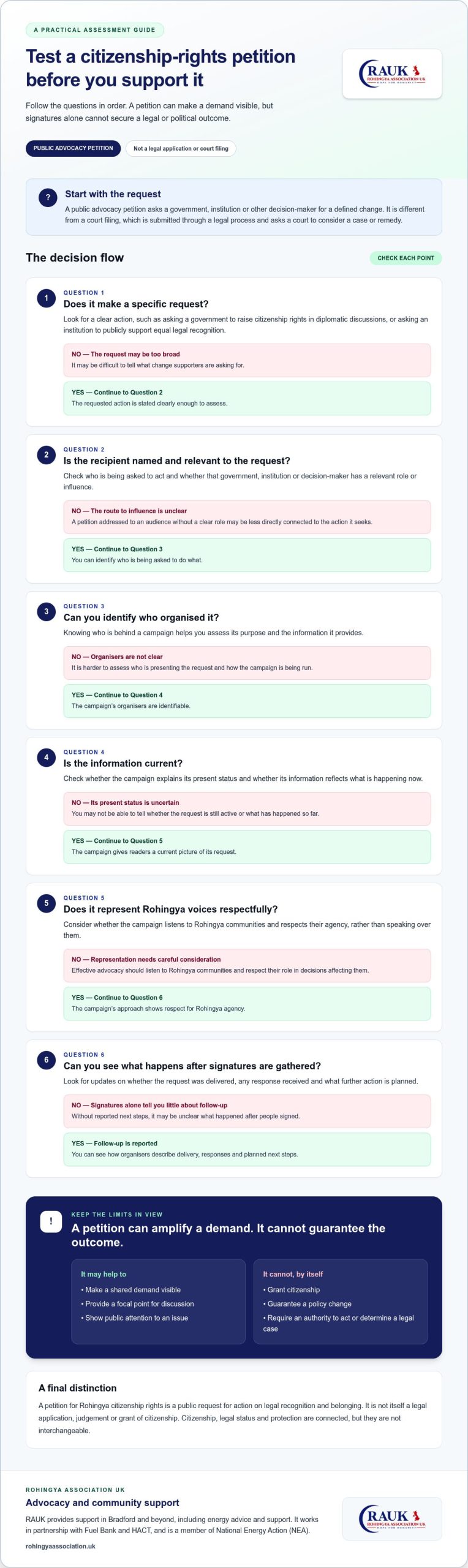
Before signing or sharing a campaign, pause to understand what it asks, who is asking and what may happen next. A careful check helps you support credible advocacy without passing on misleading claims or speaking over the people whose rights are at stake.
Questions to ask before signing or sharing
Use this checklist to assess the petition’s purpose and reliability. You do not need specialist knowledge to look for clear, consistent information:
- Who organised it? Look for a named organisation or individuals, a clear explanation of their role and a way to find further information about the campaign.
- What exactly is being requested? The wording should describe a specific action, rather than relying on broad language that could mean different things to different readers.
- Who is the intended recipient? Check that the petition identifies the government, institution or decision-maker it asks to act, and that the request relates to that audience’s role.
- What evidence supports its claims? Look for sources that can be identified and checked. Be cautious of statistics without attribution, claims presented without context and promises that signing will guarantee a particular result.
- Is the campaign current? Check for dates, updates and information about whether it is still collecting signatures or has already been delivered. An old page without recent updates may not reflect the campaign’s current status.
- Are Rohingya voices represented respectfully? Consider whether the campaign reflects affected people’s perspectives accurately, avoids treating the community as having one shared view and explains how its framing was developed.
Read the full petition, not only a headline or social-media caption. A short summary can leave out important qualifications, while emotive wording may obscure what the organisers are actually asking for. If a claim seems important, follow its source and see whether it supports the wording used.
Share advocacy without increasing harm
Sharing can extend a campaign’s reach, but it also means taking responsibility for its accuracy. Share the original petition or reliable supporting material where possible, and retain the context: who is being asked to act, what action is requested and what the campaign can realistically influence. Avoid adding claims or predictions that the organisers have not substantiated.
Protect people’s dignity and privacy. Do not repost personal details, images or accounts that could identify someone without their consent, and do not repeat unverified allegations about individuals or communities. Rights-centred advocacy can be urgent without being inflammatory. Choose language that recognises Rohingya agency and avoids reducing people to suffering or treating their experiences as a tool for persuasion.
Taking time to verify a petition is a meaningful contribution in itself. For further insight into community-led advocacy and awareness, explore Rohingya Association UK’s advocacy work.
How Rohingya Association UK supports advocacy and community wellbeing
Rohingya Association UK (RAUK) is a community-led charity supporting Rohingya refugees, families and young people. Based in Bradford, RAUK provides support in Bradford and beyond through community integration, education, youth empowerment, advocacy and practical assistance. These strands address different needs: public advocacy can help keep rights and recognition in view, while community programmes focus on people’s everyday experiences and aspirations.
RAUK’s advocacy and awareness projects operate in the UK, Myanmar and Bangladesh. The charity’s work supports informed discussion about Rohingya rights and brings community perspectives into wider awareness efforts. Responsible advocacy makes space for different views and respects people’s agency.
Community support and advocacy can strengthen one another
Awareness work can encourage people to learn about issues affecting Rohingya communities, while education and integration initiatives support families and young people as they build connections and pursue opportunities. RAUK also provides energy advice and support. It works in partnership with Fuel Bank and HACT and is a member of National Energy Action (NEA). These forms of support complement one another, but none should be treated as a substitute for political or legal processes. Their shared foundation is respect: people should be recognised for their knowledge, choices and contribution, not defined only by the challenges they face.
RAUK’s community work also includes support for displaced families. Connecting practical assistance with long-term awareness can help keep community wellbeing in view alongside wider advocacy for rights. It is a steady approach, grounded in listening and sustained engagement rather than a single public campaign.
Take an informed next step
Supporting a petition for Rohingya citizenship rights is one way to express a public demand, but informed engagement can continue beyond signing. Follow reliable updates, learn from Rohingya-led perspectives and share accurate information with care. Before endorsing a campaign, consider whether its request is clear, its claims are supported and its wording represents affected people respectfully.
Explore RAUK’s wider community and advocacy work to understand how awareness, education and community assistance contribute to Rohingya rights and wellbeing. Stay attentive to verified information, listen to community perspectives and share material responsibly. Each considered action can help sustain public attention while respecting the voices and agency of Rohingya people.
Carry informed advocacy forward
A signature can be a beginning, but lasting support asks for continued attention. Return to campaign updates, note whether organisers report a response, and consider whose perspectives are shaping the next steps. This helps keep advocacy accountable and makes room for Rohingya people to express varied priorities, rather than treating one campaign as the voice of an entire community.
For a petition for Rohingya citizenship rights, a thoughtful next step is to stay engaged beyond the moment of signing: share accurate information, listen to community perspectives and support sustained advocacy grounded in dignity and agency. Progress may take time, and public attention is most useful when it is informed, respectful and consistent.
Explore Rohingya Association UK’s community and advocacy work, and support its practical assistance and advocacy through a voluntary donation. Donations help fund aid projects in the UK, Myanmar and Bangladesh, including crisis intervention, education and community integration for displaced Rohingya families.
Frequently Asked Questions
Can anyone sign a petition for Rohingya citizenship rights?
Often, supporters can sign regardless of nationality, but eligibility depends on the campaign’s own terms and the platform hosting it. Check whether the organisers specify who may sign and what information they collect. Before submitting your details, read the privacy information and consider whether you are comfortable sharing them. A signature expresses support for the petition’s stated request; it does not mean you endorse claims or proposals beyond what the petition actually says.
Does signing a petition grant Rohingya people citizenship?
No. Signing expresses support for a campaign’s request; it does not change anyone’s legal status or grant citizenship. Citizenship depends on decisions and processes under the relevant state’s laws, not on the number of signatures a public petition gathers. A petition may help draw attention to a demand, but it should not be presented as an application for citizenship or as a guarantee that governments will act.
Can a petition be submitted to the United Nations?
A campaign may direct a request or petition to a UN body or representative, but that does not mean it becomes a formal UN case or receives a particular response. The appropriate channel depends on the purpose: public advocacy, a request for attention or a submission under a specific UN process are not interchangeable. Check the campaign’s stated recipient and whether it explains how the petition will be delivered.
How can I tell whether a Rohingya rights petition is genuine?
Look beyond a familiar logo or a high signature count. Check that the organiser can be identified, the recipient and requested action are clear, and cited evidence leads to sources that support the claims. Look for dated updates showing whether the campaign is active and what has happened to its request. Be cautious if the page uses alarming claims without evidence, asks for unnecessary personal information or promises a guaranteed outcome.
Can people outside Myanmar support a petition for Rohingya citizenship rights?
Yes, if the campaign allows them to sign. People living elsewhere can also support advocacy by sharing reliable information, discussing the issue with their communities or following updates from Rohingya-led groups. Keep the campaign’s context intact when you share it, and do not imply that signatures from abroad speak for Rohingya people. The most responsible support combines solidarity with respect for the community’s own perspectives and priorities.
What is the difference between a public petition and a court petition?
A public petition gathers support for a request directed to an audience such as a government or institution. A court petition is a document submitted as part of a legal process, where rules about who may file, what the document must contain and how it is considered depend on the court and case. Signing a public campaign does not make someone a party to legal proceedings or initiate a court case.
How can I support Rohingya rights if I do not want to sign a petition?
You can learn from credible reporting and Rohingya-led organisations, share carefully sourced information, or support community and education initiatives. You might also write to a representative or institution about a clearly defined concern, making sure your message reflects reliable evidence and does not claim to speak for Rohingya people. Choose an approach that fits your circumstances; informed attention and respectful engagement can contribute without a signature.