
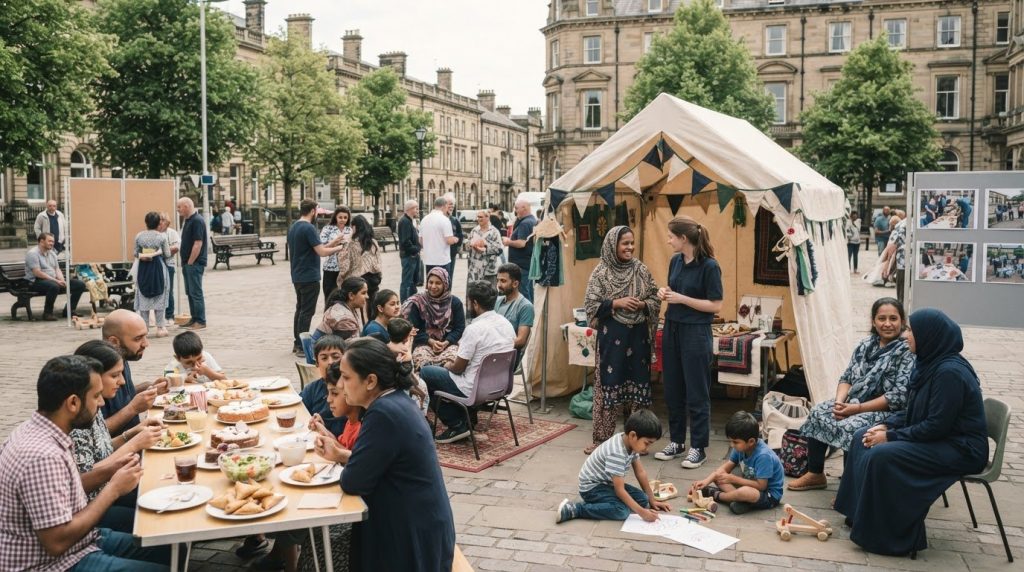
World Refugee Day 2026 UK events took place around a day of recognition and a wider week of community activity. As the June dates have passed, this guide explains how to make sense of archived listings, distinguish World Refugee Day events from Refugee Week activities and find useful details without mistaking an old announcement for an invitation to attend.
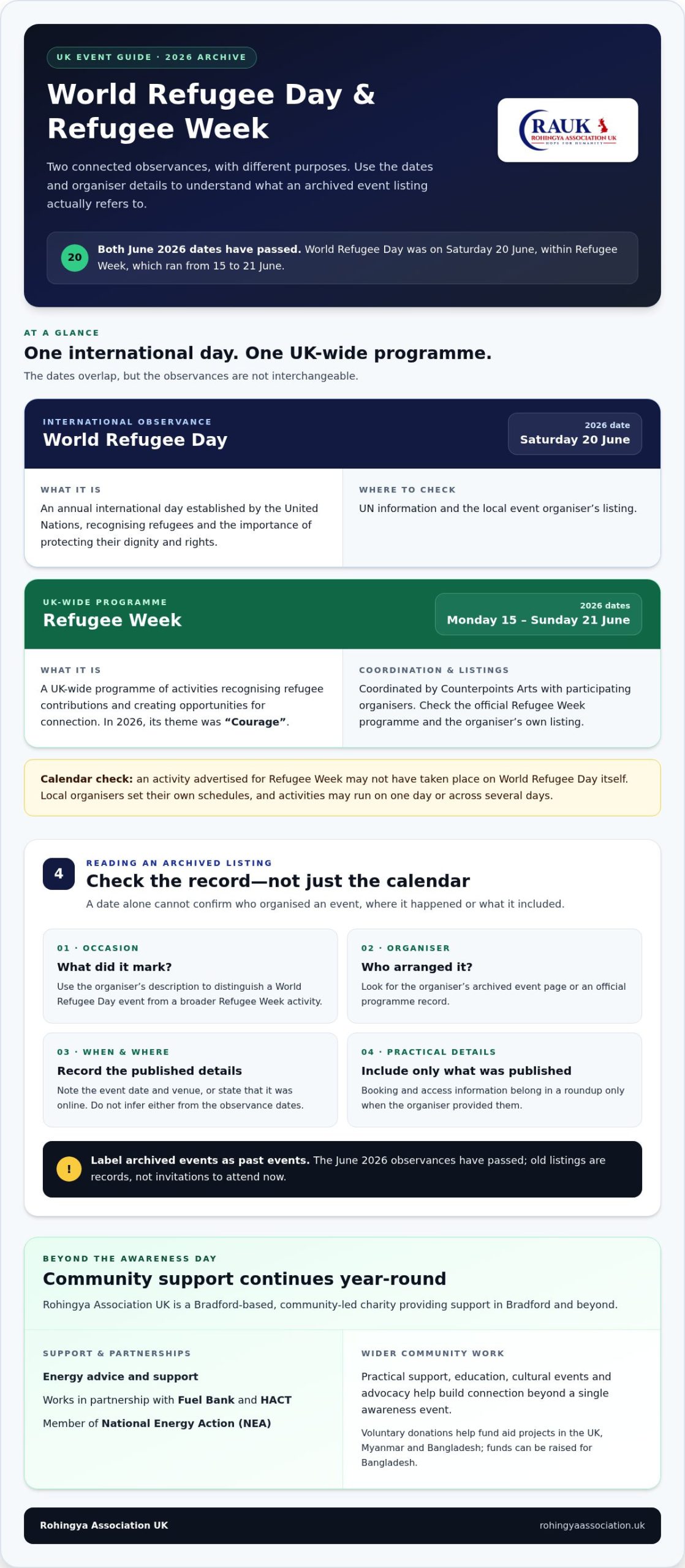
World Refugee Day is observed annually on 20 June. In 2026, that date fell on a Saturday, within Refugee Week, which ran from 15 to 21 June. The two occasions are closely connected, but they are not the same programme. This guide explains what to look for in event records and how to take part respectfully, whether you are researching an event you missed or planning for a future observance.
Community support continues beyond one awareness day. Rohingya Association UK is a Bradford-based community-led charity providing support in Bradford and beyond, including energy advice and support. RAUK works in partnership with Fuel Bank and HACT, and is a member of National Energy Action (NEA). Its wider work includes practical support, education, cultural events and advocacy. Voluntary donations help fund aid projects in the UK, Myanmar and Bangladesh, and funds can be raised for Bangladesh.
Key takeaways
- World Refugee Day 2026 was on Saturday 20 June, and Refugee Week ran from 15 to 21 June. Both dates have passed.
- Use an organiser’s archived event page or an official programme record to establish what an event was, when it took place and where.
- Keep World Refugee Day events distinct from other activities held during Refugee Week.
- At events, listen to refugee-led voices and respect people’s privacy, consent and cultural context.
- Community-led support, including practical assistance, education and cultural activity, can build connection beyond an awareness event.
What is World Refugee Day, and why does it matter in the UK?
World Refugee Day is the United Nations’ annual observance recognising refugees and affirming the importance of protecting their dignity and rights. It creates a shared moment to listen, learn and acknowledge the experiences of people forced to flee, without suggesting those experiences are all the same. The UN Refugee Agency, UNHCR, marks the day each year. The history of World Refugee Day also traces how it developed as a global occasion.
In the UK, the observance has both a national and a local dimension. Awareness activity may draw attention to refugee protection and welcome, while community organisations and local groups arrange their own gatherings and activities. For anyone researching World Refugee Day 2026 UK events, it is useful to distinguish the annual observance from each individual event. A date in the calendar does not tell you who organised a gathering, where it took place or what its programme included.
The day can mean different things to refugees, displaced people, their families and the communities around them. Some may welcome a space to share culture, build connections or have their voices heard. Others may prefer privacy or may not wish to speak publicly about displacement. Host communities can use the occasion to learn and strengthen relationships, but respectful participation means allowing people to choose how they take part rather than expecting anyone to represent a whole country, culture or experience.
When was World Refugee Day observed in 2026?
World Refugee Day fell on Saturday 20 June 2026, in keeping with its annual date of 20 June. The date has passed. If you are researching a past event, look for an archived listing or a report from its organiser rather than relying on the annual observance date alone.
What does the day recognise beyond a single event?
A gathering can create a point of connection, but recognition reaches further than attendance. It includes treating refugees as people with agency, histories and varied hopes, and recognising the importance of safety, dignity and rights. Refugee-led perspectives should be heard on their own terms, with consent and context. No individual should be expected to disclose personal experiences to make an event meaningful.
This approach connects a day of awareness with practical, sustained solidarity: listening to community priorities, valuing cultural life and supporting relationships that continue after an event ends. Families’ needs and circumstances differ, so useful support starts with attention to what people say they need, rather than assumptions about a shared experience. This is also the basis of thoughtful community support for displaced families.
World Refugee Day and Refugee Week: how UK events connect
World Refugee Day and Refugee Week are related in purpose, but they are distinct observances. The United Nations established World Refugee Day as an annual international day. Refugee Week is a UK-wide programme inviting organisations and communities to recognise refugee contributions and create opportunities for connection. In the UK, Refugee Week is coordinated by Counterpoints Arts, working with participating organisers across the country.
World Refugee Day is a single international observance; Refugee Week is a UK programme of activities that may include the date, but is not interchangeable with it. An event advertised for Refugee Week may not take place on World Refugee Day itself. When reading an archived listing, use the organiser’s description to identify which occasion the activity marked. The UN’s United Nations World Refugee Day page explains the international observance, while Refugee Week’s official programme is a starting point for UK-wide activities.
How the observances relate in the UK calendar
In 2026, Refugee Week ran from Monday 15 June to Sunday 21 June, with the theme “Courage”. World Refugee Day fell within that period, on Saturday 20 June. The dates create a natural connection, but the calendar does not establish that a particular event was held on a particular day or at a particular venue. Local groups set their own schedules, and activities may run on one day or across several days.
| Point of comparison | World Refugee Day | Refugee Week |
|---|---|---|
| Observance | International day led by the United Nations | UK-wide programme coordinated by Counterpoints Arts |
| Timing in 2026 | Saturday 20 June | Monday 15 June to Sunday 21 June |
| Typical activity | Awareness events and gatherings marking the day | Community activities and events organised across the programme week |
| Where to check | UN information and the local event organiser’s listing | Official Refugee Week programme and participating organisers |
Which listings belong in a 2026 roundup?
A clear roundup labels each entry as a World Refugee Day event or a broader Refugee Week activity. For each event, record the organiser, date and venue, or note that it was online. Include booking and access information only as the organiser published it. Since the June 2026 observances have passed, identify these as past events, not opportunities to book or attend now.
This approach makes World Refugee Day 2026 UK events easier to interpret and avoids treating a national programme as a complete local calendar. Community-led cultural gatherings can also sustain connection beyond an awareness week. Readers interested in that year-round work can learn about Rohingya Association UK’s community activity.
UK World Refugee Day 2026 events: what to look for in verified listings
Last updated: 13 October 2026. The June 2026 programme period has passed, so listings for that year are historical. To research a particular activity, use the event organiser’s archived page, an official programme entry or a venue or council record. These sources can help establish the event’s name, date, location and format, and distinguish a confirmed past event from a general announcement.
A useful roundup separates events specifically marked for World Refugee Day from wider Refugee Week activities. It also distinguishes a national programme from activities in a named UK nation, region or town. When reading a listing, check that the organiser is identified, the date and place are specific, and the event format is clear. A repost without those details may not tell you whether it describes an actual event, a general invitation or an updated schedule.
National and regional activities across the UK
Listings should identify where an event was held, rather than using “UK-wide” as a catch-all. A programme entry might have national scope, while a talk or workshop may relate to a particular nation, region or city. Record the location given by the organiser and whether the event was in person, online or hybrid. Keep the event’s original classification clear, especially when a local activity formed part of Refugee Week rather than taking place on World Refugee Day itself.
| Event | Place | Date | Format | Authoritative listing source |
|---|---|---|---|---|
| National programme entry | As stated by the organiser | As stated in the archived listing | In person, online or hybrid, as stated | Official programme archive or organiser’s event page |
| Bradford-area event | Venue or neighbourhood named in the listing | As stated in the archived listing | In person, online or hybrid, as stated | Organiser, venue or council event archive |
| Online or hybrid activity | Online, or the in-person venue if hybrid | As stated in the archived listing | Online or hybrid, with access details from the organiser | Organiser’s archived event page or official programme |
Bradford, local community events and online participation
For Bradford-area events, look for the same core details: the organiser, event date, venue and whether the activity was open to the public. A location alone does not establish who hosted an event or what happened. Likewise, an organisation’s presence in Bradford does not mean it hosted every local activity. Use an event-specific listing or report to connect an organiser with a particular event.
For online and hybrid activities, check the organiser’s published access instructions and whether the event was live, recorded or available only at a scheduled time. Note the time and any booking steps stated in the listing. An archived page can document a past activity, but it should not be presented as an invitation to attend or book now.
How to take part respectfully in a UK refugee-awareness event
Taking part well starts before you arrive. Events differ in purpose, format and what they invite attendees to do, so follow the organiser’s information rather than assuming every gathering welcomes donations, photography or volunteer support. Respectful participation means listening without demanding personal disclosure and recognising that refugee communities are diverse, with different experiences, priorities and views.
Respectful participation means following community guidance, protecting people’s consent and privacy, and listening to refugee-led perspectives without treating one person’s story as everyone’s experience.
Before attending an event
- Find the organiser’s event page. Use the organiser’s own listing or an official venue or council page. Check that the event is open to the public and note whether it is in person, hybrid or online.
- Review the latest details. Confirm the date, venue and any booking requirements. Read the access guidance that has been published, and do not assume facilities or arrangements beyond those described.
- Plan around the format. Check the programme and participation guidance so you know what to expect. If booking is required, follow the stated process and keep any confirmation details.
- Follow the host’s guidance. Check what the organiser says about discussion, photography, recording and sharing material. If permission to photograph or record is not given, do not assume it is acceptable, particularly when people could be identified.
During and after the event
Listen carefully and respond to what speakers choose to share. A person’s account belongs to them; it is not an invitation to ask for further details or draw conclusions about every refugee’s circumstances. Respect cultural context, use the language preferred by speakers and organisers, and follow any safeguarding guidance provided by the host. If you share event information afterwards, credit the organiser, describe the activity accurately and do not turn one person’s contribution into a general claim about a whole community.
Participation can take different forms. You might attend a public talk, join a workshop, learn from a refugee-led organisation’s published resources or share an event announcement. Volunteering or donating may be appropriate when the organiser explicitly invites it, but neither should be presumed. Check the stated purpose of any appeal. Donations to Rohingya Association UK support aid projects in the UK, Myanmar and Bangladesh, and funds can be raised for Bangladesh.
Respectful engagement can continue after an event through careful learning and attention to community priorities. To explore community-led work beyond a single occasion, visit Rohingya Association UK’s website. Let published information guide your next step, and keep listening.
Beyond World Refugee Day: community-led support in Bradford and beyond
An awareness day can focus attention, but it cannot replace sustained relationships and community activity throughout the year. Community-led work can respond to immediate needs while making room for people to shape the activities and priorities that affect their lives. This approach recognises that refugees are not a single group with one story, and values people’s knowledge, identity and agency.
Rohingya Association UK supports Rohingya refugees, families and young people in Bradford and beyond. Its work includes practical assistance with housing guidance, access to healthcare, education, English language classes and skills development. RAUK also provides energy advice and support, works in partnership with Fuel Bank and HACT, and is a member of National Energy Action (NEA).
RAUK’s cultural and Islamic community events create opportunities for people to come together around shared heritage and community life. This sits alongside practical support and advocacy, helping sustain connection and cultural identity beyond a public awareness date.
What community-led support can look like throughout the year
Education, youth empowerment and integration are sustained processes, not one-off activities. They can involve opportunities to learn, participate and build relationships over time, while respecting individuals’ and families’ different circumstances and aspirations. Cultural events also have value beyond celebration: they make space for traditions and community connections to be maintained and shared on participants’ own terms.
Advocacy provides another way to carry attention beyond an annual event. It can keep human rights and accountability in public discussion, while community-led perspectives help ensure that people are not spoken about only through the language of crisis. For a broader look at this context, analysis of justice for Rohingya people and global accountability explores related questions.
Ways to learn about and support RAUK’s work
A thoughtful starting point is to read about the organisation’s work and consider how it is shaped around the community it serves. Share its material accurately, distinguish ongoing work from a specific event, and avoid presenting one person’s experience as representative of all Rohingya people.
Voluntary charitable donations help fund RAUK’s aid projects in the UK, Myanmar and Bangladesh, including crisis intervention, education and community integration services for displaced Rohingya families. Funds can be raised for Bangladesh. If you contribute, use the organisation’s published information to understand the stated purpose of the appeal rather than assuming every donation supports the same activity. Learning about community priorities and sharing information responsibly are other ways to carry awareness beyond a single event.
Carry the commitment forward
Awareness has the greatest value when it shapes what we do next. World Refugee Day 2026 UK events are now in the past, but you can carry their purpose forward by learning from refugee-led perspectives, sharing information responsibly and making space for people’s own priorities.
Support does not need to begin with a large gesture. You can keep learning, engage with community-led work or make a voluntary donation to support aid projects. Thoughtful action helps sustain attention beyond a single day.
Explore Rohingya Association UK’s community-led work and make a voluntary charitable donation to support its work with Rohingya refugees, families and young people. A considered next step can help strengthen connection and contribute to a more welcoming shared future.
Frequently Asked Questions
When is World Refugee Day in 2026?
World Refugee Day was observed on Saturday 20 June 2026, the annual date recognised by the United Nations. Local organisers may hold activities on another day or as part of a wider programme, so the observance date is not necessarily the date of every event. The United Nations’ World Refugee Day information explains the international observance.
What is the difference between World Refugee Day and Refugee Week?
World Refugee Day is an annual United Nations observance, while Refugee Week is a UK programme coordinated by Counterpoints Arts and delivered through activities organised by participating groups. In 2026, Refugee Week ran from Monday 15 to Sunday 21 June, with the theme “Courage”. World Refugee Day fell within that period, on 20 June. Read each listing’s description to see which occasion it marked.
Where can I find World Refugee Day events near me in the UK?
For past events, look at the archived pages of local councils, community organisations, venues and refugee-support groups. A council page may bring together activities hosted by different organisations, while a venue page can confirm where an event took place. Check the event-specific record for the organiser, date and format, and distinguish archived information from a current invitation.
Are World Refugee Day events taking place in Bradford in 2026?
World Refugee Day fell on 20 June 2026, and Bradford may have hosted local activities as part of the day or Refugee Week. To identify a particular event accurately, use a published record from its organiser, venue or council that names the activity and date. Treat June 2026 listings as historical, not as upcoming events.
Can I take part in World Refugee Day events online?
Some events may offer online participation, but a gathering does not necessarily have a virtual option. Look for explicit wording such as “online” or “hybrid” in the organiser’s event details, together with instructions for joining and the scheduled time. If an archived page gives only a physical venue, it does not establish online access.
How can I support refugees on World Refugee Day if I cannot attend an event?
Learn from refugee-led organisations and share their published work accurately, without expecting individuals to disclose personal experiences. You can also support Rohingya Association UK’s work through a voluntary charitable donation. Donations help fund aid projects in the UK, Myanmar and Bangladesh, including crisis intervention, education and community integration services for displaced Rohingya families. Funds can be raised for Bangladesh.
What should I check before attending a refugee-awareness event?
Check the organiser’s latest event page for the date, venue and whether the event is still taking place. Note any booking requirements, then review the access information the host has published rather than assuming particular facilities are available. Read guidance on participation, photography and recording, too. If details have changed, rely on the organiser’s newest update, not an older calendar entry or a repost without context.