
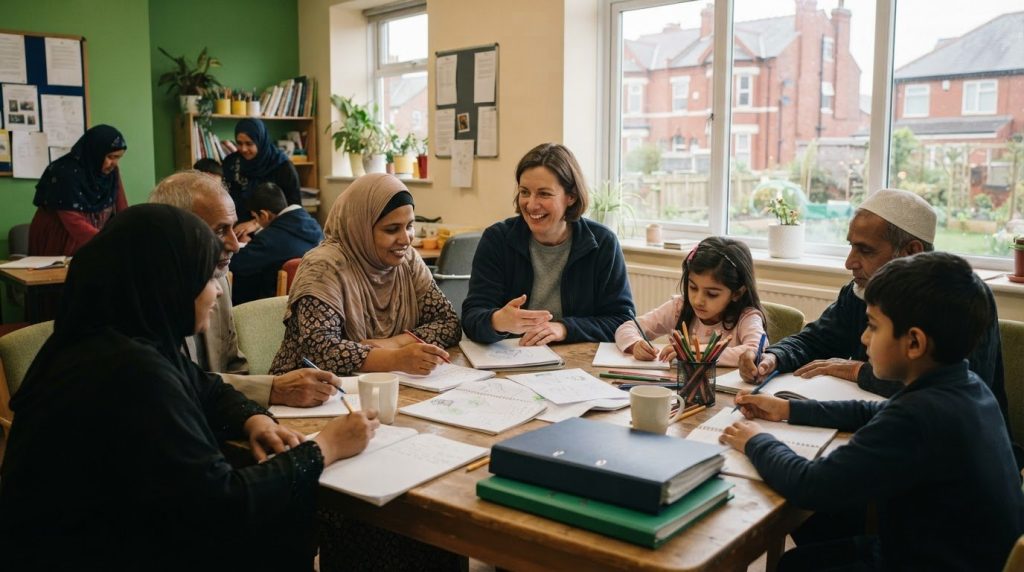
True restoration for displaced families doesn’t begin in a government office; it starts in the quiet, consistent presence of a neighbour who chooses to show up. Whilst the UK asylum landscape undergoes significant shifts in 2026, including the transition to a 30-month temporary protection status, the demand for compassionate, grassroots refugee integration services UK remains a moral priority. You likely feel the weight of this humanitarian crisis and want to act, yet the barriers can feel immense. Between navigating the new September 2026 DBS safeguarding regulations and worrying if you possess the right skills for trauma-informed support, it’s natural to hesitate before stepping forward.
We understand that your time is a precious gift and you want to ensure it’s used effectively to foster renewal. This guide provides the clarity you need to volunteer safely, whether you’re seeking remote mentoring or hands-on support in community hubs like Bradford. We’ll outline the exact steps to secure your Enhanced DBS check, explain how to apply trauma-informed principles to your interactions, and help you identify a role that honours both your skills and the dignity of those we serve. Together, we’ll explore how to join a community-led movement that prioritises protection, growth, and lasting heritage.
Key Takeaways
- Identify how your professional or personal skills can transform a displaced family’s experience from mere survival into genuine community belonging.
- Navigate the mandatory 2026 safeguarding requirements and Enhanced DBS checks to ensure your contribution to refugee integration services UK is both safe and effective.
- Distinguish between the structured training of large national organisations and the responsive, culturally rooted impact of grassroots charities.
- Gain a clear understanding of trauma-informed working practices that honour the dignity and resilience of those seeking protection.
- Discover how community-led initiatives in Bradford empower stateless families through dedicated education and cultural restoration programmes.
Understanding the Impact: Why Volunteer with a Refugee Charity in the UK?
Volunteering within the refugee sector represents a profound act of moral agency. Whilst the state provides the legal framework for sanctuary, it’s the dedicated individual who transforms a bureaucratic process into a genuine homecoming. By engaging with refugee integration services UK, you aren’t just offering aid; you’re facilitating restoration, protection, and growth. Families arriving in Britain often find themselves caught between the relief of safety and the somber reality of systemic isolation. Language barriers, cultural displacement, and the loss of heritage create a silence that only human connection can break. Personal solidarity upholds human dignity whilst actively dismantling harmful social misinformation that often permeates local narratives.
These individuals often interact primarily with the National Asylum Support Service, a division of the Home Office responsible for logistical management. However, this official infrastructure cannot replace the warmth of a local community. Volunteers serve as the vital bridge that spans this gap, fostering mutual understanding and ensuring that integration is a two-way journey of shared identity. Your presence acts as a protective shield against prejudice, affirming the inherent dignity of every person seeking a new beginning in an unfamiliar land.
To better understand the practicalities of these support systems, watch this helpful video:
The Reality of Arriving in the UK as an Asylum Seeker
Adjusting to British culture involves more than learning a new lexicon; it requires navigating a complex social landscape whilst enduring prolonged periods of enforced inactivity. Many people seeking asylum are unable to work for significant periods, leading to a profound loss of personal agency and a sense of stagnation. This systemic isolation is often compounded by the trauma of displacement. Welcoming local communities are essential in breaking this cycle. By providing a warm reception and practical orientation, neighbours help displaced families reclaim their independence, stabilise their lives, and begin the slow, vital work of renewal.
Mutual Growth: What Volunteers Gain from Serving Communities
Service is never a one-way street; it’s a dedicated partnership. Those who commit to refugee integration services UK develop sophisticated cross-cultural competence, active listening, and empathetic communication skills. You’ll gain authoritative insights into international human rights frameworks and the intricate mechanics of community development. This work fosters a resilient optimism, as you witness the incredible strength and heritage of the human spirit firsthand. The shared human connection creates a sense of communal bond that enriches your own life, providing a perspective that is both traditional in its values and forward-thinking in its pursuit of justice.
Essential Volunteer Roles in the UK Refugee Sector
Effective humanitarian work requires a diverse tapestry of skills; it’s a common misconception that volunteering is limited to manual labour or donation sorting. In reality, the efficacy of refugee integration services UK relies on professional expertise, administrative rigour, and emotional intelligence. Whether your strengths lie in compassionate mentoring or digital logistics, there’s a vital space for your contribution. According to a recent UK asylum system analysis, the complexity of the current landscape demands a structured approach to support that goes beyond emergency aid. Operational positions assist with fundraising, communications, and digital development, ensuring the organisation remains a stable, long-term presence for those we serve.
Choosing a role tailored to your specific strengths doesn’t just help the charity; it ensures your commitment is sustainable and fulfilling. Direct support roles are the front line of restoration, focusing on immediate integration, language acquisition, and local orientation. These positions help families regain their footing in a new environment, moving them from the weight of displacement toward a future of resilient optimism. By matching your professional background to these needs, you act as a principled leader within the community, providing the intellectual and emotional scaffolding required for families to flourish once again.
Education, Language Support, and Conversational Mentoring
Language is the primary tool of agency. Volunteers assist with informal ESOL classes to build everyday communicative confidence, moving beyond grammar to practical dialogue that empowers adults to navigate vocational opportunities. For the younger generation, providing homework support through structured refugee youth empowerment programmes helps bridge educational gaps caused by forced displacement. Facilitating conversational language cafes is equally transformative. These spaces build genuine friendships alongside practical vocabulary, offering a dignified environment where people can share their heritage whilst learning a new tongue in a supportive, communal setting.
Practical Orientation and Community Befriending
The British administrative landscape can be daunting for those unfamiliar with its nuances. Practical orientation volunteers act as a guiding hand, helping families register with local GPs and primary schools to ensure their health and educational needs are met. You might introduce newcomers to local transport systems, community centres, and libraries, providing the keys to their new city. Beyond these logistics, community befriending is perhaps the most somber yet beautiful role, as it directly addresses the social isolation often encountered upon arrival. By offering consistent companionship, you help alleviate the severe loneliness of displacement and become a vital part of refugee integration services UK. If you feel called to this work, you can join our community support network to start making a difference today.
Requirements, Safeguarding, and Volunteer Vetting in the UK
Safeguarding is the moral foundation of effective humanitarian work. It ensures that our desire to assist never inadvertently causes harm to those already burdened by displacement. Following Charity Commission standards, every reputable organisation providing refugee integration services UK must implement rigorous vetting procedures. This isn’t a barrier to participation; it’s a protective shield for both the volunteer and the family. Prospective volunteers should expect a methodical journey involving formal interviews, reference verifications, and comprehensive background checks. These protocols ensure that every interaction is grounded in safety and mutual respect, reflecting a long-term commitment to restoration.
Understanding the official landscape is vital for any prospective advocate. Recent briefings on pathways for newly recognised refugees highlight the complexity of the transition from asylum seeker to refugee status. Effective vetting ensures that volunteers are equipped to support this transition without overstepping their role. By adhering to these standards, we uphold the dignity of the people we serve whilst protecting the integrity of our mission. It’s about building a community where safety is a shared identity.
Understanding DBS Checks and Legal Compliance
Enhanced DBS checks are the standard for any role involving children or vulnerable adults. As of 1 September 2026, the legal framework has become more stringent with the removal of the ‘supervision exemption’. Volunteers who teach, train, or supervise children for more than three days in any 30-day period now require an Enhanced DBS check with a check of the Children’s Barred List, even if they’re supervised. Most charities manage and fund these applications for their regular teams, ensuring that financial barriers don’t prevent dedicated individuals from serving. These policies aren’t just about compliance; they’re about creating a sanctuary where everyone feels secure.
Trauma-Informed Boundaries and Emotional Wellbeing
Forced displacement often leaves deep psychological scars. Trauma-informed training is essential, as it equips you to recognise the consequences of family separation and loss without causing secondary distress. Empathy is your greatest tool, but it must be balanced with clear professional boundaries. You’re a steadfast advocate and a compassionate neighbour, not a legal advisor or a therapist. Maintaining this distinction is crucial to prevent burnout and ensure that families receive equitable, safe assistance. Protecting your own mental health through regular peer support and debriefing is a requirement for stable, long-term service. By staying within your remit, you ensure that the help you provide remains a source of strength rather than a cause of confusion.
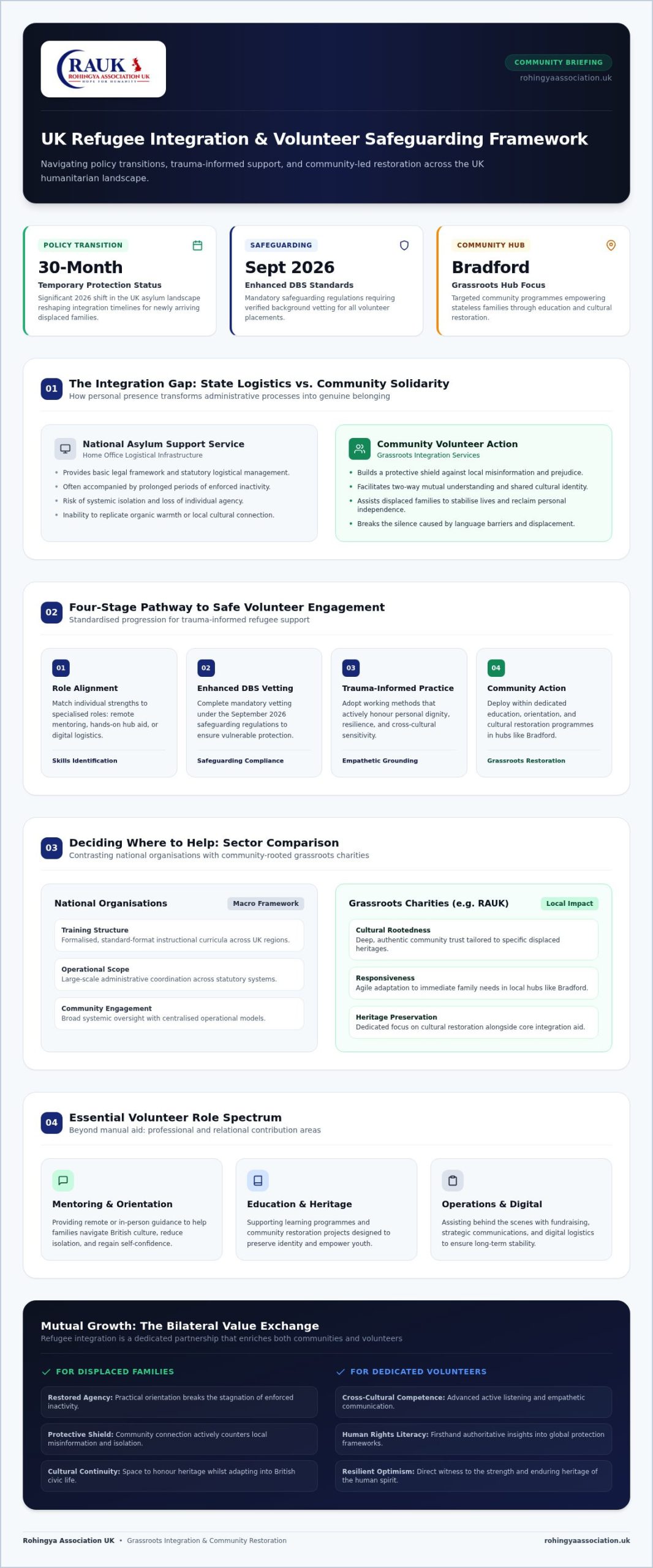
National Organisations vs Grassroots Charities: Deciding Where to Help
Choosing where to dedicate your labour is a significant decision that defines the scope of your impact. Large national organisations often provide the scaffolding for refugee integration services UK through highly structured training programmes and extensive regional networks. These institutions possess the intellectual authority to influence policy at a systemic level; they’re essential for large-scale advocacy and coordination. However, their size can sometimes lead to a transactional approach to case management, where the individual’s story is secondary to the process. You might feel like a small cog in a vast machine, even whilst performing vital work.
In contrast, grassroots organisations are defined by their deep cultural roots and immediate responsiveness. They prioritise restoration, protection, and growth through a relational lens. Instead of distant case files, they offer a guiding hand, a protective shield, and a sense of shared identity. Evaluating your personal values helps determine whether you prefer the structured environment of a national body or the agile, community-led spirit of a local charity. Both are necessary, but the grassroots level is where the most profound social belonging is often forged.
The Distinctive Power of Community-Led Initiatives
Lived experience is the compass for grassroots leadership. When those who have walked the path of displacement guide the humanitarian response, the relief provided is inherently more dignified and culturally appropriate. These initiatives don’t wait for protracted bureaucratic procedural delays; they act with urgency to address immediate crises. This agility allows for the direct delivery of vital community support for displaced families upon their arrival. By removing layers of administration, grassroots teams ensure that the first hand a newcomer shakes is one that understands their heritage and their struggle.
Evaluating Time Commitments and Organisational Culture
Your contribution should be a sustainable act of solidarity, not a fleeting emotional reaction. Before committing, assess whether flexible remote volunteering or regular in-person engagement in Bradford suits your current capacity. It’s essential to understand an organisation’s moral ethos, collaborative approach, and community integration goals. Aligning your efforts with teams that advocate for global justice for Rohingya people ensures your local actions contribute to systemic change. If you’re ready to move from observer to advocate, apply to join our grassroots community network today.
Volunteering with Rohingya Association UK: Grassroots Action in Bradford
Rohingya Association UK (RAUK), a registered charity (number: 1211433), operates as a principled leader and a steadfast advocate for displaced families within West Yorkshire. Based in Bradford, this community-led organisation provides a sophisticated model for refugee integration services UK by ensuring that aid is delivered with moral seriousness and cultural pride. For stateless families, the journey toward renewal is often hindered by systemic inequality and the weight of historical trauma. RAUK acts as both a protective shield and a guiding hand, offering a stable environment where restoration and growth become possible. By volunteering here, you join a dedicated partner committed to justice and long-term communal bonds.
The impact of grassroots action is immediate and profound. Every contribution directly strengthens families striving to build stable, flourishing lives locally, moving them from a state of survival to one of resilient optimism. Volunteers play an integral role alongside community leaders, restoring hope through shared human concepts like family, heritage, and safety. This work is not a fleeting emotional reaction; it’s a methodical, narrative-driven effort to empower a community that has faced profound displacement. Your presence helps ensure that the possibility of renewal is a lived reality for every neighbour we serve.
How Volunteers Support RAUK Programmes
Service at RAUK is both traditional in its values and forward-thinking in its methods. Volunteers are the lifeblood of our programmes, providing the consistent support necessary for families to thrive amongst their new neighbours. You can contribute to this mission through several core areas:
- Youth Empowerment: Mentoring young people in after-school homework clubs helps bridge educational gaps, whilst creative workshops provide a space for expression, heritage, and personal growth.
- Vocational Language Support: Assisting adults in practical English classes is a vital step in unlocking employment opportunities, restoring a sense of personal agency and independence.
- Cultural Preservation: Supporting Islamic community gatherings and cultural events ensures that Rohingya heritage remains vibrant, fostering a sense of belonging and continuity for future generations.
Starting Your Volunteer Journey with RAUK
The path to becoming a steadfast advocate begins with a simple, dignified step. We invite you to complete an initial volunteer enquiry through our official website portal to express your interest in our mission. Once your enquiry is received, you’ll participate in an informal induction process designed to explore which community roles best match your existing skills and personal values. This conversation is an opportunity to learn about our trauma-informed practices and our stable, long-term commitment to the families we serve. By choosing to volunteer with a dedicated community team, you become a partner in restoration, protection, and growth. Take your first step today and join a community that is fighting for justice and systemic change from the ground up.
Step Forward as a Steadfast Advocate for Renewal
The journey from legal sanctuary to genuine social belonging requires more than policy; it demands the dedicated presence of neighbours who value justice, dignity, and heritage. We’ve explored the essential mechanics of 2026 safeguarding requirements, the vital distinction between national and grassroots impact, and the profound role of trauma-informed mentoring. By choosing to support community-led initiatives, you ensure that refugee integration services UK move beyond transactional aid toward lasting restoration, protection, and growth.
Rohingya Association UK (Registered Charity number: 1211433) remains deeply embedded in Bradford, providing a holistic model that spans vital education and cultural preservation. Your labour directly empowers families to reclaim their agency whilst building a stable, flourishing future amongst a community that truly understands their journey. Whether you’re facilitating language acquisition or mentoring the next generation, your contribution acts as a protective shield and a guiding hand for those seeking safety. We invite you to join Rohingya Association UK as a volunteer to restore hope and dignity. Together, we can turn the possibility of renewal into a resilient reality.
Frequently Asked Questions
Do I need specific qualifications to volunteer with a refugee charity in the UK?
Most roles don’t require specific academic qualifications; instead, they demand a deep sense of moral seriousness and empathy. Whilst professional skills in education or administration are highly beneficial, your lived experience and willingness to act as a protective shield are paramount. Rohingya Association UK provides necessary training to ensure your contribution aligns with our trauma-informed model. We value your commitment to restoration, protection, and growth above formal certifications.
Can I volunteer with refugees if I work full-time?
You can absolutely contribute whilst maintaining full-time employment. Many of our advocates offer their time during evenings or weekends to support cultural and community events in Bradford. Remote mentoring and digital advocacy roles also provide flexibility for those with demanding professional schedules. We believe that agency and renewal are collective efforts that shouldn’t be limited by your working hours. A few hours a month can provide vital stability for a displaced family.
What is the minimum time commitment typically expected by refugee charities?
Time commitments vary depending on the specific role you choose to undertake. For consistent support, such as English language classes or youth empowerment programmes, a commitment of two to four hours per week is typically expected. However, participation in one-off cultural gatherings or crisis intervention projects offers a more flexible alternative. We prioritise long-term commitment over fleeting reactions, as stable relationships are the foundation of effective refugee integration services UK.
Is an Enhanced DBS check mandatory for all refugee volunteer roles?
An Enhanced DBS check is mandatory for any volunteer engaged in ‘regulated activity’ with children or vulnerable adults. As of September 2026, the removal of the supervision exemption means that teaching, training, or instructing children more than three times in a month requires this check. Rohingya Association UK manages this vetting process to ensure the safety of our community. This formal background check is a standard requirement for maintaining a secure and dignified environment for restoration.
Can volunteers provide legal advice or assist with asylum claims?
Volunteers must never provide legal advice or attempt to process asylum claims. Providing legal representation is a strictly regulated activity that requires specific accreditation from the Office of the Immigration Services Commissioner. Rohingya Association UK is a community-led charity that focuses on settlement, education, and cultural preservation rather than legal advocacy. Our role is to act as a guiding hand through social integration whilst directing families to qualified legal professionals for their immigration status.
What is the difference between working with a large NGO and a grassroots charity?
Large NGOs typically focus on systemic advocacy and international human rights frameworks at an institutional level. In contrast, grassroots charities like ours are deeply embedded in the local landscape, prioritising relational bonds and cultural continuity. Whilst national organisations offer structured regional networks, a community-led charity provides direct, responsive assistance that honours the heritage of displaced families. Choosing a grassroots path allows for a more personal connection to the families striving for renewal in Bradford.
How does Rohingya Association UK support volunteers working with trauma-affected families?
We provide comprehensive support through trauma-informed training, regular supervision, and peer debriefing sessions. Working with families who have experienced forced displacement requires a sophisticated blend of empathy and professional boundaries. Our organisation ensures you’re never isolated in your service, acting as a protective shield for both you and the families you assist. This methodical approach to refugee integration services UK ensures that your efforts contribute to stable, long-term empowerment without causing secondary distress.