

What if your standard charitable gift could deliver substantially more frontline relief without costing you an extra penny? When navigating tax-efficient charity donations UK donors often find themselves caught between generous philanthropic intent and the dense mechanics of statutory relief. You want your hard-earned resources to directly alleviate suffering, provide sanctuary, and restore dignity to vulnerable communities, yet the labyrinth of Gift Aid declarations, marginal brackets, and payroll giving can feel overwhelming. Nobody wants to risk an unexpected tax clawback from HMRC, nor leave vital funding unclaimed on the table.
You already recognise that thoughtful philanthropy should be purposeful, accountable, and impactful. This comprehensive guide details how statutory UK tax reliefs work, showing you exactly how to claim your higher-rate personal entitlements via Self Assessment, structure asset gifts, and amplify your reach. From restoring the personal allowance to funding essential refugee settlement and emergency aid, here is your definitive roadmap to maximising every pound you give in 2026.
Key Takeaways
- Understand how the Gift Aid mechanism immediately amplifies contributions by 25p on every pound, turning basic tax relief into vital community funding.
- Uncover how higher and additional rate taxpayers can reclaim personal tax relief through Self Assessment to substantially lower the net cost of their generosity.
- Master the full scope of tax-efficient charity donations UK taxpayers can utilise, from automated payroll giving to reducing adjusted net income below critical tax tapers.
- Discover the dual advantages of gifting quoted shares or land, combining complete Capital Gains Tax exemption with significant Income Tax deductions.
- Connect statutory tax mechanisms directly to frontline grassroots impact, empowering displaced families through vital settlement support, education, and humanitarian relief.
Understanding Tax-Efficient Giving: How HMRC Incentivises UK Philanthropy
Tax-efficient giving represents a principled partnership between the individual, the state, and frontline charitable causes. At its core, it refers to the strategic use of statutory exemptions established by HM Revenue and Customs (HMRC) to maximise the real-world value of a charitable contribution whilst reducing the donor’s personal liability. When setting up tax-efficient charity donations UK taxpayers ensure that resources which would otherwise be absorbed by the Exchequer are channelled directly into vital community relief, education, and shelter. Both parties benefit immensely; registered charities receive non-repayable uplifts, and donors mitigate their marginal tax liabilities.
Far from being an exclusive preserve for high-net-worth philanthropists, statutory incentives operate equitably across all income bands. Whether you contribute a modest monthly sum through your pay packet or gift substantial capital assets, these mechanisms preserve the integrity of your giving. To examine how these foundational mechanisms operate in practice, watch this concise summary of UK charitable tax incentives:
The Core Objectives of UK Philanthropic Tax Relief
Statutory tax relief exists to foster sustained civic responsibility across British society. By removing fiscal friction, the legislation minimises administrative leakage between your initial intention and the vulnerable individuals who receive support. The statutory Gift Aid scheme, alongside dual oversight from the Charity Commission and HMRC, ensures rigorous accountability. To secure these statutory advantages, contributions must go directly to a UK-registered charity, an essential standard that guarantees transparent governance and lawful execution of relief programmes.
Overview of Tax Relief Categories for UK Donors
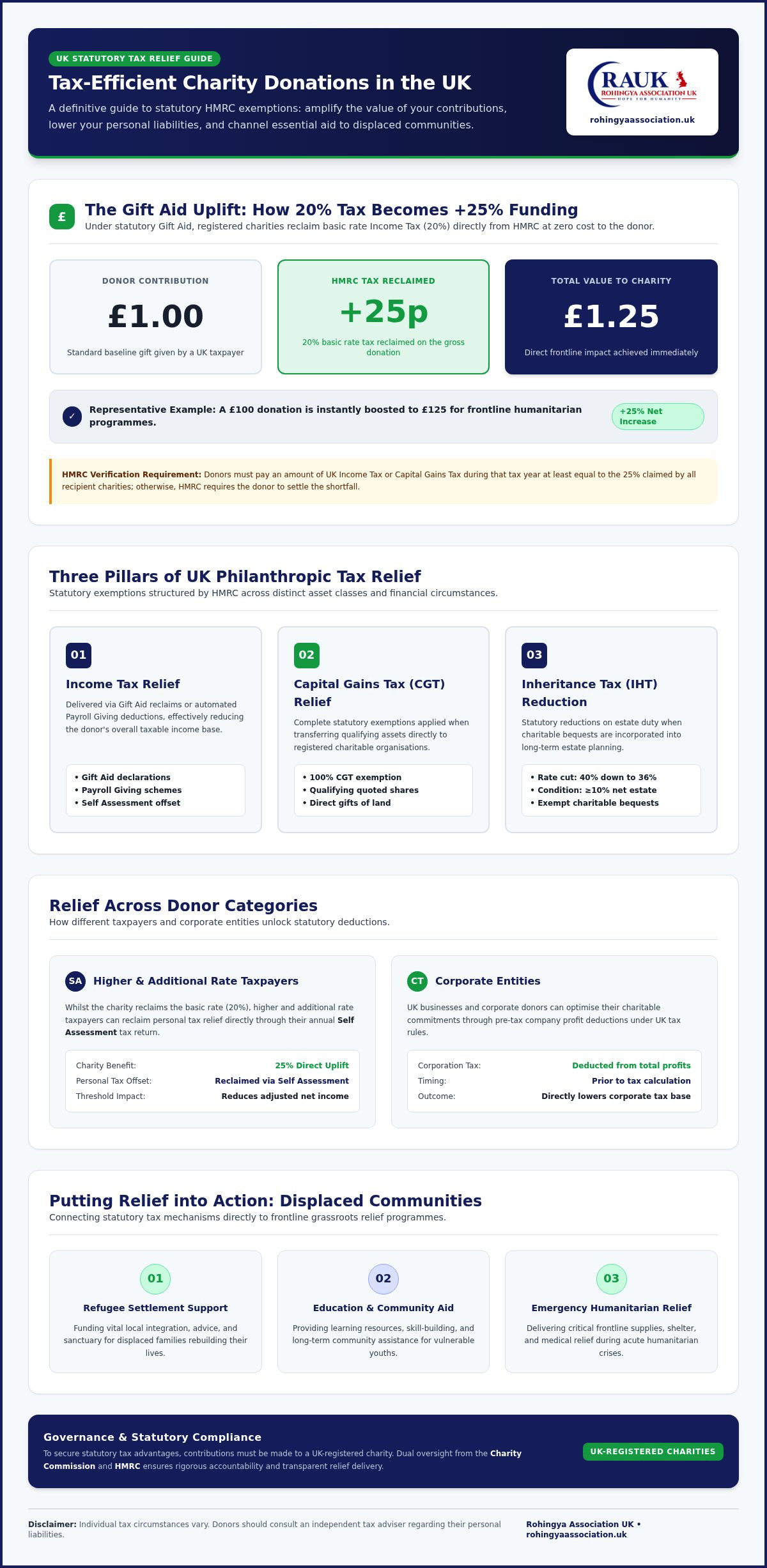
Structuring tax-efficient charity donations UK donors can draw upon three primary legislative pillars, each tailored to distinct asset classes and financial circumstances:
- Income Tax Relief: Delivered via Gift Aid reclaims or automated Payroll Giving deductions, reducing the donor’s overall taxable income base.
- Capital Gains Tax (CGT) Relief: Complete exemptions applied when transferring qualifying quoted shares or land directly to registered organisations.
- Inheritance Tax (IHT) Reductions: Statutory exemptions on charitable bequests, lowering the estate duty from 40% to 36% when leaving at least 10% of your net estate.
Corporate entities also benefit by deducting qualified donations from their total profits before Corporation Tax is calculated. Aligning personal financial planning with enduring humanitarian commitments creates a sustainable shield for displaced families. However, because individual circumstances vary considerably, donors should consult an independent tax adviser regarding their personal liabilities.
How to Maximise Everyday Giving: Gift Aid and Payroll Giving Explained
Everyday generosity fuels immediate humanitarian assistance, yet millions of pounds in government uplifts remain unclaimed each year. Two primary statutory routes enable individuals to optimise regular gifts: Gift Aid and Payroll Giving. Under Gift Aid, registered charities reclaim basic rate Income Tax (20%) directly from HMRC on the gross value of your donation. This equates to an extra 25p for every £1 you give, substantially expanding the reach of your contribution at zero personal cost. When establishing tax-efficient charity donations UK supporters can easily unlock this mechanism with a simple declaration.
However, this arrangement requires careful verification. To qualify, you must pay an amount of UK Income Tax or Capital Gains Tax during that tax year that at least equals the 25% claimed by all recipient charities. If your total tax paid falls short, HMRC requires you to settle the difference directly. Consulting official UK government guidelines on tax relief for charity donations provides clarity on your baseline tax responsibilities before committing large sums.
How to Complete a Gift Aid Declaration Accurately
A valid Gift Aid declaration requires your full name, home address including postcode, the charity’s name, and an explicit confirmation that you pay sufficient UK tax. Avoid using commercial addresses. If you retire, experience reduced earnings, or move house, inform your supported charities immediately to avoid inaccurate claims and unexpected tax adjustments.
Setting Up Payroll Giving Through Your Employer
Workplace giving schemes, commonly known as Give As You Earn, process contributions directly from your gross pay before PAYE Income Tax is deducted. This automated method delivers immediate tax relief without requiring year-end reporting:
- Basic-rate taxpayers (20%): A £100 monthly pledge costs £80 from net take-home pay.
- Higher-rate taxpayers (40%): A £100 monthly pledge costs £60 from net take-home pay.
- Additional-rate taxpayers (45%): A £100 monthly pledge costs £55 from net take-home pay.
National Insurance remains calculated on unadjusted gross pay. You retain total agency over workplace pledges; you can amend, pause, or redirect your monthly support whenever personal financial priorities shift.
Tracking and Managing Your Annual Commitments
Disciplined record-keeping ensures a stress-free tax season. Retain digital receipts, confirmation letters, and bank statements detailing every declaration. When you partner with principled grassroots initiatives such as Rohingya Association UK to fund community integration and essential relief, maintaining organised records ensures your generosity achieves maximum impact whilst remaining fully compliant with HMRC standards.
Higher-Rate Taxpayers: How to Claim Relief and Offset Income Tax
Higher and additional-rate taxpayers possess an extraordinary statutory lever to expand their philanthropy whilst mitigating their tax exposure. When you donate under Gift Aid, the charity reclaims the basic rate of 20%, but your personal entitlement does not stop there. You can claim back the difference between your marginal tax band and the basic rate on the gross value of the gift. Through these tax-efficient charity donations UK professionals turn personal fiscal strategy into direct humanitarian sustenance.
This grossing-up mechanism proves particularly vital for individuals caught in the personal allowance taper band between £100,000 and £125,140, where earnings face an effective 60% marginal tax rate. Because gross charitable gifts lower your adjusted net income pound for pound, giving generously can restore your untaxed £12,570 Personal Allowance. Scottish taxpayers navigate a differentiated system with six bands; while charities claim the standard 20%, Scottish donors reclaim the gap between 20% and their top rate, reaching up to 28% for top-rate contributors.
Calculating Your Personal Tax Relief: 40% and 45% Bands
The mathematics of Gift Aid illustrate how substantial gifts require far less net outlay than many realise:
| Donor Tax Band | Net Gift to Charity | Charity Claims (Gift Aid) | Gross Value to Cause | Donor Personal Relief | Effective Net Outlay |
|---|---|---|---|---|---|
| Basic Rate (20%) | £100 | £25 | £125 | £0 | £100 |
| Higher Rate (40%) | £100 | £25 | £125 | £25 (20% of gross) | £75 |
| Additional Rate (45%) | £100 | £25 | £125 | £31.25 (25% of gross) | £68.75 |
Under this statutory architecture, an additional-rate contributor funds £125 of vital relief for an actual out-of-pocket expenditure under £69. While cash gifts represent the most common pathway, donors holding capital assets should consult the HMRC guidance on donating land, property, or shares to explore substantial non-cash offsets.
Step-by-Step Guide to Claiming Relief on Your Self Assessment
Reclaiming your personal relief requires direct communication with HMRC, typically executed through your annual Self Assessment return. Input your total net contributions within the designated Gift Aid boxes on the SA100 form; HMRC automatically grosses up the total and reduces your final tax calculation.
Donors can also elect to carry back gifts to the prior tax year, provided the claim occurs before or alongside filing that earlier return (by 31 October for paper or 31 January for online returns). If you don’t file Self Assessment, simply contact HMRC directly or complete form P810 to adjust your PAYE tax code across the calendar year. Because individual tax liabilities depend on unique income thresholds, consulting an independent tax professional remains strongly recommended.
Giving Beyond Cash: Donating Land, Listed Shares, and Legacy Gifts
Philanthropic vision often extends far beyond liquid cash balances. For donors holding appreciated assets, statutory UK tax frameworks provide powerful incentives to transfer capital investments directly to charitable causes. When structuring tax-efficient charity donations UK supporters can leverage these mechanisms to bypass substantial capital taxes whilst securing immediate income relief. Rather than liquidating investments and donating net proceeds, gifting the underlying asset directly unlocks a dual tax exemption that protects your capital from erosion.
Every asset gift transforms stored wealth into immediate communal resilience. These transactions demand careful planning and professional execution, yet they represent some of the most potent contributions a supporter can offer.
Tax Advantages of Donating Shares and Securities
Gifting qualifying quoted investments listed on the London Stock Exchange, AIM, or recognised overseas exchanges delivers two complementary fiscal benefits:
- Full Capital Gains Tax Exemption: Zero CGT is incurred on accumulated paper growth, circumventing the standard 18% or 24% charges that arise upon disposal.
- Income Tax Deduction: The full market value of the gifted shares (plus any transfer charges, minus minor incidental benefits) is deducted directly from your total taxable income for that financial year.
Transferring shares requires coordinating between your stockbroker and the receiving charity custodian. Crucially, statutory rules provide no carry-back option for share gifts; the entire relief must offset income during the tax year the transfer concludes.
Property and Land Donations: Rules and Practicalities
Gifting a whole freehold or leasehold interest in UK property follows identical dual-relief principles. Donors bypass capital gains charges and offset the land’s market value against their income tax bill. HMRC requires a rigorous, independent valuation by a qualified surveyor to substantiate your self-assessment claim. Always consider potential environmental liabilities, legal conveyance costs, and whether the charity possesses the operational capacity to hold or liquidate the parcel efficiently.
Legacy Giving and Inheritance Tax Reductions
Estate planning allows you to safeguard vulnerable populations across generations. Leaving gifts to registered charities in your Will is entirely free from Inheritance Tax (IHT). Under statutory provisions, if you bequeath at least 10% of your net estate to charity, the IHT rate applied across the remainder of your taxable estate drops from 40% to 36%.
Including a charitable clause in a new or amended Will is straightforward. It creates an enduring lineage of civic responsibility that outlives fleeting market cycles. To channel your capital assets or legacy bequests into frontline integration and emergency relief, partner with Rohingya Association UK today.
Putting Relief into Action: Directing Tax-Efficient Support to Displaced Communities
Tax relief mechanisms achieve their true purpose only when connected to direct human renewal. Beyond the statutory calculations and self-assessment forms lies an undeniable imperative: converting fiscal efficiency into warmth, shelter, and justice for those who have lost everything. When directing tax-efficient charity donations UK supporters hold the capacity to transform administrative allowances into a protective sanctuary for stateless families rebuilding their lives after catastrophic displacement.
Grassroots charities offer the most agile, transparent vehicle for this conversion. Because community-led organisations operate without cumbersome bureaucratic overheads, every reclaimed pound translates immediately into active interventions, bridging the gap between national tax policy and local human dignity.
How Gift Aid Directly Empowers Grassroots Refugee Integration
In municipal hubs like Bradford, the basic-rate 25% Gift Aid reclaim provides immediate, sustainable momentum for newly arrived families. These supplemental funds directly underwrite English language (ESOL) courses, community integration workshops, and accredited skills training that help adults secure meaningful employment. The reclaimed revenue similarly strengthens local housing guidance, ensuring mothers and children move out of temporary accommodations into stable tenancies. You can learn more about how holistic casework restores autonomy in our detailed guide on community support for displaced families.
Funding Urgent Crisis Intervention and Global Human Rights Advocacy
Grassroots support bridges international borders to protect displaced populations facing acute deprivation. Voluntary donations power frontline crisis interventions, delivering essential food parcels and emergency relief to stateless families surviving under arduous conditions in Bangladesh and Myanmar. Concurrently, these resources sustain principled advocacy campaigns that preserve cultural identity, document human rights conditions, and combat chronic systemic inequality. Gain deeper perspective on daily perseverance across displacement settlements by reading about life inside the rohingya refugee camp network.
How to Complete Your Tax-Efficient Donation Today
Aligning your financial planning with frontline humanitarian support requires three direct steps:
- Select your giving method: Choose between monthly direct debit, one-off bank transfers, employer payroll giving, or transferring appreciated shares.
- Affirm the Gift Aid declaration: Ensure your name, home address, and tax confirmation are verified during checkout so the 25% uplift is activated immediately.
- Retain your documentation: Keep your digital acknowledgement safe to reconcile your higher or additional-rate personal relief at tax year-end.
Make a lasting investment in resilience and justice today by supporting refugee youth and families through principled, tax-effective giving.
Transform Your Tax Relief into Enduring Community Hope
Strategic giving unites sound personal financial stewardship with profound social responsibility. By harnessing Gift Aid, unlocking higher-rate deductions through Self Assessment, or donating appreciated capital assets, your contributions yield vital uplift without increasing your personal outlay. When structuring tax-efficient charity donations UK supporters hold the distinct power to convert statutory relief directly into frontline restoration, protection, and growth.
As an agile Registered Charity in England and Wales (Number 1211433), Rohingya Association UK upholds rigorous, transparent stewardship across every pound received. Your contributions provide immediate casework in Bradford spanning refugee settlement, ESOL classes, and youth empowerment, whilst sustaining critical emergency food relief and human rights advocacy for families surviving abroad. With your support, administrative allowances become a resilient shield for displaced communities rebuilding their lives with dignity. Take action today: empower displaced families with a tax-efficient donation to RAUK and turn statutory tax relief into lasting generational hope.
Frequently Asked Questions
How does Gift Aid work if I pay tax at the higher rate in the UK?
Higher-rate taxpayers reclaim the 20% difference between the basic rate and their 40% marginal rate on the gross donation. When you make a net cash contribution of £100, the charity claims £25 in Gift Aid, producing a £125 gross gift. You then reclaim £25 through your Self Assessment or PAYE coding, reducing your actual net outlay to £75.
Can I claim tax relief on charitable donations without filing a Self Assessment return?
Yes, you can secure your higher or additional-rate relief without submitting an SA100 return. Contact HMRC directly by telephone or complete form P810 to request an adjustment to your PAYE tax code. HMRC will alter your tax code across the remaining pay cycles, lowering your monthly workplace deductions to reflect your tax-efficient charity donations UK contributions.
What happens if I donate through Gift Aid but have not paid enough UK tax?
HMRC requires you to repay the difference directly if your annual tax liability falls below the Gift Aid claimed. When a charity claims 25p per pound on your gifts, your total UK Income Tax and Capital Gains Tax must equal or exceed that reclaimed sum. If you pay insufficient tax, report the shortfall on Self Assessment to settle the balance.
How does payroll giving differ from standard direct debit donations with Gift Aid?
Payroll Giving deducts funds straight from gross salary before PAYE Income Tax is calculated, granting immediate relief at your highest marginal rate. Standard direct debit donations are taken from post-tax pay, requiring the receiving charity to reclaim basic-rate tax via Gift Aid and leaving higher-rate donors to recover personal relief separately. However, Payroll Giving does not reduce National Insurance contributions.
Can UK businesses claim Corporation Tax relief on charitable contributions?
Yes, incorporated UK businesses can deduct the full value of charitable donations from their pre-tax operating profits. This deduction lowers the company’s net profit figure, reducing the final Corporation Tax bill. Unlike individual giving, corporate gifts do not involve Gift Aid reclaims; the receiving charity receives the exact transfer, and the company claims the deduction in its corporate tax computations.
What types of shares qualify for Capital Gains Tax relief when donated to charity?
Qualifying holdings include shares and securities listed on the London Stock Exchange, the Alternative Investment Market (AIM), and recognised overseas stock exchanges. Donating these investments eliminates Capital Gains Tax on accumulated gains entirely. Donors also deduct the full current market value from their annual taxable income, creating dual relief that standard unquoted private shares rarely match.
How does leaving a gift in my will reduce my overall UK Inheritance Tax liability?
All charitable bequests in a valid Will are 100% exempt from UK Inheritance Tax. Additionally, if you leave at least 10% of your net estate (the baseline value after debts, exemptions, and the nil-rate band) to registered charities, HMRC cuts the Inheritance Tax rate applied to your remaining taxable estate from 40% down to 36%.
Do I need to keep receipts of my charitable donations for HMRC tax checks?
Yes, retaining organised records of every Gift Aid declaration, donation receipt, and bank confirmation is essential. HMRC can request proof to substantiate relief claims made on Self Assessment up to six years after the relevant tax return deadline. Maintain digital copies of all charitable receipts to ensure your tax-efficient charity donations UK claims remain fully compliant under inspection.