
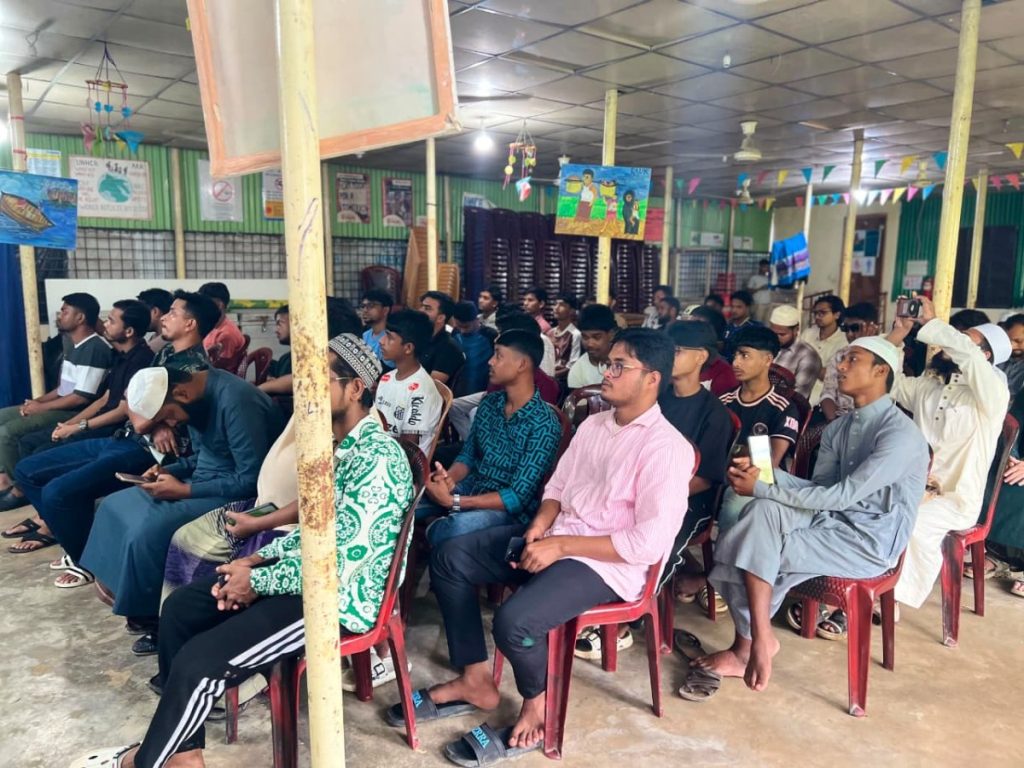
What if the most enduring solution to a generational humanitarian crisis isn’t found within an international aid package, but in the latent agency of the youth who’ve survived it? It’s natural to feel a sense of profound helplessness when faced with the statistics of displacement; the weight of the Rohingya struggle can often seem insurmountable from a distance. However, true progress is rarely found in passive charity; it’s found in the restoration of dignity, the protection of heritage, and the growth of local leadership.
This article demonstrates how structured Rohingya youth empowerment initiatives are transforming lives by moving beyond emergency relief towards sustainable community agency. You’ll discover the essential pillars that make these programmes successful, the significant impact of the Rohingya diaspora within the UK, and the ways in which local support in cities like Bradford fosters genuine integration. By understanding the transition from displaced beneficiary to active changemaker, we can identify clear, professional pathways to support a future defined by resilience, purpose, and self-reliance. We’ll explore how these young leaders are now bridging the gap between global advocacy and local action to ensure their community’s voice is never silenced again.
Key Takeaways
- Discover how Rohingya youth empowerment initiatives move beyond immediate humanitarian relief to foster sustainable, long-term community leadership.
- Identify the core educational pillars, including digital literacy and English language proficiency, that are essential for successful integration and economic independence.
- Understand the critical role of mentorship and youth-led organisations in helping young people transition from displaced beneficiaries to confident advocates for their own rights.
- Learn how preserving cultural heritage and traditional arts provides the emotional foundation and identity needed for resilient community bonds.
- Explore the strategic approach of the Rohingya Association UK in Bradford, which acts as a bridge between global advocacy and local integration.
The Current Landscape of Rohingya Youth Empowerment
Empowerment for the Rohingya people is not merely a matter of survival; it is the deliberate reclamation of a future that has been systematically denied for generations. In this context, Rohingya youth empowerment represents the transition from being a silent observer of one’s fate to becoming an active architect of community progress. It is a process of gaining the technical skills, emotional resilience, and public platforms necessary for effective self-advocacy. For too long, the narrative surrounding this community has been defined by external actors. By shifting the focus to youth leadership, we ensure that those with lived experience are the ones driving the conversation about their own rights and welfare.
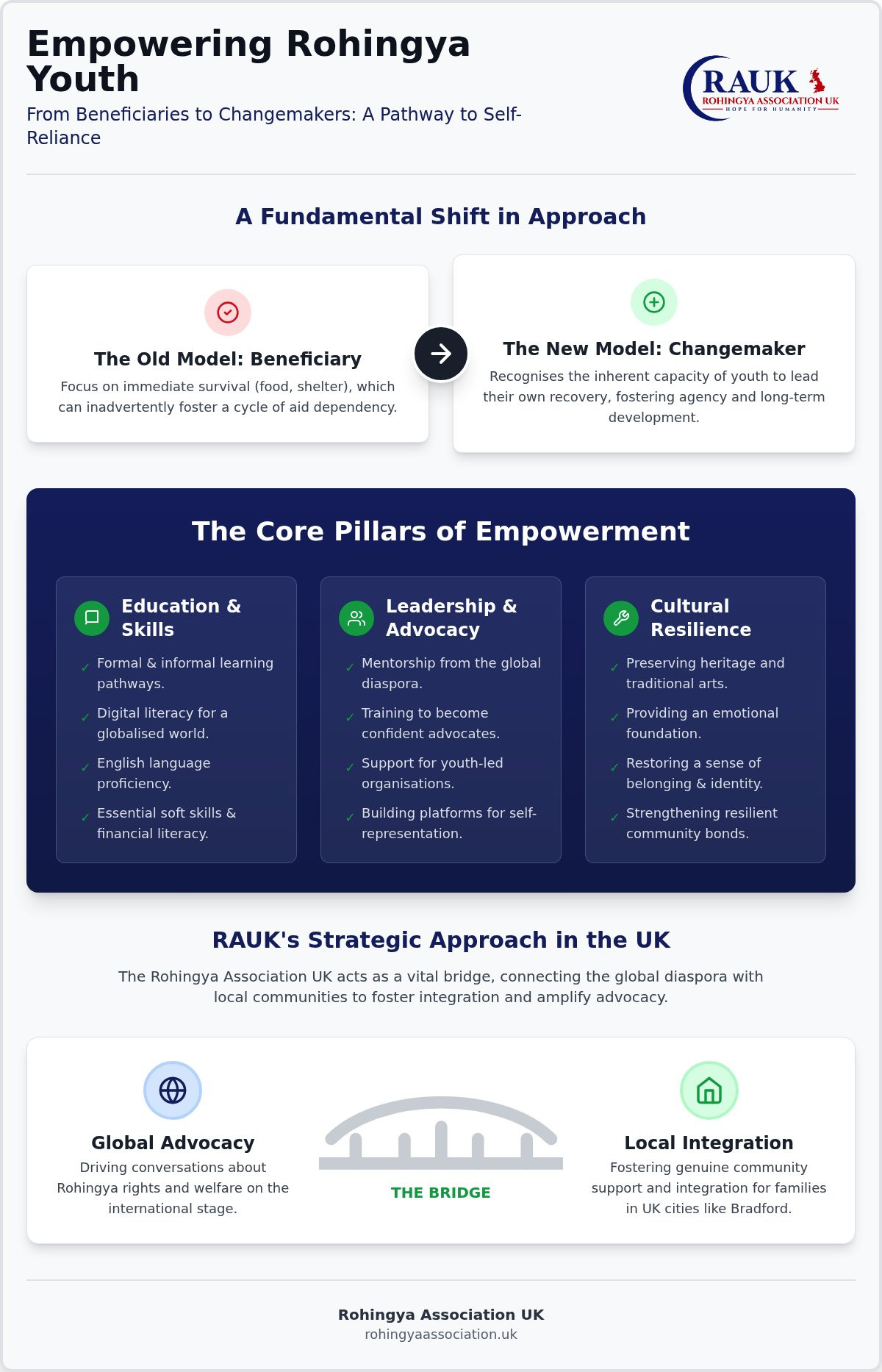
For decades, the standard humanitarian response relied on a “beneficiary” model, which prioritised immediate survival through the provision of food and shelter. Whilst these life-saving measures remain critical, they can inadvertently foster a cycle of dependency if not paired with long-term development. We are now witnessing a vital shift towards a “changemaker” model. This approach recognises that young people possess the inherent capacity to lead their own recovery. The global diaspora acts as a vital bridge in this transition, providing mentorship and resources from the UK to support those still living in precarious conditions in the camps.
The Challenge of Statelessness and Identity
Statelessness is more than a legal designation; it is a psychological weight that creates systemic barriers to formal schooling and legal work. Without a recognised nationality, many young people find themselves trapped in a limbo where their ambitions are stifled by bureaucracy. Restoring a sense of belonging is the first step in overcoming these obstacles. Through community support for displaced families, we create a stable foundation where youth can explore their identity without fear. This sense of security provides the emotional bedrock required for personal and professional growth.
From Aid Dependency to Active Agency
Moving away from aid dependency requires a deliberate focus on building individual and collective agency. It involves moving from the passive receipt of emergency aid to taking an active role in community management. Agency is built through small, incremental leadership roles, such as organising local literacy circles or managing community events in Bradford. Agency is the ability to influence the social and political forces shaping one’s life. By fostering this ability, we ensure the next generation is equipped to tackle inequality and build a self-reliant future.
Core Pillars of Empowerment: Education and Skills Development
Education is the most potent tool for dismantling the cycle of dependency that often accompanies displacement. It provides the intellectual and technical framework required to navigate a globalised economy, moving beyond mere survival toward genuine economic mobility. Research into Strengthening Soft Skills Among Rohingya Youth highlights that financial literacy and interpersonal communication are as vital as technical knowledge. These competencies form the foundation of Rohingya youth empowerment, allowing individuals to negotiate their own futures with confidence and professional rigour.
Whilst formal schooling is the ideal, non-formal education plays a critical role in refugee camp settings where access to state institutions is often restricted. These programmes provide a lifeline for those who have been excluded from traditional systems, offering a pathway to literacy and numeracy that would otherwise be out of reach. By prioritising these educational pillars, we help young people reclaim the years lost to conflict and displacement.
Access to Formal and Informal Learning
The educational journey for a young Rohingya person is often fragmented. In Myanmar, the barrier is frequently a total denial of entry to state schools based on legal status. In contrast, the challenges in the UK often revolve around navigating complex university applications and securing recognition for prior learning. “Catch-up” classes are therefore essential for those who have spent years in transit without access to a classroom. These initiatives provide more than academic knowledge; they offer a space for social restoration. You can learn more about these structured initiatives through our refugee youth empowerment programmes, which prioritise long-term integration and academic support.
Vocational Training and Digital Literacy
For a stateless population, digital literacy is a transformative asset. The digital “gig” economy operates largely independent of national borders, meaning mastery of coding, graphic design, or digital marketing allows youth to participate in a global market that their legal status might otherwise block. Simultaneously, traditional vocational training in tailoring, mechanics, or carpentry remains a vital pillar for supporting local camp economies. These skills ensure that young people can contribute immediately to their community’s self-sufficiency whilst building a portable trade that serves them wherever they may settle.
Beyond economic gain, digital skills empower youth to become the authors of their own narratives. When a young person learns to use digital tools for storytelling and advocacy, they move from being a subject of humanitarian reporting to an active witness and commentator. This transition is a core component of Rohingya youth empowerment, as it ensures the community’s history and current struggles are documented with authenticity and dignity. Supporting these efforts is a practical way to foster lasting change; consider how you might support our educational initiatives to help bridge this digital divide.
Leadership and Advocacy: Transitioning to Changemakers
Leadership within the Rohingya community is not a dormant trait waiting for discovery; it is a rigorous skill that must be nurtured through structured opportunities and consistent mentorship. For those living in the shadow of displacement, the transition from being a subject of aid to a community changemaker requires a deliberate shift in perspective. This evolution is central to Rohingya youth empowerment, moving individuals from the periphery of decision-making to the very centre of strategic planning. By fostering youth-led Civil Society Organisations (CSOs), we create a framework where young people can practice self-governance, deliver community service, and eventually offer global representation for their people.
This tripartite structure of leadership ensures that empowerment is both deeply rooted and far-reaching. It begins with the individual’s ability to govern their own choices, expands into the responsibility of serving their immediate neighbours, and culminates in the capacity to speak on behalf of the stateless on the world stage. It’s a journey that restores the agency stolen by decades of persecution, replacing a narrative of loss with one of principled action.
Community-Led Initiatives and Mentorship
Mentorship from elder Rohingya leaders is a vital thread that maintains cultural continuity whilst navigating the complexities of modern advocacy. These relationships ensure that the wisdom of the past informs the innovations of the future. Within the camps and diaspora communities, youth-led initiatives frequently tackle ethnic divisions and address immediate local concerns such as sanitation, camp safety, and mental health support. Community leadership is the voluntary organisation of peers to achieve a shared social goal. When young people take responsibility for their immediate environment, they build the confidence necessary to engage with broader political structures.
Advocacy as a Tool for Justice and Accountability
Effective advocacy allows youth to shed the restrictive label of “victim” and adopt the mantle of “defender” of human rights. This transformation is inextricably linked to the ongoing pursuit of justice for Rohingya people, as young activists become the primary witnesses and storytellers of their community’s struggle. Through the strategic use of social media and participation in international forums, these changemakers keep the crisis in the public eye, demanding accountability from global powers. They ensure that the world does not look away.
Engaging with international legal frameworks requires specific training to ensure safety and efficacy. Rohingya youth empowerment programmes must therefore include modules on international law, digital security, and diplomatic communication. This preparation ensures that when a young leader speaks at a global summit or documents a human rights violation, they do so with a level of professional authority that cannot be ignored. It’s through this structured approach that we move from reactive protests to a proactive, long-term movement for systemic change and restoration.
Cultural Resilience: Preserving Heritage Whilst Building a Future
Resilience is often framed as the ability to endure, but for the Rohingya, it is the active refusal to be erased. Heritage preservation serves as a profound form of resistance against ethnic cleansing, ensuring that the history of a stateless people remains intact despite systematic attempts at its destruction. A strong sense of identity is the prerequisite for Rohingya youth empowerment; without a deep understanding of their heritage, young people cannot effectively lead or advocate for their community’s rights. Cultural events in cities like Bradford provide more than just social engagement; they offer a sanctuary where youth can express their identity with pride, dignity, and professional poise.
By rooting empowerment in cultural pride, we move beyond the psychological weight of statelessness. When a young person understands their lineage and the strength of their ancestors, they gain the confidence required to stand as a “principled leader” in a new society. This connection to the past is what fuels the resilient optimism necessary for long-term community building and advocacy.
The Role of Faith and Islamic Community Events
Faith provides the moral framework for many empowerment initiatives, offering a sense of stability in an otherwise uncertain landscape. Islamic values of justice, charity, and communal care underpin the work of young changemakers, transforming religious duty into tangible social action. Community events centred around faith foster a vital sense of “home” within the UK, bridging the gap between a lost past and a hopeful future. Mosques and community centres serve as essential hubs where education and faith intersect, providing a stable environment for youth to grow, organise, and mentor their peers toward shared humanitarian goals.
Language and Art as Tools for Healing
The use of poetry and traditional storytelling is a powerful mechanism for processing the collective trauma of displacement. Through these creative mediums, young refugees can articulate experiences that often defy simple description, finding solace in shared narratives. Learning the Rohingya language is equally critical, as it allows youth to connect with their history and the wisdom of their elders, preventing the intergenerational isolation that can occur in the diaspora. These activities promote restoration, protection, and growth, ensuring that the community’s cultural bonds remain unbreakable across borders. By participating in these cultural programmes, young people build the confidence needed to transition from beneficiaries to advocates. You can support this vital work by joining our upcoming cultural and community events to help preserve this rich heritage for the next generation.
Empowering the Next Generation in the UK: RAUK’s Strategic Approach
The Rohingya Association UK (RAUK) operates as a vital community-led hub in Bradford, providing a bridge between the trauma of displacement and the promise of a stable future in Britain. Registered as a charity (number: 1211433), our organisation is directed by individuals with lived experience, ensuring that every programme is designed with a deep understanding of the community’s specific needs. Our strategic approach to Rohingya youth empowerment is rooted in the belief that young people are the most effective advocates for their own integration. By acting as a principled leader, RAUK ensures that youth aren’t merely assimilated into a new culture; they are empowered to contribute their unique perspectives and heritage to the fabric of British society. This model has already seen numerous young people progress from our initial support programmes into higher education and professional employment, demonstrating that a stateless background does not define one’s potential.
Community-led support remains the most effective form of empowerment because it fosters trust and mutual respect. We’ve seen youth who arrived with nothing but a desire for safety transform into confident mentors for those following in their footsteps. This cycle of restoration and growth is the hallmark of our work in the UK, moving beyond crisis intervention toward long-term community resilience.
Local Integration and Skills in Bradford
RAUK acts as a protective shield for vulnerable youth navigating the complexities of the UK’s legal and social systems. We provide the essential stability required for growth through English language classes and housing guidance, ensuring that basic needs are met so that intellectual development can begin. Our partnerships with local schools and health services in Bradford create a comprehensive support network that catches those who might otherwise fall through the gaps of social provision. By providing this foundation, we allow young people to focus on their education and skills development without the constant pressure of housing or legal insecurity.
How You Can Support Rohingya Youth Empowerment
The transition from a displaced beneficiary to a community changemaker requires consistent, long-term investment. There are several professional pathways for local residents and supporters to contribute to this mission of restoration. Your involvement helps us provide the resources necessary for young people to reclaim their agency and build a self-reliant future. You can contribute through the following actions:
- Donate to education projects: Financial contributions directly fund English language classes, digital literacy training, and “catch-up” schooling for those who have missed years of education.
- Volunteer as a mentor: Sharing your professional skills or local knowledge can provide the guidance a young person needs to navigate higher education or the UK job market.
- Raise awareness: Use your platform to highlight the importance of community-led support and the ongoing need for justice for the Rohingya people.
Financial contributions are used for both immediate crisis intervention and the long-term skills training that facilitates economic mobility. Every donation supports our mission to restore hope and dignity to a generation that has known too much loss. Support our mission to restore hope: Donate to Rohingya Association UK.
Restoring Agency and Building a Shared Future
The journey from survival to community leadership is a testament to the enduring strength and agency of the Rohingya people. We’ve explored how the pillars of education, digital literacy, and cultural preservation intersect to create a robust framework for Rohingya youth empowerment, allowing the next generation to reclaim their future. By moving beyond the restrictive model of aid dependency, young changemakers are now documenting their own histories and advocating for justice on the global stage.
As a registered charity (number: 1211433) based in Bradford, the Rohingya Association UK delivers a direct, community-led impact across the UK, Myanmar, and Bangladesh. We serve as a steadfast partner in this mission of restoration, providing the protective shield and guiding hand required to navigate a stateless identity. Your commitment provides the vital resources needed to turn individual potential into collective, principled action, bridging the gap between global headlines and local integration.
Support the next generation of Rohingya leaders by donating to RAUK today.
Together, we can ensure that the voices of the stateless are not only heard but are empowered to lead their communities toward a dignified and self-reliant future.
Frequently Asked Questions
What are the main barriers to Rohingya youth empowerment today?
Statelessness and systemic exclusion remain the primary barriers, as they deny young people the legal right to work or access formal higher education. In the camps, recent funding cuts have closed learning centres, affecting nearly 437,000 children. These external hurdles are compounded by the psychological weight of displacement. Overcoming these obstacles requires a shift from emergency aid to structured Rohingya youth empowerment programmes that focus on long-term agency and professional skill-building.
How does the Rohingya Association UK support youth in Bradford?
The Rohingya Association UK provides a stable foundation through practical integration services, including English language classes and essential housing guidance. We act as a protective shield for youth navigating the UK system by facilitating healthcare access and partnering with local schools. These initiatives ensure that young people in Bradford have the security they need to focus on their studies. Our community centre serves as a hub for both educational support and cultural preservation.
Can I volunteer to help with refugee youth empowerment programmes?
Yes, you can contribute by volunteering as a mentor to help young refugees navigate the UK job market or university application processes. We also encourage supporters to help with our advocacy and awareness campaigns to keep the crisis in the public eye. If you have specific professional skills in digital literacy or education, your expertise can directly support our refugee youth empowerment programmes. Contact us to learn how your time can foster community resilience.
Why is education so critical for stateless Rohingya youth?
Education is the most effective tool for dismantling the cycle of aid dependency and providing a pathway to economic independence. For stateless youth, digital literacy and language skills allow them to participate in a global economy that isn’t restricted by national borders. It provides the intellectual framework necessary for self-advocacy and community leadership. Without accredited schooling, a generation remains at risk of being silenced and excluded from the decisions that shape their lives.
How does cultural preservation help in the empowerment process?
Preserving heritage provides the emotional and psychological foundation required for a young person to lead with confidence. When youth understand their history and traditional arts, they gain a sense of belonging that counters the trauma of displacement. This resilience is a form of resistance against ethnic erasure, ensuring community bonds remain strong across the diaspora. Cultural pride transforms a survivor’s narrative from one of loss to one of principled strength and identity.
What is the difference between aid and empowerment for refugees?
Aid focuses on immediate survival, such as the provision of food, shelter, and emergency medical care. Empowerment, however, focuses on restoring agency and providing the tools for self-reliance. Whilst aid is a temporary necessity, empowerment is a permanent solution that moves refugees from being passive beneficiaries to active changemakers. It involves shifting the focus toward long-term skills, leadership training, and the ability to influence social and political forces shaping their lives.
How does RAUK ensure that its programmes are community-led?
RAUK is a registered charity (number: 1211433) led by Rohingya individuals who possess direct lived experience of the crisis. This ensures that our programmes are designed with cultural sensitivity and a deep understanding of the community’s specific challenges. We maintain a presence in the heart of Bradford, allowing for constant dialogue and feedback from the families we serve. This embedded leadership model ensures that our advocacy remains authentic and our support truly effective.
Where can I find more facts about the Rohingya refugee crisis?
You can find detailed reports and updates on our website or through authoritative sources like ReliefWeb and the Joint Response Plan for the Rohingya Humanitarian Crisis. These platforms provide verified data on funding requirements, education access, and the current conditions within the camps. Staying informed about the scale of the crisis is the first step toward effective advocacy. We also publish regular updates on our local UK projects and global humanitarian efforts.