

What if the very moment you finally secure your legal right to remain is also the day a clock begins a terrifying countdown toward homelessness? For many, the 28-day move-on period transforms a hard-won victory into a frantic search for shelter, safety, and stability. Accessing reliable refugee housing support Bradford becomes not just a preference but a vital necessity during this transition. We understand that the weight of this period is compounded by language barriers, the absence of a UK credit history, and the daunting lack of a local guarantor. It’s a heavy burden to carry alone whilst trying to build a new life.
You deserve a home that offers more than just four walls; you deserve a foundation for restoration, growth, and belonging. This guide will help you manage the intricate private rental market, clarify your legal protections as a tenant, and connect you with community-led networks that honour your heritage. We’ll explore how to overcome systemic hurdles while building a future rooted in the heart of West Yorkshire. By understanding your rights and the local landscape, you can move from the uncertainty of temporary accommodation to the dignity of a permanent front door.
Key Takeaways
- Master the critical 28-day “move-on” window by prioritising administrative essentials like National Insurance numbers and bank accounts to prevent homelessness.
- Evaluate the trade-offs between the long-term security of social housing and the immediate availability of the private rental sector in West Yorkshire.
- Access specialised refugee housing support Bradford to navigate complex tenancy agreements and mandatory “Right to Rent” legal requirements with confidence.
- Recognise that a stable tenancy is the vital foundation for wider integration, enabling consistent access to English classes and essential healthcare.
- Discover how community-led guidance can bridge language gaps and overcome the lack of UK credit history when dealing with letting agents.
Understanding Refugee Housing Support in Bradford
For those who have fled conflict or persecution, a home is far more than a physical structure. It is the essential foundation for agency, dignity, and renewal. Securing refugee housing support Bradford represents the first vital step in transitioning from a state of survival to a life of active participation. Bradford has long stood as a City of Sanctuary. It possesses a rich, enduring history of welcoming displaced communities from across the globe. This legacy of hospitality provides a unique backdrop for new arrivals seeking to plant roots and rebuild their lives in safety.
A stable tenancy acts as the primary catalyst for every other aspect of integration. Without a fixed address, registering with a local GP or enrolling children in school becomes a fragmented, exhausting struggle. It’s vital to distinguish between the support provided during the asylum process and the requirements of refugee status. Whilst an individual’s asylum claim is pending, they are typically housed and supported by the National Asylum Support Service (NASS). However, once refugee status is granted, this Home Office provision ends. Responsibility then shifts toward local authority support or the private rental market.
To understand how stable foundations help families thrive in our city, watch this video about refugees finding their way in Bradford:
The Role of Local Authorities and Charities
With 1,266 people currently housed on asylum support in Bradford as of March 2026, the transition to independent living is a significant collective challenge for our community. Bradford Council maintains statutory duties to assist those at risk of homelessness, yet the demand for social housing often outstrips the available supply. This is where community-led organisations bridge the gap. We provide the personalised guidance that large institutions often cannot, helping families decipher complex documents and letting agent requirements. Seeking help early is paramount. As soon as your Biometric Residence Permit (BRP) arrives, the countdown begins. Engaging with refugee housing support Bradford immediately ensures you aren’t left behind when the 28-day move-on period expires.
Statelessness and the Search for Permanence
Families facing statelessness encounter even steeper hurdles in the local housing market. According to the 1954 UN Convention, a stateless person is someone who is not considered as a national by any state under the operation of its law. Without traditional passports or clear documentation from a home country, proving identity to landlords can feel like an impossible task. We work to validate these unique histories, acting as a protective shield for those the system might otherwise overlook. Community bonding mitigates the isolation of the housing search. It reminds families that their heritage is a source of strength, not a barrier to safety and belonging.
The Transition Period: From Asylum Support to Independent Living
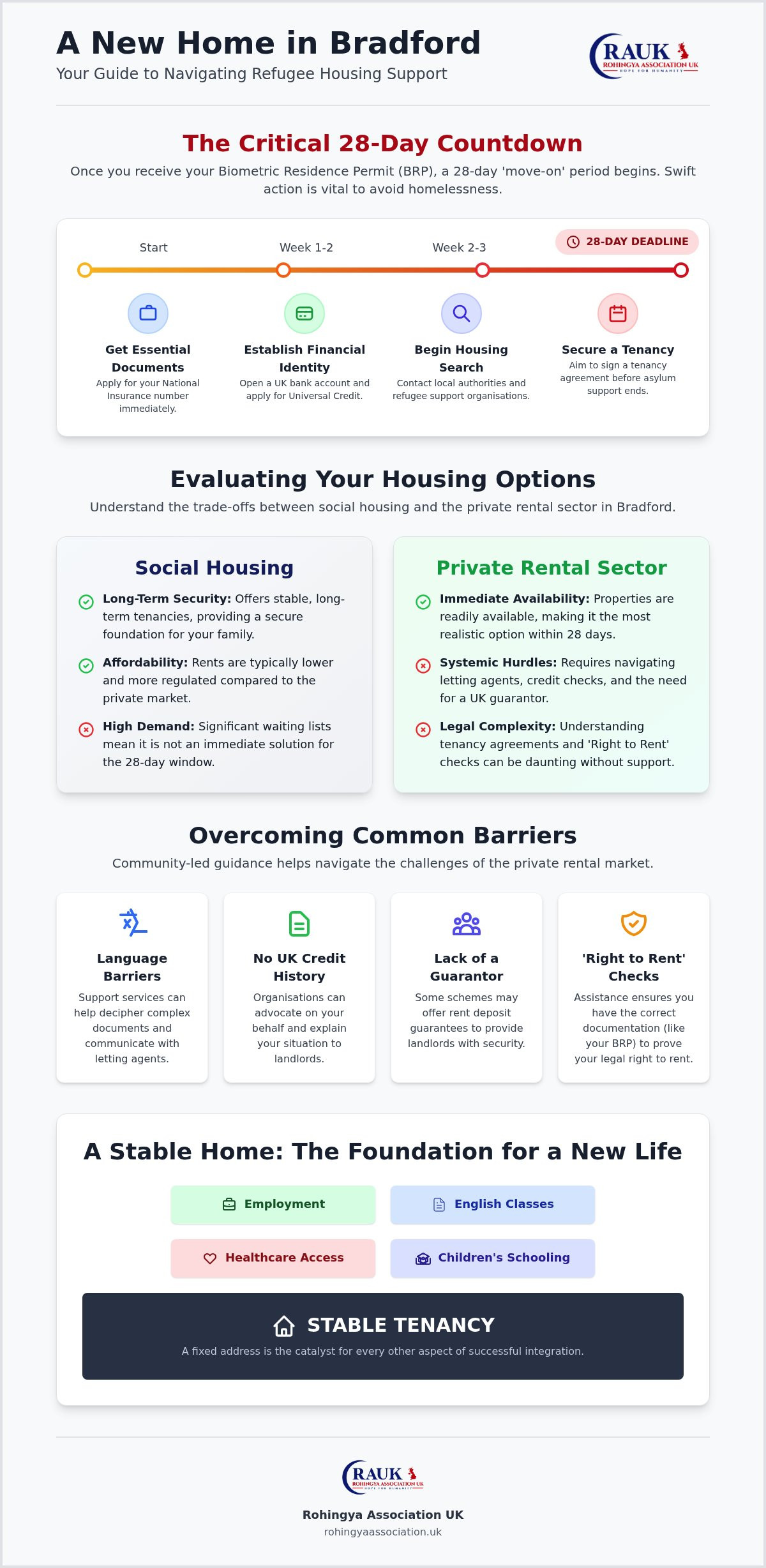
The arrival of a Biometric Residence Permit (BRP) is a moment of profound relief, marking the end of a long journey toward legal safety. Yet, this milestone immediately triggers the 28-day move-on period, a window of time that is often too short for the complexities of the UK property market. During these four weeks, you must transition from asylum support payments to either employment income or Universal Credit. This shift requires a National Insurance number and a UK bank account, both of which can take time to process. Accessing dedicated housing help for refugees in Bradford is essential to ensure your first month of freedom isn’t spent in crisis.
Without immediate action, the risk of homelessness becomes a stark reality. The transition involves more than just finding a flat; it requires establishing a financial identity in a new country. Moving from the weekly asylum support rate of £39.63 to the mainstream benefits system demands careful management, especially as Universal Credit has now fully replaced the old Housing Benefit system as of March 2026. This period is a test of resilience, but with the right refugee housing support Bradford, it becomes a bridge to a new life.
Step-by-Step: The First 28 Days
Success requires a methodical approach to every passing hour. We recommend prioritising these actions to maintain your stability, protection, and peace of mind:
- Day 1-7: Contact Bradford Council’s Housing Options team immediately. This ensures they’re aware of your status and can assist with the housing register. You must also apply for your National Insurance number if it wasn’t issued automatically with your BRP.
- Day 8-14: Begin searching for private tenancies. Understand that landlords will require a “Right to Rent” check, which verifies your legal status. This is also the time to open a bank account, as you’ll need it for rent payments and benefit claims.
- Day 15-28: Finalise your tenancy agreement. If no home is found, you must submit a formal homelessness application to the local authority before your NASS support expires.
Overcoming Documentation Barriers
Landlords often hesitate when faced with unfamiliar documents. You can prove your right to rent using your BRP or a digital share code from the Home Office website. This digital proof is often more persuasive to letting agents than physical cards alone. Community advocates play a vital role here, speaking on your behalf to explain your rights and reliable character. At the Rohingya Association UK, we act as a bridge between new arrivals and the local housing market, ensuring your voice is heard and your dignity is preserved. We help you explain your status to landlords who may be unfamiliar with refugee documentation, turning a barrier into a conversation about your future and your potential.
Evaluating Housing Options in Bradford: Social vs Private
Finding the right home requires a careful balance between the desire for long-term security and the urgent need for immediate shelter. In West Yorkshire, families typically choose between social housing provided by associations and the private rental sector. Whilst social housing offers lower rents and greater protection, the reality of the local market often necessitates a different approach. Accessing Bradford Council refugee housing support is the first step in understanding these paths, as the council manages the central gateway for many affordable homes. Every choice you make now serves as a building block for your family’s future stability and growth.
The “Bradford Homes” portal serves as the primary system for bidding on social properties. It’s a competitive process where available homes are listed weekly, and those on the register bid for the ones that meet their needs. Proximity to schools and community centres is a vital consideration during this stage. You should assess neighbourhoods like Manningham or Girlington, which have established support networks, to ensure your family remains connected to your heritage and essential services. A home is more than a postcode; it’s the heart of your new community.
The Reality of Social Housing Waitlists
Bradford Council uses a priority banding system to categorise applicants based on their level of need. Refugees are often placed in high-priority bands if they’re at immediate risk of homelessness, yet significant wait times remain a persistent hurdle. For many, this means their first independent home will likely be in the private sector. It’s a difficult reality to face after the long wait for status. Maintaining an active application on the housing register is still essential, as it preserves your chance for a permanent association home in the future whilst you settle elsewhere.
Navigating the Private Rental Market
The private sector offers faster access to housing, but it comes with higher monthly costs and stricter requirements. For the 2026-2027 financial year, Local Housing Allowance (LHA) rates remain frozen at the levels set on 31 January 2024. This creates a growing gap between the financial support available and the actual market rent. Reputable letting agents in the city are increasingly familiar with refugee housing support Bradford, yet many still demand a UK-based guarantor. If you don’t have a guarantor, we can help you explore council schemes that might offer assistance with deposit bonds or advanced rent. These options require early application and a clear understanding of your legal rights as a tenant.
Essential Guidance for New Tenants: Rights and Responsibilities
A tenancy agreement is far more than a simple formality; it’s a binding legal covenant that secures your family’s safety and peace of mind. This document outlines the terms of your stay, the rent you’ve agreed to pay, and the duration of your occupancy. Before you receive the keys, you must complete a “Right to Rent” check. This is a mandatory legal requirement for all UK tenancies, where the landlord verifies your immigration status using your Biometric Residence Permit or a digital share code. Accessing refugee housing support Bradford ensures you understand every clause of this contract before you commit your signature to the page.
Transitioning to independent living also means taking full control of your household finances. You’ll be responsible for managing utility bills, including water, gas, and electricity, alongside Council Tax. Many new tenants are eligible for Council Tax Reduction schemes, which can significantly lower your monthly outgoings. Establishing these accounts in your own name is a powerful act of restoration. It marks your transition from a supported individual to a self-sufficient member of the Bradford community, capable of managing a household with dignity and foresight.
Landlord Responsibilities and Your Protections
Your landlord has a strict legal duty to provide a home that is safe, dry, and well-maintained. Any security deposit you pay must, by law, be placed in a government-backed protection scheme within 30 days. This ensures your money is safe and will be returned at the end of the tenancy, provided the property is kept in good condition. The Landlord and Tenant Act 1985 requires that landlords maintain the property’s structure and exterior whilst ensuring all essential services for water, gas, and electricity are kept in safe working order. If a landlord ignores urgent repairs or safety issues, such as damp or faulty wiring, you can report these failings to Bradford Council’s environmental health department for intervention. If you require assistance reviewing a contract before signing, our team at the Rohingya Association UK provides the guidance you need to step forward with certainty.
Being a Responsible Member of the Community
Building a new life in West Yorkshire involves more than just occupying a space; it requires active, positive participation in your neighbourhood. Paying your rent on time is the most effective way to build a positive UK credit history, which will make it much easier to move to a larger home or apply for a mortgage in the future. Respecting your neighbours and understanding local customs is equally vital. In Bradford, this includes following waste collection rules, such as correctly using the grey bin for general waste and the green bin for recycling. Maintaining a clean, quiet, and respectful home creates a stable environment for your children and fosters a sense of communal bond. A strong record as a responsible tenant is a valuable asset that protects your family’s future mobility and reputation within the city.
How Rohingya Association UK Supports Your Integration
Settling in a new city requires more than a physical address; it demands a sense of belonging and the restoration of one’s identity. At the Rohingya Association UK (RAUK), we recognise that the journey toward independence is paved with complex administrative hurdles and emotional weights. Our team provides practical, hands-on refugee housing support Bradford, assisting families with the intricate process of housing applications and the interpretation of high-register legal documents. We act as a protective shield, ensuring that no family is left to struggle alone against language barriers or systemic apathy. By providing this guiding hand, we enable families to transition from the uncertainty of displacement to the stability of a permanent home.
A Community-Led Approach to Resettlement
Our strength lies in our lived experience. We are not just service providers but a collective of individuals who understand the gravity of displacement, the pain of loss, and the hope of renewal. This deep-rooted understanding enables us to offer community support for displaced families that is both empathetic and authoritative. We bridge the gap between new arrivals and local healthcare providers, whilst facilitating access to English language classes that are essential for long-term agency. Beyond the paperwork, we strengthen communal bonds through cultural and Islamic events; these gatherings provide a vital space where heritage is celebrated, traditional values are honoured, and shared identity is preserved amidst the transition to life in West Yorkshire.
Beyond the Tenancy: Building a Future
Stable housing is the vital prerequisite for every other form of growth and participation. Once a family is securely settled, they can begin to engage with our wider initiatives, including refugee youth empowerment programs designed to foster the next generation of leaders in Bradford. We offer skills development, volunteer opportunities, and educational pathways that ensure a brighter future for every child. Our work is grounded in a commitment to both local integration and global advocacy. Even as we build new lives in the UK, we remain steadfast in our mission to promote justice for Rohingya people on the international stage. We invite you to join our mission of empowerment, restoration, and collective growth as we work together to build a community where everyone can thrive.
Building a Foundation for Belonging in Bradford
Securing a permanent home is the essential first act of restoration for any displaced family. We’ve explored the necessity of acting swiftly during the critical 28-day move-on period and the importance of understanding your legal protections within the private rental market. Accessing dedicated refugee housing support Bradford ensures that no individual faces these systemic hurdles in isolation. As a community-led organisation and Registered Charity (1211433), we provide expert advocacy from our local Bradford support centre to ensure every family finds the stability they deserve.
Every contribution helps us provide the guiding hand families need to navigate these complex transitions with dignity. Please support our mission to provide homes and hope; donate to RAUK today. Your journey from displacement to stability is a profound testament to human resilience. Together, we can ensure that every new arrival in West Yorkshire finds a front door that opens to a future of safety, heritage, and lasting peace.
Frequently Asked Questions
What happens to my housing when I receive my refugee status?
Once you receive refugee status, your Home Office asylum support and accommodation will cease. You’ll receive a Biometric Residence Permit (BRP) and a “termination of support” letter. This marks the beginning of the 28-day move-on period. During this time, you must secure independent accommodation, apply for a National Insurance number, and set up a bank account. It’s a challenging transition that requires immediate action to avoid homelessness and ensure your future stability in the city.
Can I get help with a rent deposit in Bradford?
Yes, you can access assistance through Bradford Council’s Bond Scheme or similar initiatives for new tenants. These programmes often provide a written guarantee to landlords instead of a cash deposit. Additionally, some charities offer small grants for essential household items. Accessing professional refugee housing support Bradford early in your search can help you identify which specific financial aids you’re eligible for before you sign a tenancy agreement. This support is vital for those without a UK credit history.
How long is the waiting list for social housing in Bradford?
Waiting lists for social housing in Bradford are extensive, often spanning several years depending on your priority band. Whilst refugees at risk of homelessness are placed in higher priority categories, the sheer volume of applicants means that social housing is rarely an immediate solution. Most families find their first home in the private rental sector whilst remaining on the housing register for a more permanent association property in the future. It’s a path that requires patience and careful planning.
What is the “move-on” period and why is it only 28 days?
The move-on period is a 28-day window provided by the Home Office after your refugee status is confirmed. This timeframe is the statutory limit for transitioning from asylum support to mainstream benefits or employment. It’s notoriously short, creating an urgent pressure to find a home quickly. Accessing refugee housing support Bradford ensures you manage this window effectively. As of August 2026, you must still plan for a 28-day transition once your status is granted by the authorities.
Can a landlord refuse to rent to me because I am a refugee?
It is illegal for a landlord or letting agent to refuse to rent to you simply because you are a refugee. Under the Equality Act 2010, they cannot discriminate based on race, nationality, or ethnic origin. However, they must conduct a “Right to Rent” check to ensure you have a legal right to be in the UK. If you feel you’ve been unfairly treated, you can seek advice on your legal rights and report the incident to the council.
How do I apply for Universal Credit to help with my rent?
You should apply for Universal Credit online via the government website as soon as you receive your BRP. You’ll need your National Insurance number, a UK bank account, and an email address to complete the application. Universal Credit includes a housing element to help cover your rent. Because the first payment usually takes five weeks, it’s vital to apply on day one of your move-on period to minimise financial gaps and avoid falling into rent arrears.
What should I do if I am at immediate risk of homelessness?
If you are at immediate risk of homelessness, you must contact Bradford Council’s Housing Options team immediately. They have a statutory duty to assess your situation and provide emergency assistance if you meet certain criteria. You should bring your BRP and your termination of support letter to their office. Seeking help from a community advocate can ensure your case is handled with the urgency it requires during this high-pressure transition to independent living in West Yorkshire.
Does Rohingya Association UK provide emergency accommodation?
Rohingya Association UK does not provide emergency accommodation or direct housing. Our role is to act as a guiding hand, offering integration support, education, and assistance with the housing application process. We help you navigate the local system, understand your tenancy rights, and connect with the appropriate local authority services. Our mission focuses on long-term empowerment and cultural preservation rather than providing temporary shelter. We are your partners in building a new, stable life within the community.