

To support stateless refugees in the UK is to answer a profound call for human dignity. It requires moving beyond abstract headlines to understand the lived reality of individuals stripped of their most basic right: a nationality. For communities like the Rohingya, statelessness is not merely a legal classification; it is a systematic erasure of identity that fuels a desperate search for safety, security, and a place to call home. This guide will illuminate the path from legal ambiguity to holistic community integration, showing how compassionate action in the UK can restore hope for those who have been rendered invisible.
Discover how to provide meaningful support to stateless refugees in the UK through holistic community integration, legal understanding, and dedicated advocacy.
Understanding Statelessness: The Case of the Rohingya People
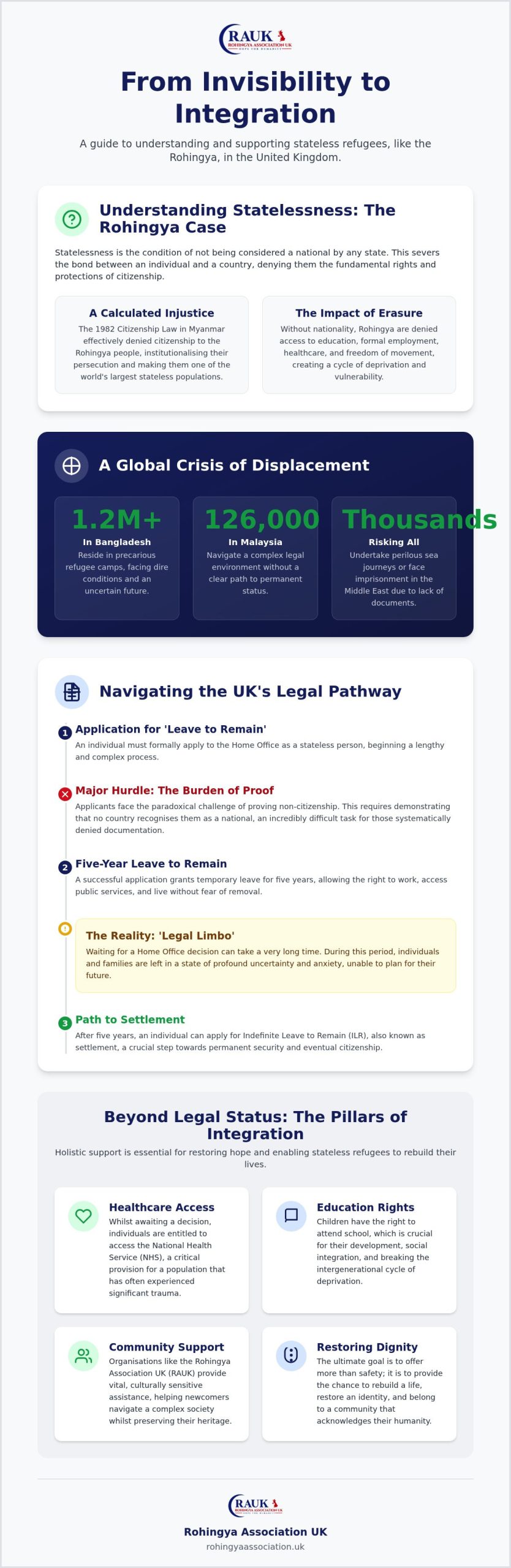
Statelessness is the condition of not being considered a national by any state under the operation of its law. It is a devastating legal anomaly that severs the bond between an individual and a country, leaving them without the protections and rights that citizenship affords. For the Rohingya people, this is not a recent misfortune but a calculated, generational injustice. The 1982 Citizenship Law in Myanmar (Burma) effectively denied them citizenship, institutionalising their persecution and rendering them one of the largest stateless populations in the world.
Stripped of their nationality in their ancestral homeland of Rakhine State (also historically known as Arakan State), the Rohingya became ‘legal ghosts’. This status denies them access to education, formal employment, healthcare, and freedom of movement. For families and children, the impact is catastrophic, creating a cycle of deprivation and vulnerability that perpetuates across generations. Without documentation, they cannot prove who they are, where they are from, or to whom they belong, making them exceptionally susceptible to exploitation, trafficking, and violence.
The Global Landscape of the Rohingya Crisis
The systematic persecution in Myanmar has forced the Rohingya to flee, creating a sprawling humanitarian crisis. The largest concentration of refugees, over 1.2 million people, resides in sprawling, precarious camps in Cox’s Bazar, Bangladesh, where they face dire conditions and an uncertain future. The desperation born from statelessness compels many to undertake perilous journeys in search of refuge.
Thousands have fled to Malaysia, where an estimated 126,000 refugees navigate a complex legal environment, with recent transitions to systems like the Digital Platform for Pendaftaran (DPP) offering a semblance of registration but not permanent status. Many others risk their lives on treacherous sea voyages, hoping to reach Indonesia or Thailand, often falling victim to human traffickers or perishing at sea. The crisis extends to the Middle East, where countless Rohingya are imprisoned in countries like Saudi Arabia for years, trapped in a legal void due to their lack of documentation. This global displacement underscores a stark reality: for a stateless person, there are few safe harbours and many hostile shores.
Why Stateless Refugees Seek Sanctuary in the UK
Against this backdrop of global instability and danger, the United Kingdom represents a beacon of hope. Stateless refugees seek sanctuary in the UK not only to escape immediate persecution but also to find a stable future where their fundamental human rights are protected by the rule of law. The UK’s established legal framework for statelessness applications, whilst challenging, offers a potential pathway to recognition and security that is absent elsewhere.
Furthermore, the presence of established community hubs, such as the Rohingya Association UK (RAUK) in Bradford, provides a vital support network. These organisations offer culturally sensitive assistance, helping newcomers navigate a complex society whilst preserving their heritage. For those fleeing systemic erasure, the UK offers more than just safety; it offers the chance to rebuild a life, restore an identity, and belong to a community that acknowledges their existence and their humanity.
Navigating the UK Legal System for Stateless People
The journey to legal recognition in the UK is a formal process governed by the Home Office. An individual can apply for ‘leave to remain’ as a stateless person, but the path is often fraught with complexity and emotional strain. The central challenge lies in the ‘burden of proof’, which requires the applicant to demonstrate that they are not a citizen of any country. For someone who has been systematically denied documentation their entire life, this can be an almost impossible task.
Applicants must prove they have taken reasonable steps to acquire a nationality or citizenship from other countries they may have a connection to, but have been refused. This process often involves contacting the very authorities that have persecuted them. If an application is successful, the individual is typically granted leave to remain for five years. This period allows them to work, access public services, and live without fear of detention or removal. After this period, they can apply for settlement, also known as indefinite leave to remain, which is a crucial step towards permanent security. However, the waiting period for a Home Office decision can be lengthy, leaving many in a state of ‘legal limbo’ where their lives are on hold, filled with uncertainty and anxiety.
Eligibility and Documentation Challenges
To be eligible for statelessness leave in the UK, an applicant must be in the country and not be admissible to another country for the purpose of permanent residence. The documentation required is extensive, often including any identity papers they might possess, birth certificates of children, and evidence of their life history and attempts to confirm their citizenship status with foreign authorities.
The primary hurdle is obtaining proof of ‘non-citizenship’. How does one secure a formal letter from a hostile regime confirming it does not recognise them as a citizen? This paradoxical requirement places an immense burden on vulnerable individuals. For families, the process can be even more complex, as the status of each member must be assessed, and the categorisation of their applications can impact their collective future and stability.
Healthcare and Education Rights During the Application
Whilst awaiting a decision from the Home Office, stateless individuals in the UK have certain fundamental rights. They are generally entitled to access the National Health Service (NHS), ensuring they can receive medical care. This is a critical provision for a population that has often experienced significant trauma and long-term neglect of their physical and mental health.
Crucially, children and youth have the right to education. Enrolling in the UK school system provides not only academic learning but also a vital sense of routine, stability, and integration. For a generation at risk of being lost to the crisis, education is the cornerstone of empowerment and a brighter future. Organisations like RAUK play a key role in helping families understand and access these rights, connecting them with schools and healthcare for stateless refugees in the UK, ensuring that the waiting period does not become a period of stagnation and decline.
Holistic Support: Beyond Legal Status to Community Integration
Achieving legal status is a monumental victory, but it is only the first step towards a new life. Successful resettlement depends on a foundation of holistic support that addresses the social, emotional, and practical needs of individuals and families. Legal status alone does not secure a home, guarantee employment, or heal the wounds of trauma and displacement. This is where the work of community-led organisations becomes indispensable.
By providing guidance on housing, navigation of healthcare systems, and access to education, these organisations serve as the missing link between government policy and genuine human welfare. They offer a trusted, culturally aware presence that can translate bureaucratic processes into understandable steps. Through this dedicated work, community support for displaced families does more than provide services; it restores the dignity that statelessness attempts to destroy.
Housing and Practical Assistance
One of the most immediate challenges for newly recognised refugees is finding a place to live. Navigating the UK housing market is difficult without a credit history, rental references, or a financial deposit. Community organisations like RAUK provide essential housing guidance, helping families in places like Bradford understand their rights, connect with reputable landlords, and access local authority housing schemes. They also address the specific needs of larger displaced families, who often struggle to find suitable accommodation, ensuring they have a safe and stable home from which to rebuild their lives.
English Language and Skills Development
Language is the gateway to integration and independence. ESOL (English for Speakers of Other Languages) classes are vital, empowering refugees to communicate with neighbours, engage with public services, and enter the workforce. Beyond language, vocational training and skills development programmes are crucial for building long-term self-reliance. By equipping individuals with marketable skills, from digital literacy to practical trades, these programmes foster economic independence and professional success. Empowering the Rohingya diaspora in the UK through skills development for refugees in the UK is not just about finding a job; it is about restoring a sense of purpose and agency.
How to Help Stateless Refugees: Practical Ways to Take Action
The scale of the global statelessness crisis can feel overwhelming, creating a ‘spectator barrier’ where compassionate individuals feel powerless to help. However, meaningful change is built through collective local action. Every contribution, whether of time, resources, or voice, makes a tangible difference in the lives of stateless refugees. You do not need to be a lawyer or a diplomat to support their journey towards integration and justice.
Local volunteering at community centres, for example, provides direct support and human connection that is invaluable. Raising awareness through social media or community discussions can challenge misinformation and build a more welcoming society. It is possible to support global projects aimed at addressing the root causes of the crisis whilst simultaneously fostering the integration of those who have already sought sanctuary here. Your actions can help dismantle the barriers that stateless people face and build a community of welcome.
Volunteering with the Rohingya Association UK
For those in or near Bradford, volunteering with RAUK offers a direct way to make an impact. Opportunities range from assisting with English conversation classes to helping organise community events that celebrate Rohingya culture. Mentorship for refugee youth is particularly powerful, providing guidance and encouragement as they navigate the UK education system and plan for their future. By sharing your time and skills, you become an active part of the integration process, helping to build the strong, resilient community that is essential for overcoming the trauma of displacement. You can learn more about how to volunteer with the Rohingya Association UK on our engagement pages.
Faith-Based Giving: Zakat and Sadaqah
For many, faith provides a powerful framework for charity and social justice. Islamic giving, through Zakat and Sadaqah, plays a crucial role in supporting the most vulnerable members of the global community. These contributions are a lifeline for stateless Rohingya, both in the UK and in refugee camps abroad. When you donate through a trusted, community-led organisation like RAUK, you can be confident that your contribution is channelled effectively to provide food, shelter, education, and medical care.
Your Zakat for UK refugees can help a family in Bradford secure a deposit for a new home, whilst your Sadaqah Jariyah can help build sustainable projects, such as schools or water wells, that provide long-term hope in places like Cox’s Bazar. This form of giving is a profound expression of solidarity and a powerful tool for alleviating suffering and empowering communities.
Building a Future: The Role of Advocacy and Justice
Whilst direct community support is essential for helping stateless refugees rebuild their lives in the UK, it must be paired with a steadfast commitment to global advocacy. The ultimate goal is not only to manage the consequences of statelessness but to end the injustice itself. The fight for justice for the Rohingya people in Myanmar—for accountability, citizenship, and the right to return home in safety and dignity—is intrinsically linked to the success of integration efforts in the UK.
Effective advocacy ensures that the voices of the displaced are heard in the corridors of power, from the UK Parliament to the United Nations. It pressures the international community to take meaningful action against the perpetrators of persecution and to work towards systemic change. By supporting these efforts, you connect your local actions to a global movement for human rights, helping to create a world where no one is left without a country.
Preserving Rohingya Heritage and Identity
Statelessness is an assault on identity. The regime in Myanmar has not only denied the Rohingya citizenship but has also attempted to erase their history, language, and culture. Therefore, preserving their heritage is a powerful act of resistance and resilience. Organising cultural events, teaching the Rohingya language to the younger generation, and celebrating their rich history strengthens community bonds and reinforces a positive sense of self.
For a people whose very existence has been denied, identity is the strongest tool against the void of statelessness. It provides a source of pride, a connection to one’s roots, and a foundation upon which to build a future. Supporting these cultural initiatives is a vital part of holistic care, ensuring that integration into British society does not come at the cost of losing one’s ancestral identity.
How You Can Take Action Today
The journey from statelessness to security is long, but it is a journey made possible by a community of support. You can be a part of this journey today. Whether by volunteering your time, raising your voice for justice, or making a financial contribution, your participation is a powerful statement of solidarity. You can directly support RAUK’s mission by helping with our community projects in Bradford or contributing to our life-saving work in the refugee camps in Bangladesh.
A principled, steadfast commitment to justice and human dignity has an enduring impact. By choosing to act, you help turn the tide against indifference and build a future where every individual is recognised, protected, and empowered to thrive.
Frequently Asked Questions (FAQs)
What is the difference between a refugee and a stateless person in the UK?
A refugee is someone who has fled their country of nationality due to a well-founded fear of persecution. A stateless person is someone who is not considered a national by any state. While many refugees are also stateless (like the Rohingya), a person can be stateless without being a refugee (e.g., if they have never left the country where they were born but are not recognised as a citizen). The UK has separate legal processes for asylum (refugee status) and statelessness applications.
Can a stateless person work in the UK while waiting for a decision?
Generally, individuals who have a pending statelessness application are not permitted to work. However, they may be able to apply for permission to work if their case has been outstanding for more than 12 months through no fault of their own. Once leave to remain is granted, they have the full right to work in the UK.
How many Rohingya refugees are currently living in the UK?
Precise figures are difficult to ascertain, as the UK government does not publish statistics specifically on Rohingya refugees. However, community organisations estimate the population to be in the low thousands, with a significant and well-established community hub located in Bradford.
What is the DPP system in Malaysia and how does it affect Rohingya refugees?
The Digital Platform for Pendaftaran (DPP) is a system used in Malaysia for registering foreign nationals. For Rohingya refugees, it is a mechanism for documentation and data collection. While it provides a form of identification that can help prevent arrest for being undocumented, it does not confer formal legal status, work rights, or a path to citizenship, leaving them in a state of continued vulnerability.
How does the Rohingya Association UK support families in Bradford specifically?
RAUK provides a wide range of tailored support in Bradford, including guidance on securing housing, assistance with registering for healthcare and schools, English language classes, and youth empowerment programmes. They also organise cultural and religious events to foster a strong sense of community and preserve Rohingya heritage.
Is it possible for a stateless child born in the UK to get citizenship?
Yes, under certain conditions. A child born in the UK to a stateless parent may be entitled to register as a British citizen if they have lived in the UK for a continuous period of five years and have always been stateless. The process is not automatic and requires a formal application to the Home Office.
How can I ensure my donation goes directly to Rohingya crisis intervention?
The most effective way is to donate through a registered, community-led charity like Rohingya Association UK (Registered Charity number: 1211433). We have established projects both in the UK and directly in the refugee camps in Bangladesh, ensuring your Zakat, Sadaqah, or general donation is used efficiently for food, shelter, education, and medical aid where it is needed most.
Why is the region referred to as both Rakhine State and Arakan State?
Arakan is the historical name for the region and is preferred by the Rohingya people as it reflects their long history and heritage in the land. Rakhine is the name given by the Myanmar government, which is associated with the dominant ethnic group in the state. Using both names acknowledges the historical context and the political sensitivities surrounding Rohingya identity.