
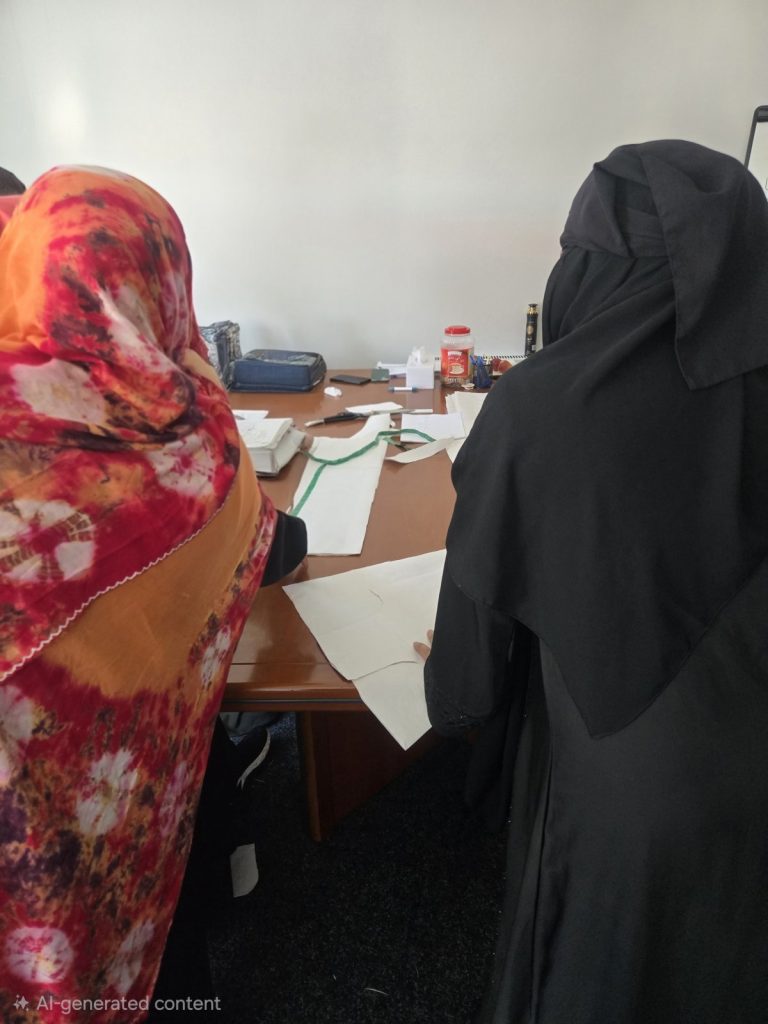
What if the most powerful tool for restoring a displaced person’s identity wasn’t a legal document, but a pair of shears, a soldering iron, or a digital tablet? In the face of prolonged displacement, vocational training for Rohingya refugees serves as a vital bridge between survival and a future defined by self-reliance. It is a restorative process that rebuilds agency, honours heritage, and fosters a renewed sense of purpose; it’s the foundation upon which a community can finally begin to heal.
You likely recognise that for those living in the camps of Cox’s Bazar or settling into new lives in cities like Bradford, the pain of displacement is often sharpened by the frustration of unrecognised skills and the isolating wall of language barriers. It’s a heavy, silent burden to possess the will to contribute but lack the formal accreditation required to enter the local workforce. This article will show you how tailored vocational training programmes are transforming these systemic obstacles into pathways for economic independence and long-term resilience. We’ll examine the latest competency-based training models, highlight the impact of community-led initiatives, and outline practical steps to support or access these essential services in 2026.
Key Takeaways
- Recognise why portable technical skills are the most resilient assets for displaced populations, offering a pathway toward restoration and self-worth.
- Examine the 2026 competency standards for vocational training for Rohingya refugees, prioritising essential sectors like sustainable agriculture and healthcare.
- Contrast the survival-focused training models utilised in Cox’s Bazar with the integration-led approaches designed for families settled in the United Kingdom.
- Learn how to navigate the ‘accreditation gap’ and other structural barriers that often hinder professional development and access to local labour markets.
- Gain insight into how community-led organisations like RAUK provide vital English language support and skills development to foster genuine local integration.
The Vital Role of Vocational Training in Refugee Restoration
In 2026, the global humanitarian landscape has undergone a vital shift. We no longer view aid as a permanent solution but as a temporary bridge toward self-actualisation. Vocational training for Rohingya refugees sits at the heart of this transition, offering more than just technical instruction; it offers a pathway to reclaim the dignity that displacement seeks to strip away. For the Rohingya people, whose history is defined by resilience in the face of statelessness, technical skills represent the most portable and protected form of capital. Unlike physical assets, a person’s mastery of a craft cannot be confiscated or lost during flight; it remains a permanent part of their identity and potential.
Learning a trade is an act of restoration. It replaces the forced idleness of camp life with the steady rhythm of productivity, purpose, and pride. By prioritising vocational training for Rohingya refugees, we move away from “emergency relief” frameworks that focus solely on survival, instead embracing a model of long-term empowerment that honours the community’s cultural heritage and individual agency.
Moving Beyond Aid Dependency
Indefinite food aid, whilst essential for immediate survival, can unintentionally erode the spirit of a community by creating a cycle of waiting. The economic argument for skills investment is clear: it is far more effective to equip a person with the means to earn than to provide subsistence indefinitely. Vocational mastery serves as a protective shield, significantly reducing the vulnerability of displaced youth to exploitation, trafficking, or hazardous labour. The psychological transition is equally profound. Moving from the status of a passive “beneficiary” to that of a “skilled provider” transforms an individual’s outlook. It replaces the heavy weight of uncertainty with the quiet confidence of someone who can provide for their family, contribute to their neighbours, and care for their community.
Portability: Skills that Cross Borders
In a world where legal status is often precarious, technical expertise remains a universal currency. We focus on trades such as tailoring, small engine repair, and digital literacy because these skills are needed in every corner of the globe. These professions do not require a passport to be valuable. In 2026, the emphasis has shifted toward standardised, competency-based frameworks that provide refugees with recognised certifications. These credentials allow individuals to prove their worth in various markets, whether they are navigating the camp economy in Cox’s Bazar or integrating into the workforce in Bradford. Furthermore, these skills are a vital investment in the future of the Rakhine State. By training today, we ensure that when the time for a safe and dignified repatriation arrives, the Rohingya community will return equipped to rebuild their homes, restore their economy, and lead their own recovery.
Essential Skills and Competency Standards for 2026
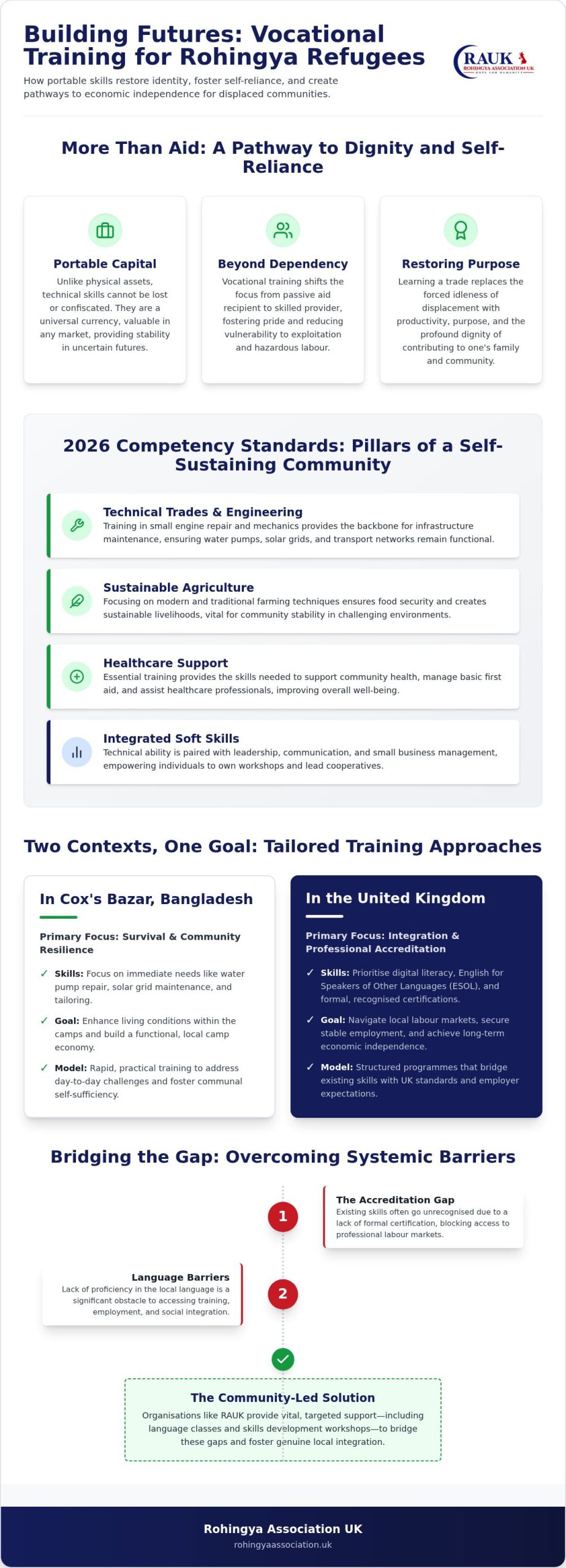
The 2026 Technical Guidance for Livelihoods and Skills Development represents a significant milestone in the standardisation of vocational training for Rohingya refugees. This framework ensures that every hour spent in a workshop or classroom translates into a recognised competency, bridging the gap between informal skill-sharing and professional accreditation. It focuses on sectors that are vital for communal stability: small engine repair, sustainable agriculture, and healthcare support. These are not merely jobs; they are the pillars of a self-sustaining society, providing the essential services required to maintain infrastructure and ensure food security in challenging environments.
Technical ability alone is insufficient for long-term independence. The 2026 standards integrate leadership, interpersonal communication, and small business management into every curriculum. These soft skills enable a mechanic to become a workshop owner, or a tailor to manage a local cooperative, ensuring that economic growth remains rooted within the community. This holistic approach fosters a sense of agency, allowing individuals to lead with confidence and manage their livelihoods with professional precision.
Technical Trades and Sustainable Livelihoods
Mechanic and engineering training provide the backbone for infrastructure maintenance, ensuring that water pumps, solar grids, and transport networks continue to function. Beyond utility, we also prioritise traditional crafts that preserve the rich tapestry of Rohingya heritage whilst generating sustainable income through the sale of artisanal goods. In the healthcare sector, training assistants to support camp clinics creates a resilient network of health practitioners who understand the specific cultural and linguistic needs of their patients. This model ensures that medical care is not just delivered but is also trusted, culturally sensitive, and accessible to those who need it most.
The Digital Frontier: Remote Work and Education
Digital literacy has become a fundamental right for the modern diaspora. For stateless youth in the UK and abroad, the digital frontier offers a borderless marketplace where skill and dedication can bypass local geographic constraints. By mastering digital tools, individuals can access remote work and education, providing a pathway to independence that was previously unimaginable. This transformation is central to our refugee youth empowerment programs, which aim to foster a generation of tech-savvy leaders. Such initiatives are essential for those seeking community support and integration as they navigate their new lives and seek to contribute their talents to the wider world.
Comparing Training Models: From Cox’s Bazar to UK Integration
The delivery of vocational training for Rohingya refugees is not a uniform process; it is a nuanced response to the specific legal and social landscapes in which the community finds itself. In the sprawling camps of South Asia, we see a “Survival Model” designed to foster resilience within a closed economy. Conversely, for those who have resettled in the United Kingdom, the “Integration Model” focuses on professional assimilation and the alignment of prior expertise with British industry standards. Both approaches are essential, yet they require vastly different pedagogical strategies to be effective.
Whilst the camp model focuses on immediate communal utility, the UK model prioritises long-term career trajectories. Effective community support for displaced families recognises that vocational success is inextricably linked to local context. Whether an individual is learning to repair a water pump in a monsoon-prone camp or studying for an apprenticeship in a British city, the goal remains the same: the restoration of agency through the mastery of a craft.
The Camp Context: Resourcefulness Under Pressure
In the world’s largest refugee settlements, training is designed for camp-based economies and repatriation readiness. Because formal employment in host countries like Bangladesh is often legally restricted, vocational training for Rohingya refugees must focus on skills that can be utilised within the camp perimeters or taken back to Myanmar. The role of the UN Framework has been pivotal in standardising this education, ensuring that even in resource-poor environments, the quality of instruction meets international benchmarks. This model fosters a culture of resourcefulness, turning limited materials into functional tools and providing youth with a sense of purpose that transcends the fences of their immediate environment.
The UK Context: Professional Integration in Bradford
In cities like Bradford, the challenge is one of translation rather than just acquisition. Many refugees arrive with significant expertise that simply lacks the specific certification required by the British job market. Navigating these professional accreditation systems is a complex task that requires dedicated guidance. Language acquisition through ESOL (English for Speakers of Other Languages) serves as the non-negotiable foundation for all professional success. Without the ability to communicate effectively in a workplace, technical skills remain underutilised. RAUK acts as a vital bridge in this process, helping individuals translate their existing talents to British standards, building professional confidence, and ensuring that the Rohingya community can contribute fully to their local economy.
Overcoming Barriers to Professional Development
While the drive for self-reliance is profound, the path to professional development is often obstructed by systemic and personal hurdles. One of the most significant obstacles is the “Accreditation Gap.” Many individuals possess years of experience in trades like tailoring, construction, or agriculture, yet they lack the physical certificates to prove it. This unrecognised prior learning often forces skilled professionals into entry-level roles, stifling both their economic potential and their sense of worth. Effective vocational training for Rohingya refugees must, therefore, include mechanisms for skill validation that translate lived experience into formal, industry-recognised credentials.
The weight of past trauma and the ongoing instability of displacement also impact a learner’s ability to commit to long-term study. It’s difficult to focus on a complex technical diagram when the safety of your family or your legal status remains a constant concern. Additionally, cultural sensitivities require the creation of gender-inclusive training spaces. Programmes that fail to provide safe environments or fail to address traditional roles often exclude women, who represent a vital demographic for community resilience. Addressing these social and psychological barriers is just as important as the technical curriculum itself.
Navigating the Legal and Bureaucratic Maze
Statelessness remains a primary barrier, complicating the right to work and access to higher education. In the United Kingdom, the 2025-2026 funding rules offer a vital pathway by exempting refugees from the standard three-year residency requirement for apprenticeships. However, those still in the asylum system remain ineligible, creating a tiered system of opportunity that can lead to frustration and stagnation. Obtaining official documentation for completed training in camp environments is equally challenging. We must continue to advocate for policy changes that recognise refugee certifications and simplify the bureaucratic process, ensuring that talent isn’t wasted due to a lack of paperwork.
Providing Holistic Support for Learners
Success in the workshop often depends on support outside of it. Practical barriers such as a lack of affordable childcare or reliable transport can end a student’s journey before it begins. Integrating mental health support with technical education is not a luxury; it’s a necessity for those dealing with the psychological scars of persecution. Community-led organisations provide the essential “safety net” needed for students to succeed, offering the empathetic guidance that institutional providers often lack. By addressing the whole person rather than just the student, we create a foundation for lasting success. If you wish to help dismantle these barriers, you can support our community integration efforts today.
Empowering the Community: How the Rohingya Association UK Leads the Way
The most effective solutions are those born from the heart of the people they serve. Whilst international NGOs provide essential infrastructure, the Rohingya Association UK (RAUK) operates with the unique advantage of lived experience. We are a community-led charity, which means our approach to vocational training for Rohingya refugees isn’t a top-down mandate; it’s a shared mission rooted in mutual trust and cultural understanding. This proximity allows us to identify the subtle nuances of displacement that larger organisations might overlook, ensuring that our support is as dignified as it is practical. We don’t just provide services; we walk alongside our brothers and sisters as partners in their renewal.
We believe that true empowerment begins with the restoration of agency. By fostering economic independence, we aren’t just teaching trades; we’re helping families reclaim their futures and their pride. Your support allows us to bridge the gap between global advocacy and the immediate, tangible needs of those seeking a new start. It’s a commitment to long-term stability that transcends fleeting emotional reactions, focusing instead on the steady build-up of communal strength.
RAUK’s Local Impact in Bradford
In Bradford, our work provides a vital safety net for those navigating the complexities of British life. We offer tailored guidance on housing, healthcare, and education, ensuring that no family is left to face these challenges in isolation. Our English language classes and skills development programmes are designed to build professional confidence, allowing individuals to transition from survival to stability with grace. We’ve seen numerous success stories where youth empowerment initiatives have led to meaningful employment and successful professional integration. These achievements are bolstered by our Islamic community events, which serve as a cultural anchor, providing a space for learners to find strength, heritage, and solidarity amongst their peers.
A Global Vision for Skills and Justice
Our commitment extends far beyond the borders of West Yorkshire. RAUK remains deeply involved in advocacy work within Myanmar and the refugee camps of Bangladesh, ensuring the Rohingya voice remains central to any international vocational strategy. We understand that local skills are inextricably linked to the broader pursuit of justice for Rohingya people. By equipping our youth with expertise today, we’re preparing them to lead the restoration of our heritage tomorrow. You can join this mission. Whether through volunteering your time or making a financial contribution, your involvement directly funds the vocational pathways that lead to dignity. Every donation helps us provide the tools, the training, and the hope necessary for our community to thrive once again.
Building a Future of Self-Reliance and Shared Dignity
Vocational training for Rohingya refugees is far more than a simple transfer of technical skills; it is a vital act of restoration that transforms individuals from passive recipients of aid into empowered, skilled providers. By mastering standardised competencies and navigating the complex accreditation landscape, displaced families can finally bridge the gap between survival and genuine economic independence. This journey requires a steadfast commitment to overcoming systemic barriers, ensuring that the talents of the community are recognised and celebrated in every workshop and workplace.
As a community-led organisation (Registered Charity number: 1211433), the Rohingya Association UK offers the direct expertise and empathetic support necessary to turn these aspirations into reality. Our work has a tangible impact in the UK and abroad, providing the essential foundation for long-term integration and justice. You can help us sustain these life-changing initiatives. Support our vocational and education programmes: Donate to RAUK today. Let’s stand together to ensure that every individual has the tools to build a future defined by dignity and hope.
Frequently Asked Questions
What types of vocational training are most common for Rohingya refugees?
The most common sectors for vocational training for Rohingya refugees include tailoring, small engine repair, and sustainable agriculture. These trades are prioritised because they offer immediate utility within camp economies and are highly portable across international borders. There is also a growing emphasis on healthcare assistant training and digital literacy; these skills allow youth to support local clinics or access remote work opportunities regardless of their physical location or legal status.
How does vocational training help refugees in the UK specifically?
In the United Kingdom, these programmes facilitate professional integration by aligning a refugee’s existing expertise with British industry standards. For instance, refugees are currently exempt from the three-year residency requirement for apprenticeships for the 2025-2026 period. This allows individuals to enter the skilled workforce sooner, fostering economic independence and reducing reliance on social support systems whilst contributing their talents to the local economy in cities like Bradford.
Are these training programmes accredited by international bodies?
Many modern programmes utilise a competency-based training framework endorsed by international bodies such as the United Nations and the International Labour Organization. This standardisation ensures that the skills acquired meet specific industry benchmarks, making certifications more recognisable to future employers. Whilst the accreditation gap remains a challenge for some informal learning, the shift toward authorised qualifications in 2026 is helping many refugees secure formal recognition for their technical mastery.
How can I support vocational training for Rohingya refugees through RAUK?
You can support these vital initiatives by making a financial contribution to the Rohingya Association UK. As a community-led registered charity (number: 1211433), we use donations to fund aid projects, English language classes, and skills development programmes in the UK, Myanmar, and Bangladesh. Your involvement helps us provide the tools and training necessary for displaced families to rebuild their lives and achieve long-term self-reliance through our community-led expertise.
What are the biggest barriers to refugees accessing skills development?
The most significant hurdles include the lack of formal recognition for existing skills and the persistent wall of language barriers. Structural issues, such as the ineligibility of asylum seekers for UK apprenticeships under current 2025/2026 funding rules, also create significant obstacles. Additionally, the psychological impact of trauma and the lack of practical support, such as childcare or transport, often prevent individuals from committing to the long-term study required for professional mastery.
Does vocational training include English language support?
Yes, English language support is a foundational component of vocational training for Rohingya refugees in the UK. Mastering English through ESOL classes is essential for professional confidence and effective communication within a British workplace. Without these linguistic tools, even the most highly skilled individuals may struggle to navigate the job market or access advanced training opportunities; therefore, we integrate language learning with technical instruction to ensure a holistic path to integration.
How does training in Cox’s Bazar differ from training in the UK?
Training in Cox’s Bazar follows a survival model focused on the camp economy and preparation for eventual repatriation to Myanmar. These programmes often prioritise trades like agriculture or basic mechanics that function within resource-limited environments. In contrast, UK-based training follows an integration model that emphasises professional assimilation, vocational English, and the navigation of the national labour market; the goal is to help families thrive within a Western professional landscape.
Can vocational training help with the repatriation process to Myanmar?
Vocational training is a critical investment in the future repatriation process. By acquiring portable skills such as engineering, healthcare, and infrastructure maintenance, refugees ensure they are prepared to lead the reconstruction of their communities in Rakhine State when it’s safe to return. These technical abilities represent a form of capital that cannot be lost; they provide the community with the expertise needed to restore their economy and maintain essential services independently.