

What does a charity’s registration tell you about its work? For anyone comparing transparent charities UK, a public register entry can confirm important details, but it can’t show by itself whether an organisation’s work is effective, how it makes decisions or whether its priorities match yours.
Charity claims can be difficult to compare. Organisations describe their impact in different ways, while accounts and governance information can seem technical or leave questions unanswered. You don’t need to become an accountant to make a considered choice. You do need to look beyond labels and ask what the available evidence actually demonstrates.
This guide provides a consistent checklist for reviewing public registration details, annual reports, accounts and impact information. You’ll learn what these records can and can’t tell you, what to check when information is limited, and how to judge a charity’s work against your own values. The aim isn’t to find a perfect organisation, but to make a fair, informed decision about where your support may contribute to meaningful work.
Key Takeaways
- Use a consistent checklist to compare transparent charities UK, focusing on mission, governance, financial reporting and evidence of work.
- Check a charity’s identity and latest available filings with the relevant regulator, then look for clear explanations of its activities.
- Compare organisations with similar purposes and scale. Headline figures alone may not reflect differences in how they work.
- Before giving, ask how donations may be used and what reporting or safeguarding information is available.
- Consider Rohingya Association UK as a community-led example, and check its current Charity Commission record and public information before deciding whether to support it.
What makes a charity transparent in the UK? A practical starting point
Charity transparency means making clear, accessible information available about an organisation’s purpose, governance, finances and reported work. For donors comparing transparent charities UK, the key question is not just whether information exists. It’s whether that information helps you understand what the charity does, who it serves and how it accounts for its work.
Registration is a useful starting point, not a verdict. It can help you confirm an organisation’s registered identity and review information held by its regulator, but it doesn’t independently prove effectiveness, service quality or financial efficiency. A charity’s website and other materials can explain its priorities and share stories of change. Read these alongside public records and reports, since claims need context and evidence to be assessed fairly.
A brief overview of how charities are established may help explain the difference between an organisation’s purpose and the evidence it makes public:
What information should a transparent charity make understandable?
Look for a plain-language explanation of the charity’s purpose, information about its trustees or other governing body, and contact details for enquiries. Its materials should describe its activities, intended beneficiaries and the progress it is working towards, rather than relying only on broad promises or individual stories.
Check whether reports, accounts and relevant policies are easy to find. If a report describes activities but says little about outcomes, treat that as a limit in the evidence, not automatic proof of poor work. Consider the charity’s size, purpose and activities when deciding what level of detail is reasonable to expect.
Does charity registration mean a charity is trustworthy?
For England and Wales, the Charity Commission for England and Wales is the regulator. Its public register can help donors check an organisation’s recorded details. Charity regulation differs across the UK, so confirm which regulator applies and consult its current guidance when checking registration and filings.
A register entry is one source of evidence. It is not an endorsement of every claim or a guarantee of impact. Read available records alongside the charity’s reports and policies, and ask direct, respectful questions if an important point remains unclear. A considered decision draws on several pieces of evidence, interpreted together.
How to check UK charity accounts, governance and impact evidence
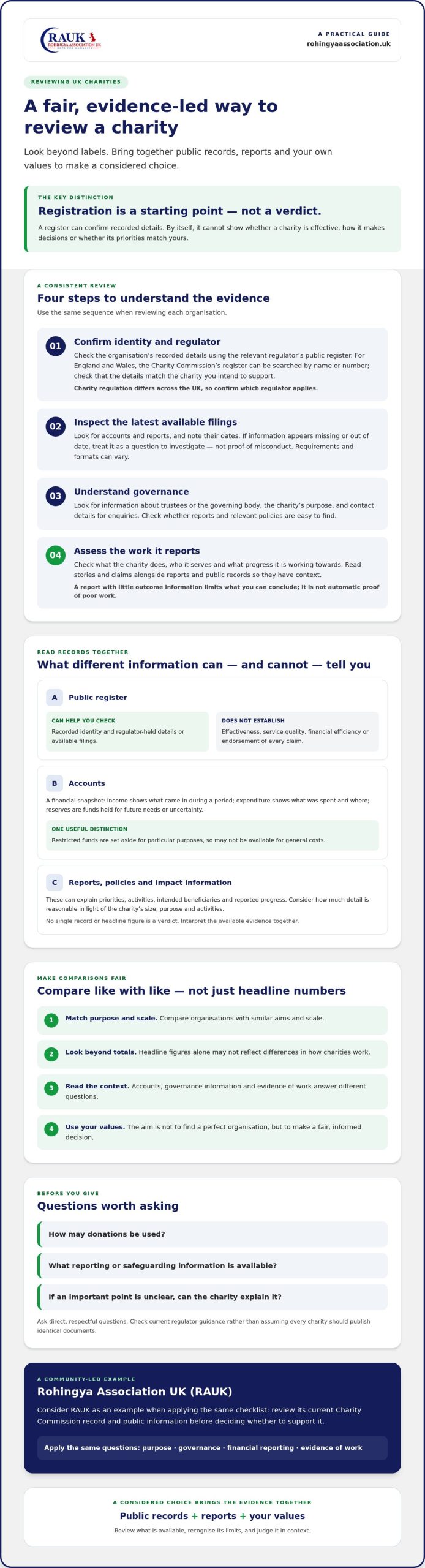
A practical review follows a clear sequence: confirm the organisation’s identity, inspect its filings, understand who governs it, then assess what it reports about its work. Registration, accounts and impact reporting answer different questions. Read them together instead of treating any single record or figure as a verdict.
Where can you check a UK charity’s registration and filings?
For a charity registered in England and Wales, use the Charity Commission’s public register to check its record and available filings. Search the official charity register by name or number, then check that the details match the organisation you intend to support. Charity regulation differs across the UK, so use the relevant regulator for the charity’s jurisdiction.
Note the dates of the latest available accounts and reports. If a filing appears missing or out of date, treat that as a question to investigate, not proof of misconduct. Reporting requirements and formats can vary with a charity’s circumstances and financial year. Check current regulator guidance rather than assuming every organisation should publish identical documents.
How should you read accounts, trustees’ details and impact reports?
Accounts provide a financial snapshot, but figures need context. Income shows what came in during a period; expenditure shows what was spent and where; reserves are funds held for future needs or uncertainty. Restricted funds are set aside for particular purposes, so may not be available for general costs. No single proportion, such as the share spent on administration, can establish whether a charity is effective or well run.
Review who the trustees are and what the trustees’ report says about the charity’s activities, aims and progress. Look for a clear account of who was reached, what changed and what remains difficult to measure. An activity report is useful, but it does not necessarily demonstrate lasting outcomes. Consider the charity’s purpose and scale, and note whether it explains limitations instead of relying only on headline claims.
Reporting guidance changes, so check which requirements apply to the period you’re reviewing. The Charities SORP 2026 applies to financial years starting on or after 1 January 2026 and introduces reporting tiers based on income. Don’t assume it applies retrospectively to earlier periods; consult current guidance from the relevant regulator.
Use the same checks when considering Rohingya community support: confirm the current public record, then review available accounts and reports to understand the evidence for the work. This keeps your comparison of transparent charities UK grounded in documents, context and questions you can follow up.
How to compare transparent charities fairly, beyond headline numbers
Start with what you want your donation to support. Then consider how clearly each charity explains its purpose, governance, finances and reported work. Compare organisations with similar aims and, where possible, similar scale. A local community group and a large international organisation may have different operating contexts and reporting needs. Similar presentation doesn’t necessarily mean similar performance.
Use a simple table to separate evidence from interpretation. For each organisation, note what you found, where it came from and when you checked it.
| Comparison area | What to assess | Record separately |
|---|---|---|
| Mission clarity | Can you identify the cause, community and intended purpose? | Verified purpose; your assessment of its relevance to your values. |
| Governance information | Are governing details and responsibilities understandable? | Publicly listed facts; any details you couldn’t confirm. |
| Financial reporting | Are available accounts explained clearly and in context? | Filing and reporting details; questions about what figures mean. |
| Impact evidence | Does reporting describe activities, outcomes and limitations? | Specific reported results; claims that need further explanation. |
Which evidence matters most when comparing charities?
First, match each charity’s stated purpose to the cause and community you want to support. Then compare the completeness and clarity of its public information, allowing for differences in size, structure and operating context. Give more weight to specific outcomes described with context than to broad claims without supporting detail. The Find a Charity register can help you check public details for charities registered in England and Wales, but it won’t answer every question about their work.
Mark each entry in your comparison as a verified fact, a charity-reported claim or an unanswered question. For example, an activity described in an annual report is a reported claim. A public filing can help verify that the document was submitted, but doesn’t independently prove every outcome it describes. Note the source and date beside each entry so you can revisit the evidence instead of relying on memory.
How can readers avoid misleading charity rankings?
A single score, overhead ratio or search result can’t establish overall merit. Administrative costs may reflect a charity’s work and context, so treat them as one part of the financial picture, not a standalone test of effectiveness or trustworthiness. Be cautious of labels such as “most transparent” unless the publisher clearly explains its criteria, evidence and method.
Before deciding, review your notes, identify what remains uncertain and consider whether the available evidence addresses your priorities. This helps you compare transparent charities UK fairly, without turning a complex judgement about purpose and work into a league table.
What questions should you ask before supporting a UK charity?
A respectful question can help you understand whether a charity’s approach fits your intentions. You don’t need to ask for private information about the people it supports or expect an instant, exhaustive answer. Focus on what the organisation can reasonably explain about donations, reporting and accountability, then consider its response alongside the public information you’ve already reviewed.
What should you ask about donations and project reporting?
If you have a particular purpose in mind, ask whether donations can be directed to that project or are used for the charity’s wider work. Check how the organisation reports progress and how it communicates if plans or circumstances change. A clear answer should explain what the charity can confirm without implying that each individual gift produces a guaranteed, one-to-one outcome.
You might ask:
- How may an unrestricted donation be used?
- Can I direct a gift to a particular project, and what happens if that project can’t proceed as planned?
- Where can I read updates about activities, progress and changes?
Look for consistency between the answer, donation information and the charity’s reports. If an explanation is broad or unclear, ask a focused follow-up. A brief reply may reflect limited context, not the charity’s overall approach. For transparent charities UK, clarity means explaining what is known and what remains uncertain, not promising more than the evidence supports.
What governance and safeguarding information should you look for?
Check whether current information about governance and safeguarding is publicly available. If you can’t find it, ask where it is published, how concerns can be raised and how the organisation describes its response process. Don’t assume a policy exists or judge its quality until you’ve checked the charity’s current information. Avoid asking for confidential details about individual cases.
Notice whether answers are clear, consistent with public materials and proportionate to your enquiry. A charity may be unable to share personal or sensitive information, but it can often explain its general processes. Note what was answered, when, and what still needs clarification. This gives you a fair basis for deciding whether the available information is sufficient for your own choice.
Fundraising guidance and complaints routes can depend on the issue and where the charity operates. Before escalating a concern, check the current guidance of the relevant charity regulator and any applicable fundraising complaints body. Their roles and routes may differ, so confirm the right process rather than relying on an old directory or a search result.
If you’re considering community-led Rohingya support, review Rohingya community work and giving information and check what the organisation currently shares about its work and donations before deciding whether to contribute.
RAUK as a community-led charity example: review the evidence and decide
Rohingya Association UK (RAUK) is a community-led charity based in Bradford that supports Rohingya refugees, families and young people. Its charity registration number is 1211433. Check the current Charity Commission record to confirm its registration details, governing information and latest available filings before relying on them.
What is confirmed about Rohingya Association UK’s work?
RAUK’s work includes refugee settlement and integration, community support, education and youth empowerment, cultural and community events, advocacy and crisis intervention. Its practical support includes housing guidance, access to healthcare, education, English language classes and skills development programmes. The charity also accepts public donations for aid projects in the UK, Myanmar and Bangladesh. These details describe its focus, but should be distinguished from evidence about outcomes, financial reporting or how donations are used.
For readers interested in community-led charitable work, RAUK’s Bradford base and focus on Rohingya communities may be relevant to their priorities. Explore the community support for displaced families guide for further context about support for displaced families. Before giving, check RAUK’s current donation information. Don’t assume a contribution can be restricted to a particular project unless the organisation confirms this.
How can readers assess RAUK against the same criteria?
Apply the same evidence-based checks you would use for any organisation. Confirm that the register entry matches the charity, review available filings and reports, and check whether its public information clearly explains its activities and intended beneficiaries. See which accounts, impact updates and relevant policies are currently available. If something is missing or unclear, note it as a question rather than drawing a conclusion without context.
Consider RAUK as an example, not as an independently rated organisation or as more effective than other charities. Its advocacy work focuses on human rights protection and justice for Rohingya people. Read its materials alongside public records, keeping organisational statements distinct from independently verifiable facts. This balanced approach helps you decide whether its stated purpose and available evidence align with your values, as you would when comparing transparent charities UK.
To review the organisation’s current information and giving details, explore RAUK’s work and ways to support. Make your decision at your own pace, guided by the cause you want to support and the evidence you can verify.
Give with clarity and confidence
Choosing among transparent charities UK isn’t about finding a perfect score. It’s about checking whether an organisation’s purpose aligns with your values, understanding what its public evidence can show and noting where questions remain. Compare like with like, consider accounts and impact information in context, and ask respectful questions before deciding where to give.
Rohingya Association UK is a community-led charity based in Bradford. Its work includes community integration, education, cultural events and Rohingya advocacy. These details may matter if you’re looking to support community-led work, but they don’t replace your own checks. Verify the charity’s current register entry and review its available information before making a decision.
If RAUK’s work speaks to your priorities, explore what the organisation shares about its activities and giving. Explore RAUK’s work and ways to support. Review its information and consider making a voluntary charitable donation to support its work.
Frequently Asked Questions
How can I check whether a charity is registered in the UK?
Search the public register of the regulator for the part of the UK where the charity is registered. In England and Wales, use the Charity Commission’s register; Scotland and Northern Ireland have separate regulators. Match the organisation’s name and registration number to its own materials, then review its register entry and available filings. If you can’t find a record, check the relevant regulator’s guidance before assuming the organisation is not legitimate.
Does charity registration prove that a charity is transparent?
No. Registration confirms that an organisation appears on the relevant regulator’s register, but it doesn’t prove that its work is effective, every claim is accurate or its finances are being used efficiently. Treat registration as one check, then review available accounts, governance details and information about the charity’s activities. If something important is unclear, seek context instead of relying on the registration entry alone.
What should a transparent charity publish?
A transparent charity should make its purpose, activities and governance understandable, and provide access to relevant public reports and financial information where available. Look for an explanation of who it aims to support, how it describes progress and where to direct enquiries. Reporting obligations and public information can differ by regulator and charity circumstances, so don’t assume every organisation must publish identical documents or impact measures.
How do I compare charities fairly?
Compare organisations with similar purposes and, where possible, similar scale. Consider mission clarity, governance information, financial reporting and evidence of work, rather than choosing by one headline figure. Keep confirmed public facts separate from claims in the charity’s own materials and unanswered questions. Note the sources and dates you checked, then decide which organisation’s work best aligns with your priorities.
Are small charities as transparent as large charities?
Size alone doesn’t show whether a charity is transparent. A smaller organisation may explain its work clearly, while a larger one may publish more extensive reporting. Their resources, activities and reporting obligations can differ. Assess each charity using information appropriate to its circumstances, and check current regulator guidance for applicable requirements. Don’t treat a different reporting format as proof of poor practice without considering its context.
What should I ask before donating to a charity?
Ask how the charity may use your donation, whether you can direct it to a particular project and how it shares progress or changes to planned work. You can also ask where to find current governance and safeguarding information, and how to raise a concern. Keep questions focused and respectful. A charity may not be able to share confidential details, but its public information and general explanations can help you make an informed choice.
Can I trust a charity that does not publish an impact statistic for every project?
Not necessarily. The absence of a statistic for every project doesn’t by itself show that a charity is untrustworthy. Some outcomes are difficult to measure through a single number, and meaningful reporting may explain activities, progress and limitations. Consider whether the organisation gives a clear account of its work and responds openly to reasonable questions. Be cautious of impressive figures too if they lack context or explanation.