

For a young person who has never known the security of a passport or the sanctuary of a permanent home, the transition to life in the United Kingdom is more than a simple change of geography; it is a profound, necessary reclamation of identity. Mentoring Rohingya youth UK represents an act of restorative justice that bridges the gap between the isolation of statelessness and the warmth of community belonging. We understand that you likely feel a deep sense of responsibility to help, yet you may also feel overwhelmed by the specific challenges these young people face, including the nuances of the ESOL system, the complexities of UCAS applications, and the deep-seated trauma of displacement.
This guide provides a comprehensive framework for offering support that is both culturally sensitive and practically effective. You will discover how tailored guidance can empower the next generation to navigate British society, education, and professional landscapes whilst preserving their rich, resilient heritage. By exploring UK-specific resources and proven communication strategies, we will show you how to move beyond basic assistance toward a model of protection, restoration, and growth that makes a tangible difference in a young person’s future.
Key Takeaways
- Understand the unique psychological and legal landscape of statelessness to provide grounded, empathetic support for youth transitioning into British urban life.
- Master the core pillars of mentoring Rohingya youth UK by adopting trauma-informed practices that prioritise emotional safety and cultural humility.
- Identify specific pathways through the UK education system, focusing on ESOL as a vital foundation for navigating non-standard qualifications and higher education.
- Discover the importance of partnering with community-led organisations like RAUK to build local trust and implement programmes that respect Islamic values.
- Learn how to recruit and support mentors who demonstrate the long-term commitment and patience required for meaningful integration and personal growth.
Understanding the Landscape: Why Mentoring Rohingya Youth in the UK is Vital
For most young people, a birth certificate or a passport is a given; for the Rohingya, these are symbols of a struggle that spans generations. As the world’s largest stateless population, Rohingya youth arrive in the Burmese communities in the United Kingdom carrying the weight of institutional rejection. They aren’t just refugees; they are individuals whose very existence has been legally denied by their home country. This unique status creates a profound sense of instability that persists even after they reach safety. It’s a condition of being that requires more than just housing or basic aid; it demands a restoration of their sense of self.
The transition from the overcrowded, resource-starved camps of Cox’s Bazar to the urban centres of West Yorkshire is jarring. Whilst the UK offers physical safety, the move introduces new, complex barriers. Generic youth services frequently struggle to address these needs because they are designed for those with linear life paths. Rohingya youth often face an “interrupted education” gap, where years of schooling were lost to displacement or restricted access. Effective mentoring Rohingya youth UK requires a specialised understanding of this fragmented history to help them overcome the educational deficits caused by years of displacement and systemic neglect.
The Impact of Statelessness on Ambition
A history of denied rights often narrows a young person’s horizon to mere survival. When your background is defined by what you are not allowed to do, imagining a career in medicine, law, or engineering feels like a radical act. Mentors must facilitate a psychological shift from a state of constant surviving to one of thriving in a stable environment. This process is not immediate. It requires a long-term commitment to building trust, fostering agency, and providing consistent encouragement before any academic goals can be meaningfully pursued. We must honour their strength whilst gently expanding their view of what’s possible.
Mentoring as a Tool for Social Integration
Displaced youth in cities like Bradford often experience deep social isolation, separated from their peers by language and experience. Mentors act as vital cultural navigators, helping young people decode the subtle social norms and complex systems of British life. They provide a protective shield against the loneliness that can lead to disengagement or mental health struggles. Through shared activities and dedicated guidance, mentors reduce the distance between the newcomer and the established community. Mentoring serves as a vital bridge between a young person’s resilient heritage and the vast opportunities of their new home.
The Core Pillars of Effective Mentoring for Displaced Young People
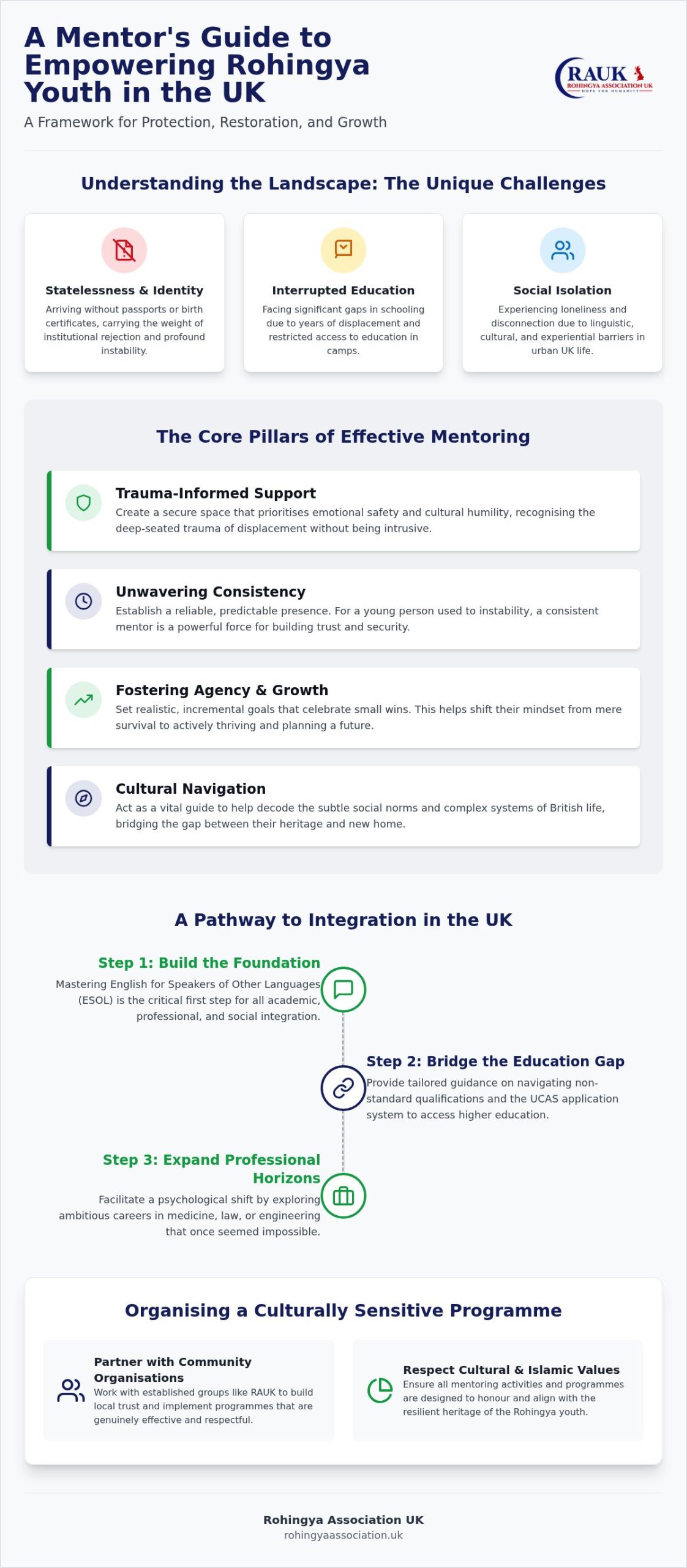
Mentoring Rohingya youth UK demands a foundation built on unwavering consistency and professional empathy. For a young person whose life has been defined by the arbitrary whims of state power and the instability of displacement, the presence of a reliable mentor is a radical departure from their previous reality. Effective support is not merely about providing answers; it is about creating a secure space where agency can be rediscovered. This requires mentors to set realistic, incremental goals that celebrate small wins, such as successfully navigating a local bus route or mastering a new set of English phrases. These moments, though seemingly minor, are essential milestones in the process of restoration and social confidence.
Establishing clear boundaries is equally vital. A mentor must be a steadfast advocate whilst maintaining a dignified distance that prevents dependency. This professional framework protects both the mentor and the mentee, ensuring that the relationship remains focused on growth and empowerment. When you Organise and Implement a Culturally Sensitive Mentoring Programme, the primary objective is to build a bridge to independence. By prioritising emotional safety and long-term commitment, you provide the structural support necessary for a young person to begin planning for a future that once seemed impossible.
Trauma-Informed Care in a Mentoring Context
A trauma-informed approach recognises that past experiences of statelessness and violence cast long shadows over the present. Mentors must learn to identify signs of distress without requiring the mentee to relive or recount their history. Creating a predictable, stable environment for weekly sessions helps to soothe the nervous system and build genuine trust. Our focus remains on resilient optimism; we acknowledge the gravity of the past but relentlessly champion the strengths and talents the young person possesses today. This shift from a deficit-based view to one of possibility is the heart of mentoring Rohingya youth UK.
Cultural Sensitivity and Religious Literacy
Religious literacy is not an optional extra; it is a fundamental requirement for working with the Rohingya community. For many, faith and the mosque are the primary sources of comfort and communal identity. Understanding Islamic values and observing cultural nuances regarding gender dynamics and family expectations demonstrates a level of respect that fosters deeper connection. When discussing sensitive topics like heritage or the ongoing situation in Myanmar, mentors should follow the mentee’s lead. If you are looking to deepen your impact, supporting community support and integration initiatives ensures that your efforts are aligned with the lived realities of the families we serve.
Navigating the UK Education and Employment System as a Refugee
The British education system often feels like an impenetrable fortress for those arriving with non-standard qualifications or fragmented academic histories. Mentoring Rohingya youth UK requires a methodical approach to identifying these bureaucratic barriers and dismantling them one by one. Many young people arrive with high ambitions but find themselves stalled by a lack of recognised documentation from Myanmar or transit countries. Mentors serve as essential advocates, helping mentees translate their existing knowledge into the British framework whilst prioritising ESOL (English for Speakers of Other Languages) as the indispensable foundation for all future progress.
Employment presents a secondary, equally daunting challenge for the displaced. Mentors provide vital support by assisting with CV writing that highlights resilience and adaptability. Identifying “refugee-friendly” employers who value diversity and understand the legalities of temporary protection status is a key part of this journey. This is a central mission of our refugee youth empowerment programmes, which provide the specific vocational and academic scaffolding needed to bridge the skills gap and foster long-term independence.
From ESOL to University: The Academic Pathway
Helping a mentee navigate the UCAS application process is a transformative act. It involves more than just filling out forms; it requires crafting a personal statement that honours their journey without being defined solely by tragedy. Mentors should guide youth toward specific financial supports, such as the Brittan Scholarship or local bursaries available for those in West Yorkshire. Vocational training offers a direct and dignified route into the workforce, providing specialised skills that complement academic aspirations and offer immediate stability.
Building Professional Confidence and Soft Skills
Professional confidence is often the final piece of the integration puzzle. Low-pressure mentoring environments allow youth to practice interview techniques and master the nuances of British workplace behaviour. We encourage mentees to view their bilingualism and life experience not as burdens, but as significant professional assets. Mentoring Rohingya youth UK provides the consistent guidance necessary to build the social capital required for career advancement. By fostering these soft skills, we ensure that young Rohingya are not just entering the workforce, but are positioned to lead within it.
How to Organise and Implement a Culturally Sensitive Mentoring Programme
Establishing a successful programme in a Western urban centre like Bradford requires a delicate balance between encouraging integration and honouring a unique, stateless identity. Mentoring Rohingya youth UK is most effective when it moves away from top-down aid models toward community-led collaboration. To build a framework that is both resilient and restorative, organisations should follow a methodical implementation process that prioritises trust and long-term stability.
- Partner with community-led organisations: Collaborating with RAUK ensures your programme has the local trust and cultural authority necessary to engage families effectively.
- Recruit for commitment: Seek mentors who demonstrate deep empathy and patience. A mentor’s presence must be a stable fixture in a life often marked by upheaval.
- Provide specialised training: Mentors require a grounding in Rohingya history and current UK refugee law. This includes understanding the March 2026 shift to 30-month temporary protection status, which significantly impacts a young person’s ability to plan for the future.
- Strategic matching: Pair mentors and mentees based on shared career aspirations or personal interests to foster a genuine, organic bond.
- Implement feedback loops: Regular check-ins allow for the adjustment of goals and ensure the relationship remains productive and safe.
If you’re ready to contribute to this mission, contact us to explore education and youth empowerment opportunities today.
Safeguarding and Ethical Considerations
Protection is our primary duty. All mentors must undergo enhanced DBS checks and comprehensive safeguarding training before their first session. We maintain strict confidentiality whilst ensuring mentors know exactly when and how to escalate serious concerns regarding mental health or safety. Ethically, we must guard against paternalism; our role is to act as a protective shield and a guiding hand, never to speak “for” the Rohingya community, but to empower them to speak for themselves.
Measuring Success Beyond Grades
Whilst academic achievement is a key milestone, we measure the true impact of mentoring through improvements in confidence, social connection, and mental well-being. A young person’s ability to navigate a new city with independence is as significant as a passing grade. Creating a holistic support network through community support for displaced families ensures that the progress made in mentoring sessions is reinforced at home. We celebrate the preservation of heritage alongside successful integration, recognising that a strong sense of identity is the best foundation for a prosperous future in the UK.
Join the Mission: Partnering with Rohingya Association UK for Lasting Change
The path toward meaningful integration is not a journey that can be walked alone. At the Rohingya Association UK, we stand as the primary facilitator for those committed to supporting the displaced through direct, community-led action. Based in our Bradford hub, we provide the essential infrastructure for mentoring Rohingya youth UK, ensuring that every hour of volunteer time or every pound donated is transformed into tangible progress. Our initiatives aren’t mere temporary fixes. They are strategic investments in a generation that has known the weight of statelessness but possesses the resilience to build a new future on British soil. This is more than charity; it’s a moral duty to restore what has been taken.
Our youth initiatives in Bradford and across the UK focus on practical empowerment. We organise cultural events that celebrate heritage whilst providing the English language classes and skills programmes necessary for modern integration. This dual approach ensures that young people don’t have to choose between their identity and their success. It’s a stable, long-term commitment that honours the strength of the people we serve. By providing these resources, we act as both a protective shield and a guiding hand for the next generation. The long-term impact of mentoring Rohingya youth UK is seen when a young person transitions from a state of uncertainty to one of professional and personal confidence.
Volunteering Your Skills
We’re actively seeking individuals who can offer more than just a fleeting emotional reaction. Our programme requires tutors to bridge educational gaps, career coaches to navigate the UK job market, and cultural ambassadors to foster social connection. This commitment is serious. We ask for a stable, long-term presence because consistency is the only way to build the trust necessary for restoration. RAUK supports its volunteers through dedicated peer networks and comprehensive training, ensuring you’re never alone in this vital work. Your expertise can become the guiding hand a young person needs to secure their future and find their place amongst their British peers.
Creating a Legacy of Hope
Investing in the Gen-Z Rohingya diaspora creates a ripple effect that extends far beyond the individual. When one mentored youth achieves their potential, they become a beacon for their peers and a leader for their community. This is how we move from surviving to thriving. RAUK remains a steadfast advocate for systemic justice whilst delivering the practical aid that restores dignity at a local level. By joining us, you aren’t just providing assistance; you’re helping to craft a legacy of agency and renewal. Explore our mission further on the Rohingya Association UK homepage and discover how your involvement can catalyse lasting change. Together, we can turn awareness into principled leadership and support into a future defined by safety, heritage, and success.
Cultivating a Future of Agency and Belonging
Mentoring Rohingya youth UK is a profound act of restoration that transforms the isolation of statelessness into the confidence of community belonging. We have explored how a trauma-informed approach, combined with practical guidance through British academic and professional systems, provides the structural support necessary for young people to thrive. By partnering with community-led initiatives, you move beyond providing top-down aid to fostering genuine, resilient leadership. It is through this dedicated, long-term commitment that we can truly honour the strength of the families we serve.
As Registered Charity 1211433, the Rohingya Association UK is led by those with lived experience, ensuring a direct and nuanced impact in Bradford and beyond. Your support helps provide the protective shield and guiding hand these young people require to navigate their new lives with dignity. Support the empowerment of Rohingya youth by donating to RAUK today and help us bridge the gap between a history of displacement and a future of opportunity. Together, we can ensure that the next generation has the tools, the heritage, and the sanctuary they need to flourish amongst their peers.
Frequently Asked Questions
What are the primary challenges facing Rohingya youth in the UK education system?
Rohingya youth primarily struggle with language barriers, fragmented academic histories, and the psychological impact of statelessness. Navigating the transition from displacement to the UK’s rigid education system requires intensive ESOL support and help translating non-standard qualifications. These barriers are often compounded by the uncertainty of their legal status, making long-term academic planning difficult. Mentors provide the consistent guidance needed to navigate these bureaucratic and linguistic hurdles effectively.
How can I become a mentor for a Rohingya young person in Bradford?
You can begin the process by contacting the Rohingya Association UK directly at our Bradford centre to discuss mentoring Rohingya youth UK. We look for individuals who demonstrate empathy, patience, and a genuine commitment to community-led integration. After an initial application and interview, successful candidates undergo comprehensive vetting and training. This ensures every mentor is fully prepared to support the specific needs of the local Rohingya diaspora whilst upholding our professional standards of care.
Do I need a specific background in social work to mentor refugee youth?
You don’t need a formal qualification in social work to become an effective mentor. We value diverse life experiences and professional skills, ranging from academic tutoring to career coaching. RAUK provides all necessary training, covering topics such as trauma-informed care and Rohingya cultural history. What matters most is your ability to offer a stable, reliable presence and a willingness to learn about the unique challenges facing displaced youth.
What is the difference between mentoring and traditional tutoring for refugees?
While traditional tutoring focuses on specific academic subjects or exam preparation, mentoring Rohingya youth UK takes a more holistic approach. Mentors act as cultural navigators and emotional supports, helping mentees build the social confidence required for long-term integration. This relationship covers everything from understanding social norms to exploring career pathways. It’s about providing a bridge between a young person’s heritage and the various opportunities available within British society.
How does the Rohingya Association UK support mentors in their roles?
RAUK offers a robust support network for all our volunteers, including specialised training on refugee law and safeguarding. We facilitate peer networks where mentors can share experiences and seek advice from others in similar roles. Regular check-ins with our community leaders ensure that any challenges are addressed promptly. This structured approach ensures that you are never alone in your mission to provide restoration and protection to the next generation.
Can mentoring help Rohingya youth preserve their cultural heritage?
Mentoring is a vital tool for preserving heritage because it prioritises cultural humility and mutual respect. A mentor’s role isn’t to assimilate the young person, but to help them integrate whilst celebrating their unique identity. By encouraging mentees to see their bilingualism and history as professional and personal assets, mentors help them build a future where their Rohingya roots and British aspirations coexist with dignity and pride.
What are the legal requirements for volunteering with displaced youth in the UK?
The primary legal requirement is an enhanced Disclosure and Barring Service (DBS) check, which is mandatory for anyone working with children or vulnerable adults. Volunteers must also complete safeguarding training to understand their responsibilities in protecting young people. These measures are essential for maintaining a safe, professional environment. RAUK handles the administration of these checks to ensure all our mentoring programmes meet the highest ethical and legal standards in the UK.
How much time commitment is typically expected from a volunteer mentor?
We generally ask for a commitment of one to two hours per week for at least twelve months. This duration is necessary because building genuine trust with a young person who has experienced displacement takes time. A consistent, long-term presence is the most effective way to provide the stability they need to plan for their future. Short-term volunteering, whilst well-intentioned, doesn’t offer the same depth of impact as a sustained mentoring relationship.