
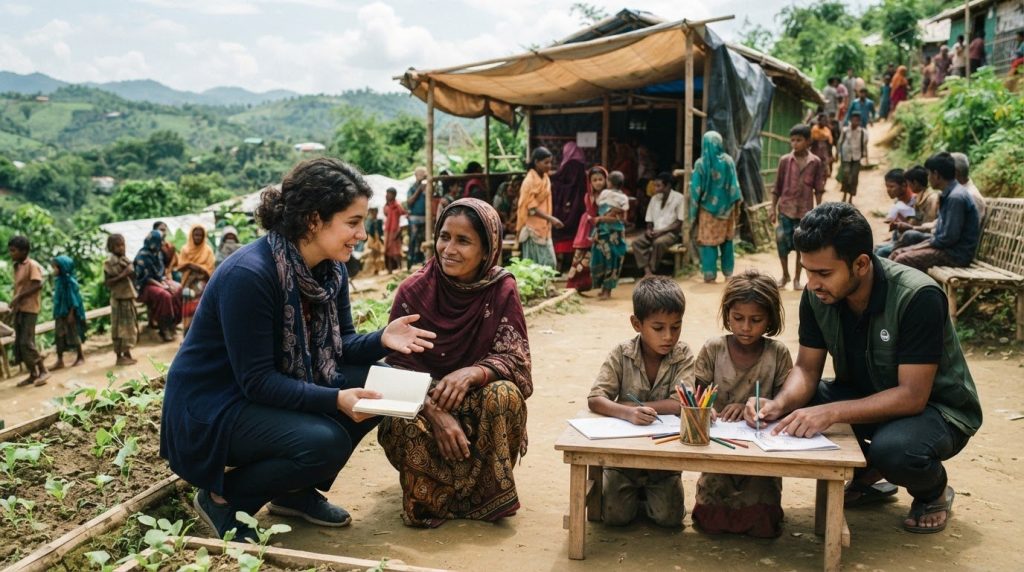
What if charitable action could meet an urgent need while also helping a community build towards a more secure future? If you’re wondering how to make a meaningful difference with charity, it’s understandable to want confidence that your contribution will be useful, respectful and shaped around people’s priorities. Giving matters, but so can sharing time, attention and support over the longer term.
This article explores how thoughtful charitable action can respond to immediate needs and strengthen community-led work in education, cultural connection and advocacy. You’ll find practical ways to contribute, whether through voluntary donations, staying informed or getting involved in your community.
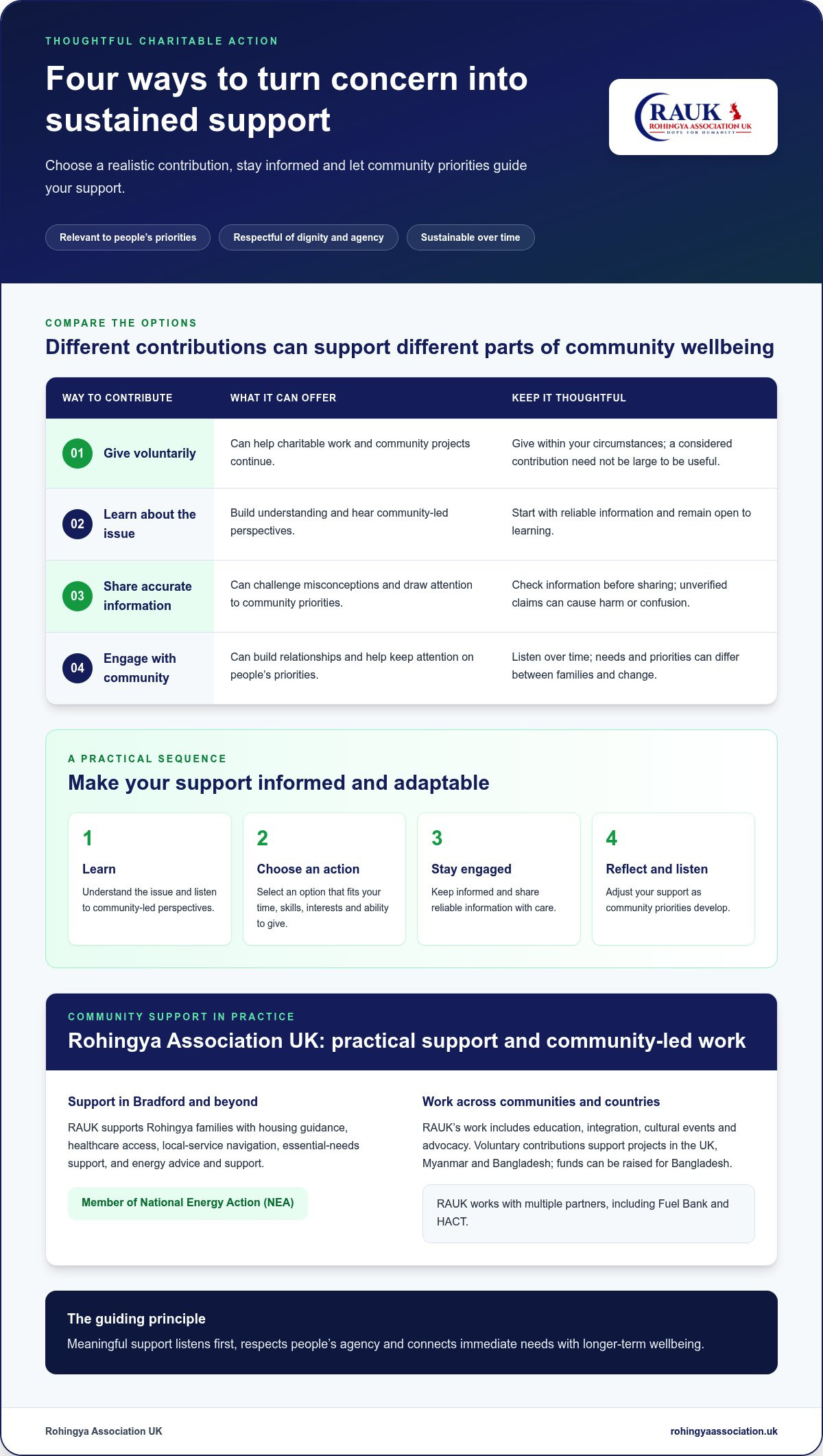
Rohingya Association UK (RAUK) supports Rohingya families in Bradford and beyond with housing guidance, healthcare access, local-service navigation, essential needs support, and energy advice and support. RAUK is a member of National Energy Action (NEA). Its work also includes education, integration, cultural events and advocacy. Voluntary contributions support projects in the UK, Myanmar and Bangladesh. Together, these efforts offer a grounded starting point for action that respects people’s agency and helps sustain hope.
Key Takeaways
- Learn how to make a meaningful difference with charity by aligning your support with people’s priorities, dignity and long-term wellbeing.
- Turn concern into sustained action: learn about the issue, choose a realistic way to help, stay engaged and listen to community perspectives.
- Look for clear information about a charity’s purpose, community involvement and the work your support can contribute to.
- Support Rohingya families through practical assistance, integration, youth education, cultural connection and advocacy.
- Understand how practical support, education and cultural preservation can work together to strengthen community-led efforts.
What does it mean to make a meaningful difference with charity?
To make a meaningful difference with charity is to offer support that responds to people’s expressed priorities, protects their dignity and contributes to their wellbeing over time. The value of an action isn’t determined solely by its size. It depends on whether it is relevant, respectful and connected to what people say they need.
Support can take several forms. Voluntary giving can help charitable work continue; learning about an issue can deepen understanding; sharing accurate information can challenge misconceptions; and community engagement can build relationships and keep attention on people’s priorities. You don’t need to do everything. A realistic contribution made thoughtfully can be more useful than a grand promise that isn’t sustained.
Some charitable work responds to immediate practical needs, while other activities support longer-term wellbeing through education, integration, cultural preservation and advocacy. These strands can complement one another. Practical assistance can help with a present difficulty; education can support future choices, while cultural connection and advocacy help communities maintain identity and make their priorities heard. Meaningful support recognises both urgent needs and people’s hopes for the future.
Meaningful support begins with listening to community priorities
Good intentions aren’t a substitute for listening. Needs can differ between families and change over time, so support based on assumptions may miss what matters most. Paying attention to community perspectives helps direct effort towards relevant priorities, whether they relate to access, learning, connection or representation.
This approach recognises people’s agency, skills and cultural identity. Community-led work is a partnership, not a one-way act of rescue. People affected by an issue are participants in shaping responses, not simply recipients of help. Respect means making room for their knowledge, choices and leadership.
Why consistent charitable action matters
Steady attention can connect immediate assistance with longer-term efforts. You might begin by learning about an issue, then share reliable information, take part in community engagement or make voluntary contributions when you’re able. Each action can support a different part of community wellbeing; none should be presented as a complete solution.
Consistency also means staying open to what communities communicate, rather than assuming one response will suit everyone. For practical examples of community-focused support, read about community support for displaced families.
Evidence and careful judgement can help you consider where your effort may be useful. The idea of Effective Altruism explores how evidence and reason can inform decisions about benefiting others. It can prompt worthwhile questions, but no single measure captures dignity, cultural connection or community agency in full.
Impact shouldn’t be confused with visibility. A public campaign or striking headline figure may draw attention, but neither alone shows whether support reflects people’s priorities or contributes to their wellbeing. Treat unverified numbers with caution, look for clear descriptions of the work, and value listening, accountability and sustained engagement alongside measurable results.
How to turn charitable concern into practical, sustained action
Concern becomes useful action when it leads to informed choices and a commitment you can maintain. This simple sequence can help you decide where to begin, without expecting one person to solve complex challenges or make promises that aren’t realistic.
- Learn. Take time to understand the issue and listen to community-led perspectives. You don’t need to know everything before getting involved. Start with reliable information and remain open to learning.
- Choose an action. Consider what you can offer, whether that’s a voluntary contribution, joining a network, receiving updates or connecting online. Choose an option that fits your circumstances.
- Stay engaged. Keep informed about the work and share accurate information thoughtfully. Advocacy can draw attention to community priorities, but repeating an unverified claim may cause harm or confusion.
- Reflect and listen. Pay attention to what the community communicates over time. Be willing to adjust your support as priorities develop, rather than assuming one action will always be the right one.
Choose a form of support that fits your capacity
Before committing, think about your available time, skills, interests and ability to give voluntarily. You might follow updates, share a verified appeal or contribute to charitable projects. These are different ways to participate, not a test of how much you care. A considered action you can sustain is more dependable than an ambitious commitment you can’t fulfil.
RAUK provides support in Bradford and beyond, including energy advice and support. RAUK work in partnerhip with many organisation, and is a member of National Energy Action (NEA). If you’re exploring how to make a meaningful difference with charity, these details offer a concrete starting point for learning about community support. You don’t need to take the same route as every other supporter.
Build a habit of informed engagement
Follow community-led updates before sharing a call to action, especially if it includes a statistic, a personal story or an urgent claim. Check that the information comes from a reliable source, preserve its context and avoid presenting speculation as fact. You can contribute to respectful advocacy by sharing verified information and making space for community voices.
Learning can continue as you participate; you don’t need complete expertise before taking a thoughtful first step. For more context on education and youth-focused work, explore refugee youth empowerment programmes. To follow RAUK’s community-led work, you can connect with Rohingya Association UK, receive updates or make a voluntary contribution towards projects in the UK, Myanmar and Bangladesh.
How to support a charity thoughtfully and respectfully
Support doesn’t have to be large to be worthwhile, and no contribution should be treated as a guaranteed route to a particular result. A voluntary gift, careful sharing of information or sustained attention may each support charitable work in different ways. To make an informed choice, look at the organisation’s purpose, how it involves the community and what its work focuses on.
Responsible charitable support is informed, respectful and accountable action, guided by community priorities rather than assumptions.
Before deciding how to contribute, look for information that helps you understand:
- Purpose: What issue does the charity work on, and what is it trying to support?
- Community involvement: How are the people affected included in shaping or informing the work?
- Use of support: What activities or projects will voluntary contributions, time or public attention help sustain?
- Communication: Does the organisation share clear updates about its work without presenting uncertain results as fact?
These questions aren’t a demand for a single measure of success. They help you make a considered choice and understand the context behind the work. When thinking about how to make a meaningful difference with charity, avoid judging impact by the size of a gift, a dramatic headline or a claim that can’t be checked.
What does respectful support look like?
Respectful communication recognises people’s rights, identities, capabilities and choices. It doesn’t reduce a community to hardship or portray people as passive recipients of help. If you share a personal story, photograph or other identifying detail, make sure the person concerned has given informed consent for that specific use. A story shared in one context isn’t automatically permission to publish it elsewhere.
Avoid pity-led imagery, stereotypes and language that presents a whole community as a statistic. Advocacy can describe serious conditions clearly while also recognising people’s knowledge, relationships and ambitions.
How can a supporter stay informed without making assumptions?
Use community-led updates and information with a clear source. Separate confirmed facts from interpretation, particularly when discussing displacement or advocacy. If a figure is relevant, retain its wording and date, and don’t imply it describes more than it does. If you can’t establish where a claim came from, pause before sharing it.
Staying informed doesn’t mean having all the answers. It means being willing to learn, correct a misunderstanding and listen when people describe their own priorities. These habits help keep support grounded in respect, rather than turning someone else’s experience into a story for a supporter’s visibility.
Ways to make a difference for Rohingya families in the UK and beyond
Support for Rohingya families can take several connected forms, from practical assistance and education to cultural connection and public advocacy. Rohingya Association UK (RAUK) provides support in Bradford and beyond. The overview below connects its areas of work with practical ways to engage as a supporter.
RAUK’s energy advice and support sits alongside its wider community work. RAUK work in partnerhip with many organisation, and is a member of National Energy Action (NEA). These details show how practical support and community engagement sit within a broader response.
Support safety, education and integration in everyday life
Integration can involve navigating unfamiliar services and daily systems. RAUK’s practical support includes housing guidance, healthcare access, help with essential needs and local-service navigation. Families’ priorities vary, so these forms of support are not the same for everyone.
Education and youth empowerment can help young people develop knowledge, confidence and skills. RAUK’s work includes tutoring, English language classes, skills-development programmes and leadership activities for Rohingya youth. Together, practical assistance and learning can contribute to safety, participation and a stronger sense of belonging.
Strengthen cultural connection and public awareness
Cultural and community gatherings create space to share heritage, strengthen relationships and preserve Rohingya identity across generations. They also give supporters an opportunity to engage with the community beyond a crisis-centred narrative. Advocacy and awareness campaigns, in turn, help bring attention to human-rights protection and justice. For broader context, explore justice for Rohingya people.
Meaningful support isn’t limited to a single form of action. You can connect with Rohingya Association UK online, join its network, receive updates or make a voluntary contribution towards projects in the UK, Myanmar and Bangladesh. Choose an option that fits your circumstances and keeps community priorities at the centre.
How Rohingya Association UK turns community support into hope
Rohingya Association UK (RAUK) is a community-led registered charity supporting Rohingya refugees and families in the UK and beyond. Its work brings practical support, education, cultural connection and advocacy together, empowering families to rebuild their lives with dignity. These strands are connected: immediate support can help address present concerns, while learning, integration and cultural preservation contribute to a stronger foundation for the future.
That community-led approach matters. Rohingya families aren’t defined by displacement or the challenges they face. Their knowledge, choices, relationships and cultural identity are part of the work’s starting point. For anyone considering how to make a meaningful difference with charity, RAUK offers an example of support grounded in community and spanning different areas of wellbeing.
A community-led approach to practical support
Community Support & Integration and Education & Youth Empowerment are central to RAUK’s work. Practical support and energy advice help people navigate aspects of daily life, while education and youth-focused activities support learning and development. These areas are connected: security, opportunity and belonging can reinforce one another.
Cultural and community events also strengthen relationships and preserve heritage. For Rohingya families, maintaining cultural identity can be an important part of belonging and continuity across generations. Shared gatherings create opportunities for connection and participation, alongside the organisation’s wider work in advocacy and awareness.
RAUK’s energy advice and support forms part of its practical work. RAUK work in partnerhip with many organisation, and is a member of National Energy Action (NEA). This work sits within a wider response to community needs, rather than treating them as a single issue with one solution.
Choose your next step with Rohingya Association UK
There’s no single way to take part. You could join RAUK’s network, receive email updates or connect online to keep informed about its work. Staying engaged can help you understand how community priorities and activities develop, and gives you a way to continue learning beyond a single appeal or moment of attention.
Voluntary contributions are another option. RAUK accepts them for projects in the UK, Myanmar and Bangladesh. A donation isn’t a promise of a particular outcome; it’s a way to support the organisation’s work across the projects it undertakes. Choose an approach that fits your circumstances and keeps the focus on shared effort, respect and community priorities.
Practical assistance, education, cultural connection and advocacy each have a place in supporting Rohingya families. Together, they help sustain hope through ongoing work and community agency. Join RAUK’s network, follow its updates or donate now to take a considered next step.
Let your next step grow into lasting commitment
Making a difference doesn’t require a perfect plan or a promise to do everything. Choose one action that feels manageable, then remain open to learning and responding as community priorities evolve. Steady attention can help keep charitable support connected to people, rather than to a passing moment of concern.
If you’re considering how to make a meaningful difference with charity, let your values guide a practical next step. You might follow community updates, join a network or make a voluntary contribution. What matters is acting with care and allowing your support to be part of a wider, community-led effort.
Rohingya Association UK offers a way to stay connected with work supporting Rohingya families. Donate or connect with Rohingya Association UK in the way that feels right for you. A considered step can help sustain attention, solidarity and hope for the road ahead.
Frequently Asked Questions
Can a small charitable donation make a meaningful difference?
Yes, a small voluntary donation can support a charity’s work, although its specific effect depends on the project and how the organisation uses contributions. There’s no need to judge generosity by the size of a gift. If you’re considering how to make a meaningful difference with charity, you could also read a charity’s updates to understand its priorities and share reliable information with others.
What are practical ways to support a charity beyond donating?
You can learn about the community’s priorities, join an organisation’s network, receive email updates or connect online. For example, you might share a clearly sourced update with friends, while being careful not to present yourself as speaking for people whose experiences aren’t your own. Choose an action that fits your capacity and can be sustained. It can complement voluntary giving and keep community-led work in view.
How can I help Rohingya refugees in the UK?
You can learn about Rohingya-led priorities, follow community updates and make a voluntary contribution to support the charity’s work. RAUK’s activities include housing guidance, healthcare access, support with essential needs and local-service navigation, alongside education, cultural events and advocacy. If you share information, check its source and context first. This helps raise awareness without turning individual experiences into generalisations about all Rohingya families.
Does Rohingya Association UK support people outside Bradford?
Yes. RAUK provides support in Bradford and beyond, with projects in the UK, Myanmar and Bangladesh. Its activities span community support, education and youth empowerment, cultural and community events, and advocacy campaigns. It also provides energy advice and support. These areas reflect the breadth of its work, while recognising that every activity won’t be relevant to every family or community.
How does charitable support help refugees rebuild their lives?
Charitable support can contribute to conditions that help people pursue safety, education and a sense of belonging. Guidance with local services can help someone understand practical options, while learning opportunities can support future plans and cultural activities can strengthen connection. Families’ circumstances and priorities differ, so no single contribution guarantees a particular result. Respectful support leaves room for people to make their own choices.
Can I donate to support Rohingya families in Bangladesh?
Yes. Rohingya Association UK accepts voluntary contributions for projects in the UK, Myanmar and Bangladesh. More than 1.2 million Rohingya refugees were living in Bangladesh as of August 2026. If you choose to contribute, use RAUK’s donation information to understand the available options, and don’t assume that a particular gift guarantees a specific outcome.