
An emergency relief fund for refugees can help bring support together when people face urgent needs. Before giving, it is reasonable to want to understand what an appeal is for, who it aims to support and how emergency assistance relates to longer-term community support.
For Rohingya families, needs vary across countries and circumstances. Humanitarian aid can address immediate pressures, while education, practical guidance and community connections can support people as they plan for the future. Effective support recognises that families have different priorities and that their knowledge should help shape the response.
Rohingya Association UK (RAUK) is a community-led registered charity based in Bradford, providing support in Bradford and beyond. Donations support aid projects in the UK, Myanmar and Bangladesh, and funds can be raised for Bangladesh. In the UK, RAUK provides energy advice and support, works in partnership with Fuel Bank and HACT, and is a member of National Energy Action (NEA). These are examples of UK support, distinct from relief work in Bangladesh.
This article explains what emergency relief can involve, how community-led support can connect urgent assistance with longer-term integration and opportunity, and how you can support Rohingya families through RAUK.
Key takeaways
- An emergency relief fund for refugees can pool support for urgent needs while respecting families’ dignity, priorities and ability to shape their futures.
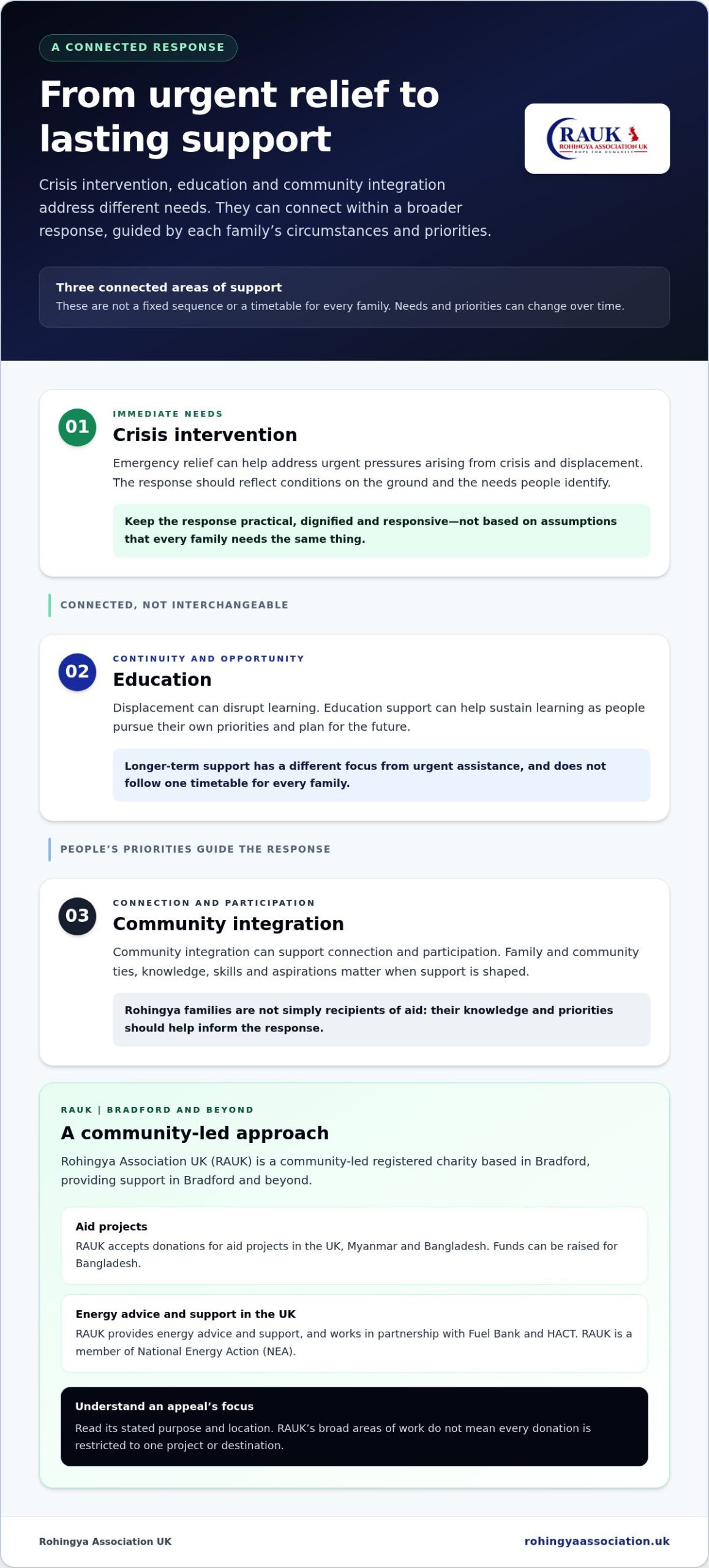
- Crisis intervention, education and community integration address different needs and can form part of a broader response.
- Before donating, identify the organisation, read the appeal’s stated purpose and check which community or location it names.
- RAUK’s charity registration number is 1211433. Use it to help verify the organisation’s identity.
- RAUK accepts donations for aid projects in the UK, Myanmar and Bangladesh. Read an appeal’s stated purpose to understand its focus.
Emergency relief fund for refugees: why urgent, dignified support matters
Displacement can disrupt daily life with little warning. An emergency relief fund for refugees pools charitable contributions so an organisation can respond to urgent needs, rather than leaving each family to manage alone. Depending on the circumstances, relief may involve practical assistance with essentials or safe shelter. The right response depends on conditions on the ground, so it should be guided by the needs people identify, not assumptions about what every family requires.
Rohingya people have experienced displacement from Myanmar, and families’ circumstances differ across locations and over time. The term refugee provides wider context, while life in the Rohingya refugee camp offers a closer look at one setting. Neither account represents every person’s experience. Priorities can change as circumstances change, which is why relief needs to be responsive rather than based on a fixed picture of displacement.
What does an emergency relief fund for refugees do?
A relief fund gathers donations so an organisation can direct support towards urgent needs arising from crisis and displacement. Its purpose is practical: to help address immediate pressures while paying attention to safety, dignity and the choices of people affected. Needs vary between families and may shift over time. Listening to people and understanding their priorities helps make assistance relevant instead of imposed.
Why Rohingya families need support beyond a single emergency
Displacement can disrupt family routines, education and community connections. Those effects do not necessarily end when an immediate crisis eases. Rohingya families are not simply recipients of aid: they bring knowledge, relationships, skills and aspirations that should inform how support is shaped. Respecting their agency means making space for people to express their priorities and, wherever circumstances allow, take part in decisions that affect their lives.
Immediate crisis support can help meet urgent needs; rebuilding stability is wider, longer-term work. Relief may be essential at a moment of acute pressure, while wellbeing can also depend on continuity: opportunities to learn, maintain family and community ties, and pursue personal goals as circumstances permit. These needs are connected but not interchangeable. A fund’s purpose should explain what kind of support it aims to advance, without implying that one donation or intervention can resolve every challenge.
For donors, this distinction offers a practical way to consider impact. Urgent assistance can help people through immediate hardship, while sustained, respectful support recognises their capacity to shape what follows. Dignified relief is not only about what is provided. It also depends on whether the response takes people’s circumstances and priorities seriously.
How a refugee relief fund connects urgent aid with lasting support
People affected by displacement can face very different circumstances. Crisis intervention addresses urgent pressures, while education and community integration relate to needs that continue over time. These forms of support are connected, but they are not the same, and there is no single timetable that fits every family. An emergency relief fund for refugees can be part of this broader response when its purpose is clear and support responds to the people it is intended to serve.
This connection helps explain why humanitarian aid and longer-term community work can sit within the same charitable mission. Immediate help may address an acute need. Education and integration can support people as they pursue their own priorities and strengthen connections in their communities. Neither should be presented as a guaranteed result of an individual gift.
Immediate response and longer-term stability
Time-sensitive needs call for a response suited to the circumstances. Continuing support has a different focus: education can sustain learning, while community integration can create opportunities for participation and connection. These areas can overlap, but they do not have to follow a fixed sequence. A family’s circumstances and priorities should guide how support is considered over time.
Urgent assistance and longer-term community support are complementary. One responds to immediate pressures; the other can help sustain opportunity and belonging as circumstances evolve. A clear explanation of a fund’s aims helps donors understand this relationship without suggesting that emergency relief alone can resolve the wider effects of displacement.
How donation purpose should be explained
RAUK accepts donations for aid projects in the UK, Myanmar and Bangladesh. Its stated areas of support include crisis intervention, education and community integration. Funds can be raised for Bangladesh as part of this wider aid work. This describes the broad scope of RAUK’s work; it does not mean every donation is restricted to one project or destination.
Plain language helps donors understand an appeal. It should describe the organisation’s work and the communities it aims to support without promising a specific result that cannot be assured. If an appeal names a project or location, that information clarifies its focus. Do not assume all donations are directed in the same way: read the stated purpose and distinguish a named appeal from broader support for aid projects.
To learn how these areas fit within a community-led organisation, visit RAUK’s community work. Understanding the stated purpose can help you choose how to give and see how timely responses relate to the wider work that supports families’ choices and aspirations.
How to assess an emergency relief fund for refugees with care
Choosing where to give can be difficult when an appeal describes urgent need but gives little detail about its purpose. A careful assessment does not require you to resolve every uncertainty. It helps you distinguish a clear, grounded appeal from one that relies on urgency alone. When considering an emergency relief fund for refugees, look at the organisation, purpose, intended communities and information available to support its claims.
What a clear and credible appeal should explain
A useful appeal makes its purpose understandable and identifies the people or communities it aims to support. Its claims should be specific enough to interpret and consistent with the information provided. Emotional imagery can convey the seriousness of a crisis, but urgency or powerful storytelling alone does not explain how a fund works or what it can achieve.
- Identify the organisation. Look for its full name and a clear way to distinguish it from other groups. Rohingya Association UK (RAUK) is a registered charity, number 1211433. The number helps identify the organisation, but does not by itself show the impact of a particular appeal.
- Understand the purpose. Check what kind of support the appeal is intended to advance. Distinguish a broad charitable purpose from a named project or stated restriction. Do not assume every donation is allocated in the same way.
- Look for the intended communities. Check who the appeal aims to support and, where relevant, which location or circumstances it addresses. This helps you decide whether the focus matches the cause you want to support.
- Review published information. Read the organisation’s current material to understand its work and any evidence it shares. Check that figures and claims have enough context to explain what they describe.
How to understand evidence without expecting simple answers
Humanitarian work involves changing circumstances and interconnected needs, so results may take time and may not be captured by a single outcome. A description of activities, such as what a programme sets out to do, is different from a verified claim about its effects. Both can be informative, but they answer different questions and should not be treated as equivalent.
This distinction matters when an appeal includes a goal or projection. A goal describes an intended direction; it is not a completed result. A clear explanation helps readers distinguish goals and estimates from verified facts, rather than presenting future aims as established outcomes.
It is reasonable to want to know what a donation supports, especially when immediate results are not visible. In complex relief work, the absence of a simple, instant measure does not automatically mean support has no value. Look for a clear description of purpose and current published information. Avoid relying on unverified figures or expecting every contribution to produce a separately traceable result.
Read with care, not cynicism. Ask what the appeal says, whom it serves and what information supports its claims. This can help you make a considered choice while recognising that meaningful humanitarian work may not fit into a single statistic.
How RAUK supports refugees in Bradford and beyond
Rohingya Association UK (RAUK) is a community-led registered charity based in Bradford, providing support in Bradford and beyond. Its work connects practical help for refugees, families and young people with opportunities for learning and community participation. This local work is one part of RAUK’s support. Its aid projects also reach beyond the UK, including Myanmar and Bangladesh.
Community-led support rooted in Bradford
For families settling into unfamiliar circumstances, everyday guidance can be valuable. RAUK provides housing guidance and supports access to healthcare, alongside education, English language classes and skills development. These areas respond to different needs: practical information can help people navigate services, while learning and skills development support their goals and participation in community life.
Community-led support recognises that families bring knowledge, experience and aspirations of their own. Listening to people’s priorities helps make assistance more relevant and respectful, rather than treating every family as though it needs the same response. RAUK’s support for displaced families connects practical guidance with the longer work of building a sense of belonging.
Energy advice and partnership work
RAUK provides energy advice and support in the UK. It works in partnership with Fuel Bank and HACT, and is a member of National Energy Action (NEA). These are examples of its UK-based support and partnerships. They are distinct from aid projects in Myanmar and Bangladesh, which address different settings and needs.
This distinction matters when considering an emergency relief fund for refugees. A charity may work across several places, but local support and overseas aid are not the same programme or response. Clear descriptions help donors understand the context of the work, without assuming that a UK partnership delivers assistance overseas or that international aid covers local needs.
RAUK’s community-led work supports refugees and their families while recognising that circumstances vary between communities and locations. Donations support aid projects in the UK, Myanmar and Bangladesh, and funds can be raised for Bangladesh. The purpose and setting of each appeal help explain what kind of support it relates to.
To explore this work, discover RAUK’s community support and learn more about its local-to-global approach.
How to support emergency relief for Rohingya refugees
Thoughtful giving begins with understanding what you want to support and what an appeal says it will do. Start by choosing a cause, reading the stated purpose and using the charity’s donation route. This helps you make a decision based on the information available, rather than urgency alone.
Choosing a way to contribute
Financial giving is one way to support humanitarian work. Learning about Rohingya communities and sharing accurate information responsibly can also help build awareness. Whatever form your support takes, respect people’s dignity and agency. Describe their circumstances carefully, avoid reducing individuals to their experiences of displacement, and do not share claims you cannot verify.
Before giving, read the donation information on this website to understand the stated purpose, then follow the donation route provided. A donation supports charitable work, but should not be treated as a guarantee that a particular item, service or individual outcome will result. Keeping this distinction clear helps align expectations with the nature of community and humanitarian support.
Taking the next step with RAUK
Rohingya Association UK (RAUK) accepts donations for aid projects in the UK, Myanmar and Bangladesh. Its work includes crisis intervention, education and community integration, recognising that families can have different needs and priorities. Funds can be raised for Bangladesh as part of this wider aid work, distinct from support for projects in the UK.
To make a considered contribution:
- Choose the cause or community you want to support, and note the location and purpose described in the appeal.
- Read the stated information about the work, distinguishing its aims from verified results or promises about what one gift will achieve.
- Use the donation route presented on RAUK’s website, and keep your expectations consistent with the stated purpose.
These steps connect generosity with informed choice and keep the focus on support shaped by the realities and priorities of Rohingya communities. Thoughtful giving can express solidarity and contribute to sustained community-led work, without claiming that any one gift can resolve the wider challenges people face.
Support Rohingya communities through RAUK’s community-led work and give with care, respect and a commitment to lasting support.
Let solidarity become sustained support
Thoughtful giving does not need to be driven by a single urgent appeal. It can begin with a considered choice and continue through a willingness to listen, learn and stand alongside communities as their priorities evolve. This approach recognises Rohingya families not only in moments of crisis, but also as people shaping their own futures.
An emergency relief fund for refugees can be one way to contribute when its purpose matches the kind of support you want to advance. Follow the charity’s stated donation route, share information responsibly and keep the focus on dignity rather than promises of instant change. Acts of solidarity can form part of a wider commitment to justice, belonging and opportunity.
Support Rohingya communities through RAUK and help sustain community-led work that respects the people and aspirations at its heart.
When support is guided by care and shared purpose, it can help make room for a more hopeful future.
Frequently Asked Questions
What is an emergency relief fund for refugees?
An emergency relief fund for refugees pools charitable contributions to help address urgent needs arising from crisis and displacement. Its priorities can change as conditions and community views evolve, so look for a clear explanation of its purpose rather than assuming every fund works alike. For Rohingya families, emergency assistance can sit alongside education and community integration, with support shaped around people’s dignity, choices and circumstances.
Can donations support refugees outside the UK?
Yes. RAUK accepts donations for aid projects both within and outside the UK, including projects in Myanmar and Bangladesh. The destination and purpose can differ between appeals, so read the stated information before giving. Do not assume a general donation is restricted to one place. If a particular location matters to your decision, look for an appeal that clearly states its focus.
How can I check whether a refugee charity is registered?
Search the relevant official public charity register using the organisation’s name or charity number, then compare the listing with the charity’s own information. RAUK’s registered charity number is 1211433. Registration helps identify the organisation, but does not explain how a specific appeal is intended to be used. Read the appeal details separately to understand its purpose and intended community.
Does an emergency donation only help during the immediate crisis?
Not necessarily. Some charitable work addresses immediate pressures, while other support focuses on learning, connection and participation over time. RAUK’s work includes crisis intervention, education and community integration. These are different areas of support, not a guaranteed sequence or outcome for every donor. Read the appeal’s stated purpose to understand what it aims to support, and do not assume one gift will deliver a particular long-term result.
Can I support refugees without making a financial donation?
Yes. You can learn about Rohingya communities, share reliable information and support responsible advocacy. RAUK conducts awareness and human rights advocacy work. When discussing displacement publicly, use current, trustworthy information and represent people as individuals and communities with agency. Avoid sharing unverified claims or images that reduce families to their experience of crisis. Accurate, respectful awareness can foster understanding without speaking over the people concerned.
What does RAUK do for refugees in Bradford?
RAUK is a community-led charity based in Bradford, supporting people in Bradford and beyond. Its practical work includes housing guidance and support accessing healthcare, alongside education, English language classes and skills development. RAUK also provides energy advice and support. Its wider community work includes cultural and Islamic events that help preserve Rohingya heritage and strengthen bonds among displaced families.