
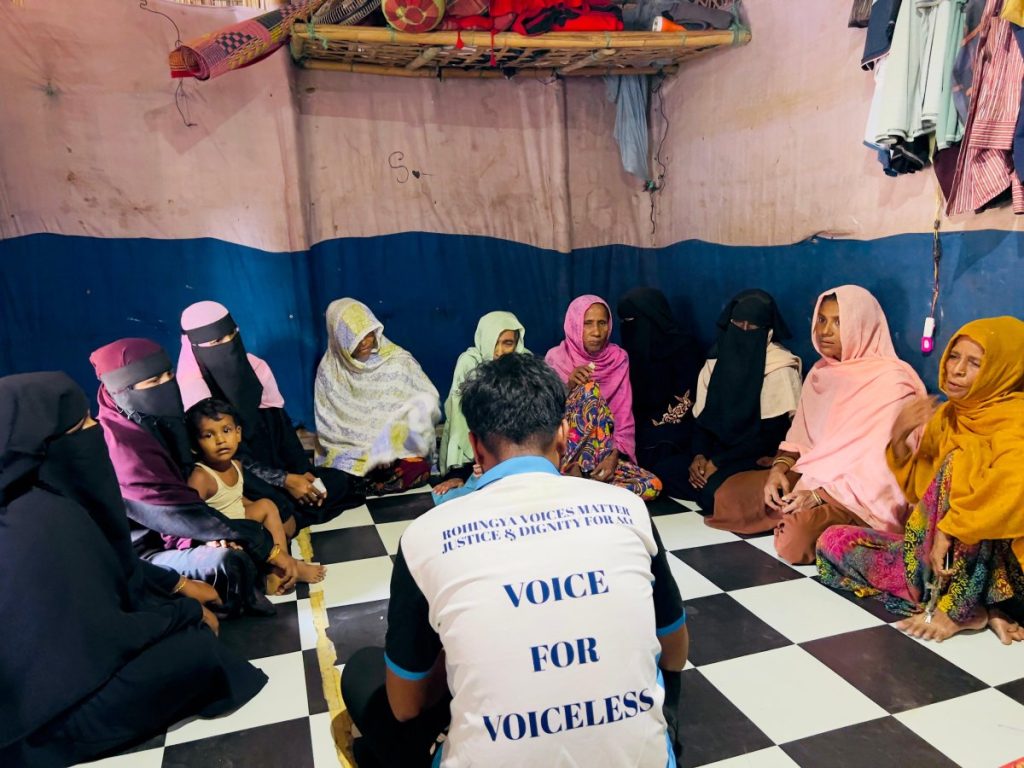
What would it take to create a future in which Rohingya people can live safely, with their rights protected and their choices respected? The long-term solutions for the Rohingya crisis cannot rest on emergency aid alone. They depend on protection, meaningful choices and sustained support, shaped around the dignity and agency of Rohingya people themselves.
A prolonged crisis can feel beyond an individual’s influence. Immediate needs are visible, but routes to lasting safety can seem less clear. This article explores how different pathways, including safe and voluntary return when conditions allow, protection elsewhere and stronger community support, can contribute to durable solutions. Each must be grounded in rights, accountability and the voices of Rohingya people.
Everyday support matters, too. Rohingya Association UK provides support in Bradford and beyond, including energy advice and support. RAUK works in partnership with Fuel Bank and HACT, and is a member of National Energy Action (NEA). Alongside community-led advocacy, this practical work shows how local support can uphold dignity whilst international efforts address protection and justice.
Key takeaways
- Understand why long-term solutions for the Rohingya crisis must protect safety, rights and dignity, not simply meet immediate needs.
- Learn how voluntary return, inclusion where people are displaced and resettlement each depend on different conditions and meaningful choice.
- Identify how governments, international bodies and communities can share responsibility for protection, essential support and accountability.
- See how community-led education, practical assistance and advocacy can strengthen dignity and connection without resolving the crisis alone.
Why long-term solutions for the Rohingya crisis must begin with safety and dignity
Emergency assistance helps meet immediate needs such as food, shelter, healthcare and protection during danger. Durable solutions ask what must change so people can live safely, exercise their rights and make informed choices about their future. Relief can help people endure displacement; lasting protection and opportunity can help them rebuild their lives.
Meeting urgent needs is essential, but it doesn’t by itself change the conditions that prevent people from planning ahead. The long-term solutions for the Rohingya crisis must therefore be understood as a continuing process, not a deadline or a single outcome imposed on everyone.
What does a durable solution mean for displaced people?
A durable solution enables displaced people to rebuild their lives in safety and with dignity. It isn’t one fixed destination. The process should uphold rights, agency and stability, while recognising that individuals and families may have different priorities, relationships and needs.
Progress should be shaped with the people affected, not simply decided for them. Circumstances can change over time, so people need accessible information and a genuine opportunity to express their preferences without pressure. Safety, dignity and informed choice should guide decisions at every stage.
Why the Rohingya crisis needs a long-term perspective
Rohingya displacement is connected to longstanding persecution and statelessness in Myanmar. The history is complex, but its consequences are immediate: insecurity and the loss of a secure place to call home can make it difficult to plan for education, work and family life. The Rohingya genocide provides further background on persecution and violence against Rohingya people.
Many Rohingya refugees live in Bangladesh, where humanitarian assistance remains vital. Yet aid alone cannot secure lasting safety, rights or meaningful choices. Conditions must allow people to consider their futures without being pushed towards a pathway that cannot protect them. The guide to life in a Rohingya refugee camp offers further context on displacement and daily realities.
A long-term perspective avoids treating displacement as if it had one simple answer. Return, inclusion where people have sought refuge and resettlement elsewhere depend on circumstances that can differ between people and change over time. The central test is whether a pathway can uphold safety, rights and personal choice, not whether it is convenient for institutions. These principles provide a foundation for considering what durable solutions require.
How can long-term Rohingya crisis solutions take root?
Durable solutions need more than plans for where people might live. They depend on conditions that let Rohingya people make informed decisions, access essential services and take part in shaping what happens next. Safety, rights, choice, services and accountability must reinforce one another. If one is missing, a proposed pathway may offer little lasting security.
Humanitarian assistance remains essential, but it meets immediate needs rather than changing every condition that drives displacement. Food distribution or temporary shelter can help people through a difficult period. Longer-term progress also requires safeguards and opportunities that allow people to plan their lives. Humanitarian aid can help people survive displacement; protection and agency help them shape what comes after it.
Protection, rights and meaningful choice
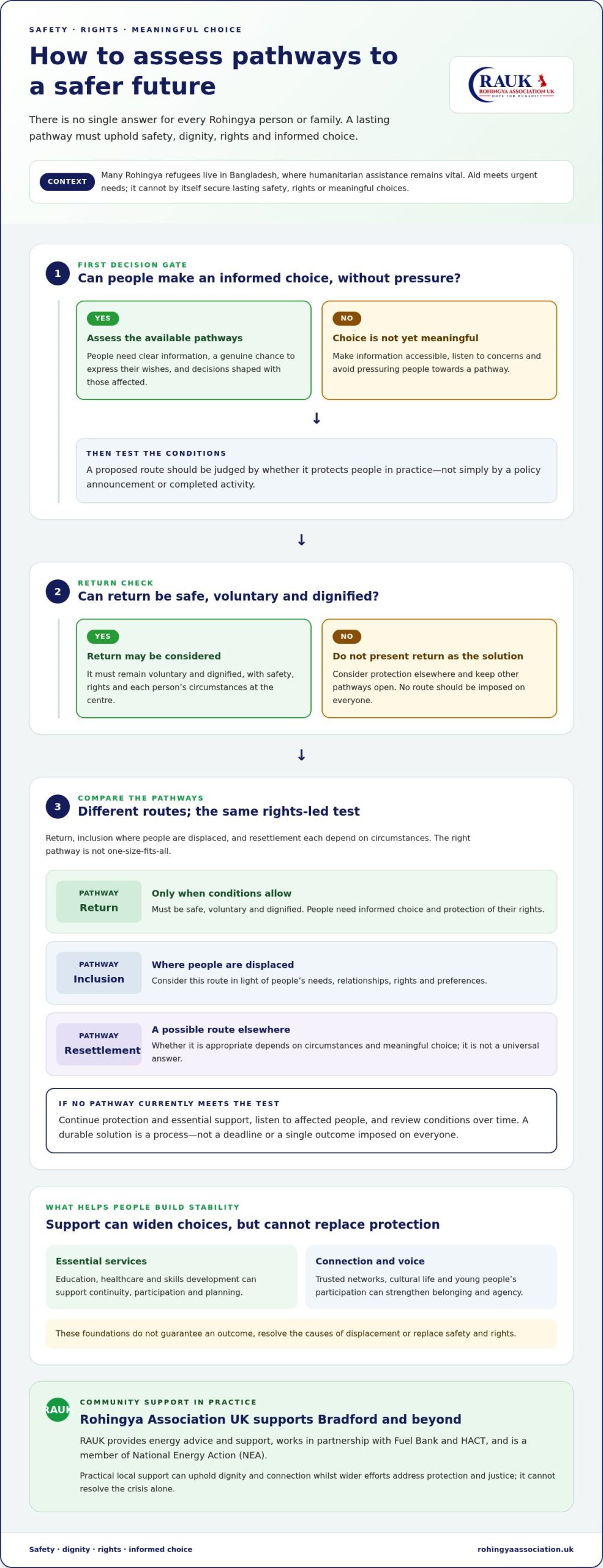
Any proposed future must be considered in light of each person’s circumstances, rather than treated as a decision for an entire community to accept. Return should not be promoted as a solution unless it can be safe, voluntary and dignified. People need clear information about the options being discussed and a genuine opportunity to express their wishes without pressure. Priorities may differ, even within one family.
Accountable decision-making makes those choices meaningful. It involves listening to affected people, explaining how decisions are reached and responding when concerns arise. It also means reviewing whether protection and services work in practice, rather than treating a policy announcement or completed activity as proof that people are safe. Long-term solutions for the Rohingya crisis require ongoing attention to rights and lived experience.
The foundations of stability for families and young people
Families are better placed to consider the future when everyday essentials are within reach. Education can support learning and continuity; healthcare can help people address health needs; and skills development can strengthen participation in community and working life. Social connection matters too. Relationships, cultural life and trusted community networks can help people maintain a sense of belonging during prolonged uncertainty.
These foundations don’t guarantee a particular outcome, and they cannot replace protection or resolve the causes of displacement. They can, however, widen the choices available to people. For young people, being heard in decisions about education, skills and community life matters. Plans are more responsive when they reflect young people’s aspirations as well as adult priorities. Community-led refugee youth empowerment programmes offer one way to connect learning and participation with a stronger sense of agency.
In practice, progress can be assessed by asking whether people can access support, understand the decisions affecting them and raise concerns safely. These questions help distinguish a process that simply manages displacement from one that builds the conditions for a more secure future. Readers can learn about community-led support and advocacy as part of that wider effort.
Return, inclusion or resettlement: comparing pathways without a one-size-fits-all answer
There is no single route that can meet every Rohingya person’s needs. A pathway that feels possible for one family may not be safe or suitable for another, and circumstances can change. The long-term solutions for the Rohingya crisis must therefore preserve choice, respond to real conditions and avoid treating one outcome as the default for the whole community.
The comparison below sets out what each pathway may involve. These are distinct options, not competing answers to apply uniformly. Different pathways may be relevant to different people, and each requires safeguards and meaningful participation.
Voluntary return
Safety and rights: Must be protected in practice, with credible safeguards. Choice: Must be informed and freely made. Continuity and conditions: People need confidence in their safety, rights and ability to rebuild daily life after return.
Inclusion where displaced
Safety and rights: Requires reliable protection and fair access to services. Choice: People need a voice in decisions affecting their lives. Continuity and conditions: Education, healthcare, livelihoods and community participation can support stability over time.
Resettlement elsewhere
Safety and rights: A new place must offer protection and a basis for rebuilding. Choice: Individual circumstances and preferences matter. Continuity and conditions: Access to services and opportunities to establish community connections can aid adjustment; resettlement is not guaranteed or available to everyone.
When can voluntary return be a meaningful option?
Return can be meaningful only when it is voluntary, safe and dignified, not when people feel compelled by hardship or pressure. Credible safeguards and conditions that protect rights and allow people to rebuild are essential. Any assessment of present conditions must draw on current, reliable information. Without that, a return pathway should not be described as safe or ready.
People also need clear information and room to decide for themselves. One person’s stated intention to return should not be treated as agreement on behalf of a whole community, and decisions should not be rushed. Conditions and individual views may change, so protection and the ability to raise concerns remain important throughout the process.
What can inclusion and resettlement offer?
Inclusion where people are displaced means being able to participate in the host community and access services such as education and healthcare, while pursuing skills and livelihoods. Resettlement is another possible pathway for some people, but it depends on circumstances and cannot be assumed to be universal or guaranteed. Community support for displaced families can help sustain connection and provide practical assistance as people navigate uncertainty.
For any pathway, decision-makers should consider whether people can maintain family and community ties, continue learning and access essential support. These considerations don’t settle the question for everyone. They make comparisons more grounded in lived realities, while keeping safety, rights and personal choice at the centre.
How governments, institutions and communities can support lasting Rohingya solutions
Lasting progress depends on different actors working towards shared goals while respecting their distinct roles. Governments can shape policies and support protection; international bodies can coordinate humanitarian action and contribute to diplomatic engagement; civil society and community-led organisations can provide practical support, communicate concerns and keep public attention on the crisis. Rohingya people must be partners in this work, not treated solely as recipients of aid.
A useful framework connects immediate support with longer-term planning:
- Protect people. Prioritise safety and dignity in decisions affecting Rohingya people, and address protection concerns through appropriate channels.
- Listen to affected communities. Make consultation accessible and ongoing, so people can influence priorities rather than simply respond to plans already made.
- Sustain essential support. Maintain humanitarian assistance while strengthening access to education, healthcare, skills and community connection.
- Pursue rights and accountability. Support credible efforts to uphold rights and address serious abuses, alongside diplomatic engagement and practical protection.
- Review progress. Assess whether people can access support, raise concerns and participate in decisions; adapt action when it falls short.
Meaningful participation means Rohingya people can help set priorities, shape decisions and see how their views influence plans that affect their lives. Consultation should include people with different experiences, including families, young people and those whose voices are often overlooked. Clear communication and ways to raise concerns make participation more than a one-off meeting.
What international and national actors can contribute
National governments influence policy, protection and access to services within their areas of responsibility. International bodies can support coordination, humanitarian response and diplomatic engagement, while civil society organisations can provide assistance and draw attention to protection concerns. These roles complement one another; none removes the need for sustained action by relevant decision-makers. Community advocacy can also keep rights and accountability in public discussion, including through work on justice for Rohingya people.
Why community-led action belongs in long-term planning
Community knowledge can show whether support is accessible, culturally responsive and relevant to everyday needs. Local organisations may help connect families with education, skills development, practical assistance and social networks, while advocacy can bring community concerns into wider conversations. This work builds connection and can support stability, but it cannot replace protection, rights or international engagement.
The long-term solutions for the Rohingya crisis require accountability at every level. Institutions should explain decisions and review outcomes, while organisations delivering support should listen and adapt. Readers can support community-led work for Rohingya families as one part of a broader, sustained response.
How Rohingya Association UK supports dignity and community in Bradford and beyond
Long-term change also depends on whether people can find practical, relevant support as they build their lives. Rohingya Association UK is a community-led registered charity supporting Rohingya refugees, families and young people. Its work connects everyday assistance with education, cultural life and advocacy, recognising that community organisations can contribute to dignity and connection without resolving the crisis alone.
As a community-led organisation, RAUK brings knowledge of Rohingya experiences into its work. This perspective helps keep support attentive to people’s circumstances, while advocacy and awareness activities connect community concerns with wider conversations about rights and justice.
Practical support that helps families navigate daily life
Families may need help understanding housing options, accessing healthcare or finding a route into education. English language classes and skills development can also support participation and help people prepare for future opportunities. These forms of assistance address practical barriers that can make daily life harder to manage, while respecting each person’s priorities.
Support is most useful when it recognises how needs connect. For example, a parent seeking to engage with a child’s education may also be working to improve their own English or develop new skills. Linking practical guidance with learning can help families take informed steps at their own pace, without suggesting that one service can meet every need.
Community support and advocacy as part of a wider response
Cultural and Islamic community events create opportunities to share traditions, strengthen relationships and maintain a sense of belonging. For families living with displacement and uncertainty, these connections can affirm heritage and help younger generations stay connected to their community.
RAUK’s advocacy and awareness work brings attention to Rohingya experiences and concerns. It can contribute to public understanding, but it is not a substitute for protection, accountability or action by decision-makers. Community-led work is one part of a wider response, alongside sustained support and efforts to uphold rights.
Support for work connected with Rohingya communities in Bangladesh can also be part of that response, with funds raised for Bangladesh. Practical assistance, learning, cultural connection and advocacy each contribute in different ways. Their value lies in supporting people while broader efforts continue. Learn about RAUK’s community-led work and how it supports Rohingya communities.
Help sustain a future shaped by dignity
Lasting change is built through decisions and commitments that endure. Readers can stay informed, listen to Rohingya voices and support community-led work that strengthens connection and opportunity. These actions cannot replace the protection and accountability required from decision-makers, but they can help keep dignity and agency at the centre of public attention.
The long-term solutions for the Rohingya crisis will depend on choices made with affected people and sustained effort, not short-lived concern. Supporting that effort means recognising Rohingya people as active participants in shaping their futures, with knowledge, aspirations and the right to be heard.
Rohingya Association UK’s community-led work offers one way to support local needs while wider efforts continue. Learn about RAUK’s community-led work in Bradford and beyond, and donate to support its aid projects, including work in Bangladesh. Every contribution can reinforce a wider commitment to safety, dignity and hope.
Frequently Asked Questions
What are long-term solutions for the Rohingya crisis?
They are sustained efforts that help Rohingya people shape secure futures, rather than a single programme or fixed destination. In practice, progress should be judged by whether people can make informed decisions, maintain family and community ties, and plan for education and daily life. The long-term solutions for the Rohingya crisis must respond to changing circumstances, with people’s views informing how support and possible pathways are planned.
Is voluntary return a solution for Rohingya people?
Voluntary return can be one possible pathway, but only if a person chooses it freely and can return safely and with dignity. It should never be assumed to suit everyone or used to justify reducing protection for people elsewhere. Any proposed return should be considered in light of reliable, current information about safety and safeguards, as well as the views of the people affected.
Can Rohingya people build stable lives outside Myanmar?
Yes, people can work towards stability in places where they have found refuge, although opportunities depend on their circumstances and the protections and services available. Continuity in a child’s education, access to healthcare and the chance to develop useful skills can all support family life. Community ties can also reduce isolation. These steps can improve daily wellbeing, but they don’t replace the need to protect rights or address the causes of displacement.
Who is responsible for finding long-term solutions to the Rohingya crisis?
Responsibility is shared, but each actor has a different role. Governments influence policy and protection; international institutions can contribute to diplomacy and coordinated responses; humanitarian organisations help address urgent needs; and community groups can connect people with support and bring their perspectives into wider discussions. Rohingya people must be involved in decisions about their futures. The roles and commitments of institutions vary according to their responsibilities.
Why is humanitarian aid not enough to resolve the Rohingya crisis?
Humanitarian aid is essential for addressing immediate hardship, but it cannot by itself ensure that people can exercise their rights, make choices about their future or obtain lasting protection. A family may receive urgent assistance while still lacking a reliable way to plan for a child’s education. The immediate need matters, and so does the longer-term barrier. Relief and durable change work together; neither makes the other unnecessary.
How can people support long-term solutions for the Rohingya crisis?
People can start by checking claims before sharing them, following informed Rohingya voices and supporting community-led organisations over time. They can also raise awareness respectfully, focusing on rights and people’s agency rather than presenting one pathway as the answer for everyone. Practical help can make a difference to everyday circumstances, while sustained public attention can keep broader protection and accountability in view. Choose actions that respect people’s dignity and stated priorities.