
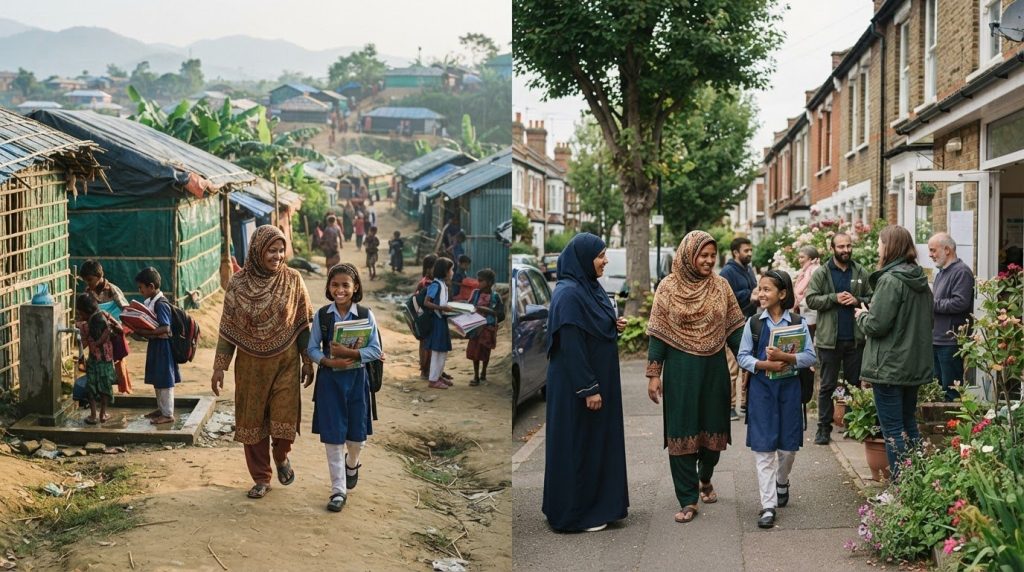
More than 1.2 million Rohingya refugees were living in Bangladesh as of August 2026. Yet the daily struggles of Rohingya refugees cannot be understood through numbers alone. Displacement affects ordinary routines, family life and future plans, and those experiences differ depending on where people are rebuilding their lives.
Accounts of crowded camps, disrupted education and uncertainty can be difficult to place in context. In Bangladesh, daily pressures are shaped by camp conditions and reliance on humanitarian assistance. In the UK, circumstances are different, but settling into a new community can bring its own challenges. Neither experience defines Rohingya people: their choices, skills, relationships and cultural identity matter, too.
This article looks at how displacement can affect everyday life in these settings, and how practical, community-led support can strengthen connection, inclusion and people’s ability to make choices. It also considers the roles of education, cultural belonging and advocacy. Rohingya Association UK supports people in Bradford and beyond, provides energy advice and support, works in partnership with Fuel Bank and HACT, and is a member of National Energy Action (NEA). Funds can also be raised for projects in Bangladesh.
Key Takeaways
- The daily struggles of Rohingya refugees vary with place and circumstance. No single account represents everyone.
- Displacement and uncertainty can affect family routines, access to education and healthcare, and social connection.
- Conditions in Bangladesh’s refugee camps differ from the challenges of settling in the UK. These contexts are not interchangeable.
- Trusted community ties, cultural belonging, practical guidance and education can help people make choices and participate in community life.
- Community-led support in Bradford and beyond can contribute to people’s wellbeing alongside wider humanitarian responses.
Daily struggles of Rohingya refugees: why everyday life differs
The daily struggles of Rohingya refugees can include practical, social and emotional pressures linked to displacement and rebuilding a life. What a person faces depends on their location, family circumstances and personal history. There is no single account that represents everyone.
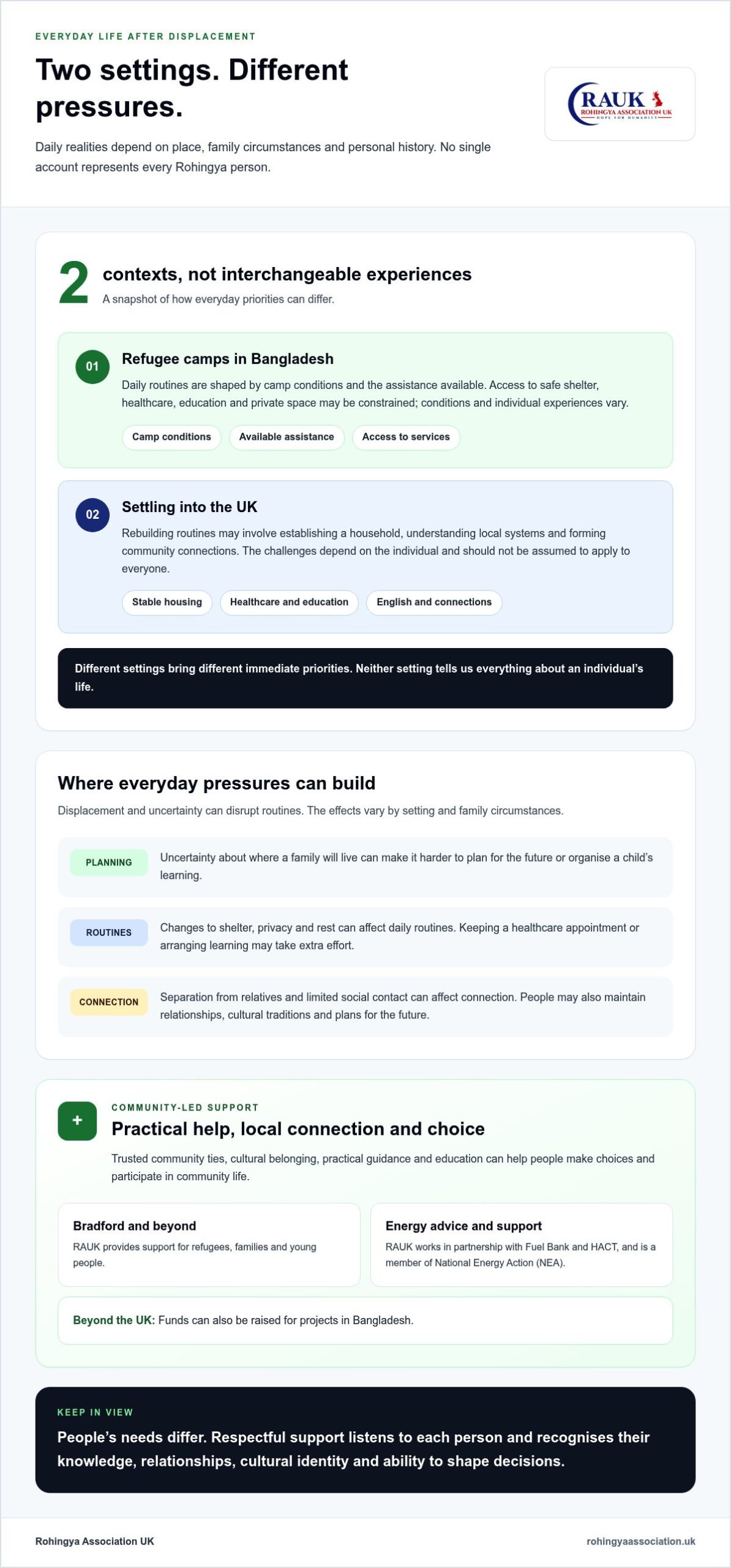
For people living in refugee camps in Bangladesh, daily life is shaped by camp conditions and the assistance available there. Rohingya people settling in the UK face a different context, which may involve establishing a household, learning how local services work and building connections in a new community. These experiences are not interchangeable, and neither setting tells us everything about an individual’s life.
The following CNN report shares one person’s account. It is a specific story, not a description of every Rohingya family’s experience.
Why displacement changes ordinary routines
When home and familiar surroundings are disrupted, everyday decisions can become harder. A family separated from relatives may have to make plans without knowing when they will meet again. Uncertainty about where they will live can also make it difficult to organise a child’s learning or plan for the future. These are possible effects, not universal experiences.
Access to safe housing, healthcare, education and work depends on where a person lives and their circumstances. In Bangladesh, camp conditions shape many aspects of daily life. In the UK, priorities may include settling into a home, understanding local systems and building social connections. For background on the Bangladesh context, see Rohingya refugees in Bangladesh.
One community, varied experiences
Age, health, family responsibilities, location and personal history all affect what support may be useful. A young person’s priorities may differ from those of a parent caring for children. Even two people in the same place may have different needs and goals. Not every Rohingya person lives in a camp, and people’s legal and social circumstances are not identical.
Recognising these differences also means looking beyond hardship. People maintain relationships and cultural traditions, support their families and communities, and make plans for the future. Respectful support starts by listening to what matters to each person and recognising their knowledge, resilience and ability to shape decisions.
How displacement and uncertainty affect daily life
Displacement can make ordinary routines harder to maintain. When a family does not know how long they will remain in a particular place, planning education, healthcare appointments, work or a move may become difficult. These pressures can build on one another. Uncertainty about shelter can affect privacy and rest, while disrupted learning or limited social contact can make it harder to establish a routine. The way these challenges arise depends on the setting and the family’s circumstances.
Challenges reported in refugee-camp settings
In camps in Bangladesh, daily routines take shape within the conditions and services available in each camp. Access to safe shelter, healthcare, education and private space may be constrained, although conditions and individual experiences vary. The International Rescue Committee’s overview of life in Cox’s Bazar describes challenges facing Rohingya refugees there. It provides context, not a universal account of every person’s experience.
When people have limited control over their surroundings or are uncertain about what comes next, even simple planning can become more complicated. For example, organising a child’s learning or keeping a healthcare appointment may take extra effort. For further context on camp life, read this guide to life in the Rohingya refugee camp.
Settlement pressures in the UK
For Rohingya people settling in the UK, pressures differ from those faced in Bangladesh’s camps. Establishing a household and rebuilding routines may involve finding stable housing, accessing healthcare, continuing education, learning English and forming community connections. Which challenges arise depends on the individual. They should not be assumed to apply to everyone or considered without recognising people’s goals and strengths.
Practical support can help people understand their options as they work towards stability and participation in community life. This may include guidance with everyday needs, opportunities to learn and spaces to maintain cultural connections. RAUK’s community support guide for displaced families explores how connected, community-led support can help families rebuild routines.
In Bradford and beyond, Rohingya Association UK supports refugees, families and young people through community-led work. Explore RAUK’s community support to learn how local support contributes alongside wider humanitarian responses.
Rohingya refugees in Bangladesh and the UK: what changes and what remains
Displacement does not create one shared daily experience. Life in a refugee camp in Bangladesh and settling into a community in the UK involve different circumstances, systems and immediate priorities. The comparison below offers broad context, not a template for every person. Conditions can change, so location-specific details should be considered in their current context.
| Context | Everyday priorities | Possible areas of support |
|---|---|---|
| Refugee-camp settings in Bangladesh | Finding safe shelter and accessing available services, while sustaining family connection, dignity and learning. | Humanitarian assistance and support shaped by conditions and services in the camp. |
| Settlement in the UK | Building household stability and local connections, with needs that may include housing, healthcare, education and energy. | Practical settlement guidance, community connection, learning and energy advice. |
Daily priorities in Bangladesh
Some Rohingya refugees live in camp settings, including in Cox’s Bazar, but people do not all live in the same place or face the same conditions. Daily routines may be influenced by shelter, available services and opportunities for learning. These factors should be described with care because circumstances can vary and change. For a focused overview, read this overview of Rohingya refugee camp life.
Daily priorities during UK settlement
In the UK, establishing stability may mean creating new routines, building local relationships and finding ways to take part in community life. Housing, healthcare, education and energy needs are useful areas to consider, not assumptions about every individual or family. Young people may also value opportunities to learn, develop skills and shape their futures. Explore this guide to refugee youth empowerment programmes.
The settings are not equivalent, but people in different circumstances may share aspirations for safety, family connection, dignity and the chance to learn. Those common themes should not obscure distinct needs or people’s own choices. In Bradford and beyond, Rohingya Association UK provides energy advice and support, works in partnership with Fuel Bank and HACT, and is a member of National Energy Action (NEA). This community-led work can contribute to stability in the UK alongside wider humanitarian support for Rohingya communities.
What helps Rohingya families navigate everyday pressures?
There is no single response to displacement. What helps depends on a person’s circumstances, priorities and plans. Useful support offers practical options while respecting people’s knowledge, choices and right to shape decisions affecting their lives. Community organisations can make a meaningful contribution, while wider humanitarian and public support also remains important.
Community connection can make practical support easier to access by linking people with trusted relationships, useful information and opportunities to participate. This connection works alongside reliable services and people’s own efforts to rebuild routines.
Practical support that helps rebuild routines
For families establishing themselves in a new place, everyday guidance can help make unfamiliar systems easier to navigate. Depending on individual needs, relevant areas may include housing, healthcare access, education, English learning, skills development and household energy. Clear information and a trusted local relationship can help someone understand their options and choose steps that suit their circumstances. The starting point should be the person’s needs, not an assumption that every family needs the same help.
Education and skills development can support people’s participation and future plans. Practical settlement support can help with the demands of organising day-to-day life. These forms of assistance matter, while broader conditions also shape people’s opportunities and experiences.
Culture, education and community connection
Cultural and community events can give people space to maintain their heritage, share experiences and strengthen bonds across generations. They are more than social occasions: they can support belonging and create opportunities for community members to contribute, lead and shape activities. The value of events differs from person to person, and participation should reflect individual interests and choices.
For young people, education and opportunities to take part in community life can support learning and connection. Their ambitions and circumstances are not uniform. Listening to young people and families helps ensure that support responds to their priorities rather than imposing a single idea of success.
In Bradford and beyond, Rohingya Association UK supports refugees, families and young people through community-led settlement, integration, education and cultural work. RAUK also provides energy advice and support, works in partnership with Fuel Bank and HACT, and is a member of National Energy Action (NEA). This practical support can help address everyday pressures while recognising that Rohingya people’s lives are about more than hardship.
Explore community-led support for Rohingya families and the role it can play in strengthening connection, choice and participation.
How RAUK supports Rohingya refugees in Bradford and beyond
Understanding the different pressures Rohingya people face is one part of the picture. Community-led support can help people draw on their strengths, make informed choices and build connections where they live. Rohingya Association UK (RAUK) is a Bradford-based charity supporting Rohingya refugees, families and young people in Bradford and beyond. Its work contributes alongside wider humanitarian and structural responses.
Community support, energy advice and integration
RAUK’s work brings together practical settlement and integration support, education and youth empowerment, cultural and community events, advocacy and crisis intervention. These strands create opportunities for people to participate, share their knowledge and shape community life, rather than being seen only as recipients of support.
RAUK provides energy advice and support, recognising that managing household energy needs can be part of establishing stability in the UK. The organisation works in partnership with Fuel Bank and HACT, and is a member of National Energy Action (NEA). These are part of RAUK’s energy-support work.
Education, skills development and cultural connection matter, too. Learning can support young people as they consider their goals, while community events create space to maintain heritage and strengthen relationships. What is useful differs between individuals and families, so support should respond to people’s priorities and choices.
From understanding to meaningful solidarity
Solidarity begins with listening. Learning from Rohingya voices, sharing accurate information and recognising people’s agency can help counter accounts that reduce a diverse community to hardship alone. Continued attention matters: displacement is not a short-lived story, and local support exists alongside broader humanitarian needs.
RAUK’s community work is rooted in Bradford and extends beyond the city. Funds can be raised for projects in Bangladesh, alongside the charity’s UK-based community support. A respectful response can include learning about the issues, valuing community leadership and supporting work that reflects people’s needs and aspirations.
Learn about RAUK’s community support.
Build understanding into meaningful support
The daily struggles of Rohingya refugees are shaped by where people live and their individual circumstances. Life in camps in Bangladesh differs from settling in the UK, so recognising those distinctions matters. Safety, family connection, dignity and opportunities to learn are important in both contexts, while Rohingya people’s choices, knowledge and resilience must not be overlooked.
Community-led support can help people strengthen local connections and navigate practical pressures, as part of a wider response. Rohingya Association UK supports refugees, families and young people in Bradford and beyond. RAUK provides energy advice and support, works in partnership with Fuel Bank and HACT, and is a member of National Energy Action (NEA). Funds can also be raised for projects in Bangladesh.
Learning from Rohingya voices and engaging with care can turn understanding into sustained solidarity. Learn about RAUK’s community support and its work alongside Rohingya communities. Explore how you can support community-led work and help uphold dignity and people’s ability to shape their futures.
Frequently Asked Questions
What are the daily struggles of Rohingya refugees?
The daily struggles of Rohingya refugees can include practical, social and emotional pressures, but they differ according to a person’s location and circumstances. Finding safe shelter, accessing healthcare and education, maintaining family connections and planning everyday routines may all be affected by displacement. Camp life in Bangladesh is distinct from settlement in the UK. These challenges do not define Rohingya people, whose strengths, choices and community ties are also central to their experiences.
What challenges do Rohingya refugees face in Bangladesh?
In Bangladesh, refugees living in camp settings may face pressures related to shelter, access to services, education, privacy and routine. Conditions vary, and people do not all live in the same place or have the same needs. Humanitarian assistance is important to daily life for many families in the camps. Individual accounts offer valuable insight, but should not be treated as a complete picture of everyone’s experience.
How is life different for Rohingya refugees in the UK?
In the UK, some Rohingya refugees are rebuilding daily routines in a new community. Priorities may include finding housing, accessing healthcare, continuing education, learning English and forming local connections. Household energy needs may also be part of establishing stability. Circumstances differ, so these are not challenges shared by everyone. Cultural belonging, family relationships and opportunities to participate can matter deeply, too.
Do all Rohingya refugees live in refugee camps?
No. Rohingya refugees live in different places and circumstances, so it is inaccurate to assume everyone lives in a camp. Some are in refugee-camp settings in Bangladesh, while others have settled in countries such as the UK. Even people in the same location may have different family responsibilities, personal histories and priorities. Recognising these differences avoids treating one person’s experience as representative of the whole Rohingya community.
How can displacement affect Rohingya children and young people?
Displacement can disrupt children’s routines and make it harder to maintain continuity in education, friendships and community life. Uncertainty may also complicate family decisions about learning and the future. Effects differ between young people and should not be presumed from refugee status alone. Opportunities to learn, develop skills, build relationships and take part in community life can support young people’s choices and aspirations while respecting their individual interests.
What support can help Rohingya families rebuild everyday routines?
Support that combines practical guidance with trusted community connections can help families make informed choices as they rebuild routines. Depending on their circumstances, useful areas may include housing guidance, healthcare access, education, English learning and skills development. Cultural events and opportunities to connect with others can also strengthen belonging. Effective support listens to what people want and recognises their agency. It can help with daily pressures while broader conditions continue to affect people’s lives.
How does RAUK support Rohingya refugees in Bradford and beyond?
Rohingya Association UK (RAUK) is a Bradford-based, community-led charity supporting Rohingya refugees, families and young people in Bradford and beyond. Its work includes settlement and integration, education, youth empowerment and cultural community events. RAUK provides energy advice and support, works in partnership with Fuel Bank and HACT, and is a member of National Energy Action (NEA). Its community-led approach recognises Rohingya people’s knowledge, participation and priorities.