
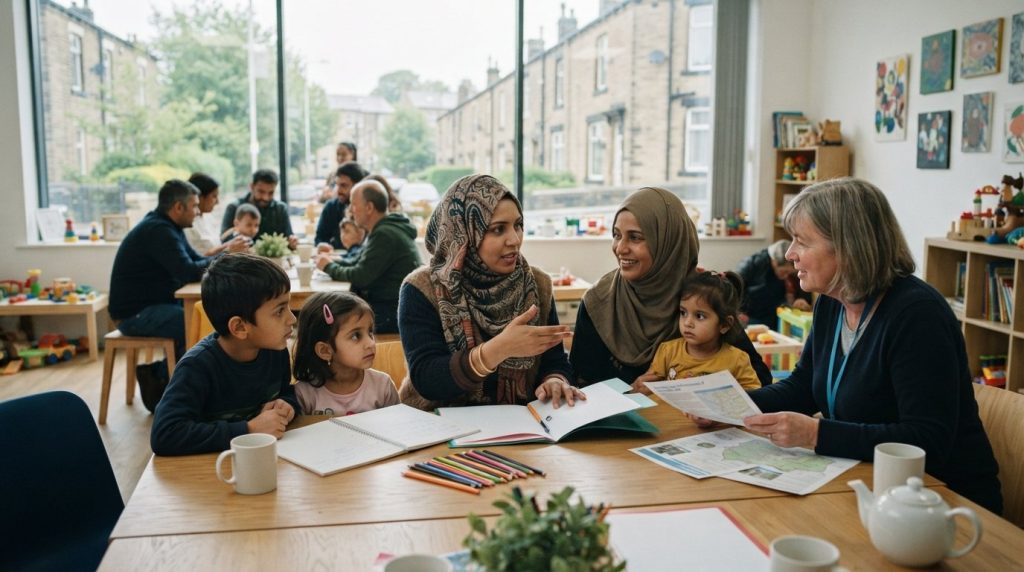
What if the most profound catalyst for integration isn’t found within a government manual or a large-scale logistics operation, but in the hands of those who have already walked that arduous path? For many supporters, there’s a lingering concern that broad humanitarian efforts lack the cultural intimacy required to truly heal; they often leave families adrift once the initial emergency food parcels are gone. By supporting a community led refugee charity UK, you ensure that aid transforms into agency, bridging the precarious gap between arrival and long-term belonging for displaced families in Britain.
In 2026, as refugees face a tightened 42-day move-on window and the complexities of 30-month temporary permission to stay, the need for nuanced, expert guidance has never been more urgent. This article examines the unique value of lived experience in charity work, the shift towards community leadership, and the vital role of local advocacy in securing a future defined by restoration, protection, and growth. You’ll discover how grassroots initiatives provide a stable, long-term commitment that honours the strength of the people they serve whilst fighting for systemic change.
Key Takeaways
- Understand why lived experience is the cornerstone of effective support, moving beyond emergency aid to foster genuine agency and honour the resilience of displaced families.
- Learn how a community led refugee charity UK builds deep trust through peer-to-peer models that navigate housing and healthcare with unique cultural insight.
- Discover the “last mile” advantage of grassroots organisations and why they often achieve higher success rates in permanent settlement than larger, distant entities.
- Explore how local action in centres like Bradford fuels global advocacy, connecting community support with the broader pursuit of justice for the Rohingya people.
- Gain clarity on identifying trustworthy registered charities and the role of “Sadaqah Jariyah” in funding educational projects that create lasting generational change.
Defining the Community Led Refugee Charity in the UK Landscape
The distinction between a traditional non-governmental organisation (NGO) and a community led refugee charity UK lies in the seat of power. While large-scale international bodies manage macro-policy and vast logistics, community-led organisations are founded and governed by those who have survived displacement themselves. This model prioritises lived experience, transforming the charitable sector from a top-down hierarchy into a partnership of equals. It aligns with the values of the City of Sanctuary movement in the UK, where the focus remains on building a culture of hospitality and safety at a local level.
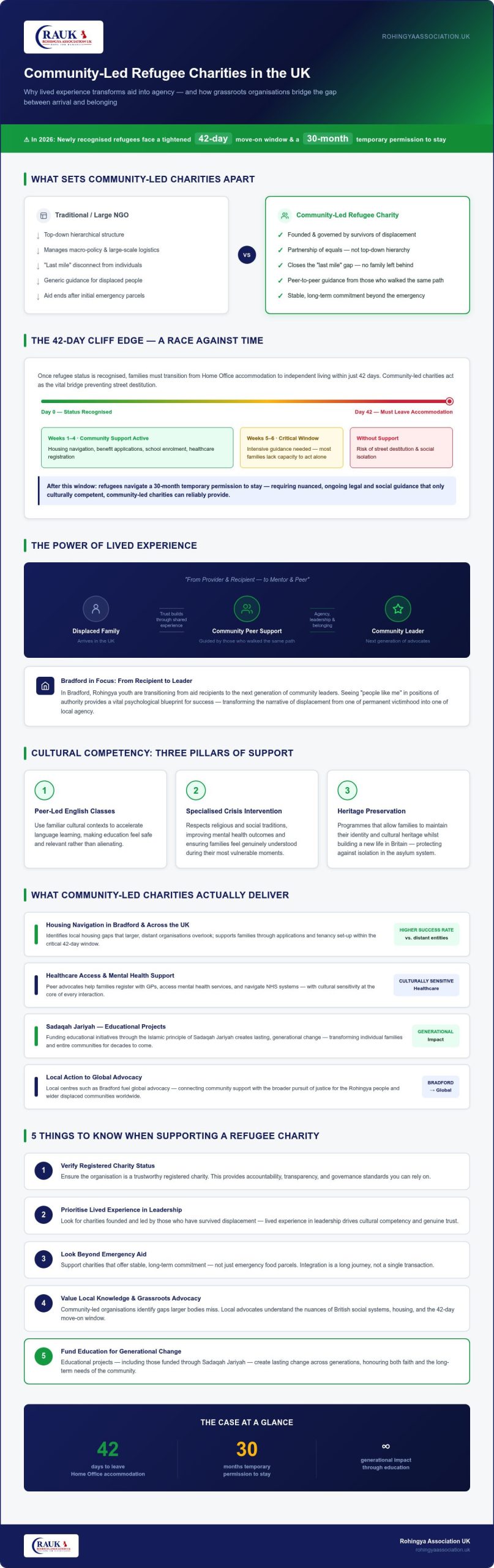
In 2026, the landscape of support has shifted. With the move-on period for newly recognised refugees set at 42 days, the transition from Home Office accommodation to independent living is a precarious cliff edge. Government services often lack the capacity to provide the intensive, culturally nuanced guidance required during this window. Here, the community-led model acts as a vital bridge, offering the stable, long-term commitment needed to prevent street destitution and foster genuine belonging.
To better understand the immediate pressures families face when navigating these systems, watch this video:
The Shift Towards Grassroots Advocacy
The humanitarian sector is moving away from treating displaced people as passive recipients of aid. Instead, the role of a community led refugee charity UK is to empower individuals to become advocates for their own futures. Local leaders, who understand the specific hurdles of British social systems, can identify gaps that larger organisations overlook. Whether it’s securing appropriate housing in Bradford or understanding the nuances of the 30-month temporary permission to stay rule, grassroots advocacy ensures that no family is left to navigate these complexities in isolation.
Why Cultural Competency is a Statutory Necessity
True integration is impossible without cultural competency. Successful mental health outcomes and social cohesion depend on a deep understanding of a community’s heritage, language, and trauma. Community-led initiatives provide:
- Peer-led English classes that use familiar cultural contexts to accelerate learning.
- Specialised crisis intervention that respects religious and social traditions.
- Heritage preservation programmes that allow families to maintain their identity whilst building a new life in Britain.
By grounding support in shared identity, these organisations provide a protective shield against the isolation often felt by those in the asylum system. They don’t just provide services; they build a home.
The Power of Lived Experience: Turning Aid into Agency
Trust is not a commodity that can be manufactured; it is earned through shared struggle and mutual understanding. For many displaced families, the formal architecture of the state can feel intimidating, opaque, or even threatening. When a community led refugee charity UK steps in, the dynamic shifts from a relationship of “provider and recipient” to one of “mentor and peer.” This shared identity is a potent catalyst for engagement, ensuring that vulnerable families feel safe enough to access essential healthcare, secure stable housing, and navigate the complexities of British life.
The peer-to-peer support model is particularly effective because it bypasses the “last mile” disconnect often found in larger organisations. Instead of generic advice, families receive guidance from those who have navigated the same legal hurdles and social barriers. In Bradford, this is vividly demonstrated by Rohingya youth who are transitioning from aid recipients to the next generation of community leaders. Seeing “people like me” in positions of authority provides a vital psychological blueprint for success. It transforms the narrative of displacement from one of permanent victimhood into one of local agency and communal pride. For those looking to understand how these local efforts fit into broader national frameworks, the UK community sponsorship scheme guidance provides a structured path for groups to take direct responsibility for the resettlement process.
Breaking the Cycle of Dependency
Empowerment requires more than temporary relief; it demands a clear path toward self-reliance. By focusing on vocational training and skills development, community-led initiatives help individuals move beyond the constraints of the asylum system. When families receive support tailored to their specific cultural and professional backgrounds, they transition more swiftly into the local workforce. This process restores the dignity of labour, fosters long-term financial independence, and allows refugees to contribute their talents to the UK economy. You can explore how these pathways are built through dedicated community support and integration programmes.
Lived Experience as a Protective Shield
Navigating the British asylum system can often feel like moving through a “hostile environment” without a map. Those who have already survived this journey serve as a protective shield, offering practical wisdom that no policy manual can replicate. Community-led charities create safer spaces where trauma can be discussed amongst those who share the same faith, language, and cultural heritage. This communal bond is essential for building the resilience needed to overcome past horrors. It ensures that the process of integration is not just about survival, but about restoration and growth within a supportive, familiar network.
Comparing Support Models: Grassroots vs. International NGOs
The humanitarian landscape is often divided between the vast, logistical power of international NGOs and the focused, relational depth of grassroots organisations. Whilst large organisations are indispensable during global catastrophes or natural disasters, they often face the “last mile” problem in refugee aid. This term refers to the critical, final stage of integration where a displaced individual must navigate local housing, employment, and social networks. A community led refugee charity UK is uniquely positioned to bridge this gap, offering a level of cultural precision that top-down models frequently overlook.
Success in long-term settlement is rarely the result of a single transaction; it is the product of sustained, local support. Large NGOs may provide the initial emergency relief, but grassroots groups provide the social infrastructure that turns a temporary shelter into a permanent home. By working in synergy, these two models can create a comprehensive safety net that protects vulnerable families from the moment of arrival through to full social participation. Evaluating a charity’s impact requires looking beyond simple financial metrics to consider the qualitative restoration of a family’s agency and dignity.
The Efficiency of Local Knowledge
Smaller, community-led groups typically operate with significantly lower overheads, ensuring that a higher proportion of donations reaches the frontline. Their agility allows them to pivot quickly during local crises or sudden policy changes, such as the adjustments to the asylum move-on window. By building deep, multi-year relationships with families, these charities provide a stable presence that transcends the short-term project cycles of larger organisations. This sustained stewardship is what allows for true social integration and the eventual transition from aid recipient to active citizen.
Scale vs. Depth: Choosing Where to Donate
Choosing where to direct your support depends on the desired outcome. For immediate, large-scale relief in conflict zones, international NGOs remain the primary choice. However, for those seeking to foster long-term social integration and systemic change within Britain, grassroots organisations offer unparalleled depth. Supporting local Refugee Youth Empowerment Programmes ensures that the next generation has the tools to lead their own communities. When evaluating a charity’s impact, consider these qualitative markers:
- Social Integration: The percentage of families successfully transitioning to independent housing within the 42-day window.
- Educational Outcomes: The number of youth entering higher education or vocational training through community-led mentorship.
- Advocacy Reach: The charity’s ability to influence local and national policy by amplifying the voices of those with lived experience.
By focusing on these outcomes, donors can move beyond fleeting emotional reactions and invest in a community led refugee charity UK that provides a stable, long-term commitment to restoration and growth.
Transforming Local Outcomes: From Bradford to Global Advocacy
The mission of a community led refugee charity UK extends far beyond the immediate horizon of local resettlement. In cities like Bradford, where the Rohingya diaspora has found a sanctuary, the work of restoration involves a dual commitment: securing a dignified life in Britain whilst relentlessly pursuing justice for those left behind. This unique position allows grassroots organisations to act as both a local safety net and a global megaphone, ensuring that the struggle for human rights remains visible on the international stage. It is a model of leadership that transforms the pain of displacement into a principled fight for systemic change.
Success in Yorkshire is the foundation for this broader advocacy. When families are settled, healthy, and educated, they gain the agency required to speak for their community. This process is reinforced by Islamic community events that foster social cohesion and provide a familiar space for collective healing. By preserving their language and culture within the British education system, the next generation maintains a vital link to their heritage. This ensures that their identity remains a source of strength, pride, and resilience rather than a casualty of displacement.
Local Support: The Foundation of Integration
Integration is a methodical process that begins with the most fundamental human needs. In Yorkshire, practical assistance focuses on navigating the complexities of housing guidance and ensuring equitable access to healthcare. These services are not merely administrative; they are acts of protection that shield families from the instability of the asylum system. English language classes play a pivotal role, building the confidence needed for parents to engage with schools and for youth to excel in their studies. By addressing inequality through targeted empowerment projects, the community ensures that every individual has the opportunity to contribute to the social fabric of their new home.
Global Advocacy: Fighting for Justice
The safety found in the UK provides the necessary platform to raise awareness of the ongoing crisis in Myanmar and Bangladesh. The diaspora in Britain maintains deep connections with families in Cox’s Bazar, acting as a lifeline for those living in the world’s largest refugee camps. This global advocacy is essential for securing long-term justice and systemic change. Local safety is intrinsically linked to global human rights; one cannot be fully realised without the other. Through persistent awareness campaigns and international links, the community ensures that the plight of the Rohingya people is never forgotten. If you wish to stand with us in this dual mission of local empowerment and global justice, you can support our advocacy and awareness campaigns today.
How to Support Community Led Refugee Charities in 2026
Supporting a community led refugee charity UK requires a transition from reactive, emergency giving to a model of strategic, long-term partnership. In an era defined by complex legal frameworks and the psychological weight of shortened residency permits, the efficacy of your contribution depends on the organisation’s proximity to the lived experience of those it serves. To ensure your support reaches the local level where it is most needed, always verify an organisation’s credentials through the Charity Commission. For example, the Rohingya Association UK (RAUK) operates as a registered charity under number 1211433, providing a transparent framework for stewardship, accountability, and impact that honours the dignity of every family supported.
Effective Giving for Long-Term Impact
While emergency aid addresses immediate hunger, the true restoration of a life is built on the pillars of education, stable housing, and social integration. Many supporters within the community find profound spiritual and social meaning in “Sadaqah Jariyah”-a form of voluntary charity that yields ongoing benefits. By investing in long-term educational projects or vocational training, you aren’t just providing a meal; you’re creating a legacy of self-reliance that can span generations. Supporting Community Support for Displaced Families through regular, monthly giving provides the financial stability required to maintain both local settlement services in Yorkshire and global advocacy efforts for the Rohingya people in Myanmar and Bangladesh.
Getting Involved Locally
Financial contributions are essential, yet the gift of time and expertise is often equally transformative for a community led refugee charity UK. In Bradford, opportunities for skills-sharing allow professionals to mentor refugee youth, providing the guidance needed to navigate British social systems and the local job market. These interactions foster mutual respect, dismantle social barriers, and preserve cultural heritage whilst building a shared future. You can become a champion for refugee rights by:
- Sharing your professional skills in digital literacy, CV writing, or vocational mentorship.
- Attending cultural events to foster a sense of belonging and communal pride amongst displaced families.
- Advocating for policy change by amplifying the voices of those with lived experience within your own local networks.
Partnering with the Rohingya Association UK means joining a dedicated collective committed to justice, empowerment, and systemic change. Whether through financial stewardship or local volunteering, your involvement ensures that the path from displacement to community leadership remains open for all. Together, we can move beyond fleeting emotional reactions toward a future defined by stable, long-term commitment and the total restoration of human dignity.
Building a Future Rooted in Resilience and Justice
The journey from displacement to belonging is not a path one should walk alone. A community led refugee charity UK transforms the landscape of support by replacing passive aid with active agency. By centring lived experience, organisations like the Rohingya Association UK bridge the gap between arrival and long-term integration, ensuring that cultural heritage is preserved whilst new lives are built in Yorkshire. It’s through this shared commitment that we build lasting trust and social cohesion.
True restoration requires a dual focus: providing safety in our local neighbourhoods whilst advocating for justice on the global stage. As a registered charity (1211433), RAUK is led by those who understand these struggles firsthand, delivering direct impact from Bradford to Cox’s Bazar. Your support is the catalyst for this renewal, turning collective effort into a protective shield for the vulnerable.
Stand with us as we fight for a future where every displaced family finds dignity. Please support the Rohingya community by donating to RAUK today. Together, we can ensure that the possibility of renewal becomes a reality for all.
Frequently Asked Questions
What is a community-led refugee charity?
A community-led organisation is founded and governed by individuals with lived experience of displacement. Unlike traditional NGOs, it prioritises the voices of the community it serves, acting as a cultural bridge that provides nuanced support top-down services often miss. This model ensures aid is empathetic, culturally competent, and focused on long-term agency. It empowers families to move beyond survival towards a future defined by restoration, protection, and growth.
How does the Rohingya Association UK support refugees in Bradford?
RAUK provides practical assistance tailored to the needs of the diaspora, including housing guidance, healthcare access, and English language classes. We focus on education and youth empowerment to ensure the next generation thrives within the British social system. By organising cultural and Islamic community events, we strengthen bonds amongst families whilst preserving their heritage. Our work tackles inequality by offering a stable, long-term commitment to settlement and social integration in Yorkshire.
Can I volunteer for a refugee charity if I don’t speak another language?
Yes, your time and skills are invaluable regardless of your linguistic abilities. Many roles within a community led refugee charity UK focus on skills-sharing, such as mentoring youth in digital literacy, assisting with CV writing, or helping families navigate local services. Volunteers also play a vital role in organising community events and advocacy campaigns. Your presence helps foster mutual understanding and builds a more welcoming environment for everyone within the local community.
How do community-led charities ensure their donations are used effectively?
RAUK maintains transparency through our status as a registered charity (1211433), which requires strict financial accountability to the Charity Commission. Because we are led by those with lived experience, we possess an intimate understanding of where resources are most urgently needed. This local knowledge allows for lower overheads and direct allocation to essential services. A community led refugee charity UK ensures that every contribution supports tangible outcomes like crisis intervention and education.
Does RAUK provide support to refugees outside of the UK?
RAUK maintains a dual focus on local integration in Yorkshire and global justice for the Rohingya people. We operate aid projects and advocacy campaigns in Myanmar and Bangladesh, supporting families in Cox’s Bazar. This global reach ensures that whilst we help refugees build new lives in the UK, we continue to fight for the human rights and protection of those still facing displacement and persecution abroad through sustained humanitarian aid.
What is the difference between a refugee and a stateless person?
A refugee is someone forced to flee their country due to a well-founded fear of persecution. In contrast, a stateless person is someone who is not considered a national by any state under the operation of its law. Many Rohingya people fall into both categories, as they have been denied citizenship in Myanmar whilst seeking safety. Understanding this distinction is crucial for addressing the unique legal and social hurdles these families face.
How can I help preserve Rohingya culture in the UK?
You can support heritage preservation by participating in or funding cultural and Islamic community events organised by RAUK. These gatherings provide a space for families to celebrate their traditions, language, and faith within a supportive environment. Additionally, supporting our education programmes ensures that Rohingya youth maintain a strong sense of identity whilst integrating into British life. Sharing their stories through advocacy also helps keep this rich cultural heritage visible and respected.
Is my donation to the Rohingya Association UK tax-deductible?
Yes, as a registered charity (1211433), donations to RAUK are eligible for Gift Aid if you are a UK taxpayer. This allows the charity to reclaim an extra 25p for every £1 you give at no extra cost to you. This additional funding is vital for sustaining our long-term projects in education, settlement, and global advocacy. Always ensure you provide a Gift Aid declaration when making your contribution to maximise your impact for families.