
For many displaced professionals, the most profound loss isn’t the physical home they left behind, but the systematic erasure of their professional identity upon arrival in a new land. You likely recognise the quiet indignity of seeing years of expertise dismissed because of unrecognised qualifications or language barriers that mask deep technical brilliance. This reality makes targeted skills development for refugees UK far more than a simple training exercise; it’s a vital act of restoring agency and dignity to those the world has too often rendered invisible.
In this article, you’ll discover how moving beyond basic aid toward specialised training can foster genuine professional autonomy and long-term integration. We’ll explore the specific training pathways available to rebuild your career, practical strategies to dismantle systemic employment barriers, and the community-led organisations that stand ready to act as your partner. By shifting the focus from mere survival to professional mastery, we can ensure that every individual has the tools to reclaim their future and contribute their unique talents to the fabric of British society.
Key Takeaways
- Understand how holistic skills development for refugees UK moves beyond basic aid to restore professional dignity and long-term agency.
- Identify the critical pillars of digital literacy and vocational training required to navigate the modern British job market effectively.
- Evaluate the unique advantages of community-led support, where lived experience and cultural nuance provide a more stable foundation for integration.
- Follow a clear, strategic checklist to audit your existing professional expertise and secure training that matches your career ambitions.
- Explore how the RAUK model in Bradford empowers the Rohingya community by blending professional upskilling with vital cultural preservation.
Defining Skills Development for Refugees in the UK
True skills development for refugees UK is far more than a simple administrative checklist; it’s a holistic framework that integrates vocational mastery, digital fluency, and the nuanced soft skills required to navigate a new professional landscape. This approach moves beyond the standard employment advice that often directs displaced people toward immediate survival jobs. While warehouse work or cleaning may provide temporary financial relief, these roles frequently result in the systematic erasure of a person’s professional identity. For a highly skilled architect or nurse, being steered away from their vocation isn’t just a personal tragedy; it’s a profound waste of human potential.
Effective training must focus on career-aligned growth that restores a sense of agency. When we prioritise professional identity, we allow individuals to contribute at their highest level, fostering a sense of dignity that basic aid alone cannot provide. This transition from “refugee” to “professional” is the cornerstone of successful, long-term integration.
The Social and Economic Necessity of Upskilling
The UK is currently grappling with significant labour shortages across several critical sectors, including healthcare, green energy, and construction. By investing in targeted training, we can unlock the untapped potential of the refugee workforce to meet these national demands. Beyond the economic impact, the psychological benefits of professional growth are immense. It offers a way to heal, grow, and belong. Providing these pathways reduces long-term dependence on crisis intervention services, creating a more resilient and self-sufficient community.
Addressing the Specific Challenges of the Stateless
Stateless individuals often face the most daunting hurdles when attempting to enter the UK workforce. Without a recognised passport or original academic certificates, traditional verification processes frequently fail them. This is why we advocate for competency-based assessments and portfolio-led hiring that value lived experience over missing paperwork. Supporting these individuals requires a dedicated partner who understands the intersection of legal status and professional ambition. Accessing robust community support for displaced families is often the first step in creating the stability needed for such professional pursuits. By developing flexible verification models, we ensure that skills development for refugees UK remains inclusive of those who have lost everything but their expertise.
Essential Pillars of Displaced Person Skills Training
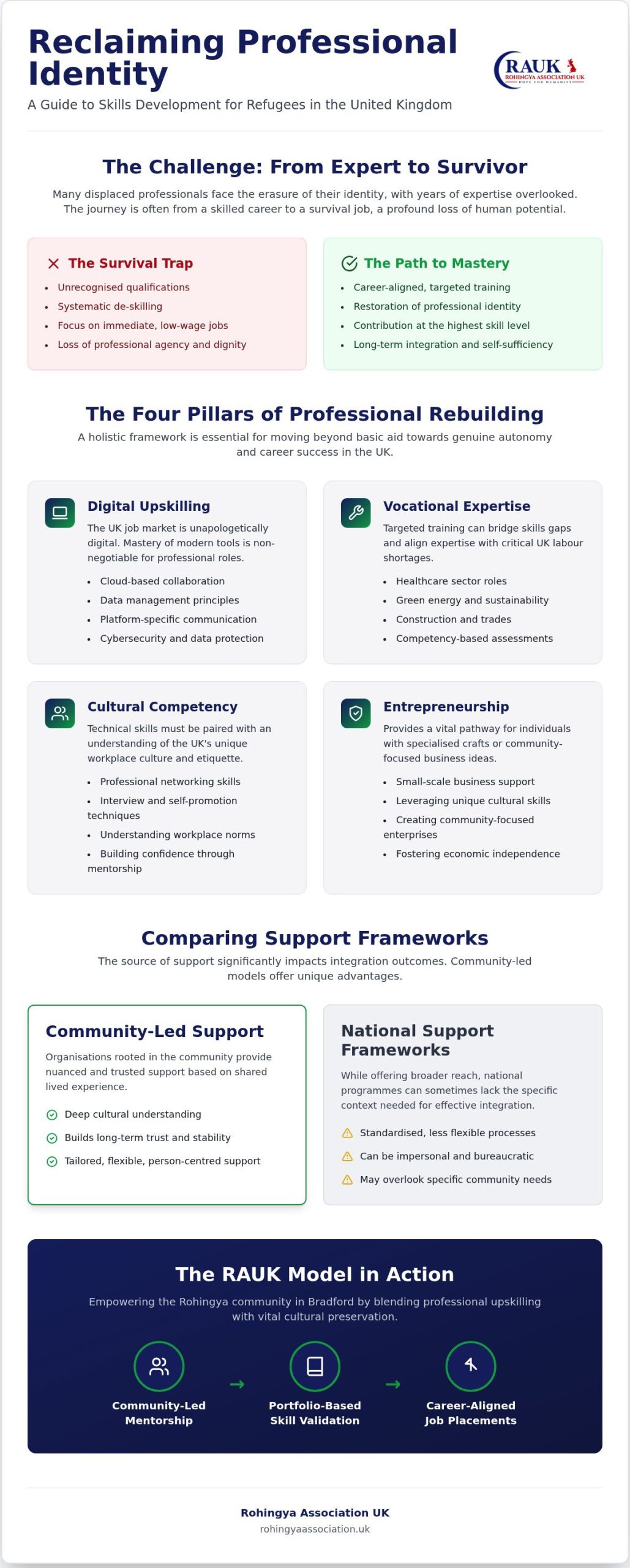
To rebuild a life with dignity, one must possess the tools to interact with a new environment on equal footing. Effective skills development for refugees UK rests upon four foundational pillars: digital literacy, vocational expertise, cultural soft skills, and the spirit of entrepreneurship. These aren’t merely educational modules; they’re the architecture of agency. By mastering these areas, displaced individuals move from the periphery of society into its active, productive centre.
Digital Upskilling in a Modern Economy
The UK job market is unapologetically digital. By 2026, even entry-level professional roles require a sophisticated grasp of cloud-based collaboration, data management, and platform-specific communication. For those who’ve experienced significant gaps in their professional timeline, remote learning platforms offer a flexible, accessible bridge to these competencies. However, this technical journey must also include robust cybersecurity awareness. Protecting personal data is a vital necessity for vulnerable populations who may still face external threats. Learning to navigate these systems ensures that technology remains a tool for liberation rather than a barrier to entry.
Cultural Competency and Workplace Integration
Technical brilliance often falters if it isn’t translated through the lens of local workplace culture. In the UK, professional etiquette involves a complex balance of directness, politeness, and understated networking. Many refugees struggle with interviews not because of a lack of talent, but because cultural modesty or the lingering effects of trauma make self-promotion feel unnatural. Mentorship programmes are essential here. They connect newcomers with established professionals who can decode these unwritten rules. Through these connections, individuals build the networks, confidence, and local references required to thrive.
Small-scale entrepreneurship also provides a vital pathway for those with specialised crafts or community-focused business ideas. Supporting these ventures fosters local economic growth whilst honouring heritage. If you’re seeking guidance on how to begin this journey, exploring the integration and empowerment initiatives at RAUK can provide a stable starting point.
Vocational training remains the final, critical piece of the puzzle. Whether in healthcare, construction, or the growing technology sector, sector-specific pathways ensure that skills are matched with the actual needs of the British economy. This alignment creates a future defined by stability, contribution, and mutual respect.
Comparing Community-Led vs National Support Frameworks
The landscape of skills development for refugees UK is defined by two distinct but complementary forces. National frameworks offer the necessary scale, significant funding, and standardised accreditation required to validate skills across the country. These systems, whilst robust, can sometimes feel distant or overly bureaucratic to those who’ve survived displacement. In contrast, community-led charities operate with a depth of cultural nuance and trust that large institutions cannot easily replicate. They understand the unspoken barriers and the weight of history that their members carry. A hybrid approach, combining the reach of national policy with the empathy of local action, remains the most effective strategy for long-term restoration.
Corporate social responsibility (CSR) also plays a vital role in this ecosystem. When businesses move beyond simple donations and actively create employment pathways, they don’t just fulfil a moral duty. They secure a dedicated, resilient, and highly skilled workforce that brings unique perspectives to the British economy. This partnership between the state, the community, and the private sector is essential for systemic change.
The Grassroots Advantage: Why Lived Experience Matters
Community-led organisations like RAUK are uniquely positioned to provide support that is deeply rooted in lived experience. We understand that professional upskilling cannot be divorced from a person’s emotional and social reality or the specific traumas they’ve endured. Our ‘peer-to-peer’ learning model is particularly effective; it allows individuals to learn from those who have successfully navigated the same systemic hurdles. This shared journey builds a protective shield of communal bond whilst fostering individual growth. For younger generations, this support is even more specialised. Our refugee youth empowerment programs focus on bridging the gap between education and the professional world, ensuring that the next generation has the agency to define their own path.
Navigating National Accreditation and Qualifications
A significant challenge for many displaced professionals is the non-recognition of overseas qualifications. The UK ENIC process is the primary route for converting these credentials into their British equivalents. However, this process can be slow and sometimes inconclusive if documentation is missing. To address this, we’ve seen a rise in ‘micro-credentials’—short, focused training modules that offer a faster path to UK professional recognition. We advocate for more flexible entry requirements, especially in sectors facing chronic staff shortages. When companies value talent and competency-based assessments over traditional certificates, they dismantle the barriers that keep highly skilled individuals in survival jobs. This shift is crucial for turning skills development for refugees UK into a genuine engine of professional renewal.
Strategic Guidance for Accessing Professional Development
Reclaiming a professional identity in a new country requires a methodical approach that balances immediate needs with long-term ambition. Accessing skills development for refugees UK starts with a clear-eyed audit of one’s own history, potential, and the specific requirements of the British market. This process is not merely about finding a job; it’s about strategic restoration. To begin this transition, consider the following steps:
- Audit your previous professional qualifications and map them against UK industry standards to identify where top-up training is required.
- Identify technical gaps that can be filled through micro-credentials or short-term vocational courses.
- Seek out ESOL programmes that focus specifically on professional environments rather than basic conversational skills.
- Research local grants and bursaries, such as those provided via the Adult Education Budget, which often fund training for those with refugee status.
Volunteering remains a powerful, often underutilised bridge to the UK workforce. It provides a low-pressure environment to build local references, understand workplace dynamics, and expand professional networks. These connections frequently lead to the “hidden” job market where many professional roles are filled through word-of-mouth rather than public advertisements.
Integrating Language Learning with Professional Goals
Professional success in the UK demands a mastery of ‘Business English’ that goes far beyond basic daily interactions. This specialised register involves understanding the nuances of workplace hierarchy, formal reporting, and collaborative negotiation. Technical sectors, such as healthcare or engineering, require an even deeper dive into sector-specific vocabulary. We encourage you to view your bilingualism not as a hurdle to overcome, but as a sophisticated professional asset. In the diverse, globalised market of 2026, the ability to navigate multiple cultural and linguistic landscapes is a high-value skill that employers actively seek. If you require personalised guidance on these steps, explore our education and youth empowerment initiatives to begin your journey of renewal.
Building a UK-Ready Professional Portfolio
Reformatting an international CV is essential to meet British recruitment expectations, which typically prioritise concise, achievement-oriented bullet points over long narrative descriptions. Your digital presence is equally critical; a robust LinkedIn profile serves as your 24/7 professional storefront, allowing recruiters to find you based on your specific expertise. Transferable skills represent the vital intersection of professional expertise and the profound resilience forged through the experience of displacement. By highlighting these attributes alongside your technical abilities, you present a narrative of strength, adaptability, and unwavering commitment to your field.
The RAUK Model: Empowering the Rohingya Through Skills
The Rohingya Association UK (RAUK) operates as more than a service provider; it’s a community-led engine of restoration. Our approach to skills development for refugees UK is built on the belief that professional mastery is a fundamental right, particularly for those whose identities have been contested by the state. In Bradford and across the country, we provide the specific training, linguistic support, and vocational guidance necessary to transform potential into participation. This model ensures that cultural preservation and professional empowerment exist in harmony, allowing individuals to contribute to British society whilst honouring their unique heritage and history.
Our advocacy work focuses specifically on the systemic hurdles faced by the stateless. We work to educate employers on the value of talent over documentation, pushing for hiring practices that recognise the profound resilience of the Rohingya people. This is a journey of collective effort, shared identity, and long-term commitment. By positioning our members as assets rather than recipients of aid, we restore the agency that displacement attempted to strip away.
Local Impact in Bradford: A Hub for Integration
In Bradford, the RAUK model has seen tangible success through the rise of Rohingya youth entering professional sectors such as healthcare and local administration. These outcomes are the result of deep-rooted partnerships with local businesses and educational institutions that see the immense value in diverse talent. These local triumphs are not isolated; they serve as the blueprint for our national advocacy strategies. By demonstrating how community-led skills development for refugees UK works on the ground, we can influence broader policy changes that benefit all displaced people across the United Kingdom. This local success proves that when integration is led by the community, it creates a more stable and lasting foundation for growth.
A Call to Action for Community Restoration
The path to restoration is a shared responsibility that requires the dedication of professionals, mentors, and advocates alike. We invite you to contribute to the future of displaced families by offering your own expertise as a guide. Professional mentorship is a powerful form of ‘Sadaqah Jariyah’, a voluntary charity that provides ongoing benefits to both the individual and the wider community. By sharing your knowledge, you help build a protective shield of agency around those who have lost so much.
We also call upon corporate stakeholders and educational leaders to collaborate with us on systemic change. Together, we can dismantle the barriers to employment and ensure that the UK remains a place where talent is recognised, protected, and nurtured. Whether through partnership, mentorship, or advocacy, your participation is a vital act of justice. Join us in building a future where every displaced professional has the tools to reclaim their dignity and thrive.
Restoring Agency Through Professional Renewal
The journey from displacement to professional belonging is paved with more than just basic aid; it requires a dedicated commitment to long-term growth and systemic change. We’ve explored how targeted skills development for refugees UK serves as a vital bridge, allowing individuals to move beyond survival jobs toward careers that honour their expertise and heritage. By prioritising digital literacy, vocational mastery, and the trust inherent in community-led support, we can ensure that every displaced professional has the opportunity to contribute their unique talents to the British economy.
As a community-led organisation (Registered Charity: 1211433), the Rohingya Association UK is deeply rooted in the lived experience of those we serve. Our work creates direct impact amongst families in Bradford, Myanmar, and Bangladesh, acting as a protective shield and a guiding hand for those seeking renewal. You can play a vital role in this mission of justice and empowerment. Support our skills development programmes and empower displaced families today. Together, we don’t just provide assistance; we build a future defined by dignity, stability, and shared success. Your commitment helps transform lives from the periphery to the centre of society.
Frequently Asked Questions
What are the best sectors for refugees to find work in the UK in 2026?
The most promising sectors for refugees in 2026 include healthcare, construction, and the burgeoning technology industry. These fields face significant labour shortages, making them ideal pathways for those seeking stable, long-term employment. By focusing on skills development for refugees UK, we can align your previous expertise with these high-demand areas. This strategic alignment ensures that your professional growth contributes directly to the British economy whilst providing you with a secure and dignified career path.
How can I get my overseas qualifications recognised in the UK?
To have your international qualifications recognised, you should apply through UK ENIC for a Statement of Comparability. This official document translates your overseas certificates into their British equivalents, providing clarity for employers and educational institutions. For those who’ve lost their documentation during displacement, we advocate for competency-based assessments. We work with partners to ensure that your talent and lived experience are valued even when traditional paperwork is unavailable or incomplete.
Are there free English language classes for refugees in Bradford?
Yes, the Rohingya Association UK provides free English language classes specifically designed for the refugee community in Bradford. Our ESOL programmes are more than simple vocabulary lessons; they’re a bridge to professional integration and social belonging. We focus on the nuanced communication styles required for the British workplace, ensuring you have the confidence to navigate both daily life and your chosen career. These classes are community-led and rooted in deep empathy.
Can stateless individuals without a passport apply for skills training?
Stateless individuals can and should apply for skills training regardless of their documentation status. Whilst lack of a passport presents administrative hurdles, many educational programmes and community-led initiatives offer flexible entry requirements. We provide guidance on navigating these complex systems and advocate for inclusive policies that recognise human potential over legal status. Our mission is to ensure that no one is left behind due to the systematic erasure of their professional identity.
What financial support is available for refugees wanting to retrain?
Financial support for retraining is often accessible through the government’s Adult Education Budget, which frequently covers course fees for those with refugee status. Various charitable foundations and local authorities also offer specific grants and bursaries for vocational training. Whilst RAUK doesn’t provide direct financial loans, we offer comprehensive guidance on identifying and securing these funding opportunities. This support ensures that financial barriers don’t prevent you from reclaiming your professional agency and future stability.
How does the Rohingya Association UK support youth skills development?
RAUK supports youth through dedicated Education & Youth Empowerment programmes that blend academic support with professional mentorship. We provide a safe space for young people to develop their talents, build networks, and explore career pathways that honour their heritage. By fostering a sense of cultural pride and individual ambition, we help the next generation move beyond the limitations of displacement. Our approach is methodical, narrative-driven, and focused on long-term communal restoration.
What is the difference between a survival job and a career-aligned role?
A survival job is typically a low-skilled role taken to meet immediate financial needs, often ignoring a person’s prior professional expertise. In contrast, a career-aligned role matches your previous skills, qualifications, and long-term ambitions. Standard employment advice often pushes refugees toward survival work, but we believe in skills development for refugees UK that restores professional identity. This shift from temporary relief to career mastery is essential for fostering true dignity and agency.
How can UK businesses help with refugee skills development?
UK businesses can assist by integrating inclusive hiring practices and providing professional mentorship to displaced individuals. By partnering with community-led organisations like RAUK, companies can access a resilient and highly skilled talent pool that brings unique global perspectives. Corporate social responsibility isn’t just about charity; it’s about fighting for justice and systemic change. When businesses offer meaningful career pathways, they help dismantle the barriers that keep talented professionals on the margins of society.