

What does it mean to possess a lifetime of expertise only to find your professional identity silenced by a system that cannot yet translate your worth? For many newcomers, the journey toward stability is stalled by unrecognised qualifications, language barriers, and the intricate hurdles of a foreign workplace. This is why robust refugee skills development UK initiatives are more than just training programmes; they are vital acts of restoration that bridge the gap between displacement and belonging. By focusing on vocational growth and professional navigation, these pathways help individuals reclaim the dignity that is so often lost in transit.
You likely recognise that the path to employment in Britain is fraught with complexity, especially as 2026 policy shifts, such as the 30-month temporary protection status, create a heightened urgency for self-sufficiency. This article explores how tailored support systems, including culturally sensitive mentorship and sector-specific training, empower you to navigate the UK labour market with renewed confidence. You will discover the essential strategies for overcoming systemic barriers and securing a future defined by stable, dignified employment and meaningful community integration.
Key Takeaways
- Identify the specific systemic barriers within the 2026 UK labour market and learn how to translate overseas expertise into local professional value.
- Understand the essential hierarchy of needs, from digital literacy to sector-specific English, required to secure stable and dignified employment.
- Explore the “Bradford Model” of community-led support, which balances professional growth with the preservation of cultural and faith-based identities.
- Follow a strategic roadmap for refugee skills development UK that focuses on auditing transferable talents and finding culturally sensitive mentorship.
- Learn how transitioning from a service user to a community mentor can restore professional dignity and foster long-term social integration.
Navigating the Landscape of Refugee Skills Development in the UK
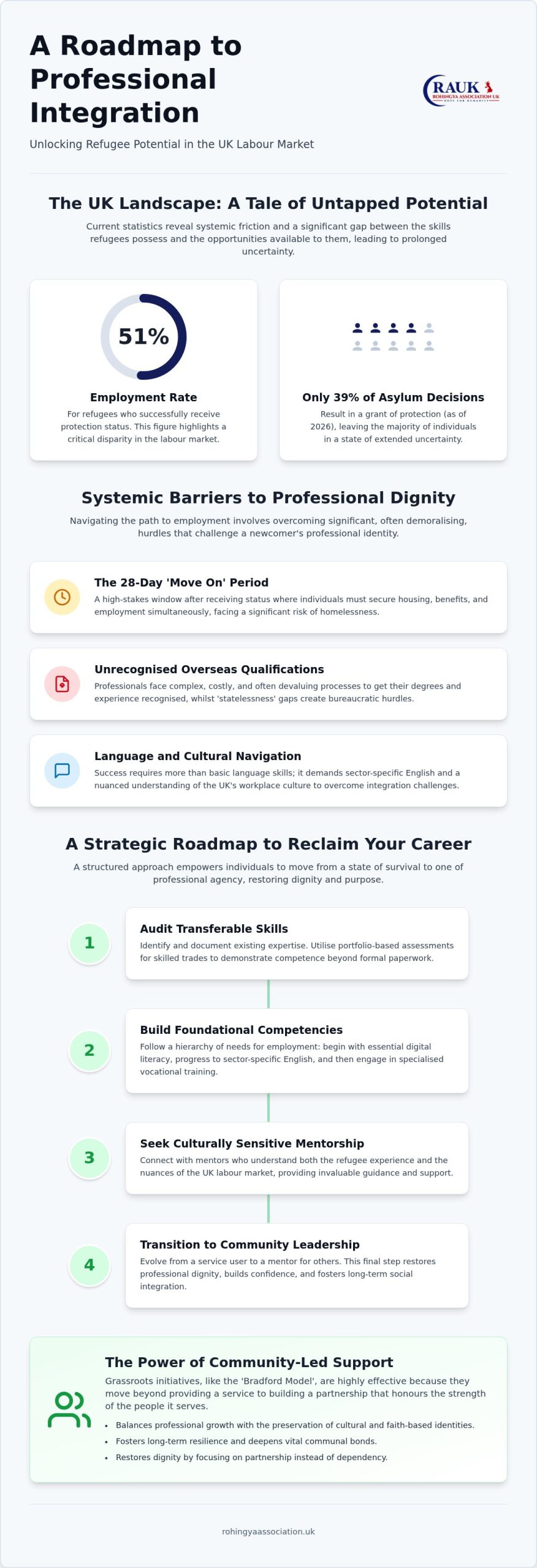
The current landscape of refugee employment in the UK remains a challenging terrain of untapped potential and systemic friction. As of 2026, data indicates that only 39% of asylum decisions result in grants of protection, leaving a large portion of the community in a state of prolonged uncertainty. For those who do receive status, the employment rate remains disproportionately low at 51%. This disparity isn’t merely an economic oversight; it’s a moral one. For many, the transition involves a difficult psychological shift from a state of survival to the pursuit of professional agency. It requires moving beyond the identity of a “displaced person” to that of a skilled contributor who possesses talent, ambition, and heritage.
Effective refugee skills development UK initiatives must address this internal transformation whilst dismantling external barriers. Traditional institutional aid often focuses on immediate survival, yet community-led support proves more effective by fostering long-term resilience. This grassroots approach understands that professional restoration is deeply linked to personal dignity, cultural pride, and communal bonds. It moves beyond providing a service to building a partnership that honours the strength of the people it serves.
To better understand this concept, watch this helpful video:
The “Move On” Period and Immediate Challenges
The 28-day “move on” period represents a critical, often chaotic, window between receiving status and losing asylum support. During this brief transition, individuals must navigate housing, benefits, and the start of a career search simultaneously. It’s a high-stakes moment where the risk of homelessness is high. Immediate skills assessment is vital during this time to prevent long-term unemployment and ensure that refugee skills development UK programmes are tailored to the individual’s existing strengths. Providing community support for displaced families creates the necessary stability for refugees to focus on learning and growth. Without this foundation, professional development remains a distant luxury rather than an achievable goal.
Recognising Overseas Qualifications and Experience
One of the most persistent hurdles is the lack of recognition for qualifications earned abroad. Navigating ENIC for degree equivalency is a complex, often expensive process that leaves many professionals feeling devalued. For those in skilled trades, portfolio-based assessments offer a more flexible path to prove competence. This is particularly important for those who are part of the broader story of Modern immigration to the United Kingdom, as they often face “statelessness” gaps in their professional histories. These gaps aren’t absences of skill; they are interruptions caused by conflict and displacement. Restoring these careers requires a system that values human experience over rigid bureaucracy.
The Core Components of Successful Professional Integration
Professional integration isn’t merely the act of securing a role; it’s the methodical process of aligning a refugee’s existing talents with the specific demands of the UK labour market. It’s a journey of professional restoration. This alignment requires a structured hierarchy of needs that begins with language proficiency, moves through digital literacy, and culminates in sector-specific training. For many, this process is supported by national frameworks like the Refugee Employability Programme, which provides a blueprint for how individuals can transition from survival to professional success. True integration happens when a person’s skills are not just recognised but actively utilised in a way that honours their previous career history.
Beyond technical abilities, understanding UK workplace culture is a vital soft skill that often dictates long-term retention. This includes navigating the nuances of professional communication, understanding hierarchical structures, and mastering the art of the British interview. These cultural competencies are often the “missing link” for highly skilled individuals who possess the right qualifications but struggle to find their footing in a new environment. You can find dedicated pathways for growth through the work of the Rohingya Association UK, where community-led support meets professional ambition.
English Language Proficiency for the British Workplace
Whilst basic conversational skills are a necessary starting point, true professional integration requires a mastery of industry-specific terminology. Effective refugee skills development UK programmes must move beyond simple ESOL classes to provide vocabulary tailored to sectors like healthcare, construction, or technology. Learning in a community-led environment offers a safe space where individuals can practice without the fear of judgment. This supportive atmosphere builds the necessary workplace confidence to lead meetings, write reports, and engage with colleagues. Mastery of the language is the most powerful tool for reducing social isolation and reclaiming one’s voice in a professional setting.
Digital Literacy and Modern Job Searching
In 2026, the ability to navigate digital landscapes is as essential as the ability to speak the local language. Modern job searching in Britain relies heavily on platforms like LinkedIn and specialised job portals, which require a specific set of networking skills. Refugees must be equipped with essential software skills, from basic administrative tools to sector-specific platforms used in the service and tech industries. Digital inclusion is a human right for refugees. Without this access, even the most talented professionals remain invisible to recruiters. Providing these tools ensures that no one is left behind in an increasingly automated economy.
Addressing the Unique Challenges of Cultural and Local Integration
Professional success for displaced communities isn’t a solitary pursuit; it’s a communal endeavour rooted in local context. In Bradford, this is exemplified by the “Bradford Model”, where community-led charities act as centres of excellence, providing a protective shield and a guiding hand. This model recognises that effective refugee skills development UK initiatives must account for the specific spiritual and cultural identities of the people they serve. For the Rohingya community, this involves a delicate balance: preserving a rich, resilient heritage whilst embracing the rigorous professional standards of the British workplace. It’s about restoration, protection, and growth.
Integrating faith into professional life is a cornerstone of this balanced approach. For many, aligning Islamic values with the expectations of UK employment, such as prayer times or dietary requirements, requires both advocacy and education. By framing these needs as integral parts of a person’s identity rather than barriers, we foster an environment of mutual respect and intellectual authority. Long-term success is further secured through refugee youth empowerment programmes, which ensure the next generation possesses the agency to lead, innovate, and thrive in their new home.
Community Bonding as a Catalyst for Skills Growth
Cultural events do more than celebrate history; they reduce the “anxiety of the new” that often paralyses learners. When a person feels a sense of belonging, their capacity to absorb new information and master complex tasks expands. Peer-to-peer mentorship amongst displaced professionals creates a unique bond of shared experience, where those who have already navigated the system return to guide others. In Bradford, this shared heritage transforms a city into a community, turning a classroom into a sanctuary of collective effort and shared identity.
Holistic Support: Health, Housing, and Education
Skills training cannot exist in a vacuum. If an individual is burdened by the instability of their living situation or the health of their family, the focus required for vocational learning is compromised. Stable housing guidance is the silent engine of professional progress; it provides the grounding necessary for consistent study. Similarly, we must address the profound impact of trauma on learning and concentration, providing a methodical path toward healing and renewal. Consistent healthcare access ensures that the journey toward employment isn’t interrupted by preventable crises, allowing for a steady build-up of momentum and professional restoration.
A Strategic Roadmap for Refugees Seeking Employment in the UK
The transition into the British workforce requires more than perseverance; it demands a methodical, tiered approach that transforms the experience of displacement into a narrative of professional resilience. This journey is best viewed as a chronological progression that begins with internal reflection and ends with successful workplace integration. For those engaging with the refugee skills development UK landscape, following a clear roadmap is essential to overcome the systemic friction often encountered by newcomers, especially given the heightened urgency of the 2026 temporary protection status. A strategic plan provides the stability needed to move from a state of survival to a position of professional agency.
- Step 1: Conduct a skills audit. Before engaging with recruiters, you must identify your transferable talents. Whether you were an educator, a clinician, or a tradesperson, your core competencies remain intact; they simply require translation into the language of the UK market.
- Step 2: Enrol in sector-specific training. General English is rarely enough for professional success. You require the specific lexicon of your chosen field combined with vocational certifications recognised by UK regulators.
- Step 3: Secure local mentorship. Connecting with a mentor through community organisations provides more than just advice. It offers a vital UK reference and a volunteer placement, which remains a cornerstone of employer trust.
- Step 4: Master the STAR method. British interviews are heavily structured around competency-based questions. Practising the Situation, Task, Action, and Result format ensures your achievements are presented with clarity and impact.
Crafting a UK-Standard CV and Covering Letter
Translating international achievements into UK-recognised outcomes requires a shift in perspective. You aren’t just listing past roles; you’re demonstrating your capacity to solve problems within a British professional context. When explaining employment gaps caused by displacement, do so with dignity and moral seriousness. Displacement is a historical fact of your journey, not a professional deficit. By adopting the tone of a principled leader, you present yourself as a candidate who has not only survived but has grown through adversity. This approach honours your strength whilst meeting the expectations of modern recruiters.
Interview Techniques and Workplace Etiquette
Success in a British interview depends on your ability to navigate non-verbal communication and subtle workplace hierarchies. Competency-based questions require you to provide specific examples of your behaviour in professional settings. It’s also vital to understand your rights regarding reasonable adjustments. If you require support due to health, trauma, or language needs, discussing this openly demonstrates professional maturity and self-awareness. To begin your journey with expert guidance and community-led support, connect with the Rohingya Association UK to explore your professional options.
The Role of Community-Led Advocacy in Skills Restoration
True restoration occurs when an individual ceases to be a passive recipient of aid and becomes an active architect of their own future. Within the Rohingya community, this transformation is driven by community-led advocacy that prioritises agency over dependency. By championing refugee skills development UK frameworks that value the lived experience of displaced professionals, the Rohingya Association UK (RAUK) empowers individuals to lead their own journeys toward success. This isn’t merely about finding work; it’s about reclaiming a professional identity that conflict and statelessness attempted to erase. It’s a methodical process of protection, restoration, and growth.
The transition from a service user to a community mentor represents the pinnacle of this empowerment cycle. When a refugee who has navigated the complexities of the British labour market returns to guide others, they provide a unique form of culturally sensitive leadership that institutional aid cannot replicate. This peer-to-peer support system challenges the systemic barriers that often ignore stateless talent. It advocates for a future where displacement is seen as a testament to resilience rather than a professional deficit. By fostering this internal leadership, we build a community that is not only self-sufficient but also capable of driving broader social change.
Investing in Minds: The RAUK Approach to Education
Grassroots education projects are the heartbeat of community resilience. RAUK’s approach moves beyond basic literacy to provide the high-level skills needed for meaningful integration into the UK’s 2026 economic landscape. These programmes are funded through collective effort and shared identity, ensuring that every learner has access to the tools they need to thrive. Your support helps provide the resources for English classes, digital training, and vocational guidance. This creates a sustainable cycle of empowerment where today’s students become tomorrow’s leaders and teachers. It’s a long-term commitment to the intellectual and professional health of the community.
How You Can Support Refugee Skills Development
Building an inclusive and skilled British workforce requires a shared sense of duty. There are several ways you can contribute to this mission of restoration and help bridge the gap between emergency aid and professional success:
- Professional Mentorship: If you’re an established professional in Bradford, consider volunteering your time to mentor a newcomer. Your guidance helps translate their expertise into the UK context and provides a vital local reference.
- Voluntary Donations: Financial contributions fund essential crisis intervention and refugee skills development UK initiatives that government grants may not always reach.
- Advocacy and Awareness: Use your platform to challenge inequality and promote the recognition of overseas qualifications within your own industry.
Every act of support contributes to a society where professional dignity is restored and protected. It’s an investment in a future where no one is silenced by their legal status. By working together, we ensure that the talents of displaced communities are celebrated as a vital part of our shared heritage.
Reclaiming the Future Through Professional Empowerment
Professional integration is far more than a checklist of vocational tasks; it’s a profound journey of restoration that honours the expertise and heritage of those seeking a new beginning. By following a strategic roadmap, from conducting rigorous skills audits to mastering the structured STAR interview method, individuals can navigate the complex UK labour market with renewed agency. The success of refugee skills development UK initiatives depends on this blend of technical training, cultural sensitivity, and stable holistic support.
As a community-led organisation (Registered Charity number: 1211433), the Rohingya Association UK remains dedicated to this mission of restoration. We bridge the gap between initial displacement and long-term success through direct impact in Bradford and steadfast global advocacy. Our work is rooted in the belief that a loss of home must never result in a loss of professional identity. We invite you to stand with us in this fight for justice and systemic change. Support our skills development programmes and empower a refugee today. Together, we can ensure that every individual has the opportunity to lead, contribute, and thrive within a more inclusive British workforce.
Frequently Asked Questions
What are the most in-demand skills for refugees in the UK in 2026?
High-growth sectors like healthcare, social care, and digital technology remain the most in-demand areas for the UK workforce in 2026. The NHS and various social care providers frequently seek skilled professionals to fill critical vacancies. Additionally, the green energy sector is expanding, creating new opportunities for those with technical or engineering backgrounds. Focusing your refugee skills development UK efforts on these resilient industries can significantly increase your chances of securing stable, long-term employment within the British economy.
Can I get my overseas university degree recognised in the UK?
You can have your international qualifications assessed through the UK ENIC service to determine their British equivalency. This process provides a Statement of Comparability that helps employers understand the value of your overseas degree or professional certification. Whilst some regulated professions like medicine or law require additional UK-specific training, many degrees are recognised as equivalent to a British Bachelor’s or Master’s degree. This recognition is a vital step in restoring your professional identity and dignity.
How long does it take for a refugee to find a job in the UK?
The timeline for finding employment varies greatly depending on your sector, language proficiency, and access to local networks. Current data from 2026 shows that the employment rate for refugees remains around 51%, highlighting the systemic hurdles many face. Some individuals find work within months of receiving their status, whilst others may take longer to navigate the “move on” period and secure UK-recognised credentials. Engaging with community-led mentorship can often accelerate this process by providing vital local references.
Are there specific grants available for refugees to start a business?
Several charitable foundations and government initiatives provide financial support for entrepreneurial newcomers, including the “Welcome for Newcomers Fund” which offers grants to supporting organisations. Whilst direct loans aren’t always available, programs like the Strategic Legal Fund or local enterprise hubs in cities like Bradford offer guidance for starting a business. These resources help bridge the gap between initial settlement and economic independence, allowing you to contribute your unique talents to the local business community.
What is the “move on” period and how does it affect my job search?
The “move on” period is the 28-day window between receiving your refugee status and the cessation of asylum support. This brief transition is often a time of intense pressure as you must secure housing and apply for benefits whilst simultaneously beginning your job search. Because this period is so short, it’s essential to conduct a skills audit early. Prompt action during this time ensures that your journey toward refugee skills development UK is not stalled by housing instability or financial crisis.
How can I improve my English specifically for professional environments?
Enrolling in sector-specific ESOL (English for Speakers of Other Languages) classes is the most effective way to master professional terminology. Basic conversational English is a foundation, but workplace success requires understanding technical jargon and the nuances of British professional etiquette. Community-led classes in Bradford provide a safe, supportive environment to practice these skills. Mastering the language of your specific industry reduces isolation and empowers you to lead meetings, write reports, and engage confidently with colleagues.
What support does the Rohingya Association UK provide for job seekers?
The Rohingya Association UK provides a comprehensive suite of support services, including community-led skills development, English classes, and housing guidance. We act as a protective shield and a guiding hand, helping you navigate the complexities of the UK labour market whilst preserving your cultural heritage. Our focus is on long-term professional empowerment, moving beyond emergency aid to help you reclaim your professional dignity. We provide the mentorship and community bonds necessary for successful social and professional integration.
Is it possible to do an apprenticeship as a refugee in the UK?
You’re eligible to apply for UK apprenticeships once you’ve been granted refugee status or another form of leave that allows you to work. Apprenticeships are an excellent route for gaining practical experience whilst earning a wage and studying for a recognised qualification. In 2026, many sectors are utilising apprenticeship standards to fill skill gaps. This pathway is particularly beneficial for younger refugees or those looking to transition into a new career within the British professional landscape.