
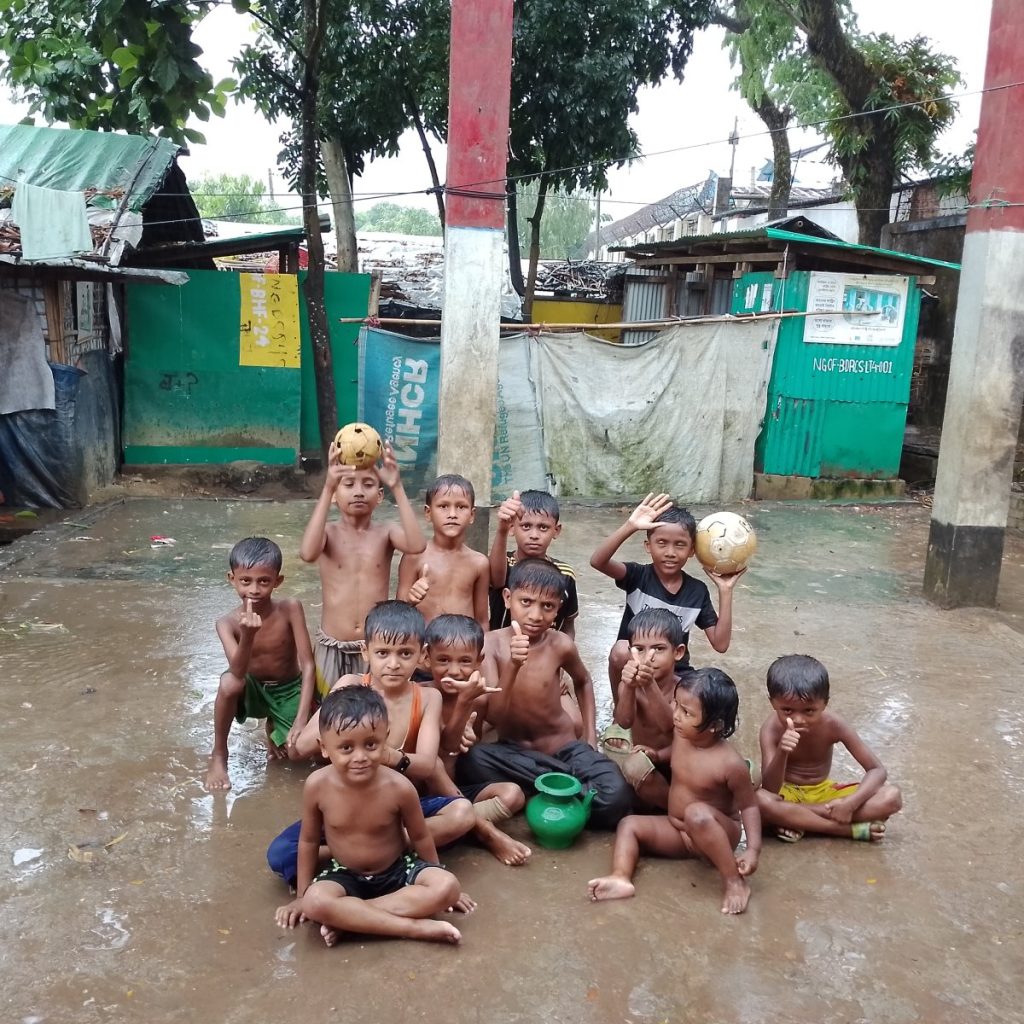
For a people systematically denied their past, the act of preserving heritage is not a luxury; it is an essential act of resistance. Rohingya heritage preservation is more than an academic exercise in archiving history. It is a living, breathing process of safeguarding an identity that has been targeted for erasure. It is about ensuring that a child born in a refugee camp understands that their story did not begin with displacement, but with a rich and deep history rooted in the land of Arakan.
This article explores the critical importance of protecting Rohingya culture, from the linguistic revival of the Hanifi script to the community-led efforts sustaining traditions in the diaspora. It argues that heritage preservation is an active act of resistance that transforms the Rohingya from victims of history into the proud custodians of a future. It is a cornerstone of resilience, a source of psychological strength, and a vital component of rebuilding a community with agency and hope.
Table of Contents
- Understanding Rohingya Heritage: Identity Beyond the Crisis
- The Systematic Erasure of Rohingya Culture in Rakhine State
- Intangible Heritage: Language, Faith, and Oral Traditions
- Preserving Identity in the Diaspora: From Cox’s Bazar to Bradford
- How You Can Take Action Today
- Frequently Asked Questions
Understanding Rohingya Heritage: Identity Beyond the Crisis
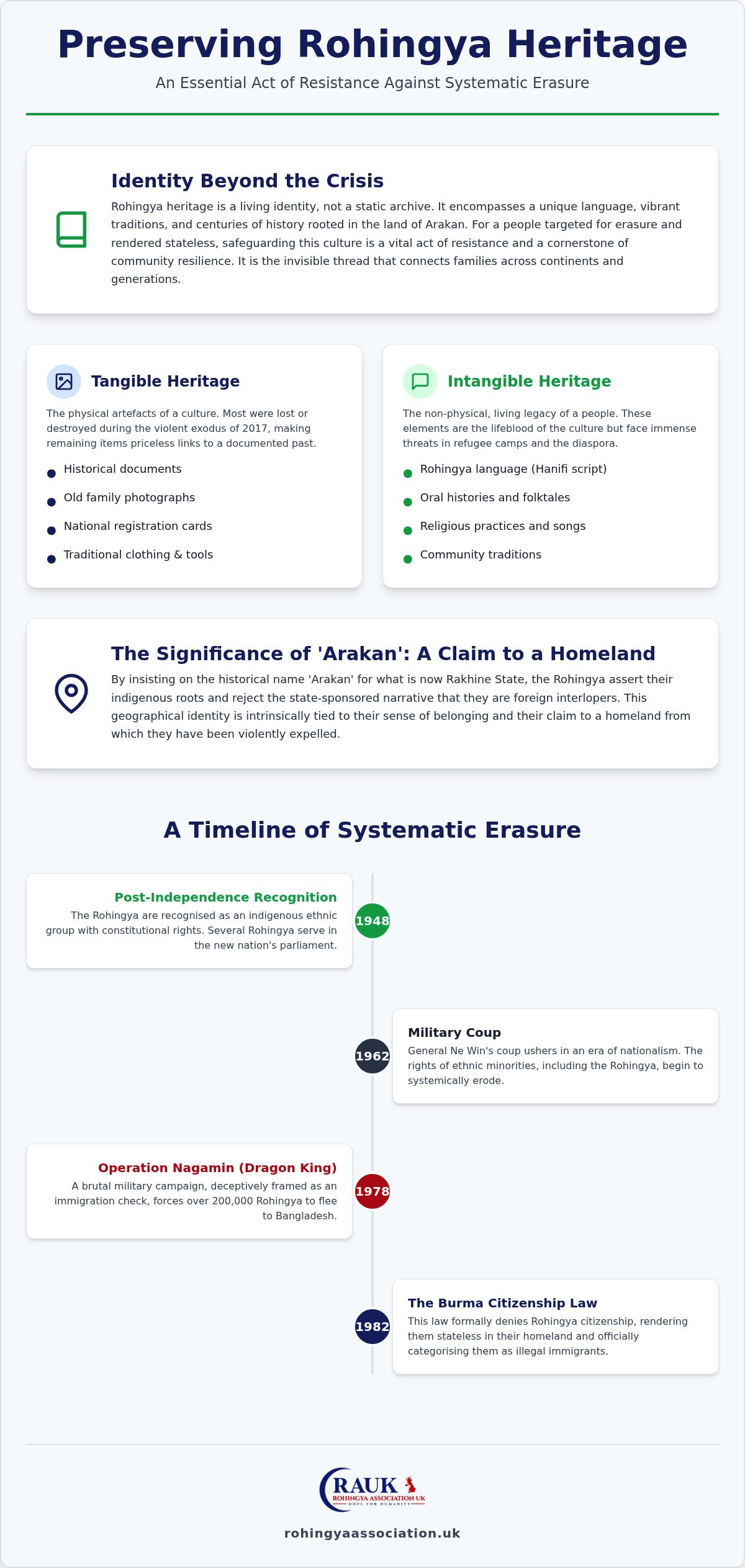
Rohingya heritage encompasses the unique language, the distinct Hanifi script, vibrant traditions, and centuries of history rooted in the region historically known as Arakan. It is a living entity, not a static archive of the past. For a people rendered stateless and scattered across the globe, this shared culture serves as a powerful anchor, providing a sense of continuity, belonging, and profound psychological stability. When homes, possessions, and legal status are stripped away, heritage becomes one of the few things that cannot be physically seized. It is the invisible thread that connects families across continents and generations, reminding them of who they are beyond the label of ‘refugee’.
Community-led organisations like the Rohingya Association UK (RAUK) play a pivotal role in this process, creating spaces where cultural identity can be nurtured and passed on. This work addresses the deep psychological wounds of displacement, affirming that whilst the Rohingya people have been uprooted, their identity remains intact and resilient.
Tangible vs. Intangible Heritage
The distinction between tangible and intangible heritage is crucial in understanding the scope of preservation efforts. Both are deeply vulnerable in the context of forced displacement.
- Tangible Heritage refers to the physical artefacts of a culture. For the Rohingya, this includes historical documents, old family photographs, national registration cards that prove their lineage in Myanmar, traditional clothing, and handcrafted tools from their homes in Rakhine State. During the violent exodus of 2017, most of these items were lost or destroyed, making the few that remain priceless links to a documented past.
- Intangible Heritage is the non-physical legacy of a people. This includes the Rohingya language, oral histories, religious practices, traditional songs, and folktales passed down through generations. These elements are the lifeblood of the culture, but they face immense threats in makeshift refugee camps, where the daily struggle for survival can overshadow the practices that sustain communal identity.
The Significance of ‘Arakan’ in Rohingya Identity
The name ‘Arakan’ holds profound historical and emotional significance for the Rohingya people. It is the historical name for the coastal region in Myanmar that is now officially called Rakhine State. For centuries, Arakan was an independent kingdom and a multicultural hub where the Rohingya community flourished.
The renaming of the state by the Myanmar government was part of a broader strategy to erase the historical presence of the Rohingya. By insisting on the name Arakan, the Rohingya are not just using an old term; they are asserting their indigenous roots and rejecting the narrative that they are foreign interlopers. This geographical identity is intrinsically tied to their sense of belonging and their claim to a homeland from which they have been violently expelled. The act of remembering and using the name ‘Arakan’ is a powerful statement against the state-sponsored re-writing of history.
The Systematic Erasure of Rohingya Culture in Rakhine State
The persecution of the Rohingya is not limited to physical violence; it is a calculated, multi-generational project of cultural erasure. The legal and political framework for this was solidified by the 1982 Citizenship Law, which officially rendered the Rohingya stateless in their own homeland. This law denied them recognition as one of Myanmar’s 135 official ethnic groups, effectively categorising them as illegal immigrants and stripping them of fundamental human rights.
Following this, the state imposed severe restrictions on every facet of Rohingya cultural life. Religious gatherings were monitored, education in the Rohingya language was prohibited, and cultural expression was suppressed. The government enforced the use of the derogatory term ‘Bengali’ to delegitimise their indigenous identity and sever their connection to the land of Arakan. The 2017 genocidal campaign was the brutal culmination of this process, an attempt to physically remove the Rohingya people and erase any remaining trace of their generational memory from the land.
A Timeline of Identity Stripping
The process of stripping Rohingya identity was methodical and has been carried out over decades through discriminatory laws and violent military campaigns. It is crucial to recognise that many of these military operations were given deceptive names by the Myanmar junta to mask their genocidal intent.
- 1948: Burma gains independence. The Rohingya are initially recognised as an indigenous ethnic group with constitutional rights, and several Rohingya serve in parliament.
- 1962: A military coup led by General Ne Win ushers in an era of nationalism and xenophobia. The rights of ethnic minorities, including the Rohingya, begin to erode.
- 1978: Operation Nagamin (Dragon King): This military operation was framed as a process to register citizens and identify illegal immigrants. In reality, it was a brutal campaign of violence and persecution that forced over 200,000 Rohingya to flee to Bangladesh. The name was chosen to sound powerful and protective of the nation, whilst its true purpose was ethnic cleansing.
- 1982: The Burma Citizenship Law: This law formally denies citizenship to the Rohingya, laying the legal foundation for decades of institutionalised discrimination and statelessness.
- 1991: Operation Pyi Thaya (Clean and Beautiful Nation): Another military operation disguised under a benevolent name. This campaign led to another mass exodus, with approximately 250,000 Rohingya fleeing extreme human rights abuses, including forced labour, torture, and religious persecution.
- 2012: State-sponsored violence erupts in Rakhine State, leading to the displacement of over 140,000 Rohingya into squalid internal displacement camps.
- 2017: “Clearance Operations”: Following attacks by a Rohingya armed group, the Myanmar military launched a disproportionate and systematic campaign of violence, which the UN has described as a “textbook example of ethnic cleansing” with genocidal intent. This led to the flight of over 740,000 Rohingya to Bangladesh.
The Impact of Displacement on Cultural Memory
The mass displacement of the Rohingya people has created a profound crisis for cultural memory. For the generation of youth born and raised in refugee camps, their connection to their ancestral homeland is secondhand, constructed from the stories of their elders. This presents an urgent challenge:
- Generational Gaps: Without the physical and social structures of their homeland, passing down traditions becomes incredibly difficult. The risk of losing language, folklore, and historical knowledge grows with each passing year.
- Siloisation of Efforts: The Rohingya diaspora is scattered globally, from Bangladesh and Malaysia to the UK and North America. This can lead to fragmented or ‘siloed’ preservation efforts, making it harder to maintain a unified cultural identity.
- Loss of Elders: The elder generation holds the deepest knowledge of Rohingya history, traditions, and oral genealogies. There is an urgent need to document their stories and wisdom before they are lost forever.
Intangible Heritage: Language, Faith, and Oral Traditions
In the absence of physical monuments or state-protected archives, the intangible heritage of the Rohingya has become the primary vessel for their identity. Language, faith, and oral traditions are not merely cultural artefacts; they are active tools of resilience that provide stability, continuity, and a sense of communal purpose in the face of profound uncertainty.
The Rohingya language, with its unique Hanifi script, is a cornerstone of this identity. Faith, predominantly Islam, provides a moral and social framework that organises community life and offers solace. Oral traditions, from folktales to personal histories, weave the fabric of a shared past and a collective hope for the future. Cultural events, such as religious festivals and community gatherings, are not simple celebrations; they are essential acts of communal affirmation, reinforcing bonds and sustaining the spirit of the people.
The Hanifi Rohingya Script: A Linguistic Revival
For a people whose existence has been denied, having a unique written alphabet is a powerful declaration of identity. The Hanifi Rohingya script, developed in the 1980s and refined over the years, is a standardised writing system created specifically for the Rohingya language. Its adoption represents a modern linguistic revival, empowering the community to document its own stories, educate its children, and communicate across the diaspora in its own voice.
The script is crucial for several reasons:
- It affirms uniqueness: It visually distinguishes the Rohingya language from neighbouring languages like Bengali or Burmese.
- It facilitates education: It provides a consistent tool for teaching literacy to children and adults, both in the camps and in diaspora communities.
- It unifies the diaspora: With the help of digital tools like smartphone keyboards and social media, the Hanifi script is helping to connect Rohingya communities worldwide, fostering a sense of shared identity and enabling stronger community bonding for refugees.
Faith and Heritage: Islamic Community Events
Islam is deeply interwoven with Rohingya cultural identity, providing not only spiritual guidance but also a robust structure for community life. In the diaspora, mosques and community centres have become vital hubs for heritage preservation. They are more than places of worship; they are sanctuaries where cultural and religious traditions are maintained and passed on to the next generation.
Islamic community events, such as the observance of Ramadan, Eid celebrations, and communal prayers, provide a regular rhythm and a sense of normalcy amidst the chaos of displacement. These gatherings reinforce shared values, strengthen social networks, and offer a platform for elders to share wisdom. Furthermore, these faith-based structures are often the first place where community leaders emerge, creating a foundation for effective Rohingya community leadership and self-advocacy.
Preserving Identity in the Diaspora: From Cox’s Bazar to Bradford
The effort to preserve Rohingya heritage is a global one, taking different forms in the diverse environments where the diaspora has settled. From the sprawling camps of Bangladesh to the integrated communities in the United Kingdom, the Rohingya people are actively working to keep their culture alive.
- Cox’s Bazar, Bangladesh: Home to approximately 1.2 million refugees, this is the epicentre of the Rohingya humanitarian crisis. Here, preservation is an act of daily resilience, with efforts focused on oral history projects, makeshift learning centres, and documenting life through art and photography.
- Malaysia: Over 126,000 Rohingya refugees in Malaysia face a precarious existence. Many are navigating a complex transition from UNHCR documentation to the Malaysian government’s DPP (Dokumen Pendaftaran Pelarian) system, which offers limited legal status. Community schools and cultural groups work tirelessly to provide education and a sense of identity for children who have never seen their homeland.
- The United Kingdom: In cities like Bradford, the Rohingya Association UK (RAUK) supports families in navigating the challenges of integration whilst preserving their cultural roots. This includes providing practical support alongside organising cultural events that strengthen community bonds.
- Digital Preservation: Globally, the diaspora is turning to digital tools. Online archives are being created to store copies of precious documents, photographs, and oral histories, protecting them from the physical risks of fire, floods, and decay that are ever-present in refugee camps.
Challenges of Preservation in Refugee Camps
The physical environment of a refugee camp is inherently hostile to cultural preservation. In Cox’s Bazar, there are no museums, libraries, or formal archives. Shelters are temporary and vulnerable to the elements. In this context, preservation takes on a more personal and immediate form.
Community-led initiatives like ‘memory boxes’—where families store their most precious remaining documents and small artefacts—become personal archives. Storytelling projects, where elders recount their life histories to younger generations, serve as living libraries. Humanitarian aid is also crucial, as it helps create safe spaces where children can receive a basic education that includes elements of their language and cultural history, ensuring the flame of identity is not extinguished by the pressures of survival.
Building a New Home in the UK
For the Rohingya community in the UK, preservation is intertwined with integration. Organisations like RAUK provide a vital bridge, helping families access essential services while creating opportunities to celebrate their heritage. This dual approach ensures that integration does not lead to assimilation and the loss of cultural identity.
Support includes providing housing guidance and healthcare access, which establishes a stable foundation for families to rebuild their lives. Crucially, this is paired with cultural initiatives. English language classes are offered not to replace the mother tongue, but to empower individuals to navigate their new society. At the same time, community events, youth empowerment programmes, and mother-tongue classes reinforce the value of Rohingya heritage, ensuring that young people grow up with a strong and proud sense of who they are.
How You Can Take Action Today
Rohingya heritage preservation is a collective responsibility. It is a testament to the resilience of the human spirit and a declaration that a people’s identity cannot be erased by violence or legislation. Your support can help ensure that this vital work continues, empowering the Rohingya community to protect their past and build a dignified future. Understanding the long-term impact of this work is the first step; committing to action is the next.
There are specific, meaningful ways you can contribute, from providing financial support for long-term projects to volunteering your time locally. Every act of support helps combat the narrative of erasure and amplifies the voice of the Rohingya people.
Financial Support and Sustainable Giving
Consistent financial support is the bedrock of sustainable heritage and education projects. Your contributions allow community-led organisations like RAUK to plan for the long term, creating stable programmes that have a lasting impact.
We encourage you to donate your Sadaqah Jariyah to support these ongoing efforts. These funds directly support our Bangladesh projects, providing education for children in the camps, as well as funding our community centres and cultural programmes in the UK. As a community-led, registered charity (No. 1211433), RAUK ensures that your support goes directly to where it is needed most, with full transparency and accountability.
Volunteer and Advocate
If you live in or near Bradford, you can make a direct impact on the local Rohingya community. We invite you to volunteer with Rohingya Association UK, where you can help with everything from tutoring and mentoring to organising community events. Your time and skills are invaluable resources.
For our global supporters, advocacy is a powerful tool. You can help by sharing accurate information about the Rohingya crisis, participating in awareness campaigns, and amplifying Rohingya voices on social media. To stay informed on our work and receive updates on human rights developments, please sign up for the RAUK newsletter on our website.
Frequently Asked Questions
What is the Hanifi Rohingya script and why is it important?
The Hanifi Rohingya script is a modern, standardised alphabet created specifically for the Rohingya language. It is critically important because it provides the Rohingya people with a unique written identity, distinguishing their language from others in the region. It is a powerful tool for education, literacy, and unifying the global Rohingya diaspora, allowing them to preserve their stories and culture in their own words.
How many Rohingya refugees are currently living in Cox’s Bazar?
Approximately 1.2 million Rohingya refugees are living in the camps in and around Cox’s Bazar, Bangladesh. This makes it the largest refugee settlement in the world. The majority of this population fled Myanmar during the violent military crackdowns of 2017.
What is the difference between Arakan and Rakhine State?
Arakan is the historical name for the coastal region in western Myanmar where the Rohingya people have lived for centuries. The name was officially changed to ‘Rakhine State’ by the Myanmar government. The Rohingya people continue to use the name ‘Arakan’ to assert their indigenous roots and reject the government’s narrative that attempts to erase their historical connection to the land.
How does the Malaysian DPP system affect Rohingya refugees?
The DPP (Dokumen Pendaftaran Pelarian) is a registration document issued by the Malaysian government. For over 126,000 Rohingya refugees in Malaysia, the system represents a complex situation. Whilst it provides a form of government registration, it does not grant formal legal status, access to legal employment, or state education. It exists alongside the documentation provided by the UNHCR, creating an uncertain legal environment for refugees.
Can I donate Zakat or Sadaqah to Rohingya heritage projects?
Yes, you can. According to many Islamic scholars, Zakat and Sadaqah can be given to support projects that provide essential aid and empowerment to vulnerable and displaced Muslim communities. Donating to Rohingya heritage projects, which often include education and community support, is a valid way to fulfil your charitable obligations, as it helps preserve the identity and build the resilience of a persecuted people.
What role does the Rohingya Association UK play in Bradford?
The Rohingya Association UK (RAUK), based in Bradford, serves as a vital community hub. It provides essential support for Rohingya families, helping them integrate into British society by offering housing guidance, healthcare access, and English classes. Simultaneously, RAUK plays a crucial role in heritage preservation by organising cultural and religious events that strengthen community bonds and ensure traditions are passed to the next generation.
Why is cultural preservation prioritised alongside humanitarian aid?
Cultural preservation is prioritised alongside humanitarian aid because survival is about more than just physical well-being. For a community that has experienced profound trauma and the stripping of its identity, preserving culture provides essential psychological and emotional resilience. It restores a sense of dignity, continuity, and hope, which are fundamental to a community’s ability to recover and rebuild.
How can I help preserve Rohingya oral histories?
You can help by supporting organisations like RAUK that are actively involved in documentation projects. Financial support helps fund the equipment and personnel needed to record, transcribe, and archive the stories of elders. You can also help through advocacy by sharing these stories on social media and other platforms to raise awareness, ensuring that the history of the Rohingya people is heard and remembered by the wider world.