
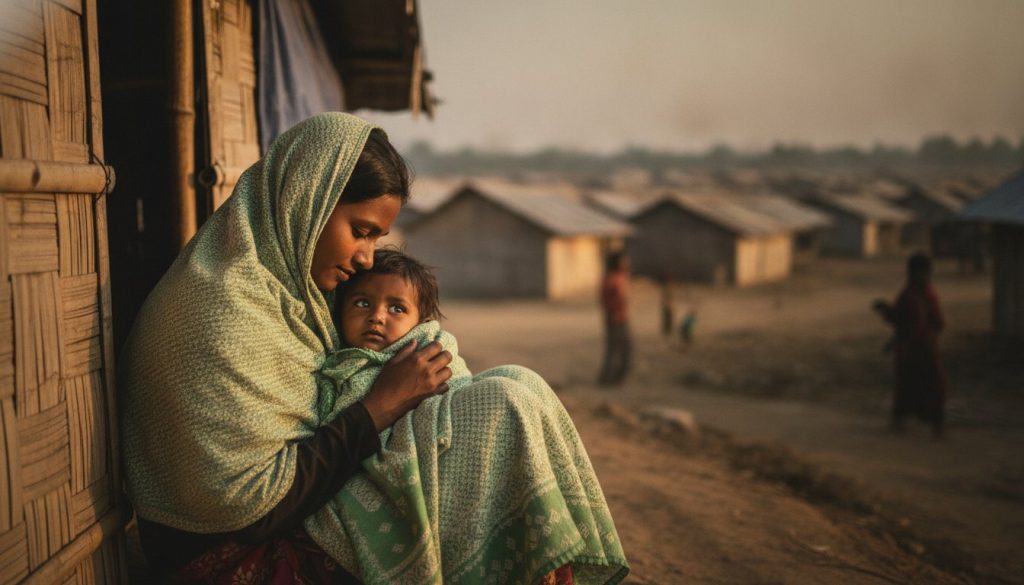
With nearly 1.2 million Rohingya refugees currently seeking safety in Cox’s Bazar, Bangladesh, and international funding for the 2026 Joint Response Plan falling significantly short of its targets, the survival of an entire people rests on the shoulders of individual conscience. You likely recognise that your Zakat for Rohingya refugees is more than a religious obligation; it’s a vital mechanism for justice, protection, and restoration for those displaced from Rakhine State, formerly known as Arakan State. It’s a commitment to upholding the dignity of a community that has endured decades of systemic erasure.
We understand the weight of ensuring your contributions reach those most in need whilst addressing systemic inequalities rather than providing only fleeting relief. This guide provides the clarity you require, detailing how your 2026 donations can offer life-changing support, legal security, and successful community integration for families in the UK and abroad. We will examine current Nisab thresholds, the evolving documentation landscape in Malaysia, and the profound impact of community-led advocacy in building a resilient future for the stateless.
Key Takeaways
- Recognise why displaced families from Rakhine State (Arakan) qualify for support under the traditional Asnaf categories of the poor and the needy.
- Discover how your Zakat for Rohingya refugees provides critical crisis intervention for 1.2 million people whilst funding long-term integration projects in the UK.
- Gain a clear framework for calculating your 2026 Zakat obligation based on the latest Nisab thresholds for gold, silver, and business assets.
- Explore the vital role of community-led advocacy in restoring dignity and self-sufficiency to stateless populations through education and youth empowerment.
- Learn practical steps to take action today by supporting transparent, direct-impact humanitarian initiatives that bridge the gap between donors and those in need.
Understanding Zakat for Rohingya Refugees: Eligibility and Purpose
Zakat represents a fundamental pillar of Islamic practice; it’s a compulsory act of worship designed to purify one’s wealth whilst ensuring social equity. Unlike voluntary charity, Zakat is a divine right of the poor over the surplus wealth of the community. When we consider Zakat for Rohingya refugees, we’re engaging with a population that exists at the intersection of multiple eligible categories defined in the Quran. These individuals aren’t merely recipients of aid; they’re survivors of the Rohingya genocide who have been stripped of their homes, assets, and legal identities.
The distinction between Zakat and Sadaqah is vital. Whilst Sadaqah is an open-ended expression of kindness, Zakat is a targeted obligation. For the displaced families from Rakhine State, historically known as Arakan State, this mandatory support provides a stable foundation for survival and eventual integration. It serves as a spiritual and social contract that binds the donor to the most vulnerable members of the global community.
The Eight Categories of Zakat Recipients
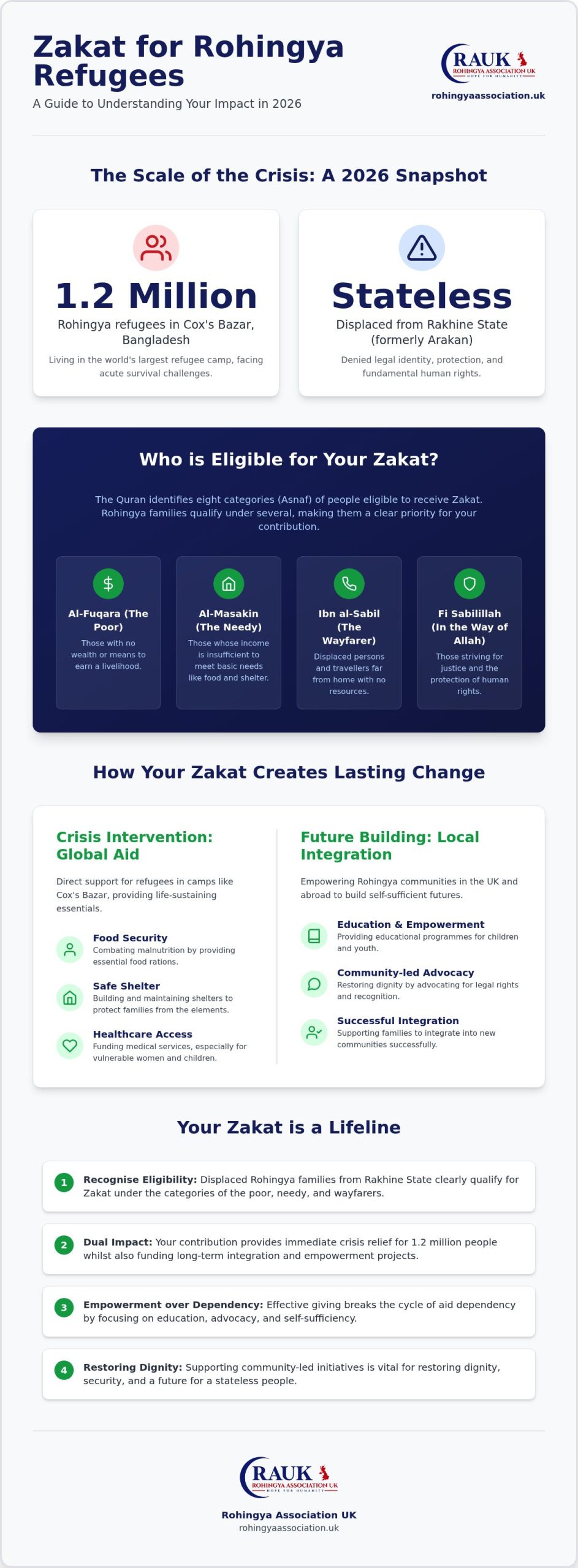
The Quranic verse 9:60 identifies eight specific groups (Asnaf) entitled to Zakat. Rohingya families typically qualify under several headings, making them a primary focus for your contributions. Their status as stateless people intensifies their eligibility, as they lack the governmental safety nets most take for granted.
- Al-Fuqara (The Poor): Individuals who possess no wealth or means of livelihood.
- Al-Masakin (The Needy): Those whose income fails to meet their basic survival requirements for food and shelter.
- Ibn al-Sabil (The Wayfarer): Displaced persons far from their homeland without resources to return or sustain themselves.
- Fi Sabilillah (In the way of Allah): Those striving for justice and the protection of fundamental human rights.
Ensuring Zakat for Rohingya refugees is distributed through trusted, community-led organisations is essential. This guarantees that funds are used in a Zakat-compliant manner that respects the dignity of the recipients and addresses the specific challenges of life in displacement.
Why Rohingya Refugees are a Priority for Your Zakat
The Rohingya are a population without a state to protect their interests or advocate for their rights. By directing your Zakat towards these families, you’re participating in the restoration of human dignity. Effective giving focuses on breaking the cycle of dependency found in refugee camps. Rather than solely providing temporary relief, Zakat-funded initiatives should aim for empowerment through education and community integration. When we prioritise this community, we act as a protective shield and a guiding hand for those who have lost everything, ensuring they aren’t forgotten by history.
The Rohingya Crisis in 2026: Why Your Support is Vital
As we navigate 2026, the humanitarian landscape for the Rohingya hasn’t merely persisted; it has deepened into a protracted crisis of survival. Approximately 1.2 million refugees are now concentrated in Cox’s Bazar, Bangladesh, creating a density of human need that strains every available resource. In Rakhine State, historically known as Arakan State, the conditions for those remaining are defined by systemic exclusion and a total absence of legal protection. The Rohingya Crisis is a stark reminder of the consequences when a population is denied the basic right to a state.
Life in Cox’s Bazar: Beyond the Statistics
Daily life in the world’s largest refugee camp is an exercise in resilience. Families inhabit fragile shelters that offer little protection, whilst food insecurity remains a constant threat to health. Women and children constitute more than half of the population. Their vulnerability is compounded by restricted access to healthcare and safe spaces for education. You can explore more inside the Rohingya refugee camp to see how these families endure.
The current humanitarian landscape is defined by three primary challenges that Zakat for Rohingya refugees helps to mitigate:
- Acute Food Insecurity: Dwindling international aid has led to reduced rations, leaving families dependent on private humanitarian support.
- Healthcare Deficits: A lack of specialised clinics means that preventable illnesses often become life-threatening.
- Restricted Movement: Legal barriers in both Bangladesh and Myanmar prevent refugees from seeking employment or higher education.
The Struggle for Recognition in Malaysia and Myanmar
In Malaysia, over 126,000 Rohingya are navigating the transition to the DPP (Dokumen Pendaftaran Pelarian) system. Whilst this centralises registration, families still face significant legal uncertainty. In Rakhine State (Arakan), structural barriers and military-enforced restrictions prevent access to markets and hospitals. This isn’t just a hardship; it’s a denial of heritage. Your help allows us to support our Bangladesh projects and advocate for those silenced by these systems.
How Your Zakat is Distributed: Local Integration and Global Aid
The allocation of Zakat for Rohingya refugees operates through a dual-lens approach: immediate crisis intervention and long-term community empowerment. By directing funds towards specific, high-impact pillars, we ensure that every contribution facilitates a transition from mere survival to sustainable growth. This distribution model prioritises food security, clean water, and emergency shelter in the camps whilst simultaneously funding advocacy efforts that demand global accountability for the displaced. It’s a methodical process designed to restore agency to those who have been systematically marginalised.
Beyond emergency relief, Zakat supports essential healthcare access and educational programmes. In regions where refugees are denied state-sponsored services, your contributions fund mobile clinics and navigate complex medical systems. Furthermore, Zakat-funded advocacy campaigns serve as a collective voice for the stateless, ensuring the struggle for justice remains on the international agenda. This comprehensive framework addresses the immediate physical needs whilst fighting the structural inequalities that perpetuate the crisis.
Supporting the Rohingya Community in Bradford
In the UK, the Rohingya Association UK (RAUK) utilises Zakat to facilitate the successful integration of families who have settled in Bradford. This local work is critical; it transforms the refugee experience from one of displacement to one of stability, belonging, and hope. By providing housing guidance and assisting families in navigating the NHS, we remove the barriers that often lead to social isolation. Zakat specifically funds English language classes and youth empowerment initiatives, equipping the next generation with the tools they need to thrive in their new home. To understand the full network of care available in the city, exploring the local refugee support groups Bradford hosts can help you identify where your time and resources will have the greatest impact.
Integration also requires the preservation of cultural identity. We use funds to organise cultural and Islamic events that celebrate Rohingya heritage, ensuring that whilst families integrate into British society, they do not lose their ancestral roots. This balance is vital for the psychological well-being and resilience of the community.
Global Projects: From Cox’s Bazar to Rakhine State
Our global operations extend into the most challenging environments, including the hard-to-reach areas of Rakhine State, previously known as Arakan State. Delivering aid within Myanmar requires sophisticated logistics and deep community trust. Because RAUK is community-led, we utilise established networks to ensure food and medical supplies reach vulnerable families who are often bypassed by larger international agencies. This “Rohingya helping Rohingya” model ensures maximum transparency and cultural sensitivity.
In Bangladesh, your contributions directly support our Bangladesh projects, which focus on maintaining camp infrastructure and providing crisis intervention. These projects are managed by those who understand the daily realities of the camps, ensuring that aid is not just delivered, but is effectively prioritised based on the most urgent local needs. Through these community-led distribution networks, your Zakat becomes a powerful tool for both survival and restoration.
Calculating and Fulfilling Your Zakat Obligation
Fulfilling the third pillar of Islam requires more than a compassionate heart; it demands a precise spiritual audit. To ensure your Zakat for Rohingya refugees is valid, you must first determine if your wealth meets the Nisab, the minimum threshold that triggers the obligation. In 2026, the silver Nisab threshold is approximately £416.40, whilst the gold threshold stands at roughly £5,094.94. Most scholars recommend using the silver threshold to maximise the support available for the vulnerable, ensuring that the collective strength of the community is utilised to protect the stateless.
Calculating your contribution involves a straightforward assessment of your qualifying assets held for one lunar year (Hawl). You’ll need to aggregate your cash, gold, silver, business stock, and shares, then deduct any immediate debts. The resulting figure is your Zakat-eligible wealth, of which 2.5% is due. This isn’t merely a tax; it’s a mechanism to purify your earnings, honour your faith, and provide a lifeline to families who have lost everything in Rakhine State, formerly Arakan State.
Whilst many choose to give during Ramadan 2026—expected to begin on 17 or 18 February—the urgency of the crisis often demands year-round intervention. For instance, the devastating landslides and floods in July 2026, which displaced over 13,000 people in the camps, highlight why immediate support is vital outside the holy month. You can pay your Zakat in a single sum or through regular instalments, provided the total obligation is met by the end of your Zakat year, allowing for sustained crisis intervention and long-term integration efforts.
Zakat vs. Sadaqah Jariyah: Choosing the Right Intent
Understanding the distinction between these two forms of giving is essential for impactful support. Zakat is typically prioritised for immediate, life-saving needs such as food, emergency medical care, and shelter for the 1.2 million refugees in Cox’s Bazar. In contrast, you might choose to donate your Sadaqah Jariyah to fund sustainable infrastructure, such as permanent school buildings or water filtration systems. A balanced approach ensures that whilst today’s hunger is satisfied, the foundations for a resilient future are also being laid.
Fulfilling Your Duty with Rohingya Association UK
When you decide to donate to Rohingya refugees UK, choosing a community-led organisation ensures your funds are managed with the highest level of cultural and religious sensitivity. The Rohingya Association UK (RAUK) maintains a strict Zakat-compliant policy, ensuring your donation reaches the most eligible recipients amongst the poor and the needy. If you’re a UK taxpayer, remember to select the Gift Aid option; this allows us to reclaim an extra 25p for every £1 you give at no extra cost to you, significantly amplifying the impact of your generosity.
By choosing a dedicated partner, you can ensure your contribution provides the safety, stability, and integration these families deserve. Explore our current initiatives to see how you can support our Bangladesh projects today.
How You Can Take Action Today: Supporting the Rohingya Association UK
The transition from awareness to action is the definitive step in restoring justice for the stateless. By choosing to support the Rohingya Association UK (RAUK), you’re partnering with a community-led organisation that understands the nuanced needs of those displaced from Rakhine State, previously known as Arakan State. Allocating your Zakat for Rohingya refugees through RAUK ensures that your contribution acts as a direct lifeline, providing both emergency relief in the camps and essential integration services for families arriving in the UK.
Beyond financial support, your voice is a powerful tool for advocacy. Raising awareness about the 1.2 million people in Cox’s Bazar or the legal shifts in Malaysia, such as the transition to the DPP system, keeps the Rohingya struggle on the global agenda. For businesses, partnering with RAUK offers a transparent pathway to fulfil corporate social responsibility goals whilst making a tangible difference in tackling global inequality. If you possess professional skills in teaching, administration, or community organising, we invite you to volunteer with Rohingya Association UK in Bradford and become a literal part of our integration network.
The Impact of Your Contribution
We maintain a rigorous commitment to transparency, ensuring every pound is utilised to foster restoration and growth. Your contributions are transformed into essential resources that address both immediate survival and long-term stability. Whilst Zakat meets urgent needs, you may also choose to donate your Sadaqah Jariyah to fund the enduring infrastructure our community requires.
- Crisis Intervention: Food packs and clean water for families in the high-density camps of Bangladesh.
- Education: ESOL materials and English language classes to help refugees in Bradford communicate and thrive.
- Legal Guidance: Support for families navigating complex asylum and healthcare systems in the UK.
- Youth Empowerment: Mentorship and skill-building workshops for the next generation of Rohingya leaders.
Consider the story of a family who recently arrived in Bradford from the camps. Through community-led housing guidance and ESOL support, they’ve moved from the isolation of displacement to active participation in local life. The father has secured employment, and the children are excelling in school, a testament to what is possible when Zakat is used to build a bridge toward integration.
Join Our Community of Supporters
Our work is a collective effort rooted in a shared identity and a deep sense of duty. We encourage you to sign up for our newsletter to receive regular updates on how we support our Bangladesh projects and local initiatives. Attending our cultural events in Bradford is another excellent way to meet the community and witness the resilience of the Rohingya people firsthand. If you are looking to connect with the wider network of organisations making a difference in the city, our guide to local refugee support groups in Bradford offers a comprehensive overview of impactful community action available to you. Your Zakat is more than a donation; it’s a bridge to hope and a commitment to a future where no one is left stateless.
Empowering a Future of Dignity and Justice
The survival of the Rohingya people in 2026 depends on a collective commitment to justice that transcends temporary aid. By understanding the specific eligibility of displaced families from Rakhine State, formerly Arakan State, you can ensure your wealth purification serves as a powerful shield for the vulnerable. We’ve seen how community-led initiatives provide not just food and shelter, but a pathway to integration and youth empowerment for those settling in the UK. Your Zakat for Rohingya refugees is the vital link between their current displacement and a future defined by agency and restoration.
The Rohingya Association UK is a Registered Charity in England and Wales (1211433) led by advocates from within the community. This unique position allows us to maintain direct access to camps whilst providing transparent reporting on every project your donations fund. We invite you to stand with us as a dedicated partner in this mission of hope. Donate your Zakat to support Rohingya refugees today and help us build a world where the stateless are finally seen, protected, and empowered to thrive. Together, we can ensure that resilience is met with the support it deserves.
Frequently Asked Questions
Is it permissible to give Zakat to refugees who are not in Muslim-majority countries?
Yes, the permissibility of Zakat is determined by the recipient’s eligibility under the eight Quranic categories, regardless of their current geographical location. Rohingya families in the UK or Malaysia are often classified as the poor (Al-Fuqara) or the needy (Al-Masakin). Your Zakat for Rohingya refugees provides essential support for those navigating complex legal systems like the Malaysian DPP, ensuring they have access to basic necessities whilst seeking stability.
How does RAUK ensure that 100% of Zakat-designated funds reach the eligible recipients?
We operate a strict 100% Zakat policy where every penny donated for this purpose is distributed directly to those in need. As a community-led organisation, we cover our administrative and operational costs through separate Sadaqah donations or specific grants. This ensures that your contribution provides maximum impact within the camps of Cox’s Bazar and the hard-to-reach areas of Rakhine State, formerly known as Arakan State.
Can I pay my Zakat-al-Fitr to the Rohingya Association UK?
Yes, you can fulfil your Zakat-al-Fitr obligation through our dedicated appeals before the Eid al-Fitr prayer in 2026. These funds are specifically used to provide nutritious food parcels to displaced families, allowing them to celebrate the festival with dignity. In 2026, the estimated amount is $12 per person, which we distribute across our project sites in Bangladesh and Myanmar to alleviate acute hunger.
What is the difference between Zakat and Sadaqah Jariyah in the context of RAUK projects?
Zakat is a mandatory annual payment used primarily for immediate, life-saving intervention such as food, clean water, and emergency shelter. In contrast, Sadaqah Jariyah is a voluntary, ongoing charity used for sustainable, long-term infrastructure. For RAUK, this includes funding English language classes in Bradford or building permanent educational facilities that continue to benefit the community for generations, providing an eternal reward for the donor.
How much is the Nisab for Zakat in the UK for 2026?
The Nisab thresholds for 2026 are calculated based on the current market value of gold and silver. As of early 2026, the silver Nisab is approximately £416.40, whilst the gold Nisab is roughly £5,094.94. Scholars generally recommend using the silver threshold to ensure that a broader range of support is captured for the 1.2 million refugees currently facing extreme hardship in the camps.
Can I specify which project my Zakat should support (e.g., Bangladesh or UK)?
Yes, donors have the option to earmark their Zakat for specific regions or initiatives. Whether you wish to prioritise crisis intervention in the 1.2 million-strong camps of Bangladesh or support the integration of families in Bradford, we honour your intent. This transparency allows you to connect your religious duty with the specific humanitarian outcomes that resonate most with your personal values and concerns.
What happens if I have missed Zakat payments from previous years?
If you have missed Zakat payments, you should calculate the amount owed for each of those years and pay it as soon as possible. Zakat is considered a debt to the poor and remains an obligation until it’s fulfilled. RAUK can assist you in calculating these back-payments based on historical Nisab values, ensuring your wealth is fully purified and your duty to the stateless is met.
Does RAUK provide a Zakat certificate or receipt for tax purposes?
Yes, as a Registered Charity in England and Wales (1211433), we provide formal receipts for all donations. These documents are essential for your records and can be used to claim Gift Aid if you’re a UK taxpayer. This allows us to reclaim an additional 25% on your donation from the government, significantly increasing the resources available for our advocacy and integration projects.