

The threshold for Zakat isn’t one fixed cash sum: it’s the market value of 87.48 grams of gold. If your wealth exceeds the nisab, you may need to pay Zakat based on your circumstances. Finding the best charity to give Zakat to in the UK means considering not only where your donation goes, but how it’s allocated.
It’s reasonable to want confidence that your Zakat reaches people eligible under Islamic principles and is handled carefully. Comparing charities can help you understand their approach before you give.
This guide explains how to assess whether your wealth qualifies, then what to compare across UK charities: Zakat allocation, aid delivery, reporting and Shariah compliance. You’ll have a clearer basis for choosing a charity whose work and accountability align with your values.
Key Takeaways
- Use the nisab threshold, the market value of 87.48 grams of gold, to assess whether your wealth qualifies; Zakat is calculated at 2.5% of excess wealth.
- Compare how charities allocate Zakat and explain who receives it, rather than relying on a headline promise alone.
- Look for clear information about aid delivery and reporting so you can understand how donations are put to work and what outcomes are shared.
- Check how a charity addresses Shariah compliance, including distribution to people who qualify under Islamic principles.
- Islamic guidelines suggest distributing Zakat within one lunar year of collection, so consider how a charity manages that timeframe.
1. International humanitarian and development work
UK charities may distribute Zakat to eligible recipients in the UK or overseas, depending on their programmes and allocation policies. To understand where your donation could go, compare the charity’s stated destinations and check whether it distinguishes Zakat from other donations.
International humanitarian aid can address urgent needs such as food, shelter and essential supplies. Development work may focus on longer-term support, such as education or livelihoods. These descriptions alone don’t establish whether a project accepts Zakat, so look for a clear explanation of how Zakat funds are allocated.
One reported example of cross-border reach is that more than 9.2 million people across 33 countries have benefited from Zakat and sadaqah since 2017. That figure covers two forms of giving together. It illustrates scale, but doesn’t tell you how a particular charity allocates Zakat or which recipients its current programmes serve.
Local giving can support eligible individuals and families facing hardship in Britain, while international giving may reach people affected by conflict, displacement or disaster. These are possible areas of charitable work, not a guarantee that every charity funds them through Zakat. Compare each organisation’s stated destinations with the needs you want to support.
Before donating, follow three practical steps. First, identify whether the appeal is for local or international assistance. Next, read the charity’s description of the programme and its intended recipients. Then check whether it explicitly identifies the donation as Zakat and explains how it is kept distinct from other funds.
For example, an appeal describing food parcels in Bangladesh tells you the location and type of assistance. It still leaves important questions: who receives the parcels, how the charity assesses eligibility, and whether Zakat donations are allocated to that work. Clear answers help you compare the appeal with another programme supporting families in the UK.
Humanitarian emergencies can require immediate relief, while development programmes address needs over a longer period. A charity’s explanation should help you distinguish these approaches and understand how your donation is intended to be used. If an appeal describes both, look for a breakdown of the activities funded by Zakat rather than assuming all project costs qualify.
For a Muslim choosing regular giving, consistency can make the destination and purpose especially important. Compare reporting on locations, activities and recipients, not only broad claims about international reach. A clearly described programme gives you a stronger basis for deciding whether local support, international humanitarian aid or a particular combination reflects your priorities.
2. Zakat donation allocation and 100% donation promise
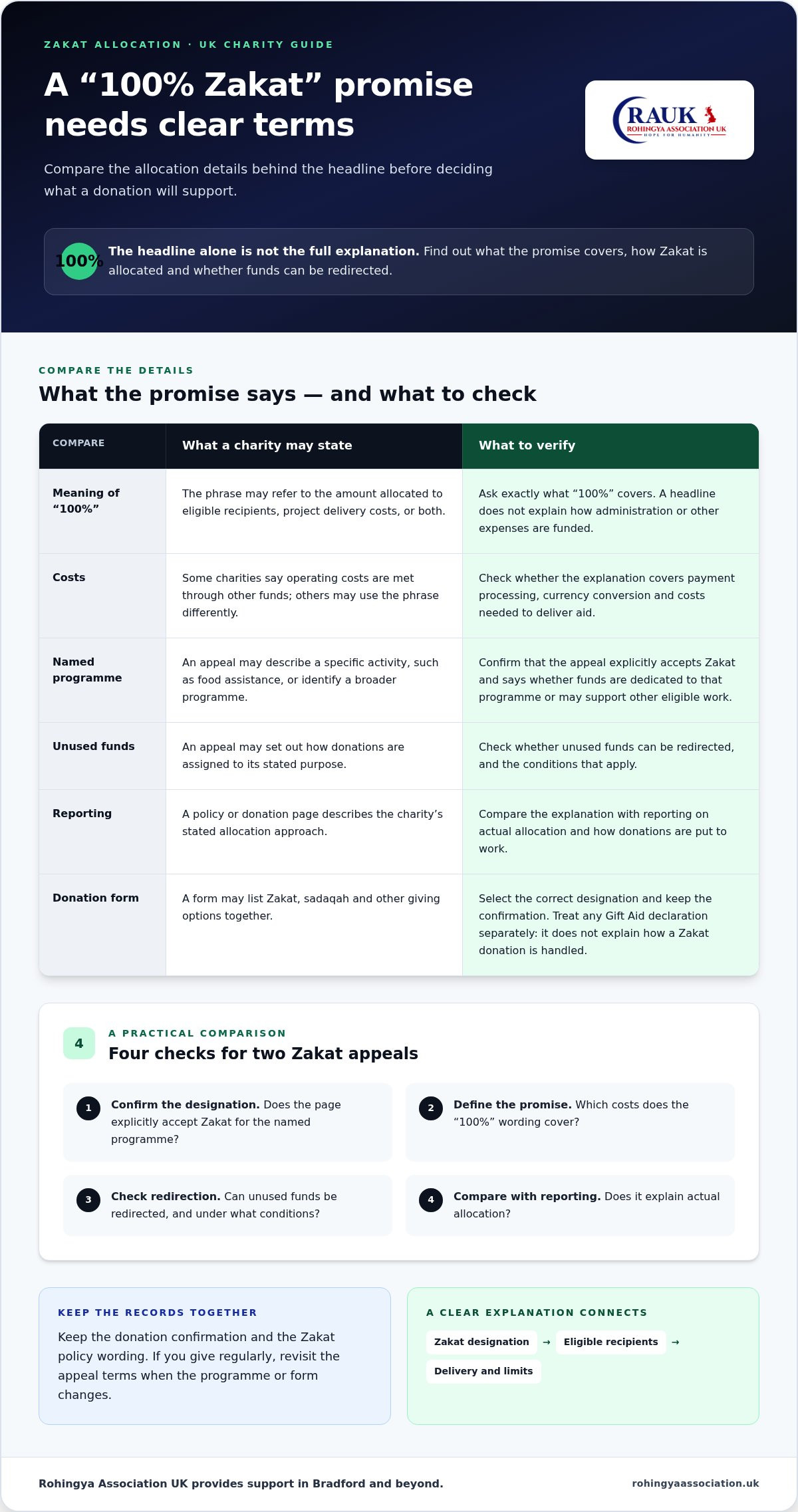
A “100% Zakat donation” promise needs a precise explanation before it can guide your decision. Ask what “100%” covers: the amount allocated to eligible recipients, the project’s delivery costs, or both. A headline phrase alone doesn’t tell you how the charity funds administration, payment processing or other expenses.
Read the charity’s Zakat policy alongside the donation page. Look for a clear description of the fund, intended recipients and permitted uses. For example, an appeal for food assistance should explain whether your Zakat is dedicated to that programme or may support other eligible work. This distinction helps you understand what your donation will support.
Some charities describe a 100% policy by saying they meet operating costs through other funds. Others may use the phrase differently. Compare the wording, not just the label, and note whether the explanation covers online payments, currency conversion or costs required to deliver aid. Don’t assume every organisation uses “100%” in the same way.
Use these steps when comparing two appeals:
- Identify whether the page explicitly accepts Zakat for the named programme.
- Find how it defines the 100% promise and which costs it covers.
- Check whether unused funds can be redirected, and under what conditions.
- Compare the charity’s explanation with its reporting on actual allocation.
Donation forms may present Zakat, sadaqah and other giving options together. Select the correct designation and keep the confirmation for your records. If a form offers a Gift Aid declaration, treat it as separate from the Zakat designation. That option alone doesn’t explain whether Gift Aid applies to a particular Zakat donation or how any related funds are handled.
This distinction matters because a donation form records your instruction, while the charity’s policy explains its allocation process. Read both before submitting. For example, if you select a Zakat appeal for vulnerable children, check that the description identifies the intended recipients and explains whether the funds remain dedicated to that appeal.
When a charity says funds go “towards” a programme, look for details showing what that means in practice. A useful explanation connects the donation category to eligible recipients, delivery activities and any limits on redirection. Clear terms let you compare promises fairly, rather than treating “100%” as a complete account of costs.
Keep the donation confirmation and the policy wording together. If you donate regularly, revisit the appeal terms when the programme or form changes. A transparent zakat donation process should make the designation, allocation approach and meaning of any 100% promise understandable before you give.
3. How quickly is aid delivered after I donate?
How a donation is delivered depends on the programme’s practical steps: identifying eligible recipients, sourcing assistance and getting it to them. For example, food support for families requires different arrangements from education support for orphans. The charity’s appeal should explain the work your contribution supports, so you can understand what happens after you donate.
Your own Zakat calculation starts with the nisab, the wealth threshold for eligibility. The research figure used here is the market value of 87.48 grams of gold. If your wealth exceeds that threshold, Zakat is calculated at 2.5% of excess wealth within one lunar year. The threshold is a value, not a fixed cash amount.
Gold and silver valuations can produce different threshold values as their market prices change. A Zakat calculator should make clear which valuation it uses and which assets and liabilities it asks you to include. Use the same approach consistently when reviewing your wealth. Don’t compare a gold-based result with a silver-based result as though they were identical.
To use a calculator, gather current values for the assets it asks about, then follow its categories carefully. Cash, savings and other relevant wealth may need separate entries. Check the calculator’s stated valuation basis before accepting its result. If the figure is close to the nisab, reviewing each entry can help identify whether you missed an input or counted it twice.
The calculation and aid-delivery timetable answer different questions. The nisab helps you decide whether Zakat is due; the charity’s programme explains how donations are put to work. A Muslim charity supporting families in Africa, for instance, may describe food or shelter assistance, but that description alone doesn’t set a delivery date.
Look for concrete details in the appeal: the type of aid, intended recipients and steps between donation and distribution. A programme for children may need different supplies from emergency food assistance. These details help you judge whether the work matches your priorities, without assuming every appeal moves at the same pace.
For an informed comparison, note the appeal’s stated destination and activity, then read how it explains recipient selection and delivery. A regular donation may support ongoing programmes, while a specific appeal may focus on a defined need. The key is to understand the programme’s process, not infer a timetable from the donation button.
Zakat carries spiritual significance, but careful calculation and informed giving also matter. Use a calculator to organise your figures, confirm whether it applies the 87.48-gram gold threshold, and review its treatment of silver valuation. Then compare the charity’s programme details to understand how eligible recipients are reached.
4. Impact reporting and donor trust
Useful impact reporting connects donations to activities, recipients and outcomes. For example, a report about food assistance can identify the programme, the countries involved and the support delivered. A claim of global reach matters less than clear evidence of what the charity did with each designated fund.
How can you verify a UK charity’s registration and Zakat policy? Search the official charity register for the organisation’s name and registration details, then compare these with its website. Read its Zakat policy for information about eligible recipients, fund allocation and reporting.
Look for reports that distinguish Zakat from sadaqah and other donations. If a charity publishes an annual report, check whether it explains how Zakat was allocated, which programmes received funds and how outcomes are assessed. A combined total for all charitable giving won’t show how your Zakat was used.
Strong reporting describes more than the number of people reached. It may explain the assistance provided, the needs it addressed and what changed for recipients. For example, a report might distinguish immediate food support from a longer-term programme intended to strengthen livelihoods. This detail helps you assess the work without relying on broad claims.
What risks or warning signs should you check before donating Zakat to a charity? Be cautious if an appeal gives no clear Zakat policy, uses unclear allocation language or offers no meaningful reporting. Pressure to donate immediately, unsupported impact claims and inconsistent organisation details also deserve careful attention.
Before giving, compare the appeal with the charity’s published documents. Check that the donation page names the same organisation as its reports, and that the stated programme matches the Zakat policy. If an appeal concerns children, for instance, look for an explanation of the project and how the charity reports its work with intended recipients.
Scholars’ guidance can help donors understand Zakat principles, but a charity should also explain its own procedures. Look for information about who oversees its Zakat approach, how funds are reviewed and how the organisation handles questions about eligibility. Specific explanations are more useful than a general claim of Shariah compliance without supporting detail.
For regular giving, review each annual update rather than assuming an earlier report covers later donations. Compare stated activities with reported outcomes, and note whether the charity explains delays or changes to a programme. Clear reporting supports informed decisions across countries and projects, while keeping the purpose of your giving visible.
A practical comparison can focus on four points: registration details, a written Zakat policy, separate reporting for Zakat and sadaqah, and specific programme outcomes. Together, these checks help you assess whether the charity communicates clearly and accounts for its work. Trust grows through consistent explanations, not a single promise on a donation page.
5. Shariah compliance and Zakat distribution
Zakat is one of Islam’s five pillars, so donors often want clarity about how charities apply Islamic principles. Surah At-Tawbah 9:60 identifies the categories of Zakat recipients. A charity’s policy should explain how it directs Zakat to people who qualify under those principles, rather than treating every charitable appeal as suitable.
Islamic guidance also concerns the timing and handling of donations. The guidance described here suggests distributing Zakat within one lunar year of collection. Read the charity’s policy to understand how it records Zakat, selects eligible recipients and manages funds before distribution. These details help you understand its approach without assuming every organisation follows identical procedures.
Look for a transparent explanation of oversight. A charity may describe how scholars advise on or review its Zakat policy, who applies that guidance, and how decisions are documented. The important distinction is between naming an adviser and explaining the process. Clear information helps donors see how Islamic principles inform decisions about recipients and projects.
Before donating, compare the Zakat policy with the specific appeal. Check whether the charity explains:
- Which recipient categories the appeal is intended to support.
- How eligibility is assessed and funds are distributed.
- Whether Zakat is kept distinct from other donations in its records.
- How the organisation reports on allocation and distribution.
For example, an appeal for food assistance should explain how its intended recipients qualify for Zakat. A project serving a wider Muslim community may include different activities, so check how the charity identifies eligible recipients within that work. A broad charitable purpose alone doesn’t explain how Zakat will be allocated.
Compare the policy with published reports and the donation wording. If the appeal says Zakat will support a particular programme, look for reporting that describes the programme’s recipients and activities. If the organisation explains that distribution can take time, its policy should clarify how funds are handled during that period and how it follows the one-lunar-year guidance.
These checks don’t require specialist knowledge. Read the policy, match it to the appeal, then note how the charity explains oversight and reporting. A clear, consistent account gives you practical grounds for assessing whether the organisation’s Zakat process reflects its stated Islamic approach.
Community support can also strengthen connection, belonging and cultural continuity, though it should not be confused with a Zakat appeal unless the charity explains its eligibility and allocation. If you’re seeking support that brings people together, explore community support as a separate part of your decision.
Rohingya Association UK: Community Support & Integration
Rohingya Association UK supports community connection and integration, with work in Bradford and beyond. If your priority is strengthening support for Rohingya families, its Community Support & Integration work is a relevant place to start.
Its work also includes Education & Youth Empowerment, Cultural & Community Events, and Advocacy & Awareness Campaigns. These activities support learning, preserve community bonds and raise awareness. They are distinct from choosing a Zakat appeal, so consider the charity’s Zakat allocation policy separately when deciding where to direct Zakat.
If you’re seeking community support or are interested in these areas of work, visit rohingyaassociation.uk to learn more about Rohingya Association UK.
Make your next step deliberate
Choosing the best charity to give Zakat to in the UK is a decision rooted in both religious duty and the kind of change you hope to support. Let your choice reflect your values, while keeping Zakat decisions distinct from other ways you may wish to contribute. Thoughtful giving can honour faith and strengthen solidarity.
If you’re also considering how to support Rohingya communities, learn about Rohingya Association UK’s work and decide whether it aligns with your wider intentions. You can explore its community-led work while keeping in mind that not every form of support is a Zakat donation.
Contact Rohingya Association UK to learn more about its work. Each considered step can help build a more connected and hopeful future.
Frequently Asked Questions
How much money do I have to possess to qualify?
Eligibility depends on whether your zakatable wealth reaches the nisab, not on one fixed cash amount. The threshold is tied to the market value of 87.48 grams of gold, so its cash equivalent can change. For example, if your savings and other relevant assets are close to the threshold, review the values and categories entered in your calculation before deciding whether Zakat is due.
How quickly is aid delivered after I donate?
There’s no single delivery timetable for every Zakat appeal. The process depends on the programme, the assistance being arranged and how recipients are identified. For example, distributing food parcels involves different arrangements from supporting a longer-term education programme. Read the appeal’s description of its delivery process, and don’t interpret the donation date as the date aid reaches recipients.
Which UK charities are trusted and eligible to receive Zakat?
Choose a charity whose Zakat policy explains how it directs funds to eligible recipients, and assess its reporting and registration details. To find the best charity to give Zakat to in the UK, compare the policy with the particular appeal, not just the organisation’s general charitable work. Registered charity status alone doesn’t explain whether a specific project accepts or appropriately allocates Zakat.
What percentage of Zakat donations goes directly to beneficiaries at UK charities?
There isn’t one percentage that applies across UK charities. A “100%” promise can refer to different things, such as the amount allocated to eligible recipients or how delivery costs are funded. Before donating, read the charity’s definition and see whether it explains any costs, fund transfers or changes to the appeal. Compare policies using the same meaning of “directly to beneficiaries”.
Which UK charities provide the clearest Zakat spending and impact reports?
Look for reports that separate Zakat from other donations and connect spending with named programmes and reported outcomes. A practical comparison is to choose one appeal from each charity and see whether its report identifies the work funded and the people it aimed to help. Clear reporting should let you follow the link between the appeal’s stated purpose and the charity’s account of its activities.
Can Zakat be given to charities that support non-Muslims or general causes?
A charity’s wider work doesn’t automatically make every project suitable for Zakat. The key question is whether Zakat funds are directed to recipients who qualify under Islamic principles. For example, a charity may serve a broad community while allocating a distinct Zakat appeal to eligible recipients. Read the policy for that specific fund rather than judging eligibility by the charity’s overall mission alone.
What are the Islamic rules for choosing a charity to receive Zakat?
Choose an organisation that explains how it identifies eligible recipients and allocates Zakat in line with Islamic principles. Surah At-Tawbah 9:60 is the Quranic reference for recipient categories, and the guidance described in this article suggests distribution within one lunar year of collection. Ask whether the charity’s policy explains oversight, fund handling and what happens if an appeal’s circumstances change.
Are Zakat donations tax-deductible in the UK, and how does Gift Aid affect them?
Zakat’s religious calculation and a Gift Aid declaration are separate matters. A donation form may offer Gift Aid, but that option alone doesn’t establish whether you’re eligible to make the declaration or how it applies to your Zakat payment. Read the charity’s wording before selecting it, and keep the donation confirmation. Don’t assume a Gift Aid amount changes the Zakat amount you intended to give.