
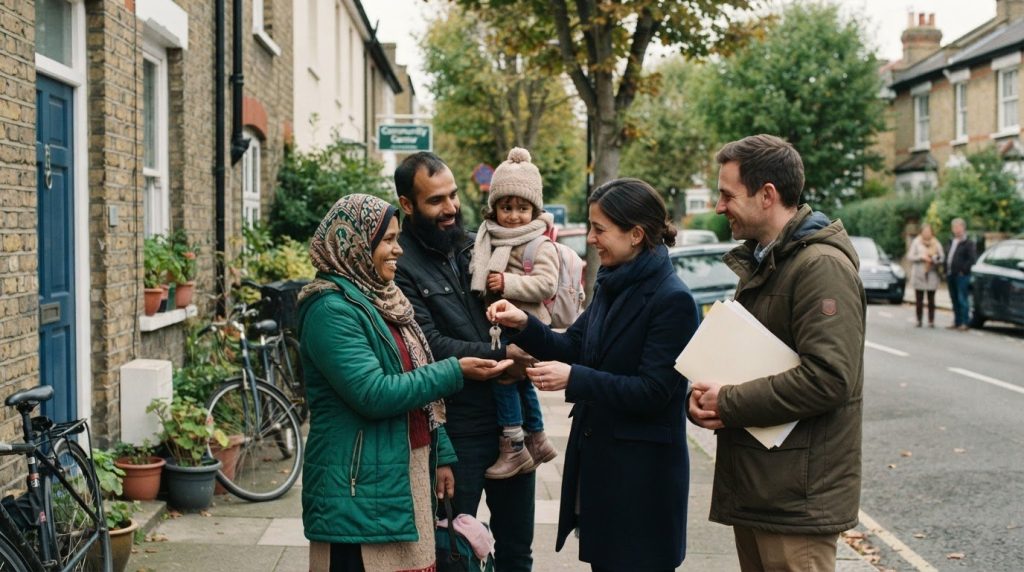
UK refugee resettlement begins when UNHCR identifies a refugee in need and refers them to the UK Government. Safe housing and practical local support can help make arrival the start of a more settled life. Communities can support refugee settlement in the UK by helping people build connections and find their footing.
It’s understandable to focus on what happens when someone arrives, especially when housing and homelessness raise urgent concerns. But resettlement also depends on support that helps people access services, learn English and take part in community life.
This article explains how UK resettlement works, how it differs from seeking asylum, and what refugee status can mean. It also explores local support and housing, including what matters when someone is at risk of homelessness, and where practical help can make a difference.
Key Takeaways
- Understand how refugees are identified for UK resettlement and why the route they arrive through matters.
- See how councils and community groups help new arrivals find local connections, education and routes towards employment.
- Learn what housing notices and the risk of homelessness can mean, including the timeframes that may matter.
- Distinguish refugee status from indefinite leave to remain, and understand how each can affect a person’s next steps.
- Find out how local support can help refugees and people seeking asylum build stability, community ties and a sense of belonging.
How can I help refugees and people seeking asylum?
Practical support can help people move from arrival towards safety, stability and connection. Councils, community groups and charities all have a role.
For context on sponsorship routes, watch this video:
Council support for refugees and asylum seekers
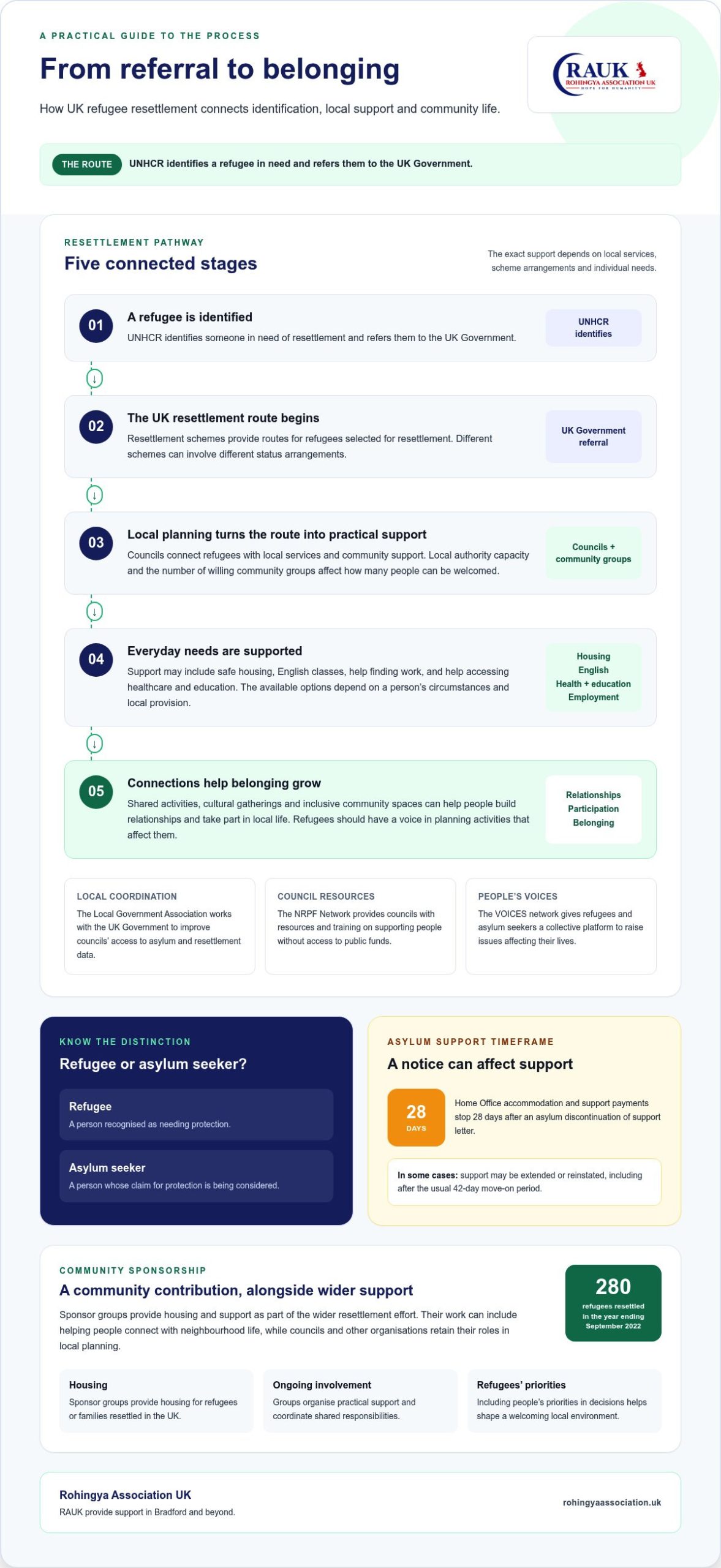
Councils help connect people seeking asylum and refugees with local services and community support. This matters because settling involves meeting practical needs as well as finding a place to belong. A refugee has been recognised as needing protection; an asylum seeker is someone whose claim for protection is being considered. Councils can bring communities together, while the VOICES network gives refugees and asylum seekers a collective platform to raise issues affecting their lives. The British Red Cross advocates for improved family reunion.
Research and consultation should include the experiences of refugees and people seeking asylum. The VOICES network is one example of people speaking out to improve their lives. If you want to help, listening to people affected and supporting inclusive local initiatives are meaningful starting points.
Differences in support across the UK
Support varies according to local services, council capacity and arrangements in each UK nation. The same need, such as help connecting with community services, may be met through different local systems. The Local Government Association works with the UK Government to improve councils’ access to asylum and resettlement data, helping them plan and monitor local impacts. The NRPF Network provides councils with resources and training on supporting people without access to public funds.
Islington Council shares information about its work in Home Office contingency hotels for asylum seekers. These examples show why local context matters, and are not a template for every council.
Funding for refugee resettlement
Resettlement funding supports practical needs, including English classes, help finding work and building links with the local community. There is no single cost figure: support is shaped by scheme arrangements, local delivery and the needs being addressed. Council capacity and the number of community groups willing to participate also affect how many refugees can be resettled.
For people seeking asylum, Home Office accommodation and support payments stop 28 days after an asylum discontinuation of support letter. Support may be extended or reinstated in some cases, including after the usual 42-day move-on period.
Healthcare, education and employment support
As they settle in a new country, refugees may need help accessing healthcare, education and employment. Local services and community organisations can help people understand where to seek support. English classes and help finding work can support participation and independence. The options available depend on a person’s circumstances and local provision.
Challenges can include disrupted education, difficulty communicating in English, isolation, and uncertainty about housing or support. A practical response is to help someone identify their immediate need, understand local options and build connections at their own pace.
Local authority capacity and community support
Refugee settlement relies on national schemes and the local capacity to make them work. Councils, community groups and residents can each help create a welcome that meets practical needs and fosters lasting connections.
Building integration in local communities
Local integration means helping refugees take part in community life and build relationships. Belonging grows through everyday contact, shared activities and opportunities to contribute.
Councils can work with residents, voluntary groups and local services to create opportunities for people to connect. Cultural gatherings, shared activities and inclusive community spaces can strengthen cohesion while respecting different circumstances, languages and heritage. Refugees should have a voice in planning activities that affect them, so local efforts reflect people’s priorities rather than assumptions.
The Local Government Association engages with central government to seek sustainable solutions that minimise pressures on councils, communities and new arrivals. The Home Office also engages local government on asylum and resettlement at regional and devolved-administration levels. This coordination helps local planning respond to the needs of the area and the people arriving.
Community sponsorship approaches
Community sponsorship allows groups to provide housing and support to refugees or families resettled in the UK. It matters because local people can help newcomers establish connections and find their place in the community.
The Community Sponsorship Scheme resettled 280 refugees in the year ending September 2022. Sponsor groups provide housing and support as part of the wider resettlement effort. Their contribution can include helping people connect with neighbourhood life, while councils and other organisations retain their own roles in local planning.
Community-led sponsorship depends on a group organising practical, ongoing involvement. Residents considering participation can discuss how to share responsibilities, contribute their skills and include refugees’ priorities in decisions. Clear roles help groups coordinate their work and create a more welcoming local environment.
Resettlement schemes in the UK
UK resettlement schemes provide routes for refugees selected for resettlement. Local authority capacity and the number of willing community groups influence how many people can be welcomed each year. The ability to support refugee settlement in the UK therefore depends partly on local arrangements that turn national commitments into practical help.
Different schemes can involve different status arrangements. People arriving through the Gateway Protection Programme arrive with indefinite leave to remain, while other routes have their own terms. The UK Resettlement Scheme began in February 2021. Understanding the route named in someone’s documents can help communities better understand their circumstances and how to support refugee settlement in the UK.
Community involvement can strengthen welcome and connection in Bradford and beyond. Explore community support and integration to learn about local ways to contribute.
Housing and homelessness support
After arrival, housing and financial support depend on a person’s circumstances, immigration status and route to the UK. Refugees with indefinite leave to remain can live, work and study in the UK, and may apply for benefits if eligible. People seeking asylum have different support arrangements, so identifying their current status is an important first step.
Housing may involve accommodation arranged through a resettlement route or a move into other housing. Refugees and families need clear information about where they can stay, how to manage household matters and what to do if their accommodation is ending. As a practical first step, keep housing letters together and note the dates they give. This helps clarify what needs attention and when.
Timing can be critical for people in asylum accommodation. A notice to quit for asylum accommodation should give a refugee at least 7 days to leave. If a person may lose their home, they should keep the notice and contact the council’s housing service promptly. The notice date and the household’s circumstances help explain the urgency, particularly where children are affected.
In the UK, someone can be treated as threatened with homelessness if they will be homeless within 56 days. This timeframe makes early action important: a person should explain when accommodation ends and share relevant letters with the council. Families can also set out who lives in the household and any urgent needs. These details help housing staff understand the situation and consider what support may be relevant.
Financial support is not a single fixed payment for every refugee. Eligibility depends on a person’s status and circumstances, including whether they can access benefits. Indefinite leave to remain permits someone to apply for benefits if eligible, but it does not mean every claim is automatically granted. Keep decision letters and information about income or household needs to hand when seeking support.
Housing instability can disrupt children’s education, health appointments and family connections. A change of address may also make it harder to stay in touch with local services. If you’re helping a family, support them to record key dates, understand written notices and communicate their immediate housing needs. These practical steps make it easier to explain the situation clearly and identify what to do next.
If someone is concerned about asylum accommodation, refugee status or a notice to leave, distinguish the housing issue from the immigration decision. Record relevant dates and the exact wording of letters, then discuss the housing concern with the council. Clear information can help focus the conversation on immediate shelter, household needs and available next steps.
Refugee status and duration of stay
In the UK, refugee status recognises that someone needs protection, while immigration permission sets the terms of their stay. The Home Office grants status after assessing a claim, and the permission attached can depend on when the person claimed and which route they followed. Understanding this distinction can help people supporting refugees interpret a letter and understand what steps may follow.
People granted refugee status usually receive permission to stay for 5 years, subject to the rules applying to their claim date. However, people who claimed asylum or made further submissions on or after 2 March 2026 will usually receive 30 months’ permission instead of the usual 5 years. The date of the claim or further submission therefore matters when considering how long permission lasts.
Indefinite leave to remain, or ILR, is settlement permission to live, work and study in the UK for as long as a person likes. A person with ILR may apply for benefits if eligible. People resettled through the Gateway Protection Programme arrive with ILR, while a refugee generally becomes eligible to apply for ILR after holding refugee status for 5 years. The route and current permission determine which timeframe applies.
For a refugee on the usual five-year permission, the ILR application should be made in the last month of current permission, just before it reaches 5 years. Keeping the grant letter and records of permission dates together can help someone understand when that application window falls. It also helps distinguish a current status document from a future application for settlement.
Citizenship is a later step, not the same as refugee status or ILR. According to the Home Office, a person with refugee status may apply for British citizenship after holding indefinite leave to remain for 1 year or more, subject to the other requirements. Meeting that timeframe alone does not establish that every citizenship requirement has been met.
Time spent outside the UK can also affect settlement. A person with ILR may lose it after staying outside the UK for more than 2 years, according to the Home Office. A refugee may have to apply for a returning resident visa after being outside the UK for more than 2 years. These are distinct consequences, so the person’s permission and travel history matter.
Documents have changed as well. Before 31 October 2024, people granted refugee status in the UK were usually sent a Biometric Residence Permit. The Home Office began rolling out digital eVisas to replace physical Biometric Residence Cards on 31 October 2024. Keeping current immigration records accessible can help with everyday tasks and future applications, including for vulnerable people supporting a family member coming to the UK.
What refugee resettlement schemes are available in the UK?
UK refugee resettlement has involved several government schemes, with different names, priorities and periods of operation. UNHCR identifies refugees in need of resettlement before referring them to the UK Government. This differs from applying for asylum after arriving in the UK. The scheme and referral route matter because they shape how someone is considered for resettlement.
The UK Resettlement Scheme began in February 2021. It prioritises vulnerable refugees, including children, in regions affected by conflict and instability, rather than people already in safe European countries. Its geographical focus was intended to expand beyond the Middle East and North Africa. Local authorities’ capacity and the number of community groups willing to participate also affect how many refugees can be resettled each year.
Several earlier programmes provide context for how UK resettlement has developed:
- Gateway Protection Programme: Between 2004 and February 2021, the UK resettled around 750 refugees annually through this programme.
- Vulnerable Person Resettlement Scheme: Between March 2014 and February 2021, 20,319 people were resettled. The UK reached its commitment to resettle 20,000 refugees under the scheme in February 2021.
- Vulnerable Children’s Resettlement Scheme: By February 2021, 1,838 people had been resettled under this route.
- Mandate Resettlement Scheme: This route is for refugees with a close family member in the UK willing to accommodate them. Six refugees had been resettled under the programme in the figures provided.
The UK also developed routes for people affected by Afghanistan’s circumstances. The Afghan resettlement scheme intended to resettle 5,000 people in its first year. Under Pathway 2 of the Afghan Citizens Resettlement Scheme, four people were recorded as resettled in the year ending September 2022. These figures describe particular periods, rather than a current annual target.
For Syrian refugees, the Vulnerable Person Resettlement Scheme resettled 20,000 people by February 2021. Arrivals through that scheme initially received five years of Humanitarian Protection. Since 1 July 2017, Syrian refugees arriving through it have been granted five years of Refugee Status. The date and route therefore help explain which status arrangements apply.
These histories show why scheme names and dates matter. A person’s route may distinguish a resettlement referral from an asylum claim, while local capacity influences the places available. People supporting a family can start by understanding the scheme named in its documents, then identify the relevant local settlement support. To explore ways to support refugee settlement, consider how local community involvement can contribute to welcome and integration.
Rohingya Association UK: Community Support & Integration
Rohingya Association UK supports refugees and families through community support and integration, education and youth empowerment, cultural and community events, and advocacy and awareness campaigns. If you want practical ways to help refugees build connections, develop skills and preserve cultural heritage, these activities offer a meaningful place to begin.
For people seeking support, local community ties can help them find a sense of belonging and take part in education and cultural life. Rohingya Association UK provides support in Bradford and beyond, with a community-led approach rooted in the needs of Rohingya refugees, families and young people.
To learn more about its work and how to get involved, visit Rohingya Association UK.
Help build a lasting welcome
Supporting refugee settlement in the UK is more than a single act of welcome. It means making space for people to shape their own futures, participate in community life and keep cultural ties strong. Local involvement can start with listening, sharing skills or creating opportunities for people to connect.
Rohingya Association UK provides support in Bradford and beyond through Community Support & Integration, Education & Youth Empowerment, and Cultural & Community Events. These activities can help refugees and families strengthen community connections, pursue learning and celebrate their heritage.
If you’d like to learn more or explore ways to get involved, contact Rohingya Association UK. A thoughtful welcome, sustained through shared effort, can help communities grow stronger together.
Frequently Asked Questions
How does resettlement to the UK work?
Resettlement starts with UNHCR identifying refugees in need and referring them to the UK Government. The Government considers referrals under its schemes, then local arrangements help prepare for arrival and settlement. For a family supporting someone, a useful first step is to understand which route is named in their documents. That context helps distinguish resettlement arrangements from decisions made through an asylum claim.
How does the UK help refugees through safe and legal routes?
The UK uses government-backed resettlement routes to bring selected refugees to the country. UNHCR identifies people needing resettlement and refers them to the UK Government; schemes provide the framework for considering those referrals. Support after arrival can include English classes, help finding work and links with the local community. These routes differ from arriving in the UK and then seeking asylum.
How is resettlement different to asylum?
Resettlement involves identifying a refugee outside the UK and referring them to the UK Government for consideration. Seeking asylum means asking the UK for protection after reaching the country. The distinction matters because the routes, accommodation arrangements and decision processes differ. For example, a person’s letters may refer to a resettlement scheme or an asylum claim, so reading the document title can clarify which process applies.
What is refugee resettlement?
Refugee resettlement is a process for transferring refugees from a country where they have sought protection to another country prepared to receive them. In the UK, UNHCR identifies refugees in need and refers them to the Government. The aim is to provide a route to safety and a place to rebuild life. It differs from moving independently or making an asylum claim after arrival.
What more could the UK be doing?
The UK could strengthen local planning by improving councils’ access to asylum and resettlement data, helping them understand service pressures and prepare support. Sustainable arrangements also depend on council capacity and community groups willing to participate. Communities can contribute by supporting inclusive activities, English learning and links to employment. Refugees’ views should inform local initiatives so that support responds to people’s priorities.
Where are people resettled?
Refugees are placed in UK local authority areas where resettlement arrangements can be organised. The number welcomed in a year depends partly on councils’ capacity and community groups’ willingness to participate. A placement is therefore connected to local housing and support arrangements, rather than being chosen solely by the person arriving. Local services and community connections shape how settlement unfolds.
Who is eligible for refugee resettlement to the UK?
People considered for UK resettlement are refugees identified by UNHCR as needing resettlement and referred to the UK Government. Scheme priorities can include vulnerable refugees, such as children, in regions affected by conflict and instability. Eligibility depends on the scheme and its criteria, so a person’s circumstances and referral route matter. Resettlement is different from applying for asylum after reaching the UK.
How does the UK refugee resettlement process work, step by step?
The process begins when UNHCR identifies a refugee in need of resettlement and refers them to the UK Government for consideration under an applicable scheme. If accepted, local arrangements support their arrival and settlement. The steps are identification, referral, consideration and preparation for arrival. Scheme documents and local arrangements help explain what happens next for an individual or family.