

A person can be stateless without being a refugee, and the two experiences can also overlap. When someone lacks the recognition and security that nationality can bring, support for stateless people is about more than understanding a legal label. It can mean finding safety, accessing essential services and building a sense of belonging. Statelessness describes someone no state considers its national; refugee status concerns the need for protection from persecution.
It is understandable to wonder where practical help ends and formal legal recognition begins. Community support can help people navigate everyday needs, but it does not itself determine or change a person’s legal status. This article explains the distinction and shows how practical assistance, education, cultural connection and advocacy can work alongside one another.
Rohingya Association UK supports safety, education, integration and hope through community-led work in Bradford and beyond. Its support includes guidance on housing, healthcare and essential services, alongside education and cultural activities. RAUK also provides energy advice and support, works in partnership with Fuel Bank and HACT, and is a member of National Energy Action (NEA). Here, you’ll learn what statelessness can mean in daily life and how to engage respectfully with community-based support.
Key Takeaways
- Statelessness and refugee status are distinct, although a person may experience both.
- Support for stateless people can address everyday needs through service navigation, learning and community connection.
- Practical help and advocacy can strengthen inclusion, but they do not grant nationality or settle formal status questions.
- Offer support respectfully: listen first, focus on the person’s priorities and follow through with care.
- Rohingya Association UK brings together integration support, education, cultural connection and advocacy through community-led work.
What does support for stateless people mean in the UK?
The 1954 Convention defines a stateless person as “a person who is not considered as a national by any State under the operation of its law”. In plain English, no country recognises that person as its citizen under its laws. This definition, used by UNHCR, is a useful starting point for understanding why support for stateless people may involve practical help as well as questions about formal recognition.
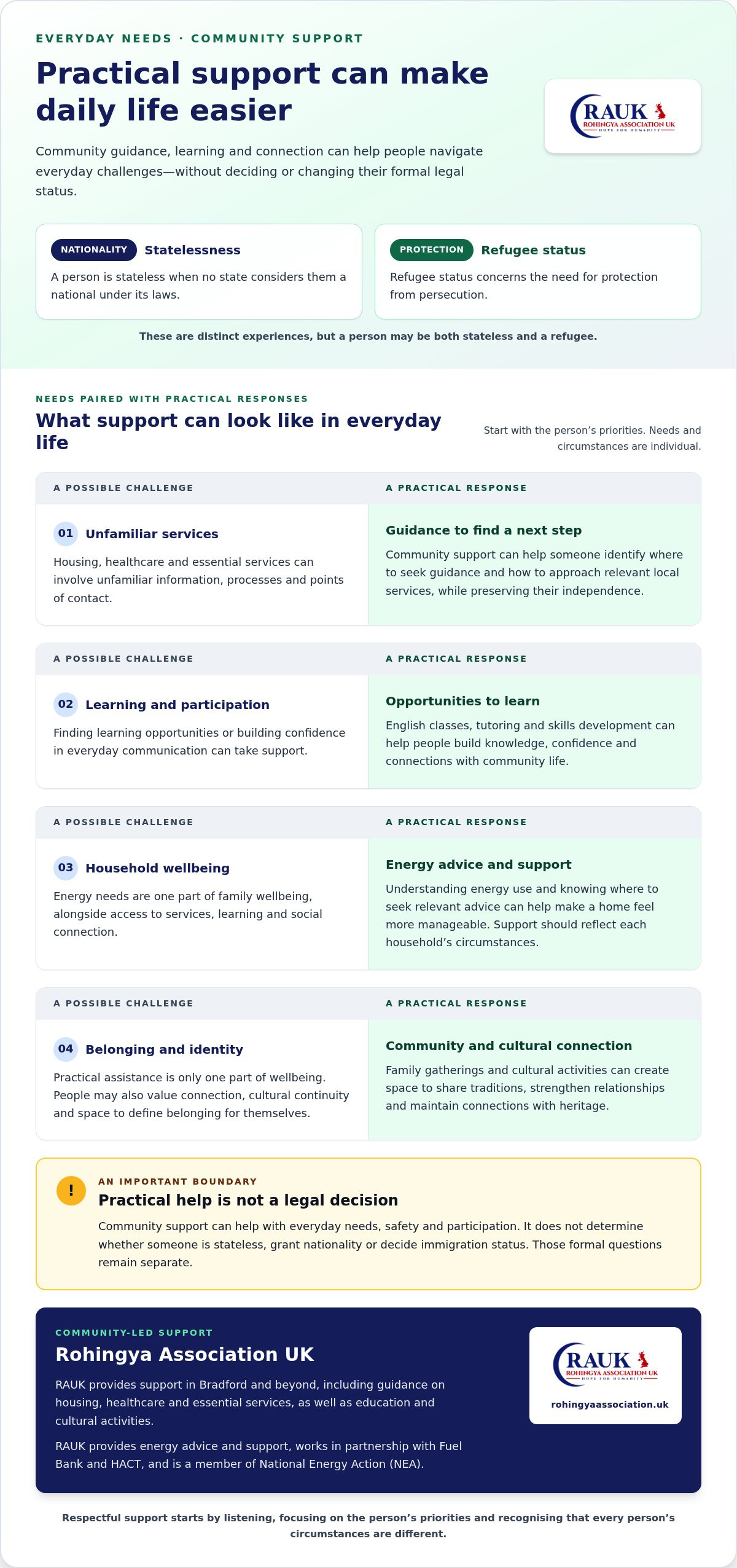
Statelessness concerns nationality; refugee status concerns protection. A person may be stateless without being a refugee, or may be both stateless and a refugee. Community support can help with everyday needs, but it does not decide whether someone is stateless, grant nationality or determine immigration status.
A short video offers another perspective on the role of organisations supporting stateless people:
Statelessness can have different causes, including discrimination or conflicts between nationality laws. Circumstances vary, so the term alone cannot tell us what a particular person has experienced or needs. For a broader overview of the issue and its legal context, see Statelessness in international law.
How is statelessness different from refugee status?
Nationality describes a person’s legal bond with a country. Refugee status relates to the need for protection from persecution. These are separate, not opposing, categories. Someone could be recognised as a refugee while no country considers them a national; another person could lack nationality without being a refugee. This distinction explains the terms, but does not determine anyone’s eligibility or legal position.
Why community support matters alongside protection
Questions about formal status do not remove the practical demands of daily life. Someone may need help finding their way through local services, accessing learning opportunities or building social connections. Useful support starts with the person’s own priorities and recognises their knowledge, abilities and aspirations. It can offer guidance and connection without treating someone as helpless or making assumptions about their circumstances.
For example, community support may help someone understand where to seek housing guidance, how to access education or where to connect with others. These steps can strengthen safety and participation, while formal decisions about nationality or immigration status remain separate. Practical help matters in its own right: it can make daily life more manageable as a person pursues their own goals.
How statelessness can shape daily life and support needs
Statelessness does not describe a person’s whole life, and it does not mean everyone faces the same difficulties. Uncertainty about someone’s circumstances or unfamiliarity with local services can make everyday tasks, such as seeking housing guidance, accessing healthcare or understanding learning options, harder to manage. The right response begins by asking what the person needs, rather than making assumptions based on their status.
Community support can make practical services easier to approach while helping people feel recognised and connected. It can offer guidance and encouragement, but it cannot remove every barrier or resolve formal status questions. Practical help is valuable in its own right, and each person’s priorities and circumstances remain individual.
Practical needs: services, learning and household wellbeing
Housing and healthcare systems can involve unfamiliar information, processes and points of contact. Community guidance can help someone identify a useful next step and understand where to seek support, while preserving their independence. For example, they might need help working out which local service to approach or what information to ask for.
Learning can support participation over time. English classes can help people communicate in everyday settings, while tutoring and skills development offer opportunities to build knowledge and confidence. Learning is not only a route to employment; it can also help young people and adults take part in community life and pursue their own aims.
Household wellbeing is another practical consideration. Understanding energy use and where to seek relevant advice can help make a home feel more secure and manageable. Energy needs are one part of family wellbeing, alongside access to services, learning and social connection. Support should respond to the person’s circumstances rather than assume one form of assistance will address every challenge. RAUK provides energy advice and support, and works in partnership with Fuel Bank and HACT. It is also a member of National Energy Action (NEA).
Belonging, identity and community connection
Practical assistance is only one dimension of wellbeing. Family gatherings and cultural activities create space to share traditions, strengthen relationships and maintain a connection with heritage. For Rohingya families, cultural and Islamic events can help sustain identity and continuity across generations. These connections can be a source of strength, while each person and family decides what belonging means to them.
Not everyone who is stateless shares the same culture, language, faith or support needs. Respectful community work makes room for those differences rather than treating people as a single group. Community-led support can bring practical guidance together with learning and social connection, helping people participate in ways that reflect their own priorities.
Does practical support resolve statelessness? What it can, and cannot, do
Practical help can make a real difference to daily life, but it cannot by itself change a person’s nationality or determine their formal status. Statelessness can involve questions about recognition by a state alongside immediate needs, such as understanding services, accessing education or finding community connection. These are distinct needs, and practical support does not answer every question about a person’s circumstances.
The distinction is clearer when you consider what different forms of support are designed to do:
These forms of support can complement one another, but they are not interchangeable. Help with daily needs remains valuable even when it cannot resolve a formal question.
Immediate assistance and longer-term inclusion
Community guidance may help someone identify where to seek housing support, healthcare access or help with essential needs. This kind of navigation can make unfamiliar systems easier to approach while leaving choices and priorities with the person concerned. It responds to practical barriers without assuming that everyone needs the same assistance.
Longer-term inclusion also depends on opportunities to learn and participate. English classes, tutoring and skills development can support learning, confidence and engagement with community life. Their value lies in opening possibilities, not guaranteeing a particular outcome. Education can help a person pursue their own goals alongside any practical support they need now.
Advocacy, rights and formal status questions
Advocacy has a different purpose. It can bring attention to statelessness, promote human-rights protection and challenge inequality by making people’s experiences and concerns more visible. It complements practical assistance: one addresses immediate needs, while the other contributes to awareness and calls for justice. Neither should be mistaken for a formal decision about someone’s status.
It is also important to distinguish advocacy from legal representation. Community organisations can offer practical guidance and speak about wider concerns without acting as a person’s legal representative or deciding their case. UK processes and individual circumstances can be complex, so general information should not be treated as a determination of anyone’s position. Effective support respects these boundaries, is clear about what it can do and recognises that inclusion involves practical care, learning and continued advocacy.
How to make support for stateless people practical and respectful
Useful support begins with a conversation, not a checklist of assumptions. A person should be able to explain what matters to them, choose what they want to share and remain involved in decisions about next steps. This keeps assistance grounded in their priorities, rather than guesses about their background or circumstances.
A simple sequence can help supporters offer practical assistance while preserving choice:
- Listen first. Give the person space to describe what they would find helpful, without rushing to suggest a solution.
- Clarify the immediate need. Agree what they want to address now, without treating one concern as a complete account of their situation.
- Discuss possible support. Explain options in straightforward language and let the person decide whether to take them forward.
- Follow up with care. Respect their preferences about further contact, keep personal details private and make no promises about outcomes.
Start with the person’s priorities
Listening carefully can reveal that the most urgent concern is different from what a supporter first expected. Someone might want help understanding a letter, finding out what a service does or preparing questions for an appointment. Ask open, respectful questions, check that you have understood and give the person time to respond. Let their choices guide the conversation.
Consent and confidentiality are central to respectful practice. Explain why information is being requested, avoid asking for details that are not needed, and do not pass on personal information without permission. Keep practical needs separate from assumptions about nationality or immigration status. A person’s language, heritage or immediate request cannot tell you their full circumstances.
Connect everyday needs with community support
Some people may welcome help understanding where to seek housing guidance, how to approach healthcare services or what local support is relevant to their situation. Others may prioritise education, family connection or something else. Offer information in a clear, manageable way, and ask whether the person wants help taking a next step. The aim is to support informed choice, not take control.
Rohingya Association UK’s community-led approach recognises that respectful follow-through matters as much as the first conversation. Support should respond to people’s needs, preserve dignity and leave room for them to change their minds or priorities. To learn more about this work, explore community support and integration.
How Rohingya Association UK supports stateless people and families
Rohingya Association UK (RAUK) is a community-led registered charity supporting Rohingya refugees, families and young people. Its work brings practical assistance, education, cultural connection and advocacy together, with a focus on safety, education and hope. This approach recognises the strengths and aspirations people bring to their communities while making room for different needs and experiences.
Safety, education, integration and cultural preservation
Community Support & Integration includes housing guidance, healthcare access and help with essential needs. Guidance on local services can help individuals and families understand where to turn and what steps may be useful, while leaving decisions in their hands.
Through Education & Youth Empowerment, RAUK provides English language classes, tutoring and skills development. These opportunities support learning and participation without promising a particular result. People can build knowledge and pursue goals that matter to them. For young people, this work also creates space to develop interests and take part in community life.
Cultural & Community Events include cultural gatherings, Islamic events and family meet-ups. These bring people together, preserve Rohingya identity and strengthen community bonds, providing continuity across generations. Participation is personal, and these activities sit alongside practical and educational support that families may value.
Advocacy and ways to stand alongside the community
Advocacy & Awareness Campaigns raise awareness of the Rohingya crisis and promote human-rights protection and justice. This work draws attention to wider issues and encourages understanding alongside community support. Learn more about RAUK’s justice for Rohingya people advocacy.
You can stand alongside the community by learning about Rohingya experiences, sharing information thoughtfully, joining the network or receiving updates. Voluntary donations also help fund the charity’s work. A contribution is not a promise of a particular outcome. Explore community support for displaced families and connect with RAUK’s community work to find a thoughtful way to engage.
Carry understanding into action
Understanding can shape the way we listen, speak and act. Respectful support makes room for people to describe their own priorities, rather than allowing a label to define their identity or potential. Each informed conversation can challenge assumptions and help create communities where people are treated with dignity and included in decisions that affect them.
Support for stateless people is not only a matter for organisations or policymakers. Individuals can learn from community voices, share accurate information and challenge language that reduces people to their circumstances. These actions help sustain a culture of respect and shared responsibility.
Rohingya Association UK’s community-led work offers a way to put that commitment into practice. Donate now to support Rohingya Association UK’s community work, helping fund aid projects, crisis intervention, education and integration support for displaced Rohingya families.
Frequently Asked Questions
Can someone be both stateless and a refugee?
Yes. A person can be both stateless and a refugee because the terms describe different aspects of their circumstances. Someone may need protection from persecution and also have no country that recognises them as a national. Their experiences and needs are individual, so support for stateless people should not assume that one status explains everything about their situation.
Are all refugees stateless?
No. Refugees may hold the nationality of a country they have had to leave, even if returning there is unsafe. Statelessness concerns whether any state recognises someone as its national; refugee status concerns the need for protection. The two can overlap, but neither automatically means the other. Keeping the distinction clear helps avoid assumptions about someone’s background or support needs.
Can a stateless person work in the UK?
Possibly, depending on the person’s immigration permission. Being stateless by itself does not establish a right to work. A person granted permission to stay under the UK’s statelessness route may work, subject to the terms of that permission. Anyone considering work should check the conditions attached to their own immigration status using current official guidance, rather than relying on a general description of statelessness.
Does being born in the UK automatically make someone a British citizen?
No. Birth in the UK alone does not automatically make every child a British citizen. Citizenship depends on the law and the circumstances at the time of birth, including relevant details about a parent’s status. A birthplace by itself is not enough to determine citizenship. Current GOV.UK guidance explains the rules and any applicable registration options.
How can someone show that they are stateless?
There may not be one document that proves statelessness in every case. Relevant evidence might include identity or birth records, documents showing a person’s previous nationality, and correspondence with authorities about recognition of nationality. What matters can depend on the individual circumstances and the question being assessed. Keep copies of available records, and use current official guidance for information about any UK application or assessment process.
How many stateless people are there worldwide?
There is no single figure in this article that captures the number of stateless people worldwide. Totals can depend on how people’s circumstances are recorded, and some people may not be included in available estimates. A global figure should not be treated as a count of people in the UK or of Rohingya people specifically. Refer to current UNHCR reporting for the latest estimates.
Can stateless people access healthcare in the UK?
Statelessness alone does not determine access to every NHS service. Eligibility and possible charges can depend on the type of care, a person’s circumstances and where in the UK they live, as health services and rules vary across the nations. For a particular appointment or treatment, consult current NHS or relevant national health-service guidance. Community organisations may also help people understand how to approach local healthcare services.