
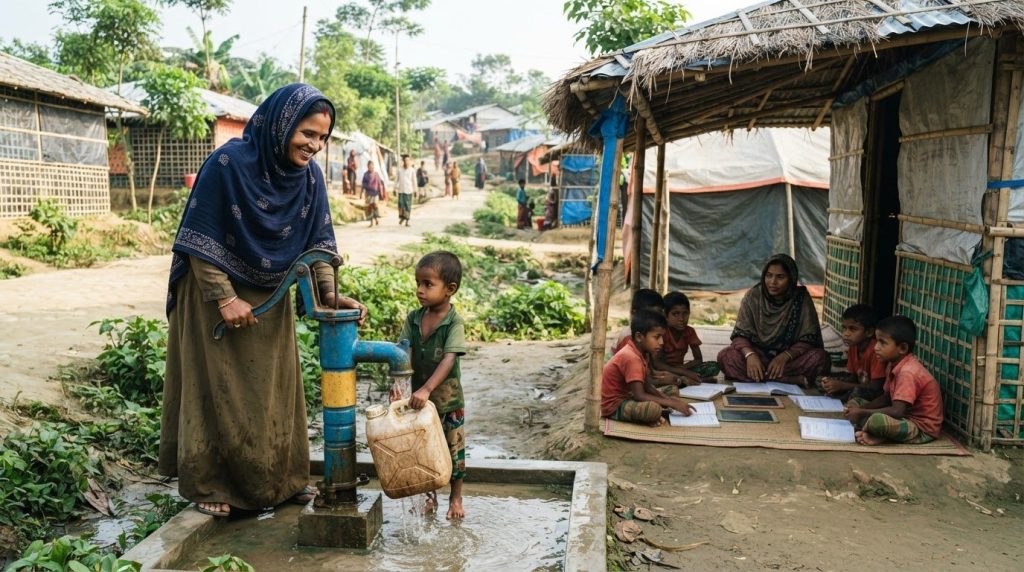
A gift can do more than provide immediate relief. Sadaqah jariyah projects for refugees can support resources and services with lasting benefits. Sadaqah jariyah means ongoing charity. In Sahih Muslim, the Prophet Muhammad is quoted as saying that three things continue to benefit a person after death: ongoing charity, knowledge that benefits others, and a righteous child who prays for them.
It’s understandable to wonder whether a small donation can make a meaningful, lasting difference. It can contribute to a shared project, and its benefits may continue as long as the resource remains useful and cared for.
This guide explains what sadaqah jariyah means, how smaller gifts can support projects for displaced families, and how long water facilities may provide benefit. It also explores livelihood tools that can help people build skills and support their families, so you can understand the different ways charitable giving may contribute to practical, enduring support.
Key Takeaways
- Understand how ongoing charity differs from immediate relief, and why knowledge and other lasting benefits matter.
- Learn how modest contributions can support continuing projects for displaced families.
- Explore how a project’s useful life depends on its upkeep, with wells potentially serving communities for years.
- See how livelihood tools can help people develop skills and work towards greater independence.
- Discover how RAUK provides support in Bradford and beyond through community integration, education, events and advocacy.
What Is Sadaqah Jariyah?
Sadaqah jariyah is voluntary charity intended to provide continuing benefit. For displaced communities, a resource or service can support daily needs long after it is first provided.
Meaning of Continuing Sadaqah
The term describes charity with a continuing benefit, rather than assistance used only once. A water source, place of learning or mosque may serve people repeatedly, provided it remains useful and cared for. Consider who can access the resource and how it supports their lives over time.
In Sahih Muslim, the Prophet Muhammad is quoted as describing three things that continue to benefit a person after death: ongoing charity, knowledge that benefits others, and a righteous child who prays for them. This teaching places sadaqah jariyah alongside learning and prayer. It also shows why a shared resource can matter: its benefits may reach people beyond the original recipient.
The Qur’an offers a vivid image in Al-Baqarah (2:261): charitable spending is compared to a grain that grows seven ears, each containing a hundred grains. The passage conveys multiplied benefit through the image of growth. It is not a calculation of the number of people a donation will help; rather, it frames giving as an act whose effects can extend.
For example, a shelter offers protection to the people using it, while a learning resource can pass knowledge between generations. Access to clean water supports everyday household needs. These examples help explain why people give sadaqah jariyah towards projects serving communities, including displaced families. What matters is not the project’s form but its continuing usefulness.
Designating Giving for Refugees
Yes. A donor can direct voluntary sadaqah jariyah towards refugees by choosing a project intended to serve displaced people. For U.S. donors, look for a charity that identifies the intended community and explains the project’s ongoing purpose and care. No single organisation is required by the meaning of sadaqah jariyah.
Sadaqah is voluntary and may be given at any time. It may also be given on behalf of someone who has died, an act described as highly recommended. A donor can dedicate a gift to someone living or deceased and direct its benefit towards a refugee-focused project.
Zakat is distinct from voluntary sadaqah. It requires giving 2.5% of qualifying wealth annually to eligible recipients identified in Qur’an 9:60. If you intend a gift as zakat, consider whether the recipients and project meet those criteria; don’t assume every sadaqah jariyah project also qualifies.
More than one million Rohingya refugees who fled violence in Myanmar are living in overcrowded camps in Cox’s Bazar, Bangladesh. This context helps make a donation’s purpose specific: a donor can focus on a community and a practical need, such as water, learning or shelter. A clear intention connects the gift with its intended beneficiaries.
Small donations to ongoing projects
A modest gift can contribute to a shared project without funding it alone. The project’s purpose, location and ongoing care help explain what the contribution supports.
Choosing Long-Term Refugee Programmes
Education builds knowledge and skills; clean-water projects support drinking, sanitation and hygiene; healthcare responds to health needs; and livelihood programmes help people develop practical ways to earn. Each addresses a different part of daily life, so consider the community’s priorities and the project’s ongoing usefulness. More than one million Rohingya refugees who fled violence in Myanmar live in overcrowded camps in Cox’s Bazar, Bangladesh, making this a specific location for long-term support.
Project amounts vary by purpose and location. Construction scope, local conditions, materials and ongoing maintenance affect what a project requires, while education and clinic costs depend on their own plans and resources.
When assessing a charity, look for clear descriptions of its work, intended beneficiaries, use of donations and project updates. Read how it reports progress and explains ongoing care. For recurring giving, use the charity’s donation process to set a regular gift where that option is available. For a memorial gift, state whose memory it honours and which project it should support.
Assessing Project Sustainability
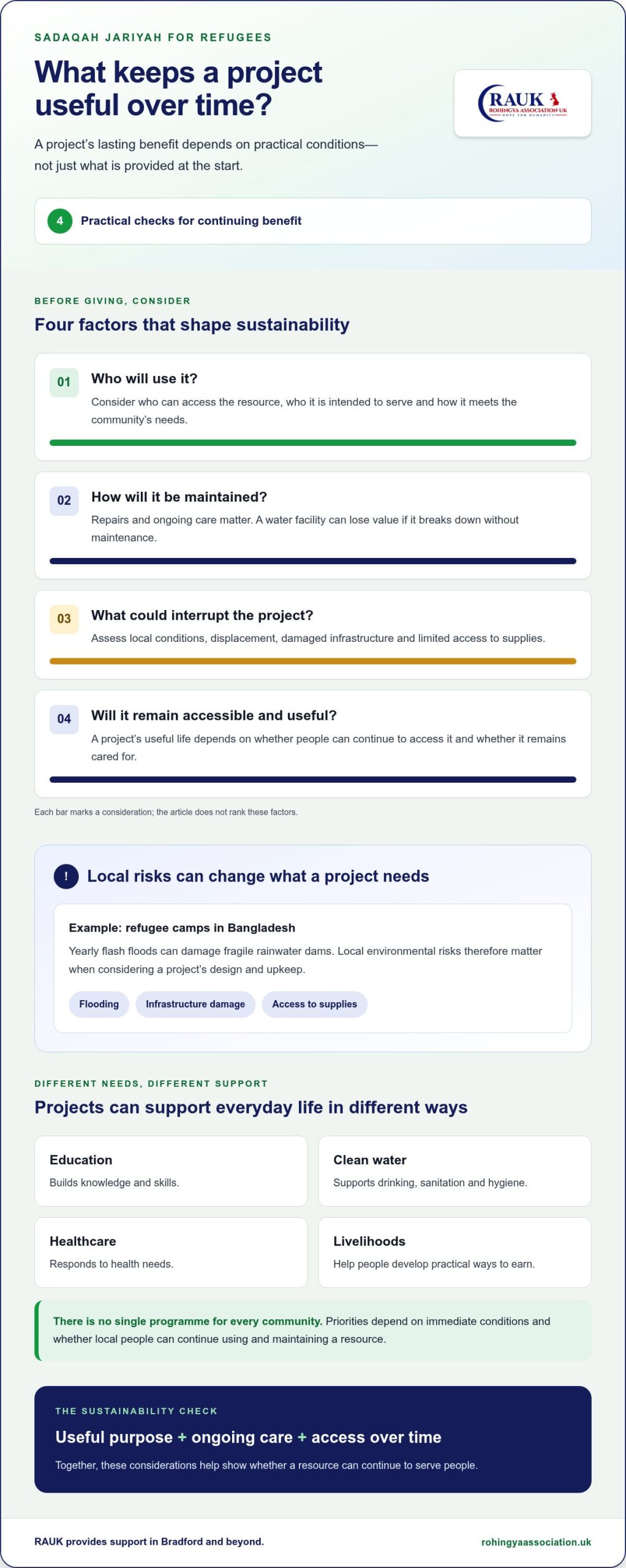
Before giving, consider whether a project accounts for repairs, local use and changing conditions. A water facility can lose value if it breaks down without maintenance; a school or clinic may struggle if essential resources or staffing are not sustained. In Bangladesh’s refugee camps, yearly flash floods can damage fragile rainwater dams, so local environmental risks matter to a project’s design and upkeep.
Other pressures can include displacement, damaged infrastructure and limited access to supplies. A useful sustainability assessment asks who will use a project, how it will be maintained and what could interrupt access. These practical questions help distinguish continuing charity from a one-off provision that may not meet needs over time.
Education, water, healthcare and livelihoods can complement one another, but no single programme suits every community. Priorities depend on immediate conditions and whether local people can continue using and maintaining a resource. A donation may be given as ongoing charity or in memory of someone; a child who prays is another form of continuing benefit mentioned in Islamic teaching.
For a locally grounded perspective on Rohingya community needs, explore support for Rohingya communities.
A donation to an ongoing project can count as sadaqah jariyah.
How long projects may provide benefit
A project’s useful life depends on what it provides and whether it remains accessible and maintained. Water wells and handpumps illustrate how the benefits of practical resources may continue over time.
Continuing Project Benefits
Water wells may last 10-20 years, while handpumps may last 5-15 years. These are possible service periods, not a promise that every installation will remain functional for the full term. The resource, its use and its condition all matter. When comparing projects, look at the intended benefit and whether the plan accounts for keeping the facility usable.
Clean water can be a lifeline for families, supporting drinking, sanitation and hygiene. A functioning source can also reduce the effort involved in collecting water, leaving more time for household responsibilities. In a refugee setting, its value continues only while people can reach and use the supply. Access, maintenance and local conditions therefore shape how long a well or handpump remains useful.
Time alone doesn’t measure a project’s impact. A water point serving a community over many years can support health, school attendance and food security, because safe water underpins each of those needs. Consider whether a project serves everyday needs rather than providing a single distribution. This continuing benefit gives charity the potential to support families and future generations.
Long-Term Impact for Refugees
The strongest long-term choice depends on the need addressed and whether the resource remains useful. Safe water can support health and daily routines; housing can provide families with shelter. Consider who benefits, how access will be maintained and whether the project meets a practical community need. These criteria matter more than the label attached to a donation.
For water projects, look beyond construction to the conditions that keep a source working. Wells and handpumps differ in their expected service periods, so match the project type to its intended use. Sustainable projects also need continued access and upkeep. Without these, even a useful facility can stop providing its intended benefit.
Housing offers another form of lasting support, though its benefits differ from those of a shared water source. A home provides shelter to the people who live there; a community water point can serve multiple households. The right project depends on the need and how its benefits will continue. Comparing these outcomes helps donors choose carefully, without assuming every project has the same reach.
In Islamic understanding, an ongoing reward is associated with charity whose benefits continue. The Prophet’s teaching places ongoing charity among acts that can benefit a person after death. A well that remains accessible, or housing that continues to shelter a family, illustrates how practical support may endure. The duration of the benefit depends on the resource’s continued usefulness, not simply its construction.
Income-generating tools and small businesses
A practical tool can help a displaced person turn an existing skill into work. Its usefulness depends on whether the recipient can access materials, use the equipment and reach customers. For Muslim donors considering Islamic giving, these practical details connect a donation with a clear purpose.
Tools support livelihoods differently from food or shelter. A sewing machine can enable clothing repairs or garment-making; other equipment can support different trades. The aim is to provide an asset that helps someone work, rather than an item consumed immediately. For vulnerable families, earning opportunities can contribute to household needs and children’s wellbeing, while respecting recipients’ skills and choices.
Unless a programme includes wider support, a machine alone does not establish a small business. A sound project considers the recipient’s experience, access to supplies, safe working conditions and potential customers. Look for a clear explanation of how people are selected and how the tools match their abilities. These factors help distinguish useful livelihood support from equipment that may go unused.
Before contributing to fundraising for livelihood tools, consider the project’s practical pathway:
- Identify the skill or trade the equipment is intended to support.
- Understand how recipients will access materials and use the tool.
- Look for a clear account of how the project tracks distribution and use.
- Consider whether the plan supports people to work with dignity and choice.
These steps help donors assess whether a project is designed around people, not simply equipment. A sewing machine has a defined function, but its value depends on the recipient’s circumstances and opportunities to earn. A programme that explains this connection gives donors a clearer basis for choosing where to direct their giving.
For someone giving sadaqah jariyah, livelihood support can represent continuing charity when a tool remains useful and enables ongoing work. The reward is connected to the intention to give and the benefit that follows; it should not be treated as a guaranteed income or fixed outcome. A practical asset can help someone provide for a household, including children, while strengthening their agency.
Small donations can contribute to a shared effort to fund equipment, even when one gift does not cover the whole project. Consider what the combined contributions are intended to provide, who will use the tools and how continued use will be supported. These questions keep the focus on recipients’ skills, the livelihood plan and the lasting value of the gift.
Which sadaqah jariyah projects have the greatest long-term impact for refugees?
No single project has the greatest impact for every refugee community. Compare the need addressed, who benefits and whether the project can continue serving them.
A reliable community water supply can support health, school attendance and food security. Its benefits go beyond drinking water: families also need water for sanitation and hygiene. For communities with difficulty accessing safe water, a functioning supply supports several parts of daily life at once.
Housing addresses a different need. A home gives refugee families shelter, while a community water source can serve multiple households. The value of each project depends on its purpose and who can use it. Consider whether a proposed project responds to a specific need, rather than choosing solely because its benefits sound long-lasting.
Education and livelihood projects can also contribute to long-term wellbeing. Education supports learning; livelihood tools can help people apply practical skills. These forms of support differ from infrastructure, but can help people build knowledge and work towards greater independence. A project’s relevance depends on the community’s circumstances and the resource it provides.
Use these questions to compare project options:
- Need: Does the project address a practical issue, such as water access, shelter or learning?
- Reach: Who is expected to use the resource, and how does it serve refugee families?
- Continuity: What will help the facility or resource remain useful over time?
- Connection: Could the project support other needs, as water access can support health and school attendance?
These questions make comparisons meaningful without treating every donation as equivalent. For example, a water project may support health, hygiene and education, while a home focuses on shelter. A livelihood tool serves a different purpose. The most suitable choice matches an identified community need and has a clear path to continued use.
For sadaqah jariyah projects for refugees, lasting impact depends on usefulness, access and continuity. A project can be valuable because it meets an essential need repeatedly, not simply because it is large or visible. Consider the intended beneficiaries, the everyday purpose and how people will continue to benefit. This approach respects the dignity and agency of displaced families.
Take a considered next step: explore ways to support displaced families through practical, community-centred work.
Providing housing for refugees is one example of sadaqah jariyah. When considering this option, look at the need it is intended to meet and who is expected to benefit. Consider whether the proposed housing responds to a need identified by the community and whether the families it is meant to serve can access it. These questions keep the focus on practical usefulness rather than appearance.
Also consider continuity: what arrangements will help the housing remain usable, and what support, if any, is needed to sustain its purpose? A clear account of intended beneficiaries and ongoing use can help donors judge whether the project fits the circumstances. Housing and other forms of support serve different purposes, so compare them against the need being addressed, not as interchangeable choices. The aim is to support a resource that meets a meaningful need and can continue to benefit refugee families over time.
Rohingya Association UK: Community Support & Integration
Rohingya Association UK provides support in Bradford and beyond, with a focus on community needs and integration. If you’re seeking practical, community-centred support for Rohingya refugees and families, its Community Support & Integration and Refugee Settlement and Integration work may be a relevant next step.
Education & Youth Empowerment supports learning and opportunities for young people, while Cultural & Community Events help sustain heritage and strengthen community bonds. Advocacy & Awareness Campaigns give space to raise issues affecting displaced communities. These forms of support complement longer-term charitable projects by addressing belonging, participation and access to community life.
To learn more about its work or discuss support, visit Rohingya Association UK.
Let your intention guide the next step
A considered gift begins with clear intention and respect for the people it is meant to support. As you consider sadaqah jariyah projects for refugees, reflect on the kind of community-led change you hope to encourage. Let that intention guide your next step.
Rohingya Association UK offers a point of connection for people seeking to support Rohingya families and communities. Consider how your values align with its work and the needs it addresses, then take the next step by getting in touch.
Explore a community-centred next step with Rohingya Association UK, and let informed, compassionate action help nurture stronger connections.
Frequently Asked Questions
Why is this important?
Long-term refugee support matters because displacement can disrupt routines, learning and community ties. A well-planned project can address a practical need while helping people retain agency and rebuild connections. For example, support for continuing English classes gives participants opportunities to practise beyond a single lesson. Considering how a project fits into daily life helps donors choose support that respects dignity, priorities and continuity.
What is sadaqah jariyah and how does it apply to refugee aid?
Sadaqah jariyah is voluntary giving intended to bring continuing benefit, and refugee support can take this form through resources or learning that people use over time. For example, support for a continuing skills programme can help participants practise and share what they learn. The key is the project’s purpose and ongoing usefulness to its community, rather than the size of an individual gift.
Which refugee communities and locations currently have the greatest need for long-term projects?
Rohingya refugees in the overcrowded camps of Cox’s Bazar, Bangladesh, are identified as needing long-term support, particularly safe water amid dry seasons and recurring flash floods. Syrian refugee communities are also named as beneficiaries of housing, mosque and sponsorship projects.