
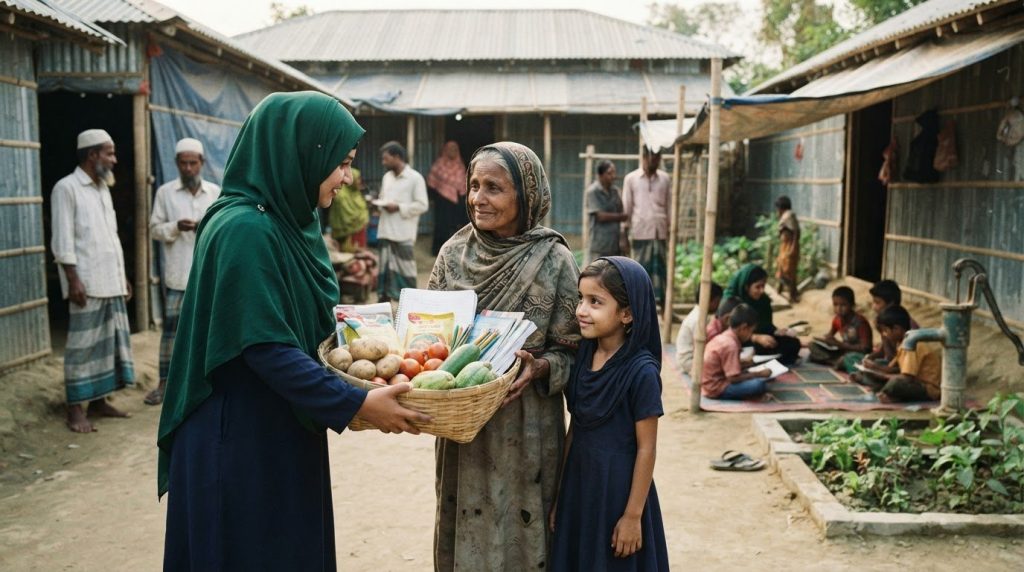
A charitable act in Islam need not involve money. Sadaqa is voluntary giving for Allah’s sake, and understanding what sadaqa is in Islam means recognising that kindness, help and material support can all have a place in it. Sadaqah jariyah is ongoing charity, whose benefits continue beyond a single act of giving.
It’s natural to associate charity with donations, but the intention behind giving and the way people are treated matter too. This article explains how sadaqa differs from lillah and sadaqah jariyah, why giving from lawful earnings matters, and how to offer support without reminding someone of a favour or causing harm.
You’ll also see how everyday kindness can express generosity, alongside donations that meet practical needs. These distinctions clarify the meaning of sadaqa and help you consider how sincere, respectful giving can support people and strengthen communities.
Key Takeaways
- Understand how voluntary sadaqa differs from obligatory zakat, and why the distinction matters when giving.
- Recognise that charity can include acts of kindness and practical help, not only financial donations.
- Learn what makes sadaqah jariyah ongoing and how it differs from other forms of giving.
- Explore how sincere intention, lawful earnings and respectful treatment shape charitable giving.
- For community support and education initiatives, Rohingya Association UK provides support in Bradford and beyond.
What is the difference between Sadaqah and sadaqah jariyah?
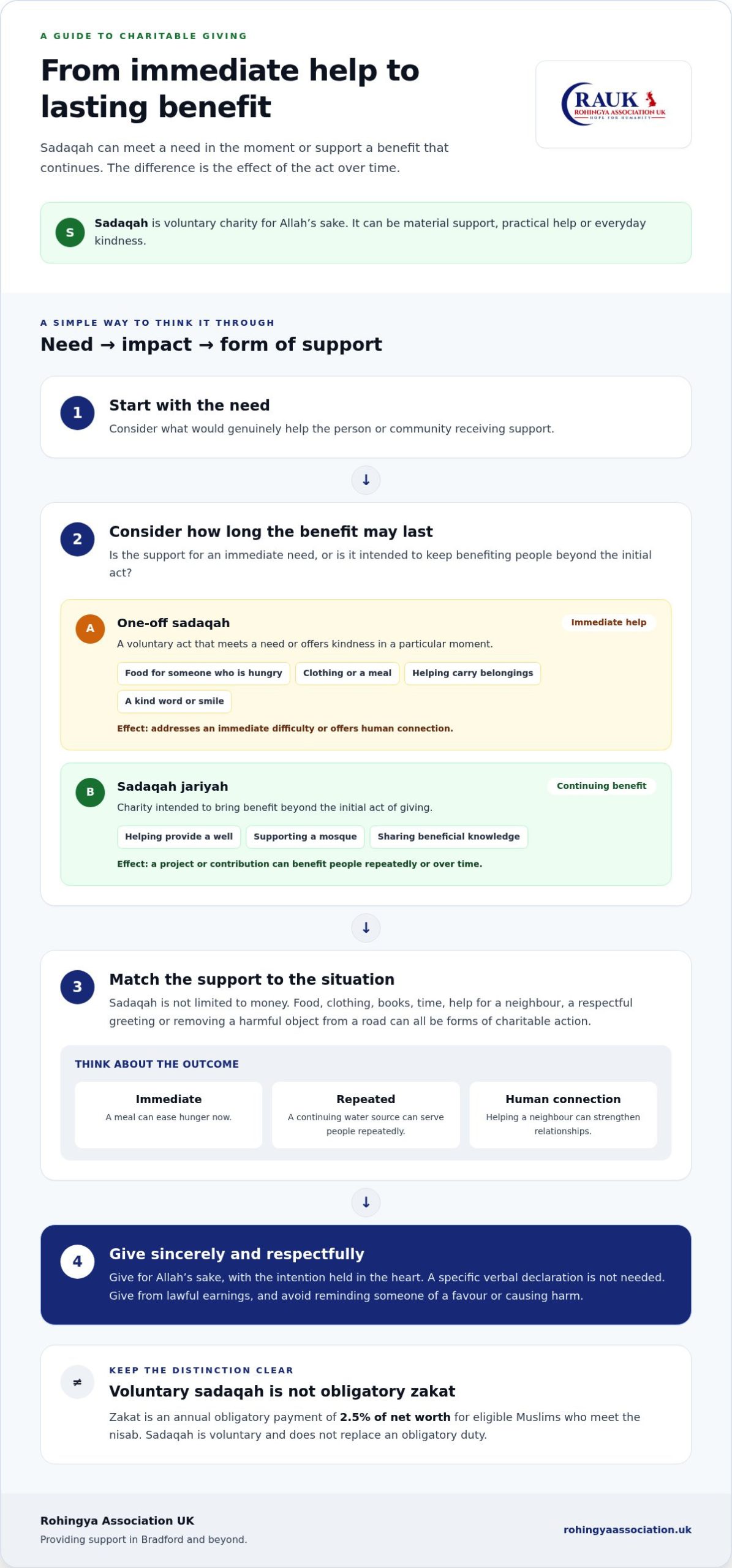
Sadaqah is voluntary charity, whilst zakat is obligatory for eligible Muslims. Sadaqah jariyah is charity intended to bring continuing benefit.
Zakat and sadaqah differ in obligation and scope. Zakat is an annual obligatory payment of 2.5% of a Muslim’s net worth, paid once a year by eligible Muslims who meet the nisab. Sadaqah, by contrast, is voluntary charity: a person may give according to their means and intention, rather than treating it as the same required payment. The distinction matters when a Muslim plans charitable giving. A voluntary donation doesn’t replace an obligatory duty, and a good deed can be sadaqah without being a financial payment.
Voluntary sadaqah can take many forms. Money, food, clothing or books can meet practical needs; giving time, helping a neighbour, speaking kindly or smiling are charitable acts too. You might provide a meal to someone in need, help carry belongings or remove a harmful object from a road. Voluntary charity isn’t limited to wealth: consideration, effort and kindness can also benefit others.
Continuing charity through sadaqah jariyah
Sadaqah jariyah is charity whose benefit continues beyond the initial act of giving. Examples include helping provide a well, supporting a mosque or sharing beneficial knowledge that people continue to use. The contribution is connected to an ongoing benefit, rather than a single moment of assistance. For a donor, the key distinction is the continuing effect of the project or contribution.
One-off charitable acts
One-off sadaqah is a voluntary act that meets an immediate need or offers kindness in a particular moment. Giving food to someone who is hungry, sharing clothing or helping carry belongings are practical examples. A kind word or a smile can also be sadaqah, even without a donation. These acts show how charitable action can begin with everyday choices.
Both forms can contribute to social wellbeing, though their effects differ. Food donations can ease an immediate difficulty, whilst a continuing water source can serve people repeatedly. Helping a neighbour also strengthens relationships through practical solidarity. Charitable giving can help wealth circulate to people facing need and contribute to economic stability. Rather than asking whether an act is large, consider what it offers: immediate assistance, repeated benefit or human connection. When choosing how to give, consider the need, the form of support and whether its benefit is one-off or ongoing.
Meaning of sadaqah
Sadaqah describes charitable giving and righteous conduct rooted in generosity and sincere faith. Its meaning extends beyond transferring wealth to include actions that benefit others.
In practice, sadaqah can include money, property, deeds or salutations. A person might give a useful possession, offer a respectful greeting, or help someone complete a difficult task. These forms connect generosity with attention to another person’s circumstances, rather than with the size of a donation alone. The meaning also covers care for people facing hardship. Qur’an 2:215 names parents, kindred, orphans, people in need and wayfarers among those for whom charitable spending is good. That guidance places sadaqah within relationships and responsibilities: support can reach family, vulnerable children and travellers in need. For a reader considering an act of giving, the practical question is what form of support would genuinely help the person receiving it.
The word’s etymology
Sadaqah is linked to the Arabic word “sidq”, meaning sincerity or truthfulness. This connection helps explain why the term carries a meaning beyond a material gift: it reflects honest faith expressed through righteous behaviour. The word and its plural form, sadaqat, occur 13 times in the Quran. That textual presence places the idea within Islamic teaching, whilst its link to sincerity connects belief with conduct.
The meaning is both inward and outward. A person may give wealth, share property, offer a greeting or perform a good deed; each can express generosity when directed towards good. A respectful salutation can acknowledge another person’s dignity, while giving a useful possession can meet a practical need. The form differs, but the shared idea is a sincere act of goodness. This wider definition helps readers recognise charitable behaviour in ordinary interactions, not only in formal donations. It also shows why sadaqah can be considered through intention and benefit, as well as what is given.
Sincerity in sadaqah
Sincerity means giving for Allah’s sake, with the intention held in the heart. A specific verbal declaration isn’t needed before an act can count as sadaqah. This keeps attention on the purpose of giving, rather than public recognition or a spoken formula. Someone can intend good while quietly offering help or sharing wealth.
For instance, someone supporting an orphan can focus on the child’s welfare rather than seeking praise. The same principle applies to giving property or offering a kind greeting: the action expresses generosity when its purpose is sincere. In Islamic understanding, righteous intention is associated with reward, but sincerity isn’t a performance for an audience. Reflect on whether an act benefits someone and is offered honestly. This makes the meaning of sadaqah practical: faith is expressed through choices that uphold care, dignity and responsibility.
Sadaqah jariyah and ongoing benefits
Sadaqah jariyah is charity whose benefit continues over time, rather than ending with one act. Its significance lies in supporting lasting good for people and communities.
Examples include providing water, supporting a mosque and sharing beneficial knowledge. A water source can serve people repeatedly, whilst useful knowledge can continue guiding others after it is shared. The benefit depends on what the charitable act makes possible over time. Considering that continuing effect helps distinguish an ongoing contribution from help that meets an immediate need.
Spiritual significance
Sadaqah jariyah has spiritual significance because its benefit may continue beyond the giver’s lifetime. A hadith describes three deeds that continue after death: ongoing charity, beneficial knowledge left behind, and a righteous child who prays for the deceased. This teaching can help readers consider how a good act may endure. Qur’an 64:16 also encourages spending in charity for the benefit of one’s own soul.
The idea of continuing benefit can shape how a person thinks about giving. Providing water can meet a recurring human need; sharing beneficial knowledge can equip others to pass learning on. A saying attributed to the Prophet identifies providing water as the best sadaqah. These teachings give spiritual weight to practical contributions and direct attention towards the people who will use or benefit from them.
Benefits for the community
Community benefits arise when charitable giving supports something people can use repeatedly. A water source can serve households over time, while a mosque can provide a shared place for worship. Beneficial knowledge can also strengthen a community when people apply and share it. These examples show why ongoing support can matter collectively, not only to the original giver or recipient.
Islamic teaching also offers a wider principle: a hadith states that wealth isn’t diminished by sadaqah. Giving can help wealth circulate in society, supporting people and projects that meet human needs. This doesn’t make every donation an ongoing charity; the distinction is whether its benefit continues. A contribution towards a lasting resource differs from a meal that addresses hunger once, though both forms of giving can be valuable.
When considering an ongoing contribution, think about what the project enables and who may benefit after the initial support. A water source, a mosque or knowledge shared with others each has a different purpose and reach. The aim isn’t simply to choose what sounds enduring, but to connect giving with a real, continuing benefit. This reflection brings together spiritual intention, practical usefulness and care for society.
Difference between sadaqah and lillah
Sadaqah and lillah both describe giving for Allah’s sake, but the terms emphasise different things. Sadaqah refers to voluntary charity and righteous acts; lillah means “for Allah” and describes the intention or dedication behind an act. A donation described as lillah is not automatically a separate kind of obligatory payment. The distinction helps readers understand what a charitable act is and why it is given.
Zakat differs from both terms because it is obligatory for eligible Muslims, whilst sadaqah is voluntary. Zakat has defined rules, including eligibility and recipient categories; Qur’an 9:60 names eight categories entitled to receive sadaqah (zakaat). A voluntary sadaqah donation, by contrast, isn’t the same duty. A Muslim might give sadaqah to help someone facing hardship, but that act doesn’t replace zakat owed by an eligible giver.
The practical difference is clear in an example. A Muslim who voluntarily gives food to a neighbour is giving sadaqah. If they give with the intention of pleasing Allah, the act may also be described as lillah. Zakat remains distinct: it is an obligatory payment, not simply another name for every charitable gift. Separating the terms helps a giver identify whether an act is voluntary or fulfils a religious obligation.
Intention also connects these concepts. Lillah highlights that an act is done for Allah, whilst sadaqah names charity or a good deed. The descriptions can overlap: a person can give sadaqah lillah, meaning voluntary charity for Allah’s sake. This wording doesn’t make the gift obligatory; it clarifies its purpose. For example, giving food without seeking recognition can be voluntary sadaqah offered with sincere intention.
Islamic teachings give charity spiritual importance as well as practical value. A saying attributed to Prophet Muhammad, cited as Tirmidhi 614, compares sadaqah extinguishing sin to how water extinguishes fire. This teaching is about sadaqah, not a definition that makes lillah or voluntary giving equivalent to zakat. It encourages charitable action, while the distinction between voluntary and obligatory giving remains important.
In everyday use, consider two questions: is the act voluntary charity or zakat owed as an obligation, and is it being given for Allah’s sake? A meal shared with someone in need may be voluntary sadaqah, given lillah through sincere intention. Keeping these meanings distinct can help a Muslim give thoughtfully, avoid confusing donations with obligatory zakat and understand how intention shapes a charitable act.
Lawful earnings and respectful giving
Sadaqah is guided by the source of what is given, the giver’s intention and the recipient’s dignity. Quranic teachings connect charity with sincere conduct, not merely the transfer of wealth.
Lawful earnings and giving conditions
Giving sadaqah from lawful earnings reflects care for how charitable support is obtained. Qur’an 2:276 contrasts usury with charity, saying Allah deprives usury of blessing and increases deeds of charity. A giver can also consider whether support meets a genuine need and preserves the recipient’s dignity. How much sadaqah should a Muslim give? It may be given in any amount, according to means and intention.
Qur’an 2:263 teaches that kind words and covering faults are better than charity followed by injury. This makes respectful treatment part of giving: provide help without humiliating someone, exposing private circumstances or turning support into a source of shame.
Giving during Ramadan
Sadaqah can be given at any time of the year, and many Muslims choose to give during Ramadan’s last 10 nights. The period gives some people a meaningful focus for generosity, but voluntary charity isn’t restricted to those nights. A person may give in a way that suits their means, whether through practical help, food or a donation.
The Qur’an instructs believers to be steadfast in prayer and practise regular charity. Ramadan giving can therefore sit within a broader commitment to charitable conduct, rather than replacing care shown throughout the year.
Consistent and sincere giving
Consistent sadaqah means making charitable acts part of regular conduct, even when each act is small. Sincerity means giving for Allah’s sake, without seeking praise or leverage over the recipient. The Prophet’s teaching that sadaqah extinguishes sin can remind a giver of its spiritual significance; intention should also go hand in hand with practical care.
Can sadaqah be given on behalf of someone else? A person can give voluntary sadaqah with the intention that its reward goes to another person. The act remains focused on sincere giving and the good intended for them.
Anonymous sadaqah
Sadaqah may be given secretly rather than openly, so anonymity is a valid way to give. A giver can arrange support without public recognition, while ensuring it reaches the intended person or cause. This can protect the recipient’s privacy and keep attention on their needs.
Whether giving privately or openly, don’t remind recipients of your favour or cause them harm. Qur’an 2:263 places kind words above charity followed by injury. For community initiatives rooted in practical support, explore community support and help strengthen shared care.
Rohingya Association UK: Community Support & Integration
Rohingya Association UK provides Community Support & Integration in Bradford and beyond, helping people access practical support and connect with community life. If you want to strengthen wellbeing through shared effort, its work also includes Education & Youth Empowerment, Cultural & Community Events, and Advocacy & Awareness Campaigns. These initiatives support learning, belonging and community voice.
Turn to Rohingya Association UK to learn how community-led support can help Rohingya refugees, families and young people. Giving can take many forms, and supporting initiatives that foster connection and opportunity is one way to stand alongside the community.
To learn more or discuss community support, contact Rohingya Association UK or visit rohingyaassociation.uk.
Let generosity shape what comes next
Understanding what sadaqa means in Islam can shape more than a single act of giving. It can guide how you respond to people around you, protect their dignity and take part in strengthening community life. The next step needn’t be complicated: choose a thoughtful action that reflects your means and values, then offer it with care.
Charitable work can also create ways for people to learn, connect and build a stronger sense of belonging. If you’d like to take part in work that strengthens connection and opportunity, contact Rohingya Association UK.
Every act of generosity can help build a more caring community. Begin with intention, and let it guide what you do next.
Frequently Asked Questions
What is sadaqah?
Sadaqah is a charitable act offered voluntarily for Allah’s sake, expressing faith through generosity and good conduct. Understanding what sadaqah is in Islam means recognising that its value isn’t limited to a financial gift. A sincere greeting can acknowledge someone’s dignity, while practical assistance can respond to an immediate need. The form may vary; intention and benefit matter.
What is the greatest Sadaqah in the sight of Allah?
A saying attributed to the Prophet identifies providing water as the best sadaqah. Water can meet a basic need repeatedly, making it a meaningful example of giving that benefits others. A charitable act’s value also relates to its purpose and effect: support that reaches people in need can serve their wellbeing. Consider what a contribution enables, rather than judging generosity only by its size.
What is the difference between sadaqa and zakat?
Sadaqa is voluntary charity, whereas zakat is an obligatory payment for eligible Muslims. Zakat is described as an annual payment of 2.5% of a Muslim’s net worth, once a year; sadaqa can be given voluntarily according to a person’s means. For example, someone may give sadaqa to support a person facing hardship, while treating zakat as a separate religious obligation.
Is sadaqa obligatory or voluntary in Islam?
Sadaqa generally means voluntary charity, so a person can give without treating each act as an obligatory payment. Zakat is distinct: it is obligatory for eligible Muslims who meet the relevant conditions. This distinction helps with planning. A person can offer a voluntary act of kindness or donation while keeping any zakat obligation separate, rather than assuming one form of giving automatically fulfils the other.
What are examples of sadaqa in everyday life?
Everyday sadaqa can include speaking a good word, visiting someone who is ill or helping a person in need. These actions bring care into ordinary encounters without requiring a formal donation. Visiting an unwell neighbour can offer companionship, while a thoughtful word may encourage someone facing difficulty. Such examples show how daily behaviour can become charitable action.
Can sadaqa be given as money, food, or help?
Yes. Sadaqa can take the form of money, food, clothing, books, property, time or practical help. The right form depends on the need: a food donation may help someone who lacks a meal, while time or help with a task can address a different difficulty. Consider what would be useful to the recipient, rather than assuming every act must involve money.
Who can receive sadaqa in Islam?
Sadaqa can support people in need and beneficial projects or programmes. Qur’an 9:60 identifies eight categories entitled to receive sadaqah (zakaat), while Qur’an 2:215 names parents, kindred, orphans, people in need and wayfarers among those for whom charitable spending is good. These references help readers distinguish guidance about zakat recipients from broader voluntary support for people and causes that benefit others.
When can Muslims give sadaqa, and is there a special time?
Muslims can give voluntary sadaqa at any time of the year. Some choose to give during Ramadan’s last 10 nights, but charitable giving isn’t limited to that period. A person might make giving part of a regular routine or respond when a need arises. Consistency can mean offering modest support repeatedly, rather than waiting for a particular occasion to act.