
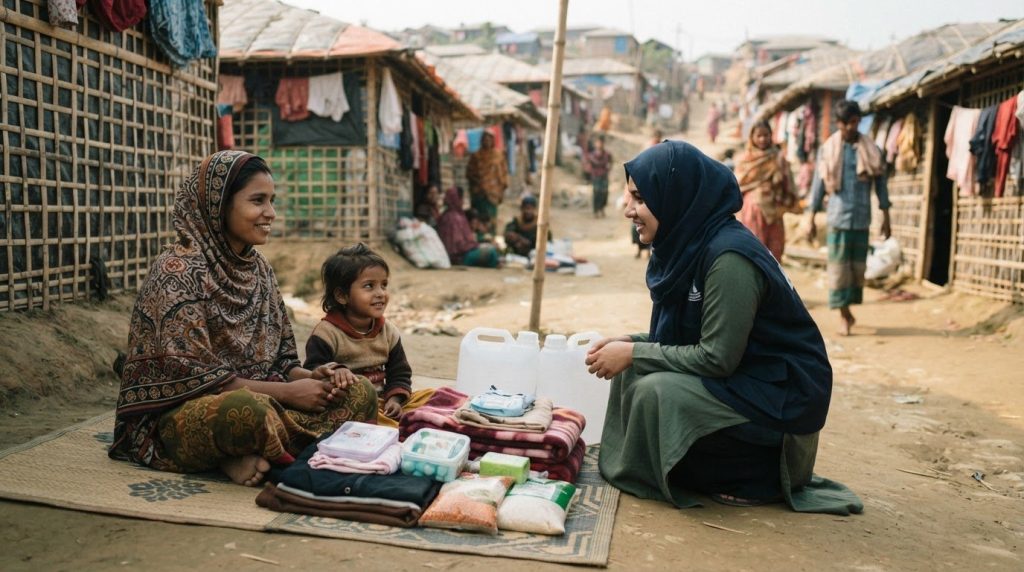
Donations help Rohingya families in Bangladesh access essentials such as food, baby kits, warm clothing, medicines and sanitation supplies. After a fire affected 3,408 people in Camp 16, Cox’s Bazar, in January 2026, these practical forms of aid mattered to families facing the loss of shelter and belongings. Understanding how donations are helping Rohingya families starts with seeing how everyday necessities can support health, dignity and recovery.
It’s natural to want to know how donations are helping Rohingya families, especially when needs are urgent and varied. Donations can fund aid projects that provide practical support, including food, essential care items, healthcare access and help with basic needs. Assistance works best when it responds to conditions on the ground.
Relief can address immediate needs while recognising the longer-term importance of safety and stability. Each form of support has a practical role in helping families protect their wellbeing and rebuild daily routines.
Key Takeaways
- See how baby kits, blankets and warm clothing can help families meet urgent needs after losing shelter and belongings.
- Learn what affects the usefulness of food support, including whether supplies suit families’ needs and circumstances.
- Understand how medicines and sanitation supplies can support health and daily dignity in crowded camp conditions.
- Get a clearer picture of the scale of displacement and why needs can differ between families and communities.
- Explore how shelter, clean water and sanitation support can help families regain safer, more stable daily routines.
Baby kits, blankets, clothing, and heaters
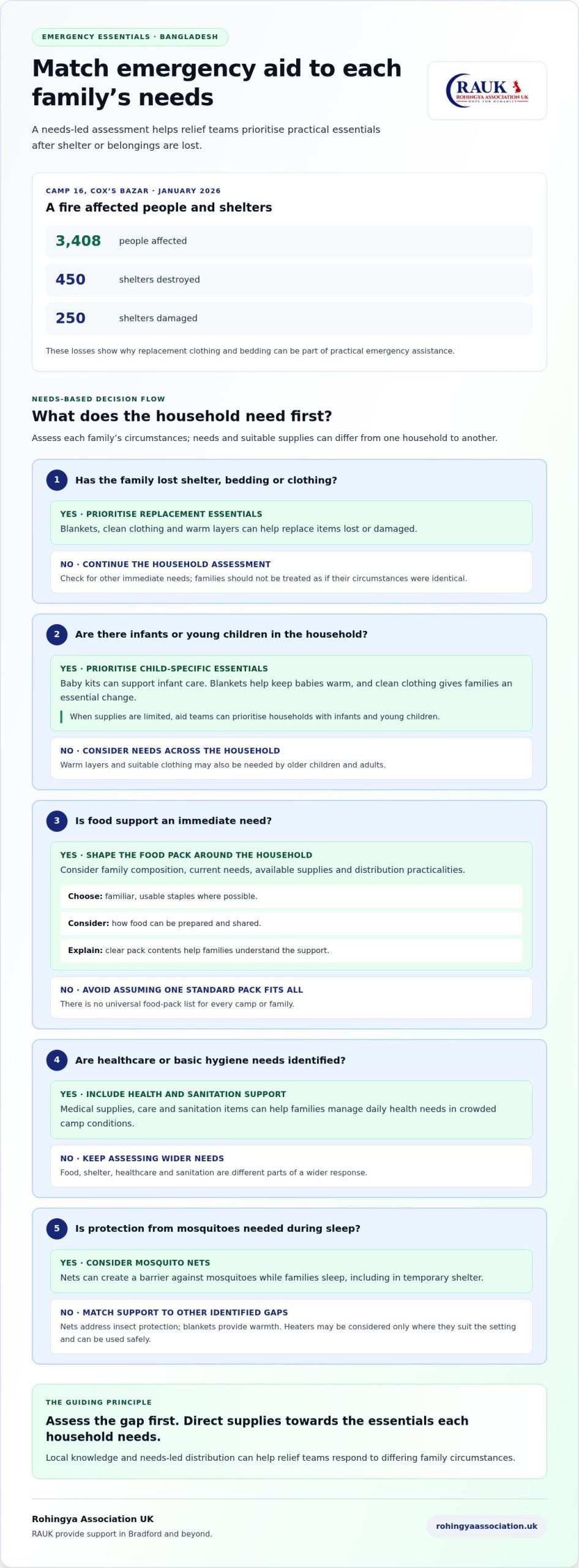
When a family loses shelter, replacing everyday essentials becomes an immediate priority. For infants, a baby kit can help caregivers meet basic care needs, while blankets and suitable clothing offer protection from cold. Donations can support the provision of these items according to what affected households need, rather than treating every family as if its circumstances were identical.
Children have particular needs during displacement. Baby kits support infant care, blankets help keep babies warm, and clean clothing gives families an essential change after belongings are lost or damaged. The contents should reflect local needs and distribution plans. This approach helps aid teams prioritise households with infants and young children when supplies are limited.
Blankets and clothing also matter beyond infancy. Families may need warm layers for children and adults, particularly when homes have been damaged and belongings cannot be recovered. In the January 2026 Camp 16 fire, 450 shelters were destroyed and 250 were damaged. These figures show why replacement clothing and bedding can form part of practical emergency assistance after a disaster.
Winter clothing and blankets address a related need: staying warm when temperatures fall. Donations can help humanitarian organisations and local partners provide these essentials to people in refugee camps. Distribution can prioritise families whose shelter or clothing has been lost, including households caring for young children. Heaters may also be considered where they suit the setting and can be used safely.
Mosquito nets serve a different purpose. They can help create a barrier against mosquitoes while families sleep, including in temporary shelter. Nets support protection from insects, while blankets provide warmth. Donations for both can therefore respond to different everyday needs within the same community.
Which organisations provide aid to Rohingya refugees, and how do they use donations? Humanitarian organisations and their partners in Bangladesh use donated support to provide essentials such as baby kits, blankets, clothing, mosquito nets and, where appropriate, heaters. The mix depends on needs identified in affected communities and the practical conditions of distribution.
For donors, the useful question is what a contribution enables relief teams to prioritise. After a fire or another disaster, teams assess which households have lost shelter, bedding or clothes, then direct supplies towards those immediate gaps. This needs-based approach helps families regain essential items while broader assistance addresses food, health and sanitation.
Food-pack contents and family coverage
Food assistance helps families meet an immediate need when displacement disrupts ordinary routines. In Bangladesh, food packs are one form of relief for Rohingya refugees living in crowded camps. Their contents should reflect household needs, available supplies and the practicalities of distribution. A package for a family with young children may need different priorities from one for adults.
There is no universal food-pack list for every refugee camp. Distribution teams can prioritise familiar, usable staples and consider how households will prepare and share them. The size and contents of a pack depend on family composition, current needs and what can be sourced and transported. Clear information about contents also helps families understand the support they receive.
How much does it cost to provide food, shelter, or healthcare for a Rohingya family? There is no single figure that applies to every family’s food, shelter and healthcare. Needs and delivery requirements differ, and emergency food assistance is only one part of a wider response.
Family coverage depends on more than the number of packs available. Relief teams need to identify household size and immediate needs, organise suitable quantities, and distribute supplies fairly. In the rohingya refugee camps, these steps help connect assistance with families who need it, including households facing disruption from crisis or disaster. Thousands of families may have different priorities at the same time.
More than one million Rohingya refugees live in Bangladesh, so donated food is part of a wider humanitarian response. Food support can help households maintain daily routines, including time for children’s education, amid displacement and uncertainty. It cannot replace safe shelter, healthcare or sustained assistance, but it can address an urgent practical need.
Donors can make their support more useful by considering how food is selected, packed and distributed. A needs-led approach takes household circumstances into account, recognises that families are not interchangeable and uses local knowledge to shape decisions. Local partners can help humanitarian organisations understand community priorities and coordinate delivery across a refugee camp.
For readers seeking a related form of support in the UK, Rohingya family support connects with community needs in Bradford and beyond. Food donations for Bangladesh and community support in the UK address different circumstances; each should be directed towards the needs it is intended to meet.
After arriving in camps in Bangladesh, more than 700,000 people, mostly Rohingya women and children, needed food, clean water, shelter, and medical care as urgent needs.
Medicines and sanitation supplies
In Bangladesh, more than one million Rohingya refugees have been displaced from Myanmar. Families affected by violence need healthcare and basic hygiene alongside food and shelter. Donations can support medical supplies, care and sanitation items that help people manage daily health needs in crowded camp conditions.
Sanitation supplies make everyday routines safer and more manageable. A hygiene kit can provide practical essentials for personal cleanliness, while access to washing facilities and clean water supports their effective use. Its contents can help meet immediate needs, though the precise items may depend on what families require and aid teams can distribute.
Healthcare support can connect people with medical care and essential supplies. Costs vary according to the patient’s needs and the care required. A child with an illness, for example, may need different support from an adult requiring ongoing care.
Bangladesh’s 2026 measles outbreak illustrates why access to health services matters. As of April 28, 2026, more than 34,600 suspected cases had been reported across 58 districts. These figures describe suspected cases, not confirmed infections. Donations supporting healthcare programmes can help affected communities access care and supplies during health emergencies.
How are donations helping Rohingya children access education and healthcare? Donations can support healthcare access and sanitation, while humanitarian programmes can help children continue learning. At least 250,000 children in Rohingya refugee camps are following the Myanmar Curriculum, demonstrating the importance of maintaining educational opportunities alongside health support.
Rohingya families are Muslim, and circumstances vary across displaced communities. A useful response starts by identifying the need: healthcare supplies address medical needs, hygiene kits support personal cleanliness, and clean water and sanitation facilities help families maintain daily routines. Coordinating these forms of assistance matters because one cannot replace another.
Donors can assess a programme by looking at how it directs support: whether it responds to identified health and sanitation needs, distributes supplies practically and explains the purpose of assistance. During a crisis, these steps help relief partners prioritise affected families, including children and people requiring medical care. Effective support recognises each family’s dignity, rather than reducing people to a statistic.
BDesh Foundation and IMANA sponsored 4 medical centers in Kutipalong Rohingya Refugee camp. That sponsorship offers an example of medical support linked to centers rather than viewed only as a contribution toward individual supplies. For donors, the distinction can help clarify what kind of assistance a programme is intended to support.
Medical centres and household sanitation supplies address different needs. When considering a contribution, donors can look for a clear explanation of whether support is intended for medical services, essential items or both, and how those priorities match needs identified by aid teams. Clarity helps explain a donation’s purpose without treating one form of assistance as a substitute for another. Families also need information about available support and how to access it. Transparency can help donors understand how medical and sanitation support may be coordinated.
How many Rohingya refugees are currently receiving aid?
More than 1.19 million Rohingya refugees from Myanmar are registered in Bangladesh. That figure describes the registered refugee population, not the number receiving aid. Humanitarian assistance covers different needs, so the people reached depend on each programme and the support it delivers.
Location helps explain the scale of the response. Cox’s Bazar is home to nearly 900,000 Rohingya refugees, while more than 33,000 refugees live on Bhasan Char. These figures describe where people live, not how many receive food, healthcare, shelter or other assistance. A single population total cannot show whether each family’s needs are being met.
Aid takes different forms. One programme may provide food, while another focuses on healthcare, sanitation, shelter or education. Someone counted as receiving one type of support may not receive every other form. For example, a household could need medical care even after receiving food assistance. Looking at aid by programme gives a clearer picture of the response.
When assessing coverage, separate three questions: how many people live in a location, what assistance a programme offers, and whom it reaches. This distinction matters in Bangladesh, where displacement affects large communities and needs vary between households. Population totals describe the overall context; programme records describe specific assistance.
Children make up nearly half of the Rohingya refugee population in Bangladesh. It is therefore important to consider whether aid reaches children through relevant support, including health services and education. The total number of people assisted cannot, on its own, show which age groups received help or what kind of support they received.
Families’ circumstances can change after a fire, flood or other emergency. A household may need urgent shelter or essential supplies after losing belongings, while another may need continuing health or education support. Assistance figures should therefore be read alongside the type of crisis, the location affected and the needs the response addresses.
When reviewing a humanitarian appeal, look for a clear description of its intended recipients and support. Check whether its stated reach refers to individuals, households or a particular service, and whether it covers a camp or a wider area. These distinctions prevent confusion between the number of refugees in Bangladesh and the number reached by a single aid activity.
There is no useful coverage figure without knowing the programme and assistance being counted. The registered population provides context; programme-level reporting explains which needs are addressed and where. Understanding both helps donors see the scale of displacement without mistaking population totals for aid coverage.
How do donations support shelter, clean water, and sanitation in Rohingya camps?
In Rohingya camps, donations can support three connected needs: safer shelter, access to clean water and sanitation facilities. Shelter protects belongings and provides privacy; water supports drinking, cooking and washing; sanitation helps make daily routines possible. These forms of assistance work best when relief teams identify immediate gaps and coordinate what they provide.
For shelter, donations can help fund materials and repairs after homes are damaged or destroyed. A practical response prioritises households without secure places to sleep, then considers which materials suit local conditions and can reach affected areas. Families may also need privacy and protection from rain. The right support depends on the damage and the needs identified in each community.
Clean water requires more than a source. Its usefulness depends on placement, access and upkeep. Donations can contribute to water access, while local planning helps make facilities reachable for the people who need them.
Sanitation support includes facilities for washing and personal hygiene. This example shows how a donation may support specific infrastructure. Facilities should respond to users’ needs, including women’s, and fit the camp’s available space and water access.
Water and sanitation are closely linked. A shower facility needs water; a tube well is more useful when people can access it safely and consistently. Relief teams can assess where families live, identify gaps in nearby facilities and prioritise improvements. This practical sequence connects donations with services that support daily life, rather than treating each item as an isolated solution.
Donors can look for clear explanations of what their support is intended to fund. Does an appeal describe shelter repairs, a water point or sanitation facilities? Does it explain whom the project serves and how local needs shape decisions? These questions help distinguish a defined response from a general appeal, without assuming one donation can meet every need.
In Bangladesh, shelter, water and sanitation projects address distinct needs, but families may require several forms of support together. A household whose shelter is damaged may also need access to washing facilities and clean water. Donations can help relief partners prioritise these needs and direct resources towards practical improvements. For UK-based community support, explore support for Rohingya families.
Rohingya Association UK: Community Support & Integration
Rohingya Association UK provides support in Bradford and beyond through Community Support & Integration, Education & Youth Empowerment, Cultural & Community Events, and Advocacy & Awareness Campaigns. These programmes help Rohingya people in the UK build connections, access learning opportunities and maintain cultural ties.
If you’re part of a Rohingya family seeking community connection, or want to support local integration, these programmes offer a relevant next step. They complement emergency relief in Bangladesh by addressing community, education and belonging in the UK. The right support depends on the need, whether that is youth empowerment, cultural connection or advocacy that raises awareness.
For community-based support in Bradford and beyond, contact Rohingya Association UK.
Let solidarity guide your next step
Understanding how donations are helping Rohingya families can turn concern into informed solidarity. Decide what kind of support reflects your priorities, then follow through with care. Thoughtful giving rests not only on urgency, but also on respect for people’s dignity, choices and resilience.
Before supporting an appeal, consider whether it clearly explains the need it addresses and treats affected people as partners rather than passive recipients. This perspective helps keep support grounded in respect. For readers in the UK, solidarity can also mean strengthening community ties close to home. Support in Bangladesh and community work in Britain meet different needs, and each deserves attention on its own terms.
Rohingya Association UK offers a point of connection for those who want to learn about community support and ways to take part. Choose a meaningful next step, whether learning more, sharing awareness or building relationships within your community. Explore ways to connect with Rohingya Association UK and carry that intention forward. Sustained solidarity begins with listening, respect and action grounded in care.
Frequently Asked Questions
How can I help Rohingya refugees in Bangladesh?
You can support humanitarian work by making a voluntary donation to an organisation funding projects in Bangladesh. Rohingya Association UK accepts contributions for aid projects, including crisis intervention, education and community integration. Decide which needs you want to support and look for a clear explanation of how contributions are directed. This helps you choose an approach that reflects your priorities and the needs of displaced families.
How are donations helping Rohingya families in Bangladesh and Myanmar?
Donations can fund aid projects in Bangladesh, Myanmar and the UK. At Rohingya Association UK, contributions support crisis intervention, education and community integration for displaced Rohingya families. These activities respond to different needs: crisis intervention addresses urgent circumstances, while education and integration support longer-term participation and connection. The specific work depends on the project and the needs it is designed to address.
What food and nutrition assistance do donations provide to Rohingya families?
Donations can support emergency food assistance for families facing crisis, helping relief programmes respond to immediate food needs. The contents and amount of support depend on the programme, household circumstances and locally identified priorities. A family with young children, for example, may have different needs from a household with adults only. Food assistance is one part of support; healthcare, clean water and sanitation also matter to family wellbeing.
What cash assistance or livelihood programs are available to Rohingya families?
No cash-assistance program is described.