

Sponsorship is more than a welcome: under the proposed UK Named Community Sponsorship scheme, approved sponsors would support a resettled family for one year, with responsibility for housing lasting two years. Understanding what the Named Sponsorship Scheme is means recognising that commitment from the outset. It includes practical help as a family settles into a new community.
It’s understandable to focus first on the person or family being supported, but a sustainable welcome also depends on what sponsors can provide and organise. This article explains sponsors’ responsibilities after approval, the practical support involved, and the funding and resources groups need to plan for.
You’ll also learn how community sponsorship works in the UK and what distinguishes this named pathway, so you can understand the commitment and consider what meaningful, long-term support requires.
Key Takeaways
- Understand the distinction between sponsors’ one-year support commitment and their two-year housing responsibility.
- Plan practical assistance around arrival, including initial expenses, English-language tuition, school and GP registration, and interpreting support.
- See how funding needs depend on the group’s resources and in-kind support, and what financial capacity sponsors are asked to demonstrate.
- Learn which organisations and participants may be eligible, and why people already in the UK asylum process are outside this pathway.
- Follow how the application pathway connects community groups with Lead Sponsor Organisations and the Home Office.
Sponsor responsibilities and practical support
After approval, sponsors provide practical settlement support, while the Government oversees and vets refugees before arrival. Under the proposed UK Named Community Sponsorship scheme, communities help secure housing, connect families with local services and arrange local English-language tuition.
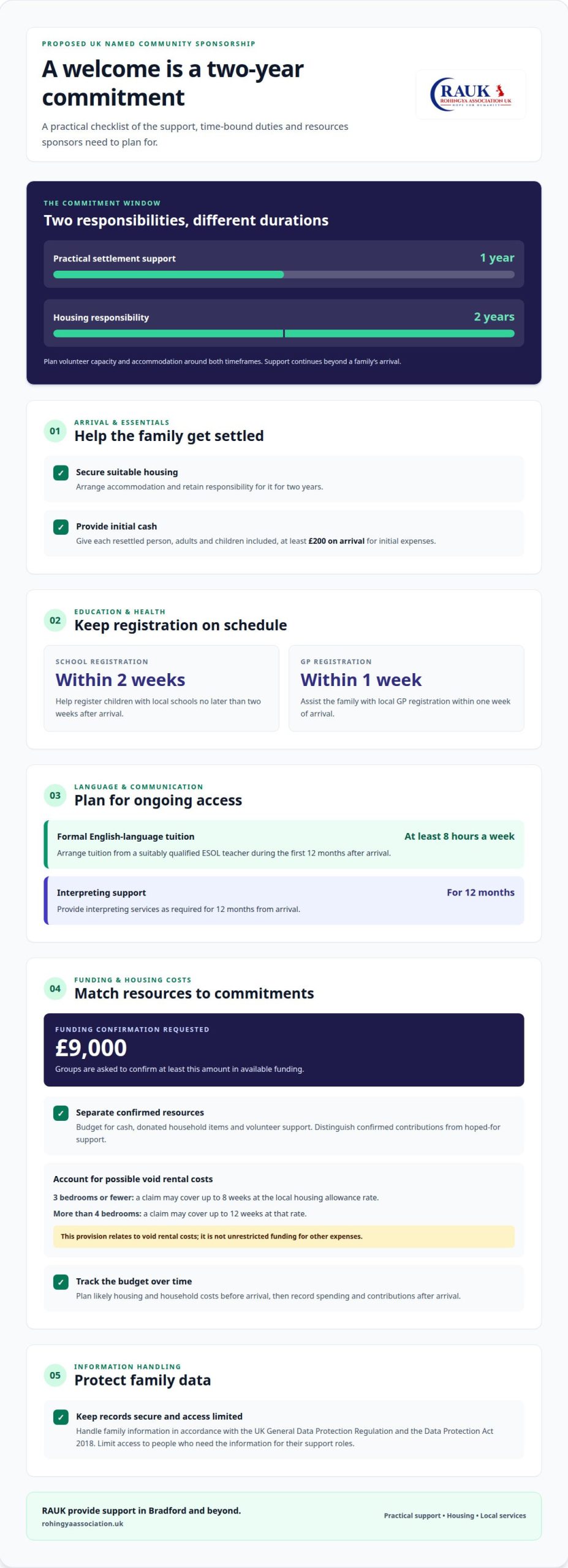
In UK community sponsorship, the formal support commitment lasts one year, while housing remains the sponsors’ responsibility for two years. This distinction matters when groups plan volunteer capacity and accommodation. Support continues beyond a family’s arrival.
Practical responsibilities include helping each family member access essential services. Sponsors must provide each resettled person, including adults and children, with at least £200 in cash on arrival for initial expenses. They must also help register children with local schools no later than two weeks after arrival, and assist families with local GP registration within one week.
English tuition and communication need sustained planning. Sponsors must arrange formal English-language tuition from a suitably qualified ESOL teacher for at least eight hours per week during the first 12 months after arrival. They must provide interpreting services as required for 12 months from arrival. These commitments call for reliable coordination, not simply a one-off welcome.
- Housing: secure suitable accommodation and retain responsibility for it for two years.
- Initial needs: provide each person with at least £200 on arrival.
- Education and health: support school registration within two weeks and GP registration within one week.
- Language access: arrange the required ESOL tuition and interpreting support.
Personal information also needs careful handling. Sponsors must hold resettled family data securely in accordance with the UK General Data Protection Regulation and the Data Protection Act 2018. In practice, groups should limit access to people who need the information for their support roles and handle records responsibly.
How does the Named Sponsorship Scheme compare with other sponsorship programmes? The proposed UK pathway combines community-led settlement support with Government vetting before arrival. Canada’s private sponsorship programme has operated since 1979, while the UK approach described here centres on local housing, services and tuition.
What are the application deadlines and processing times? Applications to become an accredited Lead Sponsor Organisation are anticipated to open in Autumn 2026, and first arrivals could begin from Autumn 2027. After allocation is agreed, a resettled family typically arrives within 6-12 weeks.
What risks or restrictions should applicants and sponsors know about? The year-long support commitment and two-year housing responsibility require sustained planning. Groups must also protect family data and meet practical support duties. People already navigating the UK asylum process are not eligible for this pathway.
Where can I find official guidance and local contact details for the scheme? Consult Home Office guidance on the scheme. Applications are submitted with help from Lead Sponsor Organisations, and local community sponsorship contacts can explain how responsibilities are organised in their area.
Funding and financial resources
UK community sponsorship requires financial preparation before a family arrives. Groups are asked to confirm at least £9,000.00 in available funding. These figures serve different purposes: one is the stated funding confirmation, while the other describes a typical fundraising range.
In-kind contributions can reduce how much a group needs to raise. Donated household items or volunteer support, for example, may ease some costs. Distinguish confirmed donations from hoped-for contributions, then make a realistic plan based on resources the group can rely on. Consider funding alongside practical support commitments and housing responsibilities.
A useful budget separates costs by purpose and timing. Before arrival, identify likely housing and household expenses, then plan for ongoing settlement support. After arrival, track spending against the agreed budget and keep records of contributions and payments. This makes it easier to see which resources are available, what commitments remain and where further fundraising is needed.
Housing can create costs even before a property is occupied. UK community sponsor groups may claim void rental costs for up to 8 weeks at the local housing allowance rate for properties with 3 bedrooms or fewer. For properties with more than 4 bedrooms, they may claim void rental costs for up to 12 weeks at that rate. Groups should account for the property size and the period before occupancy when planning cash flow.
These provisions do not replace careful budgeting. A claim relates to void rental costs and is limited by the stated period and local housing allowance rate. Do not treat it as unrestricted funding for other expenses. Plan housing separately, keeping any potential claim distinct from fundraising and in-kind support.
- Confirm available funds: include the required £9,000.00 funding confirmation in financial planning.
- Plan housing cash flow: consider property size and the applicable void-cost claim period.
- Track resources: distinguish cash, donations and volunteer contributions in the budget.
Financial readiness is not only about reaching a target; it is about matching resources to obligations over time. Groups building a wider understanding of community support networks can also consider how local relationships contribute practical, non-financial help alongside funding.
Who is eligible for the Named Sponsorship Scheme?
Eligibility involves two separate questions: which UK organisations may sponsor, and which people may be supported. Under the proposed scheme, sponsored individuals are expected to have formal refugee status recognised through international protection processes. Formal assessments are expected to be carried out through established international protection frameworks.
For community sponsor organisations, eligibility may include an individual or body falling within section 10(2)(a) of the Charities Act 2011. That reference gives groups a specific legal category to consider when assessing their organisational status. It does not mean every group interested in sponsorship automatically qualifies.
In practice, a prospective sponsor should first identify the legal form of the organisation applying. It can then consider whether that form falls within section 10(2)(a). This distinction matters: the scheme concerns a sponsoring organisation as well as an eligible refugee, so a group’s willingness to help does not itself establish eligibility.
- Potential sponsor: an individual or body falling within section 10(2)(a) of the Charities Act 2011 may be eligible.
- Potential participant: the proposed pathway is intended for people with formal refugee status recognised through international protection processes.
- Assessment: refugee-status assessments are expected to be carried out through official international channels.
- Exclusion: people already navigating the UK asylum process will not qualify for this pathway.
The distinction between refugee resettlement and an asylum claim in the UK is central. People already navigating the UK asylum process are not eligible for the Named Community Sponsorship pathway. It is not an alternative route for someone whose asylum claim is being considered in the country.
This restriction clarifies the scheme’s intended sequence. Sponsored people are expected to have formal refugee status recognised through international protection processes before the pathway applies. Assessments are expected to be carried out by official bodies; community sponsors do not determine refugee status.
Under the proposed process, people cannot apply to the scheme themselves. Community groups, universities and employers, alongside organisations such as the Rohingya Association UK, are expected to help identify people they wish to support, while Lead Sponsor Organisations help submit applications to the Home Office. The sponsored person’s eligibility and the sponsor’s role are separate considerations.
A practical eligibility review should keep those categories distinct. For example, a group can examine whether its legal form may fall within the Charities Act 2011 provision, while the proposed refugee-status requirement applies to the person it hopes to support. Neither condition replaces the other.
The scheme’s proposed criteria focus on the sponsor’s organisational category and the participant’s recognised refugee status. Understanding both helps groups distinguish this pathway from support for people already in the UK asylum process and clarify the roles of official assessment bodies, Lead Sponsor Organisations and the Home Office.
What benefits does the scheme provide to sponsors and sponsored participants?
For sponsored participants, a community sponsor can make arrival more supported and less isolating. Practical help with local services, housing and English tuition can ease the transition into daily life. For example, guidance on local services can help people attend appointments and manage essential tasks independently over time.
English tuition offers more than classroom learning. It can help participants communicate with neighbours, understand letters and join community activities. Local support provides opportunities to practise English in everyday settings, while respecting each person’s experience, choices and pace.
For sponsors, the scheme offers a structured way to turn collective concern into sustained action. Groups can share responsibilities for housing, access to services and language support, rather than relying on one person to manage every practical task. This work can build connections between local residents and newly arrived families.
The wider community may benefit too. Research from the University of Birmingham found that Community Sponsorship contributes to more outward-looking, open and inclusive communities, alongside more positive attitudes towards refugees. This suggests its effects can reach beyond the sponsor group: local relationships can shape how residents understand displacement and welcome.
Since 2016, more than 350 communities in the UK have welcomed more than 600 refugees through the Community Sponsorship scheme. This experience shows how local participation can become a practical part of resettlement. Each group brings its own local knowledge, relationships and capacity to support a family’s settlement.
- For participants: support can connect arrival with housing, local services and English learning.
- For sponsors: shared roles give community members a purposeful way to contribute.
- For local communities: sustained contact can create relationships beyond the initial welcome.
- For public understanding: the University of Birmingham research identifies links with more inclusive attitudes.
These benefits depend on meaningful partnership, not a one-way exchange. Families bring skills, knowledge, culture and personal aspirations; sponsors contribute local connections and practical support. Treating people as participants in community life, rather than only as recipients of help, respects their agency and encourages mutual understanding.
Sponsor groups can build opportunities for shared participation into their plans. A community event, conversation group or local activity can give people space to meet naturally. These activities complement practical assistance while allowing families to choose how they wish to take part.
The scheme links individual settlement with community relationships. Its value can be seen in the practical connections families develop, the shared contribution of local sponsors and the wider shift towards openness identified by the University of Birmingham.
How do you apply for the Named Sponsorship Scheme step by step?
The application pathway connects community groups with Lead Sponsor Organisations and the Home Office. Individuals cannot apply directly. Groups, universities and employers identify people they wish to support, while an accredited Lead Sponsor Organisation helps submit applications.
Applications to become an accredited Lead Sponsor Organisation are anticipated to open in Autumn 2026. The first refugees could arrive through the scheme from Autumn 2027. These milestones help groups understand the sequence, but they are not the same as an individual application deadline.
- Build a community group. Bring together people prepared to support a named refugee or family. Universities and employers may also identify people they wish to support.
- Prepare for the Lead Sponsor Organisation route. Applications for accreditation are anticipated to open in Autumn 2026. This organisation will help community groups submit applications to the Home Office.
- Identify whom the group wishes to support. Community groups, universities and employers identify the people they wish to support. The individual cannot apply independently through this pathway.
- Submit through the Lead Sponsor Organisation. The accredited organisation assists with submitting the application to the Home Office. This links the community group’s proposed support with the formal process.
- Plan for allocation and arrival. Once allocation is agreed, a resettled family typically arrives within 6-12 weeks. Groups can use this period to prepare practical arrangements.
Preparation should reflect the scheme’s requirements, not assumptions about an application form. Groups can organise their membership, agree how responsibilities will be shared and consider whether their support plan is workable. These steps help clarify readiness before entering the application pathway.
There is a specific restriction after a refusal decision. In the UK, a new community sponsor application will not be considered until 180 days have passed. Groups should factor this waiting period into any decision to submit again, rather than treating a refusal as an invitation to reapply immediately.
For timing, distinguish three milestones: accreditation applications anticipated in Autumn 2026, possible first arrivals from Autumn 2027, and the typical 6-12 weeks between agreed allocation and arrival. Each describes a different stage, so they should not be mistaken for one overall processing time.
Groups preparing locally can map available volunteers, community relationships and practical support before starting the formal route. If your group is building its capacity to welcome refugees, explore community support opportunities as part of that preparation.
Rohingya Association UK: Community Support & Integration
Rohingya Association UK provides support in Bradford and beyond through Community Support & Integration. If you’re looking for practical, community-based support alongside information about sponsorship, the organisation’s work may be helpful. It also offers Education & Youth Empowerment, Cultural & Community Events, and Advocacy & Awareness Campaigns.
This support can help Rohingya individuals and families strengthen community connections, pursue learning and take part in cultural life. It complements the wider work of building welcoming, inclusive communities while recognising that each person has their own needs and aspirations.
Rohingya Association UK is working with partners to enable community groups to sponsor refugees. If you are interested, please contact us about our Named Sponsorship, Education Sponsorship and Employment Sponsorship schemes.
For community support or information about its work, contact Rohingya Association UK or visit rohingyaassociation.uk.
Turn understanding into a thoughtful welcome
Understanding the Named Community Sponsorship Scheme can help a community decide how it wants to contribute, but meaningful welcome begins with listening. Refugees arrive with their own skills, priorities and hopes. Making space for those voices helps build relationships based on dignity and shared purpose.
If your group is considering its next step, start a conversation about the kind of community it wants to create. Look beyond arrival day: consider how people can shape local life, form connections and find a sense of belonging on their own terms. A thoughtful approach can turn good intentions into lasting relationships.
Rohingya Association UK’s work in community support, education and cultural events offers a way to connect with wider efforts that strengthen belonging. If you’d like to explore how your community can contribute, discover ways to get involved.
Every lasting welcome begins with a willingness to listen, learn and make room for one another.
Frequently Asked Questions
What is the Named Sponsorship Scheme?
The Named Community Sponsorship Scheme is a proposed UK pathway for community groups to support refugees they identify. The Government oversees and vets refugees before arrival, while Lead Sponsor Organisations help groups submit applications to the Home Office. Refugees cannot apply directly. For example, a university or employer may identify someone it wishes to support, then use the sponsorship route rather than submit an individual application.
What are the scheme’s rules, obligations, and duration?
Sponsors’ support commitment lasts one year, while responsibility for housing lasts two years. Practical duties include helping families access local services and arranging required English tuition and interpreting. For a group planning its rota, this means assigning people to ongoing tasks, not only arrival-day support. Sponsors must also handle family data securely under the UK General Data Protection Regulation and the Data Protection Act 2018.