
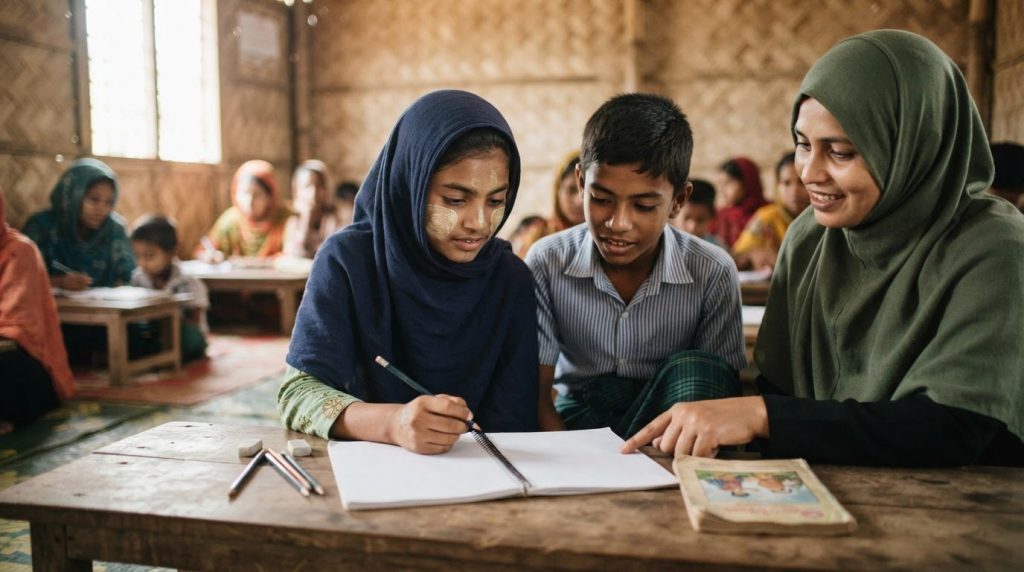
Three per cent of refugee children are enrolled in higher education. This gap shows why the long-term impact of refugee education reaches beyond the classroom: access to learning can shape a person’s identity, sense of belonging and future opportunities.
Education can provide continuity after displacement and influence how young people understand their heritage and take part in the communities around them. Its impact depends on more than attendance. Curriculum, teaching quality, accessibility and whether learners can continue their education all matter.
This article explores how curriculum and civic learning can shape identity, why access to formal schooling remains unequal, and how gender affects educational opportunities. It also considers what education can make possible for refugees and their families over time, while recognising the barriers that may interrupt learning.
Key Takeaways
- Curriculum and civic learning can help refugee students build knowledge while making sense of heritage, identity and belonging.
- Many displaced young people live outside camps and formal systems, so schooling access and learning quality can vary widely.
- Education can support future opportunities by building knowledge, skills and connections, though barriers may interrupt learning.
- Gender and wider circumstances shape whether young people can access and continue their education; the effects of disruption can endure.
- For Rohingya families seeking community and education support, RAUK provide support in Bradford and beyond.
Curriculum, civic learning, and refugee identity
In Lebanon, Syrian refugee students followed the Lebanese curriculum and needed to pass the Brevet exam to progress to further education. This route links classroom learning to recognised qualifications and future study, while placing students in another country’s education system. For displaced learners, adapting to unfamiliar teaching, language and historical perspectives can mean balancing new learning with ties to their own heritage.
A curriculum is more than a sequence of subjects. The stories, languages and histories taught in class can affect whether students see their experiences reflected in their learning. A lesson on national history, for example, may introduce the shared references of a new community, while family conversations preserve memories and traditions from home. These sources need not compete. Schooling in a host country can build knowledge for participation there, while cultural continuity sustains a sense of identity through displacement.
Civic learning helps students understand the communities around them. Discussions about public life, shared responsibilities and different viewpoints can help young people make sense of everyday experiences, such as joining a school council or completing a group project. These activities provide practice in listening, expressing views and cooperating. They can build confidence to participate without asking students to leave behind their language, faith or cultural heritage.
Curriculum choices matter because inclusion means more than placing a refugee student in a classroom. Students who have changed schools or countries may encounter different subject sequences, teaching methods and expectations. Teachers can make learning more accessible by explaining unfamiliar terms, linking new topics to prior knowledge and inviting students to share perspectives if they choose. In a history lesson, comparing how communities remember an event can open discussion without making any student a spokesperson for an entire people.
The Lebanese example shows how a national curriculum can shape both educational pathways and a student’s relationship with a host society. The Brevet exam provides a clear milestone for progression, while civic learning and classroom inclusion shape the wider experience of belonging. Schools can recognise students as individuals with their own histories, rather than as representatives of a single refugee identity. This leaves room for connections to family, heritage, classmates and the society where they study. Over time, these experiences can influence how young people understand their choices, relationships and place in public life.
Schooling outside camps and formal systems
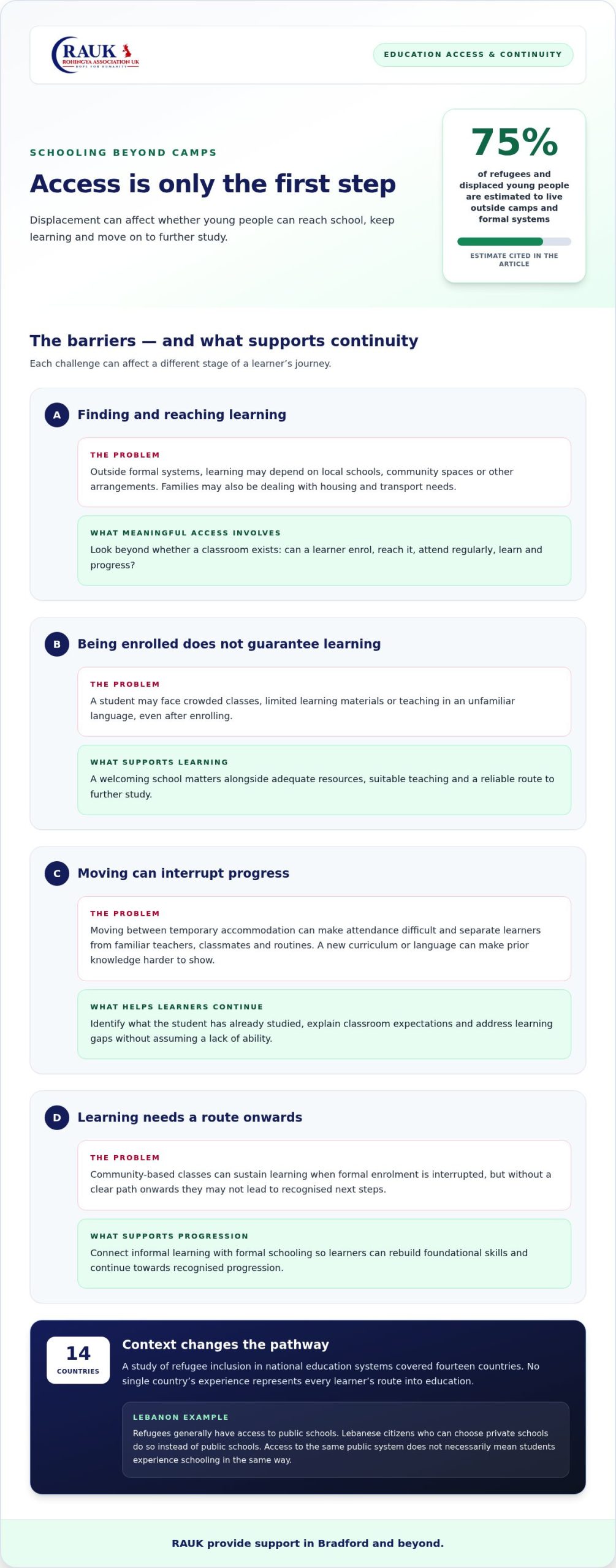
An estimated 75 percent of refugees and displaced young people live outside camps and formal systems. Their education may depend on schools, community learning spaces or other local arrangements. A family living in a town, for example, may need to find a school while also securing housing and transport. Displacement can therefore shape education through everyday practical pressures, not only through the availability of classrooms. Where learning takes place, who can reach it and how regularly children attend all influence continuity.
Access and quality are separate challenges. A child may enrol in school yet face crowded classes, limited learning materials or teaching in an unfamiliar language. Moving between temporary accommodation can also make regular attendance difficult. These barriers affect how much a student can learn and whether they can keep pace with classmates. A welcoming school matters, but cannot replace adequate resources, suitable teaching and a reliable route to further study.
Formal education provides a recognised structure for learning, with scheduled lessons, assessment and progression between stages. Community-based classes can help sustain learning when formal enrolment is interrupted. For example, a young person who missed lessons during a move may need help rebuilding foundational skills before joining a new class. The link between informal learning and formal schooling matters: without a clear path onwards, learning may continue without leading to recognised next steps.
A study of refugee inclusion in national education systems covered fourteen countries. This scope shows why one country’s experience cannot represent every refugee student’s route into education. National systems, local resources and the circumstances of displaced families all differ. The useful question is not simply whether a school exists, but whether a learner can enrol, attend, learn and progress. Each stage depends on practical conditions such as distance, teaching resources and continuity after a move.
Lebanon shows how national schooling can operate alongside unequal choices. Refugees generally have access to public schools, while Lebanese citizens who can choose private schools do so instead of public schools. Access to the same public system does not necessarily mean students experience schooling in the same way. Differences in resources and school choices can shape classroom conditions, peer relationships and the support available to learners.
For a displaced learner, interruptions can mean more than missed lessons. A move may separate a student from familiar teachers, classmates and routines. A change in language or curriculum can make prior knowledge harder to demonstrate, even when that knowledge remains strong. Schools can support continuity by identifying what a student has studied, explaining classroom expectations and addressing gaps without assuming a lack of ability. Meaningful access means more than entering a classroom: it means having the chance to participate and progress.
Education’s role in preparing refugees for the future
Education prepares young people for future choices by building knowledge they can use beyond a classroom. Literacy helps a student interpret instructions, complete forms and communicate ideas. Numeracy supports practical tasks, such as comparing quantities in a science lesson or planning a household budget. These foundations can help refugees pursue further study, work and participation in community life. They do not determine one fixed future; they strengthen the tools available to shape one.
Qualifications can document learning as a student moves between schools or countries. Learners can keep a simple record of subjects studied, assessments completed and certificates earned. For example, a student joining a new school can use previous coursework to explain what they have learned. Clear records may help teachers identify suitable next steps, rather than treating a school move as a complete loss of progress.
Classroom skills can also support practical work. A group project, for instance, asks students to share responsibilities, meet deadlines and explain decisions. These habits are useful in further study and employment, where cooperation is often needed. Digital learning can build confidence with research and communication tools, while hands-on tasks can develop technical understanding. The value depends on opportunities to practise, receive feedback and apply learning in different settings.
For a young person considering further study, a useful first step is to identify subjects they enjoy and skills they want to develop. Someone interested in health might explore biology, communication and care-related learning; someone drawn to construction could build on mathematics and practical problem-solving. These examples show how interests can guide choices without narrowing a learner’s future too soon. Guidance should connect current learning to possible next steps.
Education can prepare refugees to take part in decisions that affect their lives. A classroom discussion about community needs, for example, lets students practise presenting a view, listening to others and weighing evidence. A collaborative project can develop these skills further by asking each learner to contribute and agree on a shared outcome. Such experiences build confidence in young people’s judgement and show that participation grows through practice.
Displacement can interrupt plans, so future preparation benefits from clear, adaptable learning goals. A student and teacher can identify existing strengths, choose a skill to develop and review progress through completed work. If a move changes the learner’s school, those goals can help explain which subjects or support should continue. Part of education’s long-term value is the ability to carry knowledge and purpose forward, even as circumstances change.
Gender differences in education impacts
Education outcomes vary with age, gender, interrupted learning and time since resettlement. A younger pupil may need foundational literacy, whilst an older learner may prioritise qualifications or vocational skills. Gender can shape access and continuity; resettlement time affects familiarity with school systems, language and available support.
For girls, the risk is not only missing initial enrolment. The Malala Fund estimated that half of refugee girls enrolled in secondary school before COVID-19 would not return because of lasting pandemic consequences. This warning points to the fragility of progress when a crisis disrupts schooling. A girl who has already entered secondary education can still lose continuity if responsibilities, safety concerns or household pressures prevent her return.
Gender alone cannot explain an individual student’s experience. Two girls of the same age may have different educational histories, family responsibilities and support networks. The same is true for boys. For example, a student who missed lessons while moving may need help rebuilding subject knowledge, regardless of gender. A useful assessment starts with the learner’s age, previous schooling, current attendance and goals.
Age changes what continuity means. A younger child learning to read may need regular practice and a stable classroom routine. An adolescent who has changed schools may need to connect prior learning with subject choices, assessments or plans for further study. For either learner, interruptions can leave gaps that become harder to address as teaching moves on. Teachers can identify those gaps through classwork and discussion, then tailor support to the student’s current level.
Time since resettlement also shapes the practical demands of education. During an early transition, a student may be learning a new language and classroom expectations alongside academic subjects. Later, familiarity with the school system can support informed study choices, though earlier gaps may still affect progression. For instance, a conversation about subjects studied, strengths and areas needing attention can help a pupil entering a new school. Time alone does not show how far a student has progressed.
Schools can consider gender, age and transition together rather than in isolation. They can review attendance, ask students about barriers and offer appropriate learning support. For a girl returning after an interruption, this might mean identifying missed topics and agreeing a manageable route back into lessons. For an older student, it may mean connecting existing skills with realistic study goals. These steps respect individual agency and prevent assumptions from obscuring a learner’s actual needs.
Families and educators can notice changes in participation, such as a student becoming quieter in class or missing particular lessons. A respectful conversation can clarify whether the issue concerns learning, confidence, responsibilities or adjustment to a new school. Gender-sensitive support should respect each learner’s dignity and choices while making it easier to stay engaged. The Malala Fund’s estimate underlines why returning to education after disruption deserves attention, especially for girls approaching or attending secondary school.
Long-term effects of refugee education
Education’s lasting effects reach beyond qualifications to work, well-being and participation. These outcomes depend on continuity in learning, personal circumstances and opportunities after school.
Employment and earnings over time
Education can support future employment by building knowledge, recognised qualifications and practical skills. For a refugee student, these can help make prior learning visible when applying for further study or work. Literacy, digital skills and teamwork all have practical value. However, education alone does not determine a person’s job or earnings. The connection depends on whether learning can continue and whether skills and qualifications match available opportunities.
Economic benefits and costs
Educating refugees requires resources, including teachers, learning materials and support for students adapting to a new language or school system. Economic benefits can emerge over time as learners develop skills, pursue work and contribute to their communities. For example, a student gaining literacy and vocational knowledge may be better prepared for further training. Weighing costs against benefits means looking beyond immediate spending to the value of sustained learning and participation.
Comparing outcomes with other immigrant students
Refugee students’ outcomes should not be assumed to match, or differ from, those of other immigrant students in a uniform way. Displacement may interrupt schooling, while age, previous education, language and circumstances after arrival all shape progress. A learner who changes schools repeatedly, for instance, may need different support from a student whose education continued during migration. Fair comparison requires attention to these differences, rather than treating either group as having a single shared experience.
Health and well-being
Education can support well-being through daily structure, relationships with classmates and opportunities to build confidence. A school routine, for example, gives a young person a place to learn and take part alongside peers. Learning can also help someone understand information and communicate their needs. These forms of support matter, but schooling does not replace specialist health care. A student’s experience depends on safety, inclusion and whether the learning environment responds to individual needs.
Across these areas, the long-term impact of refugee education depends on what comes after classroom learning. A qualification can open a path to further study, a trusted teacher can help a student identify a next step, and a supportive school can strengthen connection. Families and educators can track progress by reviewing attendance, completed work and the student’s goals. These practical measures help show whether education is supporting a young person towards a future they value.
Rohingya Association UK: Community Support & Integration
Rohingya Association UK offers Community Support & Integration and Education & Youth Empowerment to refugees and families seeking connection, learning and support as they build their lives. Its work responds to community needs and recognises that education extends beyond the classroom, through relationships, cultural belonging and opportunities for young people to develop.
Families can turn to this support to strengthen community ties and encourage a young person’s learning and participation. Cultural & Community Events bring families together and help preserve Rohingya heritage, while Advocacy & Awareness Campaigns contribute to wider understanding of refugee experiences. RAUK supports Rohingya refugees and families in Bradford and beyond.
To explore community and education support, visit Rohingya Association UK.
Help learning shape what comes next
A young person’s future is not defined by displacement or a single qualification. It can take shape through continued opportunities to learn, make choices and contribute to their communities. The long-term impact of refugee education depends not only on what a student studies, but also on whether the people around them make room for their ambitions to grow.
A practical next step is to listen to what a young person wants to learn, then help them find encouragement and connection around that goal. Families, educators and community organisations can all play a part, respecting the learner’s voice while helping them build confidence and direction.
Rohingya Association UK works to support refugees and families through community connection and youth empowerment. If you would like to explore that support, contact Rohingya Association UK. Every opportunity to learn can help open a path towards a future shaped by dignity, belonging and possibility.
Frequently Asked Questions
What are the long-term educational outcomes for refugee students?
Outcomes can include continued study, recognised qualifications and stronger subject knowledge. To understand an individual student’s progress, look beyond exam results: consider completed coursework, developing language skills and readiness for the next stage of learning. A portfolio of written work, for example, can show progress that a single assessment misses. These records also help learners explain their strengths when moving between education settings.
How does refugee education affect social integration and civic participation?
Education creates opportunities to join shared activities and communicate across communities. A student might contribute to a group assignment, attend a family meeting at school or join a local youth activity. Each setting offers practical experience in expressing views, listening and working with others. Participation is more meaningful when students can contribute as themselves, bringing their own perspectives, languages and cultural knowledge.
What are the long-term effects of interrupted schooling on refugee children?
Interrupted schooling can leave gaps in subject knowledge that affect later lessons, especially when a new topic relies on skills taught earlier. A child who has missed foundational reading practice, for example, may find text-heavy subjects harder to access. Frequent changes can also disrupt study routines and peer relationships. Identifying specific learning gaps helps teachers plan appropriate support, rather than judging ability by missed work alone.
Which education programmes improve outcomes for refugees over time?
Programmes are stronger when they connect language learning, academic support and practical skill development. English classes can help learners participate in lessons; tutoring can address specific subject needs; leadership activities give young people space to practise decision-making. Rohingya Association UK offers Education & Youth Empowerment, including English language classes, skills development and leadership activities. A programme is most relevant when these forms of learning match each student’s goals and experience.