
What if the most profound response to a global humanitarian crisis isn’t found in a distant international boardroom, but within the shared meals and local advocacy of a British neighbourhood? With 76,714 asylum applications recorded in the UK in the year ending March 2026, the scale of displacement often feels insurmountable; it’s easy to feel lost amidst shifting policies and the impersonal nature of large-scale bureaucracy. True refugee crisis intervention UK is not merely about emergency aid; it’s a restorative process of community-led integration that honours heritage whilst building a future.
You likely feel the weight of these global shifts and seek a way to offer support that’s both personal and effective. This guide promises to show you how grassroots intervention and community-led programmes are transforming the lives of Rohingya refugees and displaced families across the country. We will explore the specific needs of the Rohingya diaspora, identify reliable local organisations you can trust, and examine how the principles of restoration, protection, and growth are turning the tide for those seeking safety.
Key Takeaways
- Understand why effective refugee crisis intervention UK requires a multi-stage approach involving protection, reception, and long-term social integration.
- Discover how grassroots organisations leverage shared cultural heritage and lived experience to provide more nuanced support than distant bureaucratic systems.
- Learn about the essential pillars of local support, including the practical steps required to navigate the UK’s complex housing and healthcare infrastructures.
- Explore the vital link between local community work and global advocacy efforts aimed at securing justice and restoration for the Rohingya people.
- Find out how your engagement with community-led programmes can foster resilience and empower the next generation of displaced families.
Defining Refugee Crisis Intervention in the UK Context
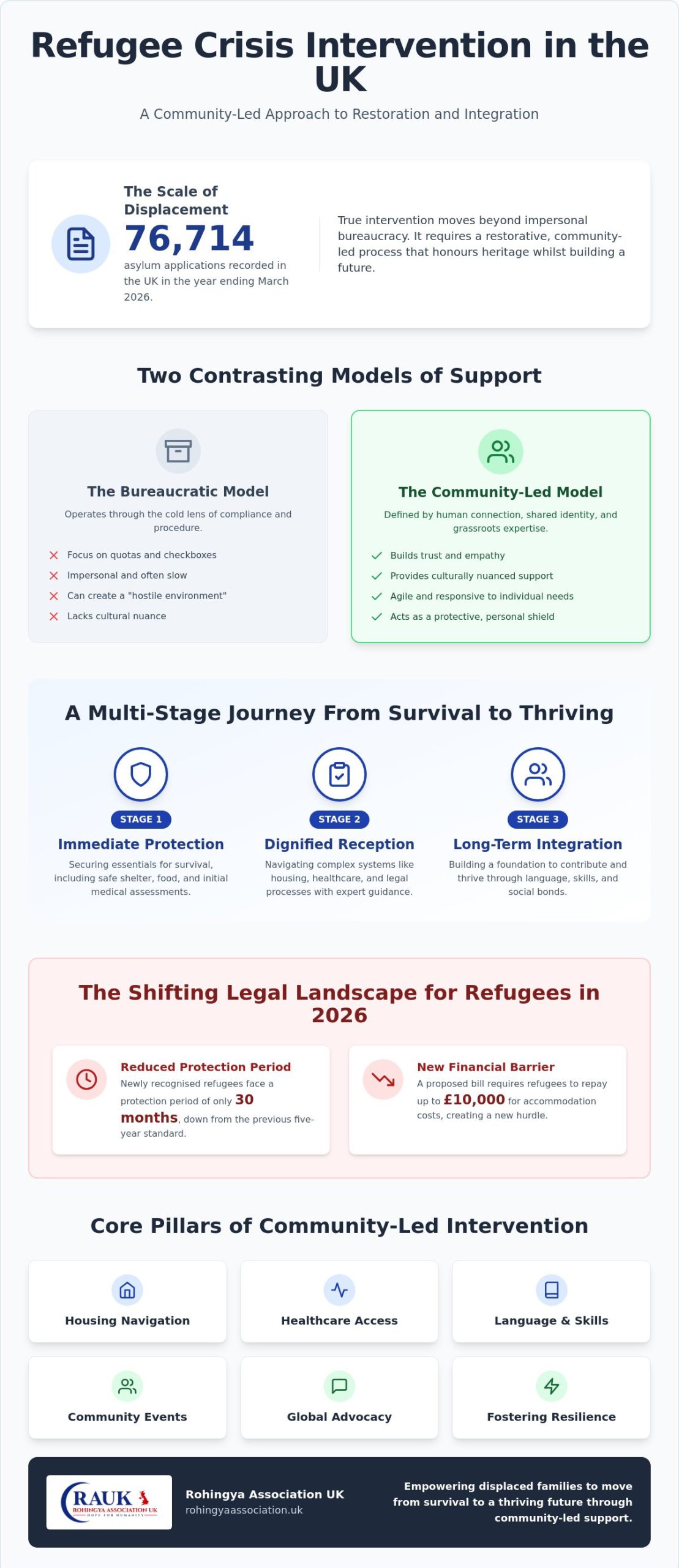
Refugee crisis intervention UK is often misunderstood as a singular moment of rescue. In reality, it’s a complex, multi-stage commitment that encompasses immediate protection, dignifying reception, and sustainable, long-term integration. Whilst the global refugee crisis continues to displace millions, the response within Britain must be precise and persistent. It requires a deep understanding of local systems, particularly the intricate networks of housing and healthcare that often remain opaque to newcomers. Without this specific knowledge, even the most well-intentioned support can falter, leaving families adrift in a sea of bureaucracy.
For too long, the narrative surrounding displacement has been defined by a “hostile environment” policy. This bureaucratic coldness stands in stark contrast to the resilient humanitarian efforts led by grassroots organisations and registered charities. These groups don’t just fill a gap; they bridge the chasm between government policy and the warmth of human necessity. They act as the primary engines of restoration, ensuring that families aren’t just processed, but are truly welcomed into the social fabric of our towns and cities.
The Distinction Between Emergency Aid and Long-Term Integration
Effective intervention begins with the “crisis” phase. This involves securing food, safe shelter, and initial medical assessments for those who’ve survived perilous journeys. However, a truly restorative journey doesn’t end when a door is locked for the night. Integration requires a continuous investment in English language acquisition, the development of employment skills, and the cultivation of social bonds. It is a journey of renewal; it moves from survival to a state where a family can contribute and thrive within their new community. Intervention must be a continuous journey rather than a one-off event.
The Legal and Social Landscape for Refugees in 2026
The UK asylum system has faced significant shifts recently. As of March 2, 2026, newly recognised adult refugees are granted a 30-month period of protection rather than the previous five-year standard. Furthermore, the proposed Immigration and Asylum Bill introduces a requirement for refugees to repay up to £10,000 towards accommodation costs once they earn enough, which creates a new barrier to settled status. For the Rohingya community, these hurdles are compounded by their status as a stateless people. Without the backing of a home nation, they rely on local advocacy groups to act as a protective shield, navigating a system that increasingly prioritises cost recovery over human dignity.
The Community-Led Model: Why Grassroots Support Outperforms Bureaucracy
Bureaucracy often operates through the cold lens of compliance, quotas, and procedural checkboxes. In contrast, effective refugee crisis intervention UK is defined by the warmth of human connection and the strength of shared identity. Whilst official UK asylum support provides a necessary baseline for physical survival, it frequently lacks the cultural nuance required for genuine restoration. Grassroots organisations act as a guiding hand, offering a level of trust that distant government departments simply cannot replicate. They’re deeply embedded in the communities they serve, providing a protective shield that is both professional and personal, ensuring that no individual is reduced to a mere statistic.
The impact of this local presence is particularly visible in cities like Bradford, where refugee resettlement is treated as a communal mission rather than a logistical burden. When a family arrives, they aren’t merely seeking a case number; they’re searching for a neighbour who speaks their language, understands their history, and respects their dignity. By facilitating community support and integration, local advocates ensure that the transition into British life is marked by empathy rather than alienation. This local expertise allows for a more agile response to the specific needs of the Rohingya diaspora, addressing challenges that larger NGOs might overlook.
Preserving Heritage Whilst Navigating a New Culture
Isolation remains a silent, pervasive threat to displaced families. Cultural and community events serve as a vital antidote, providing a dedicated space where heritage is celebrated, shared, and preserved. For the Rohingya community, maintaining their distinct identity is an act of profound resilience in the face of statelessness. Islamic community events offer more than just spiritual comfort; they provide a familiar social structure that anchors families during times of immense change. These gatherings foster the communal bonds necessary for long-term stability, growth, and psychological well-being.
The Power of Lived Experience in Crisis Intervention
There is a unique dignity in being supported by those who’ve walked the same path. When former refugees lead the intervention, it creates a virtuous cycle of empowerment, transforming yesterday’s newcomers into today’s steadfast advocates. This peer-led approach ensures that support is never patronising, but always restorative, grounded in a deep sense of empathy and mutual respect. It’s about agency, renewal, and the recognition of shared strength. Community-led intervention is the synthesis of professional aid and communal empathy. By placing the power of change in the hands of those with lived experience, we foster a sense of duty, resilience, and collective hope.
Core Pillars of Effective Intervention: From Housing to Healthcare
Survival is a necessary first step, but true restoration requires a foundation of stability and dignity. Within the framework of refugee crisis intervention UK, this foundation is built upon three primary pillars: secure housing, accessible healthcare, and empowering education. Without these, the journey of integration remains stalled at the gates of survival. Practical assistance must go beyond simple advice; it requires active advocacy to dismantle the systemic barriers that prevent displaced families from accessing the basic services they’re entitled to. This is where community-led support becomes indispensable, acting as a bridge between a complex social infrastructure and the people who need it most.
Securing a safe home is the most urgent priority for any family arriving in Britain. Whilst several UK refugee resettlement schemes exist to provide a framework for arrival, the practical reality of securing a tenancy is often fraught with difficulty. Private landlords frequently demand extensive credit histories or British guarantors, requirements that are impossible for newcomers to meet. Local advocacy groups work directly with authorities and sympathetic housing providers to ensure that families aren’t left in temporary, precarious accommodation, but are instead given a stable base from which to rebuild their lives.
Creating a truly supportive home also involves ensuring physical comfort and efficiency; for instance, you can learn more about how modern infrared heating technology provides a sustainable way to maintain a healthy living environment for families.
Navigating the UK Housing and Healthcare Systems
The transition into the British healthcare system presents its own set of unique challenges. Language barriers and a lack of familiarity with digital-first GP registration models often leave vulnerable individuals without medical support. Specialised programmes focusing on healthcare access for displaced people are essential to address the deep-seated trauma and chronic conditions that often accompany the refugee experience. By providing linguistic support and cultural mediation, intervention programmes ensure that no one is left behind by a system that can feel impersonal and impenetrable. This level of care is vital for long-term psychological and physical recovery.
Education, Language, and Skills Development
Long-term integration is impossible without the tools to communicate and contribute. In cities like Bradford, English language classes (ESOL) are more than just lessons; they’re a lifeline to the wider community. These classes provide the linguistic keys to employment, social bonding, and independent living. Beyond language, skills development programmes help prepare youth for the competitive UK job market, transforming potential into agency. Investing in refugee youth empowerment programs ensures that the next generation isn’t merely surviving, but is actively shaping their own future. This approach breaks the cycle of poverty and fosters a sense of belonging that is essential for a harmonious society.
Advocacy and Justice: Addressing the Root Causes of Displacement
True refugee crisis intervention UK extends beyond the immediate provision of shelter; it demands a relentless pursuit of the justice that was denied in the first place. Whilst local integration provides safety, advocacy addresses the systemic violence and historical erasure that forced families to flee Myanmar. By documenting human rights abuses, recording testimonies, and elevating the voices of survivors, we ensure that the world does not turn a blind eye to the ongoing persecution. This dual approach-providing a sanctuary in Britain whilst fighting for accountability abroad-is the only way to achieve lasting restoration for a displaced people.
It’s often suggested that local aid cannot solve a global problem of this magnitude. However, this perspective overlooks the profound power of a unified and politically active diaspora. Advocacy drives systemic change by influencing international policy, shifting public perception, and holding perpetrators of violence to account. When we share the stories of those now living in Bradford, we connect their individual struggle to the millions still trapped in the camps of Bangladesh. Awareness campaigns are not merely educational; they’re a vital, strategic component of refugee crisis intervention UK that pressures global leaders to prioritise human rights over political convenience.
Justice and Accountability on the Global Stage
The Rohingya diaspora in the UK plays a pivotal role in seeking international legal accountability for the crimes committed against their community. Their presence here is a testament to survival, but their work is a testament to their commitment to future generations. Engaging in Rohingya human rights advocacy allows the community to challenge the narrative of victimhood and assert their right to a homeland. There is a direct link between local stability and the capacity to fight for global justice; a secure family in the UK is a family that has the strength to stand up for those left behind.
From Cox’s Bazar to Bradford: A Global Responsibility
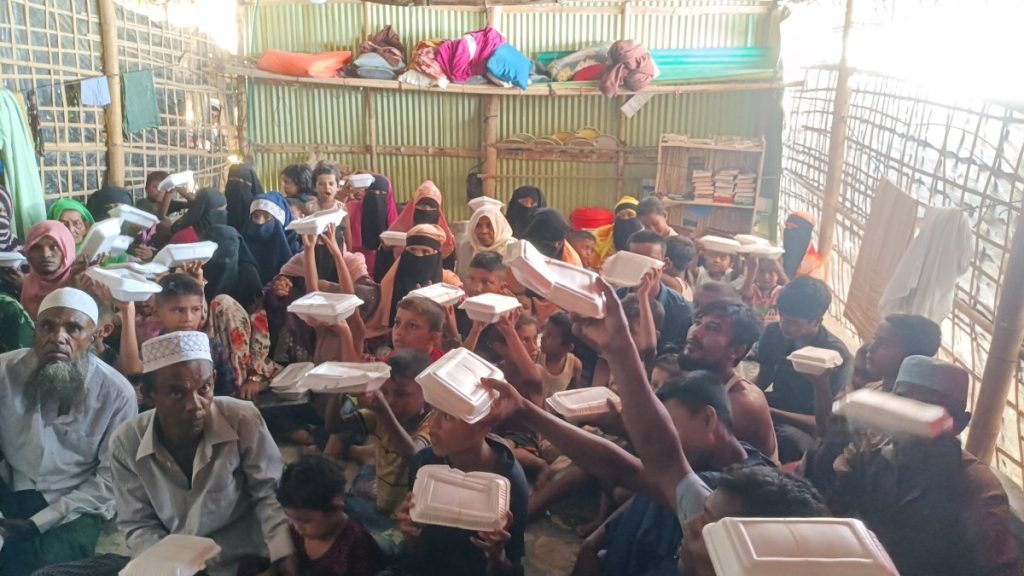
The situation in Cox’s Bazar remains one of the most urgent humanitarian crises of our time, with nearly a million people living in precarious, overcrowded conditions. RAUK’s mission spans across these borders, providing essential aid where it’s most needed whilst simultaneously building a future for those who have reached British shores. We believe that justice is the ultimate form of intervention, as it’s the only way to address the root cause of statelessness. To support this vision of global change, we invite you to join our advocacy and awareness campaigns and help us fight for a world where safety is a right, not a privilege.
How You Can Support Local Refugee Intervention
The scale of the global displacement crisis often leaves individuals feeling powerless, yet the most effective refugee crisis intervention UK begins with the conscious decision to act locally. Your participation is the catalyst for restoration; it’s the force that turns a policy into a lived reality for a family in need. By moving from sympathy to active support, you help build a protective shield around those who have lost everything. This collective effort ensures that our communities remain places of safety, heritage, and hope. Whether through financial stewardship or the gift of time, every action contributes to a larger narrative of renewal.
Supporting grassroots initiatives allows for a level of precision that large, impersonal NGOs often struggle to achieve. Community-led programmes are uniquely positioned to identify the specific hurdles faced by the Rohingya diaspora, from language barriers to the complexities of the British housing market. When we act together, we don’t just provide temporary relief; we create a sustainable environment where families can regain their agency and thrive. Your involvement is a vital part of this restorative journey, ensuring that the promise of safety is met with the reality of a warm, structured welcome.
The Impact of Your Charitable Donations
Financial contributions are the lifeblood of grassroots programmes. When you choose to support our mission by donating to Rohingya refugees UK, your funds are directed towards specific, high-impact initiatives that facilitate long-term stability. This includes the provision of essential English language classes, housing guidance, and youth mentorship. For many in our community, these contributions represent a form of Sadaqah Jariyah, an ongoing charity that provides lasting benefits for families across generations. We maintain a strict standard of transparency, ensuring that every donation is managed with professional stewardship and moral integrity. Your support doesn’t just provide aid; it invests in the long-term resilience of a people.
Volunteering and Raising Awareness
Beyond financial aid, the gift of time and advocacy is immeasurable. We invite you to join local refugee support groups in Bradford to help foster a culture of genuine welcome and social bonding. Being a “welcoming voice” in your neighbourhood is a powerful act of intervention; it combats the harmful myths that often circulate about displaced people. You can take practical steps to assist the mission by:
- Organising local awareness events to share the authentic history and heritage of the Rohingya people.
- Hosting community fundraisers that connect your social circle to the broader mission of justice.
- Volunteering your professional skills or local knowledge to assist families in navigating social systems.
By standing as a steadfast advocate, you ensure that refugee crisis intervention UK remains a community-led movement rooted in dignity and empathy. Together, we can replace confusion with clarity and isolation with belonging.
Building a Future of Restoration and Belonging
The path from displacement to dignity is rarely a straight line; it’s a journey that requires patience, expertise, and a steadfast commitment to justice. We’ve seen how community-led models provide the cultural nuance and trust that bureaucratic systems often lack. By focusing on the core pillars of integration and the power of lived experience, effective refugee crisis intervention UK transforms a period of profound uncertainty into a foundation for long-term growth. True restoration isn’t merely about finding a place to stay; it’s about reclaiming one’s heritage whilst contributing to the social fabric of a new home.
As a registered charity (number: 1211433) led by those with lived experience, the Rohingya Association UK remains a dedicated partner in this mission. With active projects spanning the UK, Myanmar, and Bangladesh, we act as both a protective shield and a guiding hand for families seeking safety. Your support provides the essential resources for education, advocacy, and social renewal. Support our mission and donate to the Rohingya Association UK today to help us bridge the gap between crisis and community. Together, we can ensure that every displaced family finds the safety, respect, and belonging they deserve.
Frequently Asked Questions
What does refugee crisis intervention mean in the UK?
Refugee crisis intervention UK refers to a structured, multi-stage process designed to provide immediate protection, dignified reception, and sustainable, long-term social integration. It encompasses a continuous journey that moves beyond simple survival to address English language acquisition, employment skills, and social bonding. This approach ensures that families aren’t merely processed through a bureaucratic system but are actively restored to a life of safety, agency, and dignity within the British social fabric.
How does the Rohingya Association UK support displaced families?
The Rohingya Association UK acts as a protective shield and guiding hand, offering community support, integration programmes, and youth empowerment initiatives. We provide practical assistance in navigating complex social infrastructures whilst hosting cultural events that preserve Rohingya heritage and foster communal bonds. Our work is deeply rooted in lived experience, ensuring that every family receives the empathetic, professional care required to navigate the challenges of resettlement and achieve long-term stability.
Can I volunteer with refugees in Bradford?
Yes, we actively encourage individuals to join local support groups in Bradford to assist with our community-led integration programmes. Volunteers play a vital role in acting as a welcoming voice, assisting with language practice, or helping families navigate local services. By offering your time and skills, you contribute to a culture of mutual respect and social bonding, helping to turn a period of uncertainty into a successful journey of renewal for new arrivals.
Why is community-led support more effective for refugees?
Community-led support is more effective because it’s built upon shared language, culture, and lived experience, which fosters a level of trust that bureaucratic systems cannot replicate. This model allows for a more nuanced understanding of a family’s specific needs, providing a sense of belonging that is essential for psychological well-being. By synthesising professional aid with communal empathy, grassroots organisations ensure that intervention is restorative, dignified, and deeply rooted in the community’s own strength.
How are donations used for Rohingya refugee projects?
Donations fund specific, high-impact projects such as English language (ESOL) classes, housing advocacy, and youth empowerment programmes. These contributions provide the essential resources for families to move from survival to self-sufficiency, funding everything from educational materials to cultural events that prevent social isolation. We ensure professional stewardship of all funds, prioritising transparency and long-term impact to build a future of hope and opportunity for the Rohingya diaspora in the UK and abroad.
What are the biggest challenges facing Rohingya refugees in the UK today?
The primary challenges include navigating a complex asylum system, overcoming language barriers, and securing stable housing amidst a “hostile environment” policy. As of March 2026, newly recognised adult refugees face a reviewable 30-month protection period, which creates significant anxiety regarding long-term security. Additionally, the statelessness of the Rohingya community makes accessing international legal status particularly difficult, requiring dedicated advocacy and local support to protect their rights and ensure their voices are heard.
How can I help refugees access healthcare and housing?
You can help by supporting advocacy and awareness campaigns that pressure local authorities and housing providers to dismantle systemic barriers. Practical assistance often involves guiding families through GP registration or helping them understand their rights when dealing with private landlords. By joining our local support networks, you can act as a cultural mediator, ensuring that families aren’t left behind by digital-first service models or opaque bureaucratic requirements.
Is the Rohingya Association UK a registered charity?
Yes, the Rohingya Association UK is a registered charity in England and Wales, operating under the registration number 1211433. This status ensures that our organisation adheres to strict regulatory standards regarding transparency, financial accountability, and professional conduct. Just as organisations worldwide seek independent assurance from International Associates Limited to verify their compliance, we are committed to maintaining the highest levels of integrity in our work. Our registered status reinforces our position as a reliable, long-term partner for both the families we serve and the donors who make our restorative work possible across the UK, Myanmar, and Bangladesh.